
#On the Unrecorded Passage
"The culvert guide knows the under-gate by smell." — Griefgate saying, repeated above ground by people who claim never to have needed one.
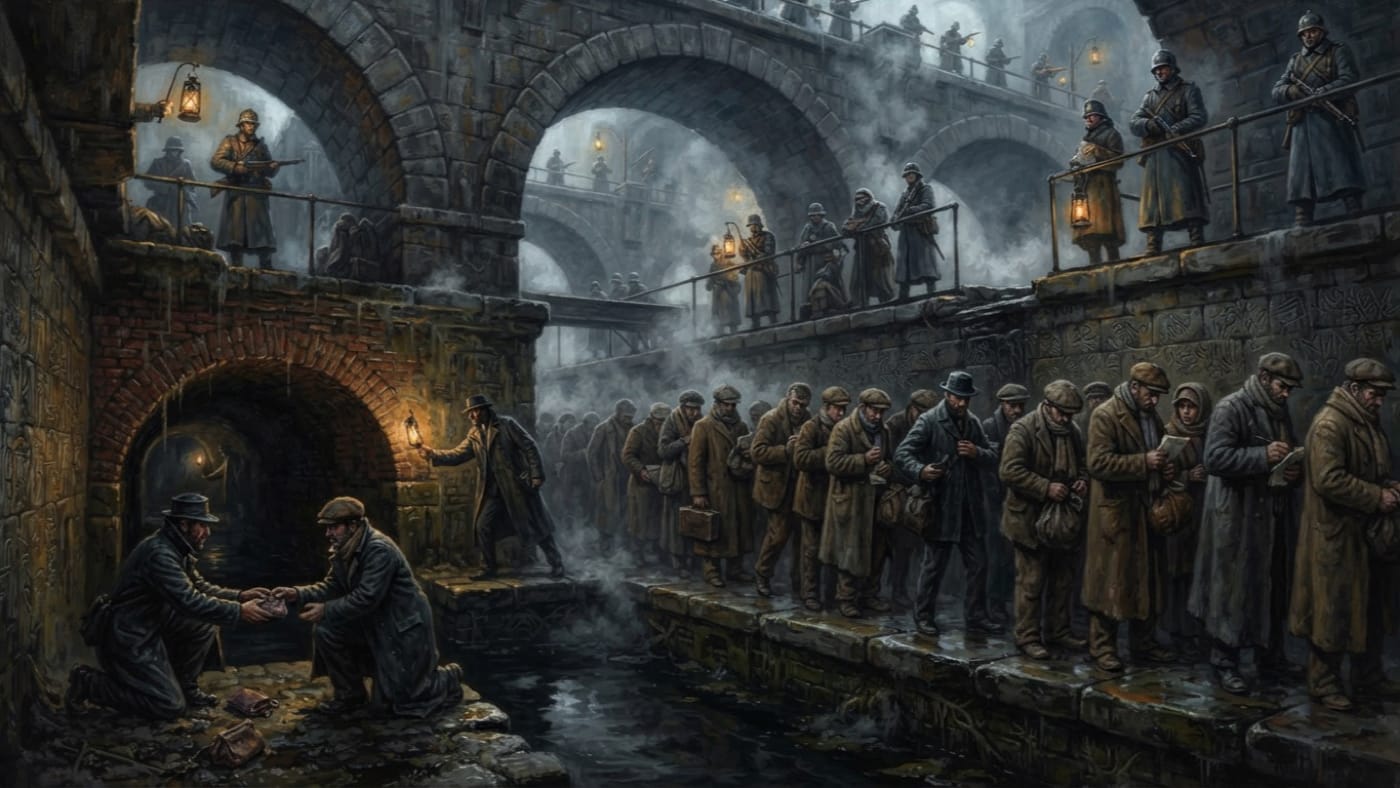
The Culvert Choir does not exist. Every register the Bureaucratic Synod keeps at Griefgate agrees on this. The Gate Chapter's lists of licensed guides do not name it, the Broker Compact's lane rolls do not mention it, and the confession ledgers have no column for it. Meanwhile people and contraband pass beneath the three black-stone arches of the Widow's Pennies Exchange every night, through the drainage culverts and the Culvert Market, and somebody is paid for each crossing.
That is the whole of the Choir's doctrine as far as the Bureau can establish it. No founder has been named and no chapter house found. Nobody has recorded an oath, a banner, a hierarchy or a hymn, and the name has never been shown to involve any singing. The Bureau would welcome a creed. A creed can be refuted from the pulpit. A business can only be priced.
The customers are made above ground. Griefgate stands in a chalk defile on the Pilgrim Roads, three lanes squeezing into one throat, and the Synod placed inspection there. Inspection produced a queue, as it always does, and the queue produced people who would pay nearly anything to be on the other side of it.
#On the Under-Gate
The culverts are Roman, and the centuries have widened them. The Choir is a later tenant of that old brickwork, and its age is unrecorded.
Below the arches the brick is permanently wet. Sluice gutters run along the passage floors, and fog settles in the low stretches and stays there. In the spring rains the runoff rises to the knee, and a flash flood in the defile can fill a culvert faster than a laden traveler can turn round. The Culvert Market smells of river slime and smoke, and nobody who has stood in it remembers it any other way. At night the curfew herds the surface crowds into the sanctioned inns and the lanterns on the arches change to inspection white. From then until dawn the culverts are the only part of Griefgate still moving.
The routes are recorded in bone. The dedicated survey speaks of a tunnel map carved in bone, while my own earlier account placed the notation on the culvert walls. Both sources agree that bone is involved, and the Choir has not offered to settle the rest. When the Bureau of Bells examined a sample, it classified the marks as non-linguistic, which places them outside the Index Damnatus.
Nobody has published a key, an alphabet or the source of the bone. I have not asked. Some questions turn into expense reports.
#On Borrowed Grief and Blank Paper
Every traveler at the confession stalls must present a story, and the clerks check it against the traveler's papers, appearance, companions, stated destination and earlier confessions filed along the road. A story that agrees with all of these is called a story-fit. One that does not raises a doubt flag.
The Choir's surveyed methods are tunnels, fake seals and what the culverts call borrowed grief. Borrowed grief involves no sorcery, and no grief changes hands. It is a costume and a script: a mourning band, a death whose details match the papers, and a story rehearsed in the dark until it fits the grief-tables above. The confession economy pays for sorrow it can measure, so the Choir supplies sorrow cut to the clerks' pattern.
The rest of the Culvert Market belongs to the market and not necessarily to the Choir. Forged lane tickets are sold there. So are rented witnesses, who will swear to any grief-story for the price of a meal, and men who will take the blame for someone else's guilt if the fee is right. No record shows the Choir controlling any of these trades, and Griefgate has no shortage of other fraud.
The blank slips, on the other hand, are attributed to the Choir by name. After about A.S. 199, indulgence slips began to circulate widely as a second currency, a kind of portable innocence. The Choir answered by selling blanks: unstamped paper of the right weight and weave. A blank has no authority until a seal is pressed onto it. A genuine clean slip, freshly stamped, carries its bearer through Pilgrim Roads checkpoints for thirty days. A forged one carries only as far as the first clerk who doubts it, and a smudged seal earns a conversation with an inquisitor that no traveler wants. Under the arches, wax smears in a mourning crowd whatever hand pressed it. At that point honest and forged seals look equally bad, which helps neither.
#On the Price of Passage
The Choir has no tariff. Its fee depends on how desperate the client is, which means the price is fixed in the client's face before it is said aloud.
Demand follows the surface. It is heaviest when a doubt sweep closes the lanes. That is when the traveler compares two prices. On one side is the queue, which already stretches to three days in peak season, and then the Holding Pens, where delay debt grows daily into a labor contract with no stated end. On the other side is an unknown sum paid to an unknown guide for a walk through water in the dark. The Pens have an exact price, posted on the Exchange walls. Many travelers choose the price that has not been posted.
The Rope Saints sell places in the queue above ground. The culvert guides sell passage below it. Both trade on the same thing, which is the distance between a traveler and the far side of the arches. One guide may let a widow cross for less than he asked. Another may take her last coin and leave her at a junction when the water rises. No surviving record shows the Choir holding to any rule of mercy, and none shows it binding its guides to keep their bargains. I have found no evidence of a charitable purpose, a revolutionary programme, or any loyalty beyond the fee.
#On the Name That Follows
One thing is never for sale at Griefgate. Once a traveler is flagged, doubt clearance cannot be bought above ground or below it.
A doubt flag attaches to a name, and the name goes with its owner through every checkpoint on the Pilgrim Roads until the flag is resolved or the owner stops travelling. The Choir can take a body under the arches. It cannot reach the Great Ledger, amend the Bureau of Records, or hand the next station a clean history. A flagged traveler who comes out of the culverts east of Griefgate is still flagged, now east of Griefgate, and has added an unlawful crossing to the record.
Some customers try to escape the problem by escaping the name. Swapped names and invented histories are common in Griefgate's fraud trade. Whether a new name holds depends on what the next station remembers and on what the Index Damnatus runners are carrying, since they take prohibitions and revoked identities from checkpoint to checkpoint. The Bureau does not publish its rate of success, and the Choir does not publish its failures.
Passage through the culverts places the traveler beyond the reach of the Gate.
Passage through the culverts places the traveler beyond the arches. The reach of the Gate is kept in the Ledger and moves with the traveler's name. The earlier wording reflected the reputation of the service, and the Bureau has wrongly accepted that reputation as fact. The Choir sells transit. It has never been able to sell safety.
There is a less comfortable reason for the demand. The culverts carry a rumour that the Exchange manufactures guilt: false confessions entered into the Ledger, grief assessed for losses that never happened, and flags written before the traveler reached the stall. If the rumour is true, some of the Choir's customers are not escaping sins of their own. They are escaping a bill drawn up in their absence. The rumour also mentions a ledger said to frighten Arbiter-Widow Solenne, known as Blue Veil. No record shows that the Choir holds it, has read it, or could prove what is in it.
#On the Present Traffic
In A.S. 201 the culverts are busy. The queues above are long, the Holding Pens have been enlarged twice in two years, and every new restriction at the arches brings the Choir more custom. The blank-slip trade pays well. Gate-Canon Meral Voss knows about it. So do the Broker Compact and Master Assayer Tinn Halve's assayers, who test the coin passing through Griefgate. Nobody has documented any arrangement between those authorities and the Choir. Each of them has an interest in being able to say that if one were found.
The Bureau of Purity sent an investigative cell, which arrived in A.S. 200. Its report recommends further observation, and observation is still under way. No suppression has been carried out and no culvert has been declared cleared.
Travelers coming from the west sometimes confuse the Choir with the Choir-Broker Hall of Peregrine Row, which runs a licensed protection market and has its own cistern-tunnel trade. The two share part of a name and nothing else on record. No tunnel joins them, and no ledger shows the same owner. The Gate's inspection does not end at the far mouth of the culvert, and the floods can come at any season.
Under the arches people sometimes forget their own names in the middle of a sentence. The Ledger keeps every one of them.
Nomen manet.