

#On the Years When Roads Became Witnesses
The Demon-Route Years ran from A.S. 160 to A.S. 175, which is the tidy range preferred by registers, instructors, and men who were not required to walk the roads in question. Events seldom obey dates so politely. The first bad chimes sounded before the clerks admitted a pattern. The last fouled chalk marks appeared after the Bureau declared the pattern contained. Still, A.S. 160–175 remains the authorised span: fifteen years during which the eastern circuits between bastions learned to imitate civic space, judicial attendance, witness procedure, and, in several cases, law's own appetite.
A road is supposed to be a strip of obedience laid across hostile ground. It tells wagons where to go, troops where to march, Judges where to stop, prisoners where to be tried, and supply where to continue being precious. During the Demon-Route Years, roads near the eastern circuits ceased behaving like commands and began behaving like traps with procedural literacy.
The phenomenon concentrated in the forward legal circuits serving Bastion-Brest, Bastion-Przemyśl, Bastion-Shipka, and the plank roads, ferry yards, market fords, supply courts, and trench-town squares between them. Roving Judge's Bailiffs had already been hardened by the Hymn-Length Reforms of A.S. 141 and Judicial Circular 4.12. They knew chalk perimeter, hymn-chime, seal chest, custody chain, witness gate, ruling measure. They knew human mobs. They knew hunger. They knew ale, mothers, guild advocates, forged receipts, and Judges who loved their own voices. Then the road supplied crowds no hunger had gathered and witnesses whose first testimony was their second arrival.
#On the First Unfiled Signs
The first reports were small, because small reports survive embarrassment better than large ones. A Court Rope on the Przemyśl feeder road wrote that his chalk line dried in rain. A Bailiff near Brest noted that the witness pen had moved three paces east between Prime and opening measure, though none admitted shifting it and the ground beneath showed old dust rather than fresh mud. A Judge on the Shipka approach complained of a crowd visible from the wagon that vanished before court, leaving only footmarks in a circle too neat for panic. The complaint was filed under atmospheric misperception, a category invented to flatter cowards and bury facts.
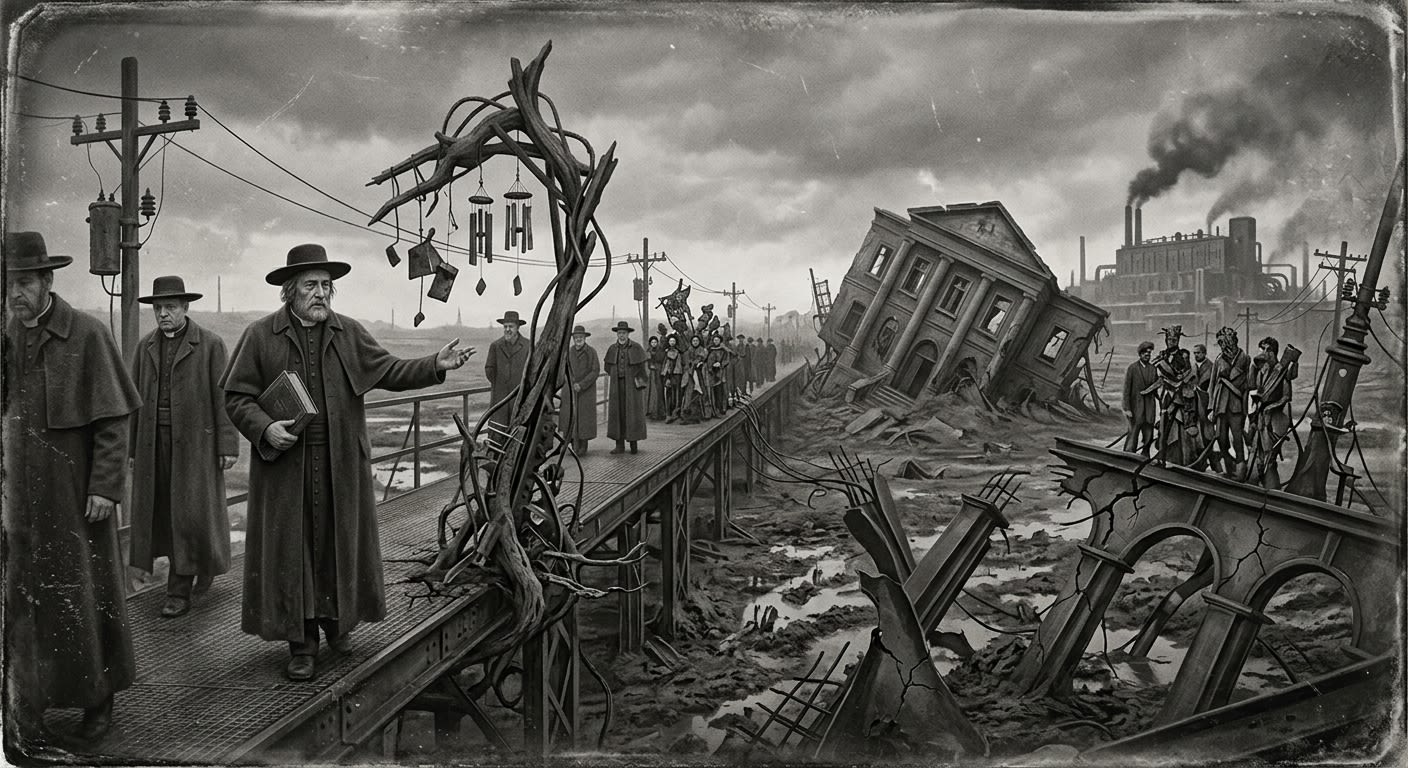
By A.S. 160, the little oddities had become too numerous to patronise. Courts were laid in market squares that no attached village claimed. Road forks appeared on maps only after a circuit had taken them. Witnesses arrived with receipts for testimony not yet given. Hymn-chimes rang before any hand touched the striker. In one Praga-bound feeder court, the second chime sounded first, producing a legal condition so irritating that three desks argued over whether testimony had opened before accusation. The accused escaped while the desks discovered doctrine.
The Bureau of Records disliked the reports because they damaged comparability. Bells disliked them because misbehaving chimes suggested either contamination or professional humiliation. War disliked them because roads that lie cannot carry ammunition on schedule. Doctrine disliked them because Doctrine dislikes any event that arrives with its own symbolism before we have assigned one.
The first joint memorandum passed between the circuit desk, Bells, War, Records, and Rites like a coal nobody wished to hold. Its conclusion was magnificent in cowardice: “route-adjacent procedural irregularity under hostile influence, confirmation pending.” Pending lasted until a Judge returned without his seal shadow.
#On Echo Crowds and False Attendance
The echo crowd remains the signature horror of the period. It looked like civic attendance from a distance: bodies gathered behind where chalk would be drawn, heads turning toward the Judge's wagon, shoulders hunched against weather, a murmur thick enough to promise trouble and familiar enough to calm the unwise. At fifty paces, it was a crowd. At twenty, it was sound. At ten, it was gone.
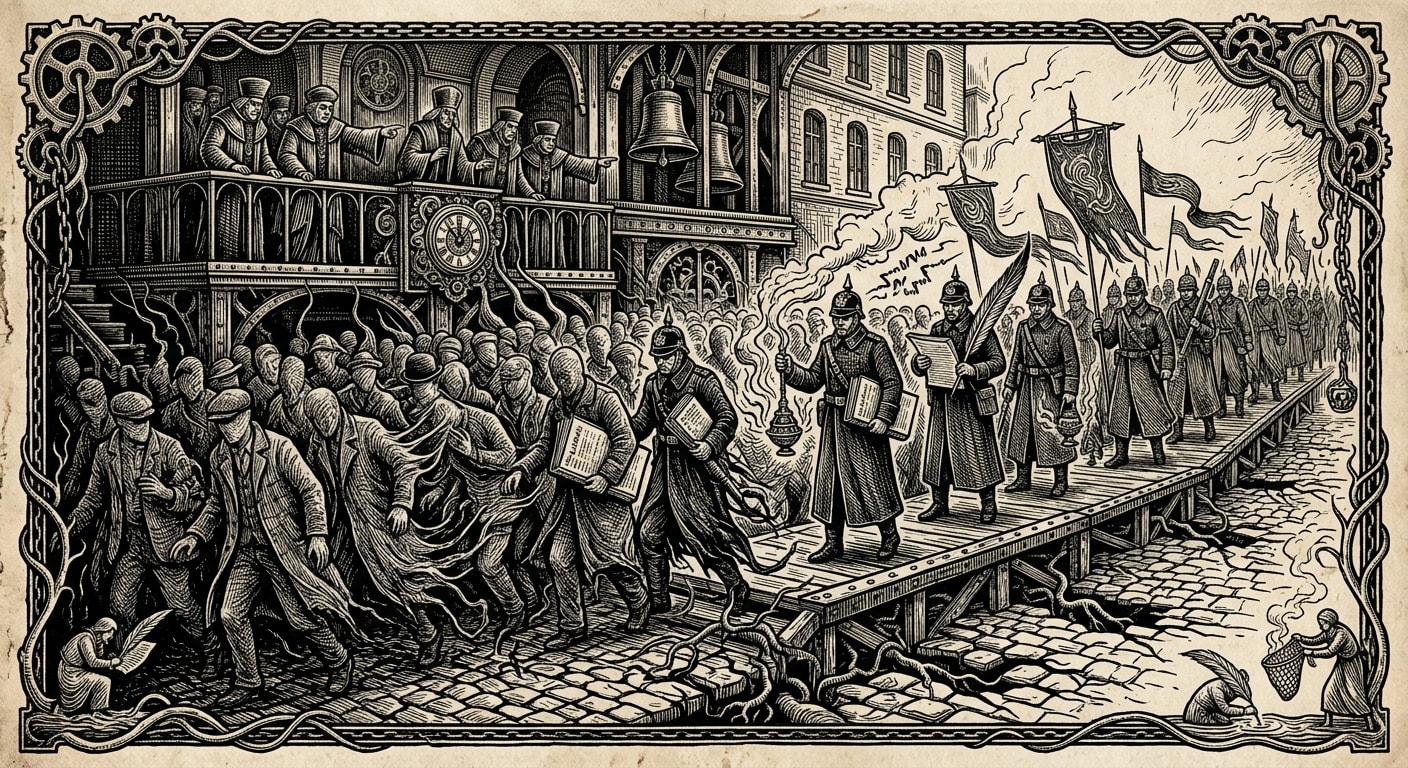
It left evidence. Chalk dust in circles. Wax flecks. Footprints beginning nowhere. The smell of wet wool on dry days. Once, near the Brest road, a Court Rope found a child's ribbon tied to the chime stand before the stand had been unloaded. The ribbon matched no local child. It matched, according to one exhausted Records clerk, a ribbon seized as evidence in a trial fourteen months later. The clerk requested reassignment to grain tallies and was denied on grounds of emergent expertise.
Echo crowds frightened officers and invited procedure. A crowd gives law an audience; without an audience, the roving court becomes violence talking to itself. The Demon-Routes understood this dependency. They supplied attendance where attendance should not exist, withdrew it when approached, and left enough trace to make cancellation look like superstition.
Early War summaries described echo crowds as “hostile decoy assemblies produced by enemy scouts.”
Clarified after Bells review. Scouts require bodies, rations, orders, retreat lines, and the elementary courtesy of occupying space. Echo crowds possessed none of these except appetite for procedure.
Judges hated cancelling for echo crowds. Bailiffs hated not cancelling more. A court opened before false attendance risked letting the procedure recognise the wrong assembly as the public. Recognition matters. A verdict pronounced to a false crowd travels badly. It returns with additions.
#On Witnesses Who Arrived Twice
Duplicate witnesses caused more legal damage than vanished crowds because the archive was tempted to believe them. A man arriving twice with the same name, different mud, and an identical fear can be called imposture if one enjoys simplicity. During the Demon-Route Years, simplicity died early and without last rites.
The first famous duplication occurred on the Irongate feeder circuit in A.S. 162. A miller named Odran (Unregistered) gave testimony against a deserter at second measure, was dismissed, and re-entered the witness gate three minutes later carrying a different hat, older bruising, and a receipt countersigned by a Bailiff who had not yet been promoted. Both Odrans knew the same childhood prayer. Both misnamed the same saint. Both had the same broken nail. When placed back to back, each accused the other of arriving late.
Records wanted both entries retained. Purity wanted both burned. Bells wanted to test their teeth for chime response, because Bells becomes inventive when humiliated. The Judge ruled the testimony void, which pleased no office and saved the deserter for precisely six days, after which the deserter was tried elsewhere and condemned on grain fraud because the Synod, though patient, is rarely forgetful.
Duplicate witness doctrine developed from such injuries. Bailiffs were ordered to mark witnesses by dust, pulse, breath temperature, name-response, and chime reaction before entry. This increased opening delays, which increased crowd risk, which offended Circular 4.12, which produced a beautiful little administrative knot tight enough to hang a reformer.
The Demon-Route amendments later gave the Screener power to test attendance before the hymn began. The bell-metal sliver did not solve duplication. It gave law permission to distrust it before the second Odran was standing in the chalk with a receipt from tomorrow.
#On Chimes That Spoke Before Law
The hymn-chime was the road court's clock, knife, bell, jaw, and little idol. It marked opening, testimony, rebuttal, ruling. It turned time into a public object and made the crowd hear procedure closing. When chimes began to ring before court, the entire portable theology of Circular 4.12 acquired a crack through the altar.
Some chimes rang once at dawn, before the Judge woke. Some rang four marks in empty rain. Some gave the ruling chime when the accused wagon arrived. One chime on the southern Shipka road rang under cloth in a locked chest, the tone muffled and patient, as if law were rehearsing without officers. A Circuit Bailiff who reported the sound was told it was atmospheric. He later wrote, “Atmosphere knows our measures.” The line survives because it was copied into an invoice margin by a clerk with taste.
Bells investigated metal fatigue, counterfeit strikers, sympathetic vibration, roadbed resonance, demonic acoustic fraud, local prank, and Bailiff intoxication. Each explanation accounted for one case and insulted the rest. The chime problem became fatal only when pre-ringing began to alter legal timing. If the second mark sounded before opening, had testimony begun? If the fourth mark sounded before accusation, had consequence been pronounced? The Legal Prelate (Unregistered)'s first answer was no. The road's answer was to leave three sealed dockets with ruling impressions already cooling.
CHIME INCIDENT ANNEX — ROUTE ███, A.S. 166 Court not opened. Seal chest locked. Chime sounded four measures before dawn. At first light, chalk circle present; docket table dry amid rain; three wax impressions cooling, seal mark accurate. Judge's seal: still in chest. Bailiff's right hand: stained red to wrist. Bailiff statement: “I did not touch the wax. It touched me.” Disposition: ███████████████████.
The corps learned to hood chimes at night, separate striker from frame, wrap frames in wool near Shipka fog, and sleep with one man awake solely to hear whether law intended to begin without them. This was the true humiliation: the Enemy could mock the chime, and the chime might answer.
#On the Shipka Circuit and the Lesson of A.S. 172
The A.S. 172 Shipka eastern circuit became the case instructors use because it contains everything a lesson requires: a bad road, a cracked sliver, a Judge embarrassed, six accused men lost, a seal preserved, and enough horror to make policy seem wise after the fact.
The court had been ordered to hear charges against six marsh-haulers accused of ration diversion, sleep-cult sympathy, and transport fraud. The site stood on a raised plank road east of Bastion-Shipka, close enough to Syrionic fog that the chime was wrapped between sessions. The assigned Screener walked perimeter before Prime with a consecrated bell-metal sliver on his chime chain. It hummed at the north stake, stopped at the witness pen, hummed behind the Judge's platform, and cracked on the route by which the accused had arrived.
He cancelled the court.
The Judge objected. The quartermaster objected. The tithe clerk objected in writing, displaying that luminous professional instinct by which Tithes recognises paperwork even while standing near damnation. The Screener invoked Demon-Route authority and extracted the Judge and seal by the second road. The accused remained chained to the plank rail. A Rites purification detail was requested. It never arrived, though Rites later proved it had been dispatched along the correct road. The correction failed to explain what a correct road becomes after leaving the map.
Recovery patrol in A.S. 173 found six chain lengths fused into the plank rail. No bodies. No clothing. No ration tokens. One witness slate remained, wiped clean except for HEARING CONTINUES.
The Screener was reprimanded for incomplete custody and commended for seal preservation in the same folio. This is not contradiction. It is Synod justice properly dressed: one hand punishes the missing bodies, the other blesses the surviving seal, and both invoice the paper.
#On the Birth of the Crack-Watchers
The Demon-Route Screener entered the records as a scar on an old profession. The Screeners were Bailiffs selected for the rare capacity to leave before pride became death. Their instrument was a consecrated bell-metal sliver affixed to the chime chain. Their authority was narrow and absolute: no tone, proceed; low hum, delay; sustained hum, withdraw Judge to guarded interval; crack, court void; powdering, burn chalk and abandon docket.
No Judge liked them. No district welcomed them. No accused man thanked them, since cancellation commonly meant remaining chained in rain while offices discussed survival. Their virtue lay in making law hesitate before a place that wanted to be court too eagerly.
The Screener's greatest power was admitting, without saying so plainly, that law required consent from ground, crowd, and sound before it could safely wound. This offended every office in a different colour. Doctrine preferred law descending from authority. Records preferred law entering columns. War preferred roads staying roads. Bells preferred tones that waited for hands. The Screener walked before all of them and listened for betrayal.
An A.S. 168 Legal Prelate note called Demon-Route screening “temporary field caution pending restoration of ordinary circuit conditions.”
Corrected by continued deaths, false courts, duplicate witnesses, and the Shipka Annex. Temporary caution has now lasted into A.S. 201, which is the usual route by which policy becomes tradition.
#On What Was Contained
The Bureau declared the Demon-Route Years contained in A.S. 175. This means the reports became less frequent, the forms became better, and the surviving officers had learned which details to bury under recognised language. The roads did not apologise. Roads rarely do.
After A.S. 175, major eastern circuits retained Screeners. Chimes travelled hooded. Witness pens were placed only after double perimeter walk. Seal chests left by second route at first crack. Rites purification response remained under review, a phrase meaning that priests continued arriving late but now possessed better explanations. Circular 4.12 absorbed the amendments. Academy boys learned HEARING CONTINUES from slates and laughed too early in the lesson.
The containment was real enough to move courts again and false enough to deserve doctrine. That is acceptable. Most civilisation is built from arrangements real enough to cross and false enough to require guards.
As of A.S. 201, Demon-Route protocols remain active on major eastern circuits. The Legal Prelate calls them safeguards. Bailiffs call them the Crack-Watch. Judges call them delays until a sliver saves them, after which they call them confidential. Records preserves the cancellations as docket wounds. Purity reads them for contagion. Bells listens to the chimes and pretends the listening is research rather than fear.
At dusk on the Shipka road, a court wagon still stops before certain planks. The Bailiff walks. The Screener listens. The chime remains covered. Somewhere under the road, law waits to hear whether law has arrived.