
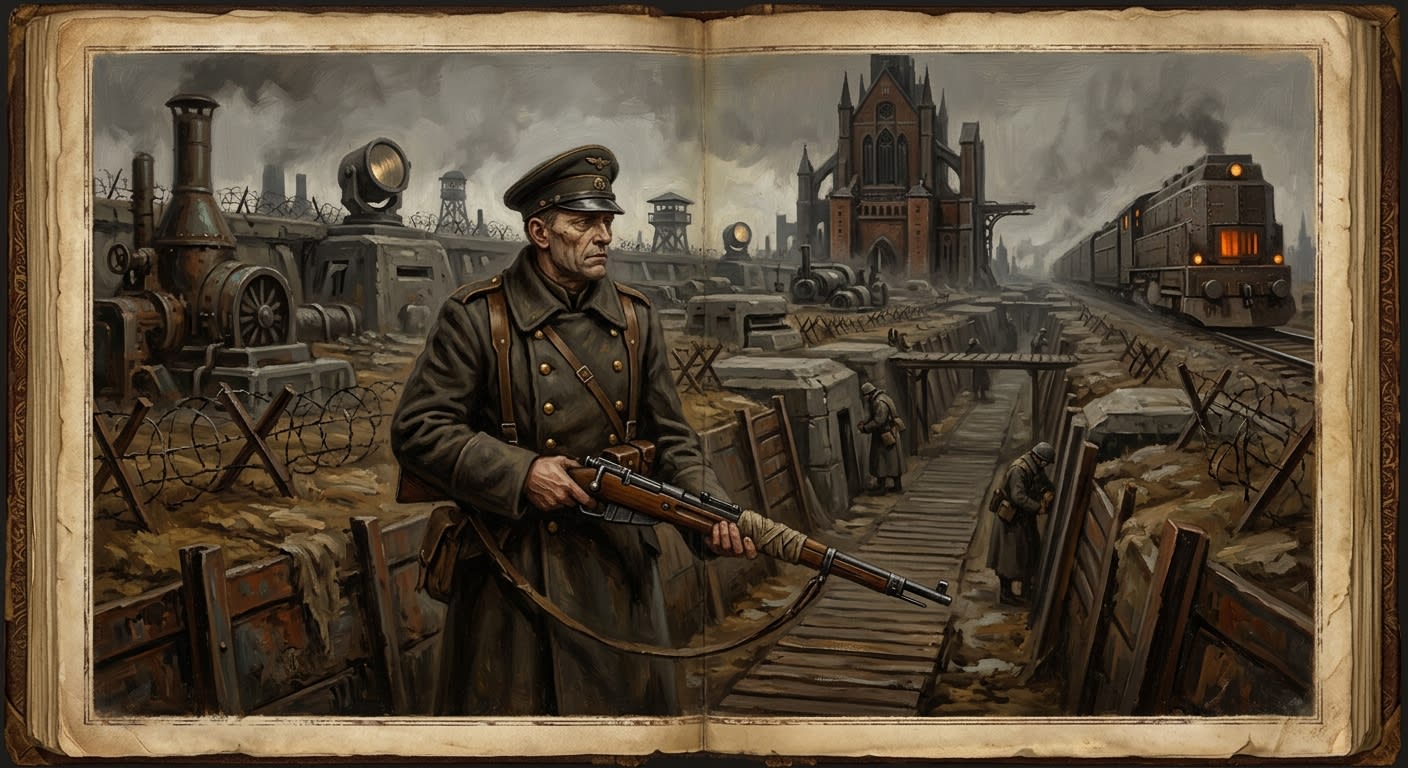
#On the Word Soldiers Spend Instead of Breath
The Line is the word used when there is no time for the full title, no patience for cartographic ceremony, and no appetite for another clerk explaining that the proper designation is the Sagittal Line, Zone 4 Defensive Continuity, Baltic-to-Bosphorus Spine, Canonically Corrected A.S. 201. Soldiers say the Line. Porters say it. Surgeons say it while tying off stumps. Mothers say it when their sons' letters stop. The word is short because the place eats long speech.
Officially, the Line is the north-south defensive spine from Königsberg to Constantinople, seven bastions, two thousand miles, trench systems, rail spurs, redoubts, bellways, supply roads, casualty stations, and grave arithmetic. Unofficially, the Line begins wherever a western citizen first discovers that safety has an eastern bill. In Strasbourg it is a map. At Black-Snow Lor it is a bell interval. At Brest it is mud with teeth. At Shipka it is the fight against sitting down.
The Line is not identical with the wall, the trench, the frontier, the command zone, the registered bastion belt, or the schoolroom diagram that colours Hell a polite black. The Line is the practical membrane between what the Synod can count and what counts us back. It is geography under oath. It is a place, a habit, a sentence, a punishment, a sacrament, and a rumour that has become load-bearing.
#On Where It Begins
Ask a map and it gives you Zone 4. Ask a quartermaster and it gives you the first warehouse where flour begins to smell of damp powder. Ask a wounded man and he gives you the moment before the shell, because memory is a poor surveyor and a sincere one.
The Line's formal birth stands at A.S. 65, when retreat hardened into refusal after the Sundering and the Great Retreat had emptied the East into roads, carts, reliquaries, ash, panic, and families dragging doors from houses they would never see again. Natural barriers offered their grudging bones: Masurian lakes, Bug River, Carpathians, Transylvanian Alps, Danube gorge, Balkan passes, Bosphorus. Men dug where flight ended. Priests blessed holes. Engineers lied with confidence. Peasants learned that a ditch can become civilisation if enough bodies are arranged along its rim.
Earlier civic primers described the Line as “the eastern wall of the Synod.”
Corrected. A wall is too tidy, too vertical, too satisfied with itself. The Line crawls, sinks, rings, floods, burns, sleeps, wakes, and occasionally moves three yards west without seeking permission.
The old bastion names — Lorraine, Ardenne, Savoy, Rhineland — cling to veteran songs and sentimental plaques like mildew on a relic case. Current doctrine uses actual geography. Przemyśl is Przemyśl. Sibiu is Sibiu. Irongate is Irongate. One may love the dead without giving them command of maps.
The Line begins, in the only sense that matters, where disobedience to the East becomes impossible to delegate.
#On the Skin of the West
Rear citizens imagine the Line as a far place. Rear citizens also imagine bread as something that occurs by bakery rather than requisition, which tells us how much weight to place on their imagination. The Line enters every kitchen west of it. It enters through ration oil, conscription ink, hospital trains, school hymns, widows' lamps, loan drives, uniforms cut small to save cloth, and the annual Feast of the Mud, when clean children smear ceremonial clay on their cheeks and are praised for understanding sacrifice.
They understand clay.
The Line's first labour is spatial. It teaches Europe that west and east are no longer directions alone. West means audited hunger, printed fear, permitted prayer, taxable grief. East means the Charnel Lands, where geography continues after mercy has been denied. Between them lies No-Man's-Land, that impatient strip of shell-hole, listening wire, false dawn, bone reef, prayer jam, and patrol reports that contradict each other while all being true enough to kill.
The second labour is civic. The Line turns citizens into supply. Bakers become ration measures. Singers become signal discipline. Dead men become wall lime, casualty tables, saint dust, pension disputes, and warning sermons. The Synod does not merely defend the West with the Line. It manufactures the West around the need to feed it.
The third labour is spiritual. A man standing on the Line discovers which parts of doctrine survive weather. Creed survives, if short. Bells survive, if rung by men with unburned hands. Records survives, because Records is a fungus blessed by the Creator and impossible to starve. Comfort survives poorly. Vanity survives better than expected.
#On Its Offices, Professions, and Little Tyrannies
The Line is administered by everyone and owned by no one, which is why it still stands. The Bureau of War claims command. Records claims the names. Tithes claims the bread before the soldier smells it. Bells claims the hour. Orison claims the throat. Engineering claims the pumps, the gaskets, the bridge plates, the shell hoists, the blessed little rivets without which heroism becomes a puddle.
A civilian sees uniforms. A veteran sees professions: Gasket-Hymn Mechanics with cracked fingers; Diesel-Resonance Plumbers listening to pipes as if confession might leak from them; Gate-Carvers of the Triune Knot chiselling permission into thresholds; Deathbed Confession Harvesters stalking wards before the final breath escapes unfiled; Line-Purists preserving the full nine movements while steam climbs the wall behind them; Field Pragmatists making repairs no court will admit saved anyone.
Little tyrannies flourish because vast systems require local teeth. At Lor, Ilex Marr rings closure and decides which lungs belong inside the Breath Cordon. At Przemyśl, humility cards teach men to survive Atheron's height by reciting boot, mud, ration, wire, cartridge, number, name, breath. At Irongate, voices keep stone from remembering silence too fondly. At Constantinople, chain, flotilla, hunger, fire, and old imperial terror negotiate each dawn like creditors at a deathbed.
#On What Comes Against It
The enemy does not approach the Line as one army. Hell has better manners than our tax offices and worse habits than our prisons. It sends hunger where bread is thin, pride where officers are decorative, envy where beauty has survived too long, sloth where men have been awake for four months, wrath where masonry thinks itself permanent, lust where discipline has begun congratulating itself, and nameless northern pressure where language would give comfort.
Gore-Slingers are one of the Line's commoner lessons in thrift. The enemy spends human material at range, throwing sacs of corrupted blood that blind, sicken, burn, starve, duplicate, seduce, or send men to sleep depending on which Sin-General has signed the body. The Bureau of War calls them Category Epsilon Combat-Modified Auxiliaries. The trench calls them the red curtain. Both names are accurate. One wastes less air.
Ash-Fodder absorb volleys. Pale Chanters corrupt the ear. Veil-Stalkers make attention itself unreliable. Blood-Tithes turn veins into infrastructure. Hellbow cohorts fire through allied flesh and call punctual cruelty discipline. The Line answers with bell-cannon, brine masks, lime smoke, wire, counter-hymn, field autopsy, and the grim art of shooting at faces that still resemble farmers.
WESTERN GATE SCREENING NOTE — ZONE 5 / A.S. 200 Returned patrol: seven listed, eight shadows counted at dusk Line officer ordered number-recitation, hymn-test, blood-test, mirror-test Result: six cleared, one detained, one shadow remained after lamp removal Disposition: ███████████████████████████████ Clerk addendum: detained man requested his mother's name be filed before questioning. Approved.
The Line's genius is not invulnerability. Invulnerable things are expensive myths sold to ministers. The Line's genius is response. A breach becomes a chamber. A failed bell becomes a revised peal. A slaughter becomes a standing order. A scandal becomes a profession. A forbidden calculation from the Ashen Circle becomes, after sufficient laundering, Engineering doctrine with saintly margins.
Public sermons describe the Line as pure defence against infernal contamination.
Clarified for internal use. The Line survives by controlled contamination: stolen enemy knowledge, heretical arithmetic, tolerated smugglers, useful criminals, unlicensed repairs, denied ledgers, and men whose souls have been patched so often that Purity has stopped asking to see the seam.
#On Knowledge Smuggled Along the Parapet
The Line hates ignorance after the first shell. It may praise ignorance in catechisms, kiss it in schoolrooms, and crown it during public festivals, but under fire ignorance dies noisily and takes friends. This is why the Ashen Circle persists in its gutters, basements, medical tents, bridge yards, and bastion back rooms. Forbidden knowledge walks the Line in devotional casing: old bridge ratios renamed Providence's affection for triangles, willow bark disguised as bitter mercy, bell acoustics hidden under saintly breath, load tables copied inside commentaries on obedience.
Doctrine condemns this. War uses it. Engineering pretends not to notice until the repair holds. Medicine copies the remedy, burns the source, and praises authorised compassion. Records files the contradiction with admirable penmanship.
The soldier's relationship to truth is brutally practical. Does the brine mask reduce the drop? Wear it. Does the unlicensed verse keep the pump from screaming? Sing it softly. Does Marr's closure bell sound early? Run. Does a document say the gate is open while Kosta says the chain will kill you? Believe the man with salt in his hands. The Line refines philosophy into obedience with exceptions. That is why philosophers dislike it and why it still exists.
#On the Present Tense
As of A.S. 201, the Line holds. This sentence is both proclamation and annual joke. Holding includes black snow arriving off-cycle at Lor, Gore-Slinger barrages across multiple fronts, Hellbow slag on southern masonry, Sibiu's debts glittering in the wrong pockets, Irongate's mirrors requiring discipline, Shipka's fog teaching exhaustion to speak kindly, and Constantinople facing hunger and fire with the expression of a saint who has read the bill.
The Line will keep holding only if fed. Feed it bread, metal, song, teeth, figures, timber, wire, names, sons, daughters, lies polished enough to march behind, truths dirty enough to work, and prayers short enough to say with blood in the mouth. Feed it everything, and it may give back another dawn.
There are citizens who ask when the Line will end. This is a civilian question, soft at the edges and perfumed with chairs. The Line ends when the East is corrected, when Hell forgets the road west, when the dead file their own amendments, or when the Synod discovers a cheaper miracle and has the courtesy to inform the infantry.
At dusk, the bell runs southward. Men count it in mud, in ash, in gorge-water, in mountain fog, in harbour smoke. Somewhere east of the wire, something listens with exquisite patience.