
#On the Reopening
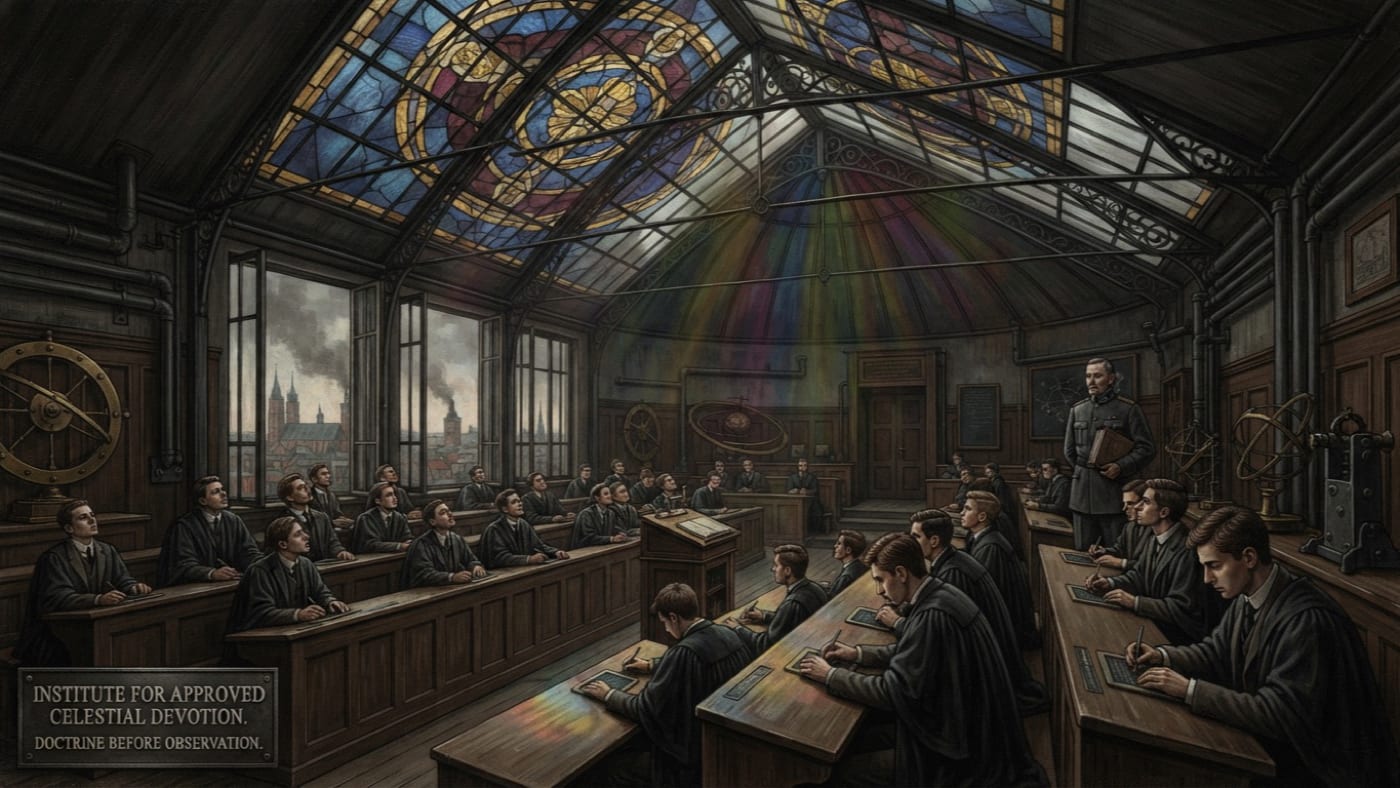
The old university quarter of Kraków keeps a building that used to argue with the sky. It was a rebuilt lecture hall with a roof that opened on mechanical shutters, so that men with brass tubes could put their eyes where their catechism had never sent them. After the Condemnation of Kraków in the autumn of A.S. 199, the building was sealed for ninety days. When the seal was lifted it reopened under a new name: the Institute for Approved Celestial Devotion.
I did not choose the words. I would have chosen every one of them.
The name reassured parents and ruined enrolment, and I count both results among the Bureau's modest successes in the east. A mother hears Approved and sleeps soundly. Her cleverer son hears Devotion and enrols in law. The building still stands, lectures still run, and the arithmetic has learned its manners.
Readers should not take the Institute for the old observatory under a fresh coat of varnish. Its former masters are elsewhere. Twenty-one persons were transported to Strasbourg for the hearing: six principal astronomers, twelve assistants, two lens-grinders and one clerk with unforgivable handwriting. Doctor Aniela Rudzka was the senior accused. Witold Sarnek produced an occultation table that the sky later had the poor taste to confirm. I presided. I sealed the case at the Tower of the Quill. The telescopes were confiscated, the charts were burned, and the clock was dismantled for being accurate past the point of courtesy. The astronomers were reassigned to the Paper Mines of Ulm, where they now make the paper that approved truth is printed on. The building they left behind was handed to an instruction they did not write.
Kraków had been corrected before. The Night of Knives of 17 Martius A.S. 18 left the city a wound and a reputation. It did not make the city immune to further correction.
#On the Roof
The shutters came off first. A shutter is a question on hinges. Every evening it asked whether tonight a man might look up unsupervised, and every evening somebody in Kraków answered yes. The Bureau of Doctrine withdrew the question.
The opening in the roof was then glazed with stained glass depicting the Seven Seals of Faith. I will not catalogue the seven panes in a provincial entry. The glazier did his work and the seals are where Doctrine wanted them, between the student's upturned face and whatever lies beyond the lead. Any scholar who lifts his eyes in that hall now meets doctrine before he meets heaven. The roof answers his question before the sky has a chance to.
I have never climbed the stairs, and I do not need to. A ledger entry describing a roof is better than a roof, because the entry does not leak. The file tells me the opening is fixed and glazed and can no longer be operated. Nothing in the room turns, slides or tracks. The architecture now holds a position, and that position is Doctrine's.
The sky still arrives in daylight, coloured, leaded, and divided into sanctioned compartments. Students who wish to admire the heavens may admire the glass. It is the same heaven, edited.
#On Permitted Observation
Lectures resumed under four rules. Each one is short and each one is correct. Together they close every door a clever student might try, and there are only four doors.
No observation after Compline. Compline closes the day's offices and commends the faithful to sleep. The stars that cause trouble keep later hours than that. A student may watch the sunset, note the first evening light, praise the Creator for its punctuality, and then go to bed. The rest of the night belongs to the bells and to persons licensed to stay awake.
No lens above three inches. A three-inch lens shows a pupil enough to wonder and not enough to dispute. It can make the moon pleasant. It cannot make Jupiter an argument. The limit is fixed by measurement, which I note with some satisfaction: the only measurement the Institute still performs on its own authority is the measurement of its lenses.
No independent tables. Tables reach the Institute already approved. Students may copy them, recite them and illuminate their margins with modest vines. They may not compute them. Copying is obedience in ink. Computation is opinion with a column of figures attached, and opinion with figures was the whole of the Kraków crime.
No use of the phrase according to the evidence unless the evidence has been filed, stamped, witnessed and rendered doctrinally acceptable. A lecturer may still say the words. He must first be able to produce the stamp.
These rules apply the decree. Its second principle held that instruments confer no interpretive licence. A telescope magnifies an object, and it does not magnify the standing of the fool behind it. The decree's first principle placed natural philosophy under Doctrine whenever its conclusions touch catechism, liturgy, calendar, sacrament, omen, miracle, prophecy, bell schedules, agricultural fasts, navigational processions, feast days or approved metaphor. That leaves the astronomer stones, and stones only while they behave. The third principle declared that celestial bodies observed in contradiction of approved charts are provisionally in error, pending corrected language from Doctrine. The Institute teaches its students to wait for that language with their hands folded.
Provincial accounts describe the Institute as a school forbidden to look at the sky.
The Institute looks. It looks before Compline, through three inches of glass, at what the approved tables already say is there. Prohibition would be crude. Supervision costs less and produces better penmanship.
#On Protection and Vocabulary
The Bureau of War sent a garrison detachment to Kraków for one year. Officially it was there to protect the university from public unrest.
The public had shown no unrest. I record that in my own hand, for the benefit of whatever auditor eventually asks why soldiers guarded a quiet street. The garrison protected Kraków from becoming interesting, and it succeeded. When the year was over, the detachment withdrew from a city that had never needed it and had understood exactly why it came.
The division of labour deserves precision. Doctrine decides what may be said about heaven. War stands in the street while it is decided. Soldiers do not interpret the stars, any more than a censer chooses the hymn. Confusing the two offices is how provincial magistrates end up writing to Strasbourg to ask whether a sergeant may rule on parallax. He may not. Nobody in that town may.
The Index Claritatis did the rest, more quietly than any musket. After Kraków, orbit, parallax, retrograde and eccentricity became restricted in lay speech. A student at the Institute learns the subject without its grammar, much as a novice learns the Mass in a tongue he is not allowed to parse. He can say the heavens are ordered. He cannot say how.
The Kraków astronomers were condemned for discovering that the Earth moves, and the Institute was founded to deny it.
Vulgar simplification. The Bureau does not condemn motion. It condemned unauthorized interpretive authority, and the Institute exists so that such authority stays where it was lodged. The heavens may revolve as Providence permits. Saying so in a lecture hall requires a licence.
#On the Present Instruction
The Institute teaches devotion with a celestial subject. That is the whole of its administrative purpose and the reason the Bureau kept the building instead of pulling it down. A demolished observatory leaves a gap in the street and a story in the taverns. A converted one keeps its address, its lecture benches and its students, and it changes what the students are for.
They used to be trained to measure. They are now trained to receive. They learn the approved charts, the approved hours and the approved lens, and they learn the one sentence the case has carried into catechists' manuals: the Creator made the heavens, the Bureau defines the permitted descriptions, and the faithful may admire what they are not licensed to measure. Children in village schools are learning the same lesson with wooden stars on a wire, which the teacher covers at the end with grey cloth stamped with the Bureau's seal. The Institute is the same lesson for adults, under a better roof.
Someone will object that the hall has stopped producing astronomers. I agree. It produces something rarer and easier to staff: graduates who can tell you where the stars are without wanting to check.
The old shutters are gone, and so is the clock. The tables are printed in Strasbourg. The phrase according to the evidence now needs a stamp to go out in public. Over all of it the Seven Seals sit in their leaded frames, catching the afternoon and keeping it.