
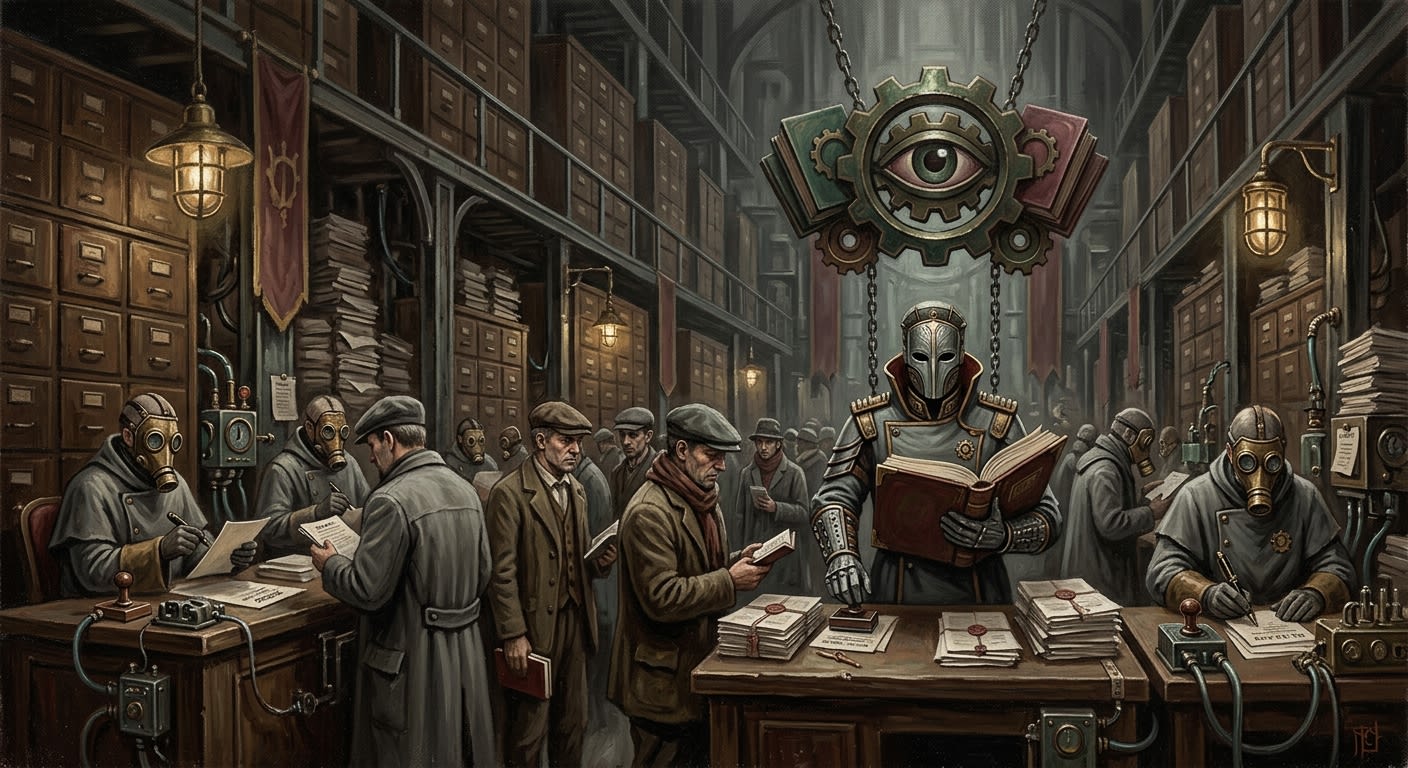
#On the Approved Tongue
The Index Claritatis is the Synod's rolling compendium of permitted words: the vocabulary by which Creation may be described without earning a visitor in a white mantle. It is maintained by the Bureau of Doctrine, enforced by the Bureau of Purity, printed by the Bureau of Records, disputed by every provincial schoolmaster with enough remaining courage to sweat through his collar, and updated every seventh day, because truth is eternal and clerical convenience is weekly.
The ignorant think censorship begins with prohibition. This is a vulgar error. Prohibition is crude. Prohibition says: do not say that. The Index Claritatis performs the higher office: it says what may be said, and thereby renders everything outside its margins suspect before Purity need lift a finger. A citizen may avoid the Index Damnatus by ignorance, cowardice, or the blessed accident of illiteracy. No citizen avoids the Index Claritatis. To speak at all is to pass through its gate.
Doctrine names the clean word. Purity hunts the unclean word. The White-Mantled Inquisitor lives in the narrow corridor between those documents, where a phrase may be acceptable at Prime, suspect by Sext, and actionable before Vespers if the update runner has strong legs and the printer has not been bribed by mercy.
#On Its Origin
The Index Claritatis grew from Doctrine's oldest anxiety: that heresy does not always arrive as argument. Sometimes it arrives as a verb. After the Sundering, slogans crossed cities faster than couriers. Market rhymes carried panic. Lullabies preserved outlawed consolations. The old languages of Europe, with their private jokes, local saints, filthy proverbs, village kinship terms, sailor curses, and endearments that no theological committee could parse, became a wilderness of possible breach.
The first working lists were defensive. Parish vicars required standard phrases for dawn prayers. Military chaplains required approved language for retreat, since the word itself was judged nutritionally bad for courage. Judges required clean terms for mutilation, confiscation, and the removal of children from families whose hereditary grammar had become suspect. Each Bureau produced its own list. Each list contradicted the others. The result was disorder, and disorder, unlike free speech, is something the Synod will not tolerate without a tariff.
The Cloister consolidated the lists after the Concordat of Strasbourg, binding prayer, court, military order, school primer, and death notice under one lexical authority. A word entered in the Index Claritatis became safe for public use, provided it was used in an approved sense, with an approved grammar, in an approved context, before witnesses who had themselves not been struck from the civic record. Safety, in Strasbourg, is never a condition. It is a chain of signatures.
Provincial catechisms once described the Index Claritatis as a “dictionary.”
Corrected. “Dictionary” is Rationalist residue: a book pretending words possess meaning before authority grants it. The Index Claritatis does not record language. It licenses it.
#On the Weekly Errata
Every seventh day, before Prime, fresh amendment strips leave Strasbourg in sealed packets. They travel by courier, bell relay, bureau cart, naval pouch, chapel runner, and, in the more desperate districts, by children small enough to pass through riot barricades with the moral invisibility that adults foolishly mistake for innocence. The packets contain additions, removals, reclassifications, pronunciation corrections, semantic restrictions, context marks, and temporary tolerations.
Temporary tolerations are the most dangerous. A word temporarily tolerated is a word already standing before the scaffold, permitted to speak while the carpenter measures its neck. Merchants learn this too late. Poets learn it theatrically. Lawyers learn it with profitable speed.
The Inquisitor calls the Errata his weather report. A new entry means new seizures. A reclassified phrase means revisiting yesterday's cases with today's definitions. This is administrative weather with teeth. The Bureau's authority is retroactive where necessary, prospective where useful, and current only when challenged.
#On Claritas and Damnatio
The relationship between the Index Claritatis and the Index Damnatus is often misunderstood by citizens, students, provincial vicars, and those charming fools who believe paired institutions must be opposites. The Claritatis tells you what may be said. The Damnatus tells you what must not be said. Between them lies the great grey pasture of the unlisted: words unapproved, uncondemned, unclassified, half-heard in alleys, preserved in grandmother mouths, scratched on prison walls, muttered by sailors, sung by refugees, carried by dialects that have not yet had the courtesy to die.
That grey pasture is where the Inquisitor operates.
The listed forbidden word is easy. It receives a warrant. It receives a tongue-brand. It enters a file, and from the file it enters the flesh. The listed permitted word is also easy, unless the speaker uses it with unsuitable expression. The unlisted word is richer meat. It permits suspicion before definition. It lets Purity seize a manuscript for review, summon a printer for clarification, halt a wedding because the vows contain a regional term for fidelity that Doctrine has not yet priced, and frighten a district into revising its own speech before the Bureau spends money on raids.
Earlier instructional broadsheets claimed that words absent from both Indexes were “free.”
Revised. Absence from the Index Claritatis is not freedom. It is exposure. The broadsheet author has been transferred to signboard inspection, where his gift for dangerous optimism can do less harm.
A.S. 196 LEXICAL GAP INCIDENT, SOUTHERN DIOCESE: an unlisted word for “mercy after defeat” spread through six barracks, three infirmaries, and one ration queue. The word did not appear in the Index Damnatus. It did not appear in Claritatis. It produced measurable refusal in ███████ soldiers and an acoustic response from chapel bells at ███████ Hz. Final disposition: ███████████████████████████. Replacement term issued: “obedient endurance.”
#On Dialects and Extinctions
Whole dialects have vanished under Claritatis rulings. Occitan was struck for subjunctive excess in A.S. 185. The Harz mining patois was suppressed in A.S. 192 after a Doctrine committee concluded that its lack of a clean term for obedience indicated cultural deformation, spiritual negligence, and poor future compliance. Breton was reclassified as provisionally extinct in A.S. 199, a category so exquisitely bureaucratic that I nearly applauded when I read it. A provisional extinction permits the Bureau to deny that speakers remain while retaining authority to prosecute them if discovered.
The mechanics are quiet. First the school primers change. Then the parish responses. Then the market notices. Then the courts refuse testimony in the old tongue. Then the Orphanarii teach children to correct their mothers. Within a generation, the forbidden language survives in dreams, curses, recipes, and the particular kind of weeping a woman does when the word for her dead child has been replaced by a filing category.
The Triune Alphabet made these extinctions efficient. A word whose sound cannot be rendered in the twenty-three approved letterforms becomes administratively weightless. A word that cannot be written cannot be entered into a petition. A word that cannot be petitioned cannot be defended. The Bureau does not need to kill every speaker. It need only make the speaker's mouth inadmissible.
#On Enforcement
Purity enforces Claritatis with glass chains, chalk marks, seizure slips, angle gauges, tongue-warrants, and the soft theatrical click that makes a market stop breathing. A White-Mantled Inquisitor begins his day with the Errata. He inspects shop signs by breakfast, schoolroom slates by Terce, hymnals by Sext, confessional scripts by None, tavern jokes by Vespers, and prison graffiti by night. He is looking for deviation.
The punishments are calibrated. A first unauthorized word may draw correction. A repeated unauthorized word may draw public recantation. A suspected singing phrase draws a Glass-Canon (Unregistered). A district retaining a proscribed dialect draws silence, and silence in Purity's hands is preparation.
The citizen learns quickly. He speaks in approved nouns. He avoids inherited verbs. He teaches his children the sanctioned word before the household word, because children repeat, and repetition is evidence. He attends chapel and mouths the responses with care. He signs forms in the Triune hand. He pauses before metaphors. He becomes, by increments, a clerk of his own tongue.
#On the Present Application
As of A.S. 201, the Index Claritatis is larger, narrower, and hungrier than at any prior point in Synodal administration. Larger, because every campaign season produces new horrors requiring approved names. Narrower, because every approved name closes a dozen local names around it. Hungrier, because language, unlike wheat, grows back after harvest unless watched.
The Bureau of War petitions weekly for practical exemptions. The Bureau of Bells requests stable tonal vocabulary. The Bureau of Records requests fewer homonyms, preferably none. The Bureau of Purity requests broader discretion, as if Purity has ever been shy. Doctrine receives these petitions, files them, corrects their language, and issues the next Errata with the serenity of a man feeding papers into a furnace that warms his own office.
The Index has enemies. The smugglers of unlicensed melodies. The old women who keep village words in bread recipes. The soldiers who name terror faster than Doctrine can approve alternatives. The children in refugee sheds who hum meanings no adult has taught them. The dead, who are careless with vocabulary and appear in dreams speaking languages the living have been fined for remembering.
I do not romanticize these enemies. Romance is how bad poets become good evidence. I merely record that they persist, which is rude of them, and that the Index persists harder, which is the Synod's answer to all living things.