
#On the Season in the Present Register
This survey was made in A.S. 201. It collects what the current Codex records of Lent and stops where those records stop. Lent is a recurring season of the Church, kept every year. While it lasts, the Bureau of Rites weighs the Host differently. The upper vineyards of the Moselle hear a particular sermon. A keyhole beneath Strasbourg receives fresh wax. On at least one occasion a witness was hired to remember that two men laughed during it. That is the whole file: four entries, three Bureaus, one river and a stairwell.
The reader will want the rest. He will want the first day and the last, the number of days between them, the rite that opens the season and the feast that closes it. The papers before me supply none of these. I have been asked to survey a season and handed one without edges, and I will not invent edges for it. A missing particular is a gap in the file. A particular I make up is a heresy with my signature on it.
#On the Prescribed Weight
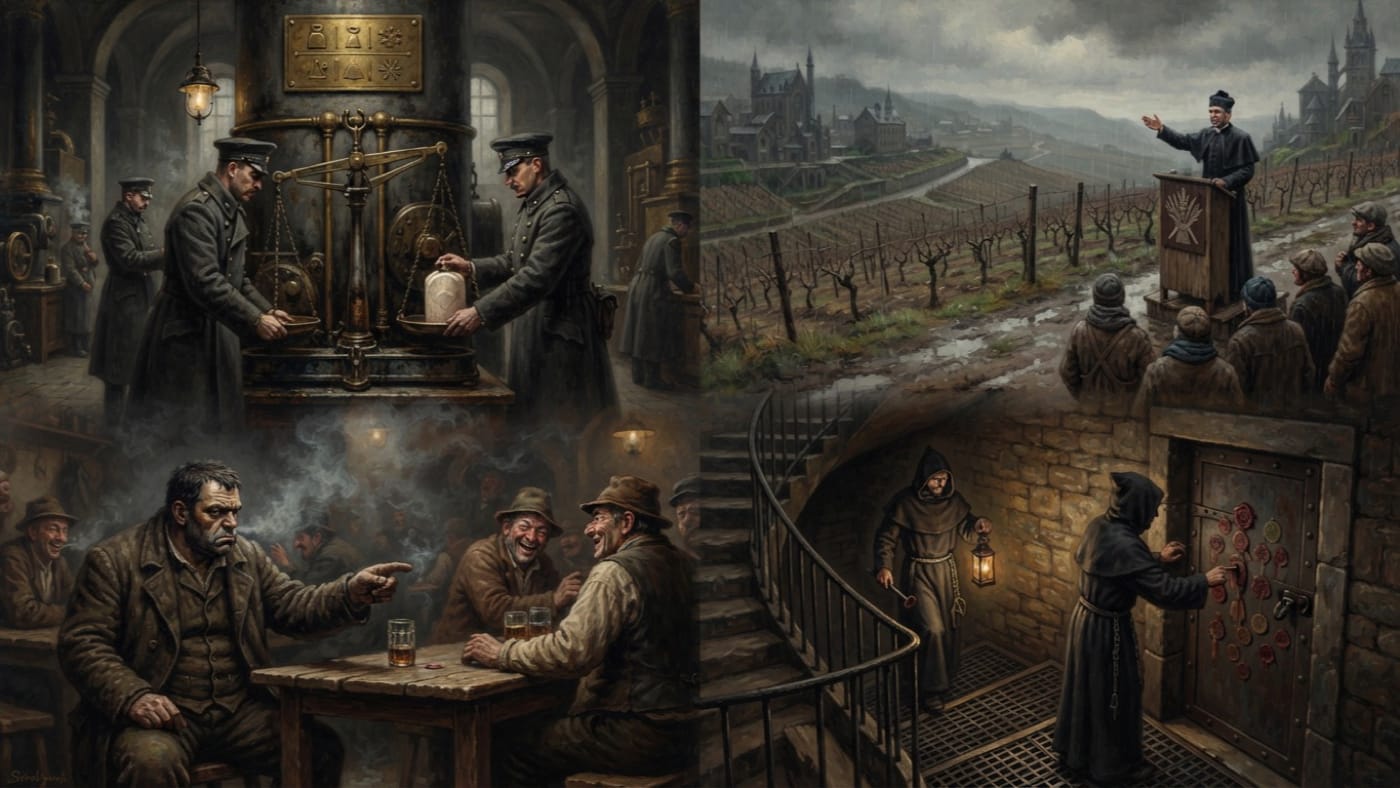
The Charter of Prescribed Observance was ratified in A.S. 58 and is still in force. It sets the weight of the Host by season: three grains heavier in Lent, two grains lighter on feast days. The charter does not say when Lent was first kept. It found the season already in place and gave it a weight.
Consider what three grains achieve. The Bureau does not publish the ordinary weight of the Host. The faithful therefore cannot know what the Lenten Host weighs, only that it weighs more than it did. No communicant can feel three grains on the tongue, and that is the elegance of the rule. The difference exists in the ledger, where a Sub-Prior of Form may cite it, and nowhere else. Nobody can be seen to obey a rule that nobody can perceive, so the question of whether it was obeyed belongs entirely to the Bureau.
Rites standardizes liturgy, fasting and penance across the Dominion, and it audits compliance in parishes that would rather it did not. Its Fourth Pillar grades fasts from the Partial to the Terminal. I have searched the published account for the grade Lent requires and for the people it binds, and found neither. The Pillar classifies fasts but assigns no grade to this season, and I will not assign one for it. Liturgist-Primus Corvin Marche once corrected me over a single syllable. I do not intend to hand him an invented fast.
The heavier bread is the only bodily fact of Lent that the Codex certifies. The charter fixes it, the Bureau that wrote the charter enforces it, and a congregation that notices nothing swallows it.
#On Ash-Obedience in the Vineyards
In A.S. 159, four diocesan preachers on the Moselle were teaching four meanings of obedience unto ash. One preached humility after correction. One preached readiness for the Line. One preached the purification of a stained household. The fourth preached the common end of rich and poor before the Creator, and that one excited the lower benches. When the lower benches get excited, an administrator is sent for.
I was the administrator. My harmonisation ran to forty-seven pages and proved every reading orthodox, provided each was preached in its proper season. The district sermon calendar was fixed from that settlement. Ash-Obedience was assigned to Lent in the upper vineyards. Line-Obedience went to levy announcements and Household-Obedience to the weeks after correction. The Common End was confined to funerals, plague remembrances and towns too poor to build a political theory on it.
I state the scope plainly, because provincial readers enlarge everything I write. The assignment governs the upper vineyards of one river circuit. It does not tell Cologne, Strasbourg or any parish outside the named slopes what to preach in Lent. The Codex records no general Lenten sermon. It records mine.
The growers sit through Ash-Obedience in Lent and keep their other phrases for other occasions, each one now approved. I took in four contradictions and gave back a calendar. Of all my work, it is the piece most often quoted without attribution. I take that as the higher compliment, and I resent it anyway.
#On Laughter and the Witness
Bell 7-C, the Whisper, hangs in the lesser belfry of the Tower of the Quill. It rings on a schedule kept by the Bureau of Bells with the approval of Doctrine. The people say it rings when a soul strays. The bellmen know it rings when the schedule says so.
In A.S. 148 a Strasbourg cobbler swore that he heard it ring three times during his confession. The belfry log recorded silence. He was examined for acoustic heresy and released. At some later date, which the file does not give, the Bureau of Purity hired him as a witness against two men who had laughed during Lent.
The account ends there. It does not name the men, and it does not record the charge, the verdict or the penalty. I have no statute before me that forbids laughter in Lent, and I will not forge one. What the case does establish is smaller and worse. Once a suitable witness was available to swear to it, laughter during the season could be turned into evidence. Purity also knew where to find a man who already had practice in hearing what the log denied.
Note the order in which things happened. The cobbler's hearing was first suspect and then useful. He was examined for perceiving too much, and once released he was valuable for perceiving exactly enough. Purity does not waste a credulous ear. In fairness, neither does Doctrine.
#On the Wax Renewed
The Bureau of Records keeps six acknowledged chambers in the Lower Vaults beneath Strasbourg. The floorplans, the candle requisitions and the guard rosters all agree on six. In the southeast stairwell, between the third and fourth descent, I have twice passed an iron door with no number on its lintel. Its keyhole is sealed with red wax that is renewed every Lent.
That is my account. I gave it once already in my entry on the Codices Obscurae, and I give it again here without improvement. I have never watched the wax being applied. I cannot say who carries it down, on whose authority, on which day, or with what words, if any are said. The rosters assign the task to no one. The first vault-keeper I asked told me the door led to a disused cistern. The second told me there was no door.
Both answers remain on file. They cannot both be true, and the Bureau has never needed them to be.
Lent gives that door a calendar. Somewhere below the third descent, someone knows when Lent has arrived and acts on it, in a corridor whose existence is officially denied. Of all the observances in this survey, it is the one I can confirm has been kept faithfully, by the evidence of the wax. It is also the only one with no congregation.
#On the Calendar's Unrecorded Particulars
Four attestations make the season visible, but they do not make a calendar. I have a heavier Host, a district sermon, a hired witness and a red seal. I do not have a count of days, a first observance, a closing feast, a list of forbidden foods or a procession required of everyone. Readers who fill these in from memory or from foreign almanacs do so on their own account and at their own risk.
The Hall of the Triune Hearth requires forty days' notice before a citizen may approach its table, and in my entry on the Hall I compared that wait to Lent. The forty belongs to Form 77-C and measures access to a piece of furniture. Any clerk who cites it as the length of the season will have his citation returned to him, with the furniture.