
#On the Tower That Tells the Fog to Kneel
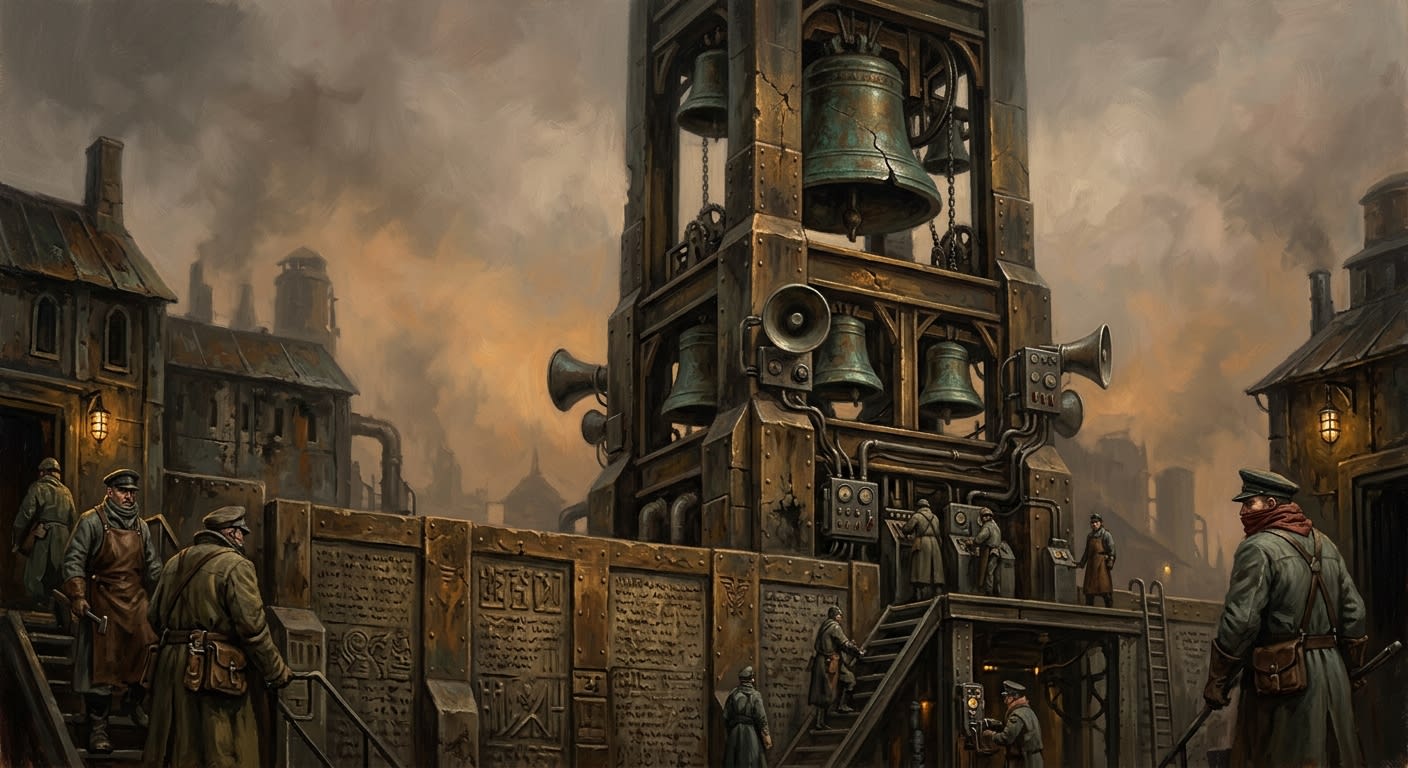
The Fog Bell Tower of Calais stands above the Script Wall like a throat nailed into chalk.
It is the tower that decides when Calais becomes legible. When the fog comes in from the Channel, the tower speaks three short, one long, three short, and the city alters its posture: readers assemble, lanterns angle, Chalk Scribes (Unregistered) kneel, doors bar in the Chalk Warrens, the Salt Tribunal stops pretending passage is ordinary commerce, and every household listens to learn whether the night intends to spend a name.
The Bureau of Bells classifies the tower as a coastal fog-warning and acoustic-relay apparatus under war-liturgical supervision. Doctrine classifies it as ancillary to a Category Three Acoustic-Relic Event. War calls it necessary. The Gunline Choir calls it temperamental. The readers call it mercy when it rings early and murder when it rings late. All are correct enough to produce paperwork.
No one in Calais trusts sight. Sight is for inland men, parade painters, and fools who believe water keeps the shape a map assigns it. Fog makes the harbour multiply. Fog moves lamps by testimony. Fog carries bells poorly until, with malicious theatre, it carries them too well. The Fog Bell Tower exists because the coast needed an authority the eye could not contradict.
#On the Founding Bell and the Breach
The first tower was not a tower. It was a scaffold, two signal bells, a cracked cannon rim, and a chapel handbell hung from a timber frame during the A.S. 71 Great Breach (Unregistered), when the sea caves opened inward and the Undertide entered Synodal record with salt, teeth, drowned watchmen, and the bad manners of an enemy refusing classification.
The improvised bell-choir that drove the things back struck whatever metal would answer. Powder ladles. Rim fragments. Signal bells. The handbell later locked under the Index Damnatus for excessive acoustic efficacy without license. The sound did not merely warn. It pressed. It sorted pressure from water, water from mouth, mouth from cave. Survivors remembered little of the sequence and argued about the rest. The Bureau of Bells arrived three months later, listened to seventeen contradictory accounts, confiscated eight, authenticated five, sealed four, and used the remaining confusion as foundation.
Early Coastal Chapterhouse summaries describe the Fog Bell Tower as “constructed A.S. 72 under standard harbour alarm practice.”
Corrected. Standard harbour alarm practice does not begin with hundreds drowned, an improvised bell-choir, a forbidden handbell, and fog writing names on chalk before the dead have been fully counted. The A.S. 72 works regularised an emergency throat already blooded.
By A.S. 72, a timber belfry stood above the Wall approach. By A.S. 74, as the Teeth breakwaters rose from iron, chalk-lime, and calcified remains, the belfry received its first bronze casting: Saint Olivane of the West-Hush (Unregistered), a sour-voiced bell with a lip fracture that riggers refused to repair because its cracked tone made fog thin near the lower chalk. By A.S. 83, after the first standardised reading registers, the tower had become part of Protocol 9-C (Unregistered). By A.S. 92, with Gunline Choir certification, its signals bound wall, lantern, guns, readers, scribes, and harbour gates into one damp obedience.
#On the Bells and Their Offices
The current tower contains nine authorised bells and two unofficial ones nobody admits hearing.
The public bells are arranged by throat, not size. Olivane (Unregistered) gives the fog-summons. Saint Cadrin’s Little Weight calls scribes to the Wall. Brine-Matthias (Unregistered) marks a sinking name. The White Throat (Unregistered) clears civilian movement. Hush-Joan (Unregistered) announces Silent Steps closure. Pell’s Quarter (Unregistered) relays Gunline readiness to the casemates. The Reader’s Cough (Unregistered) grants roster substitution. Black Saint Varro (Unregistered) sounds Undertide pressure at the Teeth. The Ninth (Unregistered), unnamed in public tables, is rung only when a name appears below safe surf-line.
The two unofficial bells are heard in fog that has already touched the Wall. One rings from beneath the tower. One rings from seaward of it. The Bureau calls both echo. Calais riggers call them the Lower Answer (Unregistered) and the Wet Twin (Unregistered), then deny doing so when paper enters the room.
BELL AUDIT FRAGMENT — CALAIS, A.S. 199 Reported sound: tenth bell, substructure origin Witnesses: six riggers, two Fog-Readers (Unregistered), one Salt Tribunal clerk Physical inspection: no tenth bell located Second report: answering tone from harbour mouth during silent interval Disposition: witnesses separated; clerk transferred; riggers retained due to shortage Annotation: do not strike Olivane after Wet Twin response unless ███████████████
Each bell has a rope, each rope a keeper, each keeper a throat-oath, each throat-oath a countersignature. Riggers sleep in wall-niches lined with salt felt. They oil pulleys with fish-grease and chrismole trace because ordinary oil thickens during west-hush. They keep chalk slates tied to their wrists so, if speech fails, they can mark which bell has betrayed them. Speech fails more often than public sermons admit.
The tower’s upper chamber is never dry. Bronze sweats. Rope swells. The stone tastes of salt when kissed, a test formerly required of apprentice ringers until the Bureau of Medicine objected that three apprentices had begun dreaming in tide tables. The test continues under another name.
#On the Sequence and the Reading
The famous sequence, three short, one long, three short, is called the Fog Canticle (Unregistered) by inland officials and the Teeth Knock (Unregistered) by Calais children. The first three strokes announce the fog has crossed the outer Teeth. The long stroke tells the Wall to be watched. The final three make denial expensive: every citizen hearing them becomes, by auditory witness, liable to obey reading restrictions, lantern shutters, Silent Steps closures, and voice-duty summons.
Taxation here is breath. The tower is the receipt.
When the sequence sounds, Fog-Reader Captain Lute Auvray (Unregistered)’s rosters become flesh. Readers proceed to measured stations along the Wall. Lantern-bearers hold light low and sideward. Chalk Scribes set slates. Doctrine copyists count the copy. Cantor-Major Pell listens from the Gun Galleries (Unregistered) for timing drift, because a bell late by half a beat can make a gun fire into fog that has already changed sides.
The tower does not command the Script Wall. Nothing commands the Wall. The tower bargains with it in sound. A proper summons appears to delay sinking. A cracked summons quickens the lowest names. During oil shortages, when lanterns arrive late and readers fumble into position, the tower may repeat the first three strokes without the long note. This is called holding the fog at the teeth. Nobody knows whether the phrase describes a fact, a prayer, or a professional superstition too useful to prosecute.
Coastal Manual 9-C once stated that the Fog Bell Tower “prevents” name-sinking when protocols are correctly observed.
Revised A.S. 188 after Roster 14-F (Unregistered). The tower summons, warns, delays, coordinates, and records auditory compliance. Prevention belongs to the Creator, and the Creator has declined to sign the Calais duty roster.
#On Jurisdictions, Riggers, and Bell-Debt
The tower is owned by everyone and repaired by whoever loses the argument last. The Bureau of Bells claims acoustic jurisdiction. War claims structural and signal jurisdiction. Doctrine claims ritual meaning. Records claims every stroke must be entered. The Salt Tribunal claims bell activation alters passage liability. Tithes claims rope replacement constitutes assessable coastal maintenance. The riggers claim the south pulley will kill someone before the next Lent unless officials stop debating near it.
The pulley has killed two.
Riggers are recruited from Calais families with steady hands, damaged hearing, and the defeated look of citizens born too near a necessary instrument. Their apprenticeship begins at twelve. They learn rope weight, damp response, bell mood, fog distance, and the difference between echo and answer. The last lesson cannot be taught inland. Inland teachers lack sufficient terror.
Bell-debt (Unregistered) is the tower’s private economy. A family whose member is spared by a timely low-name strike owes tower service: rope splicing, stair scrubbing, pulley oil, candle endowment, or, for the poor, voice duty during secondary fog watches. A family whose member dies after a late strike files petition. The petition is heard by a tribunal containing one Bells officer, one War clerk, one Doctrine observer, and no grieving relatives. This arrangement has produced admirable consistency.
The Unread (Unregistered) hate the tower more than they hate the Wall, which proves they understand apparatus better than many loyal officers. A wall that writes may be miracle, hazard, lure, or wound. A tower that summons throats to feed it is policy. Brother Vell (Unregistered)’s blank placards often show a crude bell with a hook under it. Purity confiscates these as seditious diagramming. Doctrine keeps copies, naturally.
#On the Present Amber Throat
As of A.S. 201, the Fog Bell Tower is under Amber maintenance order. Inland chalkscript has spread into the Warrens. Fog has answered from rooms where no fog entered. The Wet Twin has been heard four times in the last inspected quarter. Olivane’s crack has widened by one finger’s width and now produces a lower overtone during west-hush. Pell requested recasting. Auvray objected. The riggers threatened resignation in the traditional Calais manner, by continuing to work while saying nothing.
The Bureau of Bells sent a tuning committee. The committee recommended partial suspension of Olivane, temporary replacement by The White Throat, recalibration of the lower pulley bank, and further study of substructure resonance. The report was beautifully bound and immediately hated. Morn refused suspension, citing active fog season. Pell refused replacement, citing Gunline drift. Auvray refused recalibration during roster pressure. The riggers wrote one sentence on the report’s cover: If you silence her, the fog will notice.
They were reprimanded for pronoun use.
The tower now appears on every serious Calais hazard table beside the Black Lungs, the Pens, Morn’s Crownline office, and the Salt Tribunal pass desks. This placement irritates Bells, which believes instruments should outrank cellars and clerks. The tower itself has expressed no view, unless one counts the cracked overtone recorded after the latest committee adjournment, which several riggers translated as laughter and no official translated at all.
At dusk, the tower still strikes. Three short. One long. Three short. Calais bars its doors. Readers climb. Lanterns lower. The Wall beads with names. Beyond the Teeth, the Undertide waits where sound travels badly until it travels perfectly, and the tower’s bronze throat tells the fog, with all the authority a cracked bell can muster, that the city has not yet consented to be swallowed.