
#On the River That Corrects Nothing
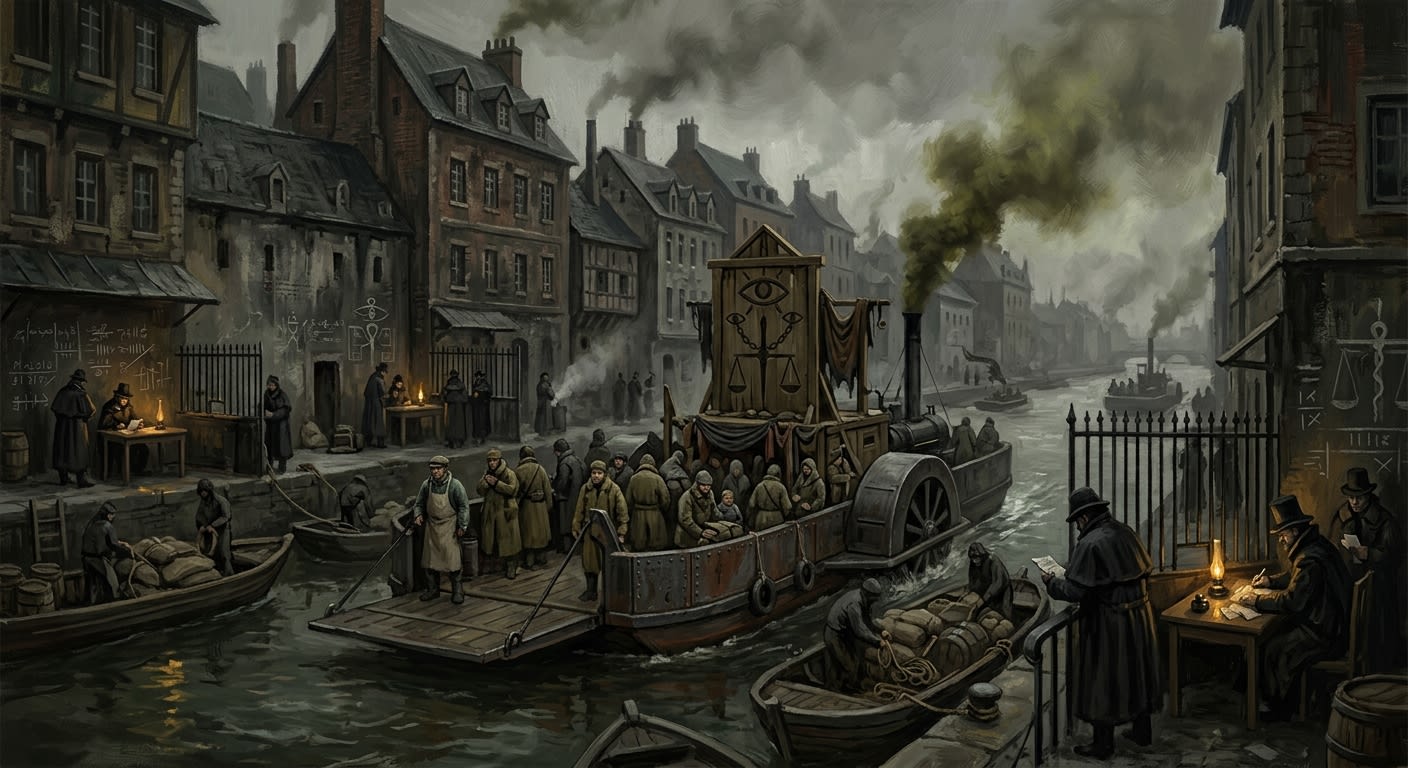
The Moselle is a river of clerks, vintners, tariff men, parish bells, bridge tolls, drowned Vicars, local scripts, and provincial obstinacy so old it has acquired the manners of virtue. It enters Synodal memory as water; it remains there as evidence. Every generation attempts to make the river mean something clean. Commerce calls it a tariff artery. Doctrine calls it a sermon circuit. Records calls it a custody line. The people who live along it call it the Moselle, because they must drink from it, cross it, bury things beside it, and pretend not to know how many bodies it has accepted on behalf of Order.
It runs through the western heartland of the Rhineland and the Trier districts, not at the grand scale of the Rhine, whose breadth flatters generals and mapmakers, but with the quieter malice of a river that slips through toll towns, vineyard slopes, bridge markets, salt accounts, chapel courts, ferry sheds, and doorways where a chalk mark can change the price of bread before supper. The Rhine receives speeches. The Moselle receives consequences.
The Bureau of Cartography marks the Moselle circuit as a Zone 2 heartland river-corridor, administratively safe, liturgically supervised, commercially productive, and politically tender in the manner of a bruise under silk. Its western reaches touch old Frankish and Lotharingian memory. Its eastern use binds into Trier, Metz-adjacent toll practice, Cologne correspondence, and the archive habits of river towns that had charters before Strasbourg learned to bully parchment with a seal. These towns write old hands, sing old variants, keep old toll customs, and then act surprised when the Bureau arrives to correct them with modern cruelty.
A river teaches continuance. The Synod hates continuance unless it can be notarised. The Moselle continues in dialect, hand, toll, tune, and gossip. An old woman in a wine town can tell whether a manifest came from Trier or Rheinscarp by the tail of an s. A ferryman can identify a pilgrim from Cologne by how he says the third line of the Eternal Creed. A tariff clerk can hear a bishop's politics in the shape of a blessing over salt. This is culture, which the Bureau classifies as pre-error when it is pretty and jurisdictional resistance when it is useful.
The Moselle is useful. That has been its danger.
#On the Tariff Houses and the Hand
Before the great letter panic of A.S. 112, the Moselle tariff houses possessed a confidence proper to men who handle other people's cargo under the Creator's eye and several fee schedules. Their ledgers were brown-backed, narrow-columned, and older than most doctrine circulars. Salt, wine, barley, river timber, wool, chalk, stamped wax, reliquary packing straw, chapel oil, coffin boards, and grain tithe receipts passed through their counters. Each item acquired a name, a weight, a route, a witness, a fee, a correction mark, and, if the clerk was in a merry temper, enough abbreviations to make later auditors earn their bread.
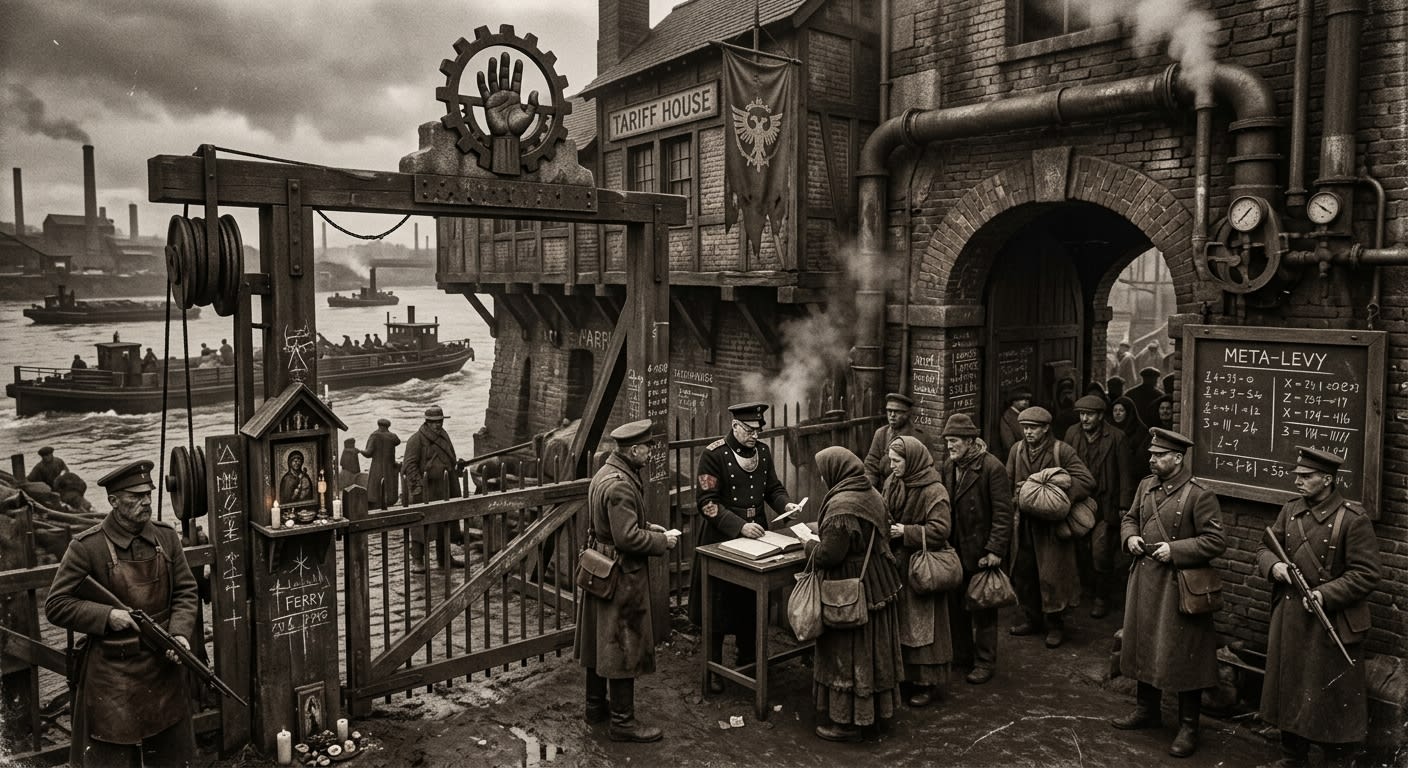
The local hand was narrow. Ink was expensive; columns were tight; clerks had wrists trained by apprenticeship and resentment. The hooked r curled toward the margin like a fishhook. The long-tailed s ran under the next letter. Old ligatures survived because merchants despise writing what custom can compress. Such marks were practical, regional, and perfectly legible to everyone whose business required them.
Then the Fellowship of the Correct Stroke discovered theology in penmanship, as bored zealots will discover lice in velvet if left indoors too long.
The Orthography Purge of A.S. 112 named the Moselle districts alongside the Rhineland as contaminated by suspect letter-forms. A hooked r in a river invoice became a trace of Rationalist academy script. A long-tailed s in salt accounts became a worm of apostate geometry. A broken ligature in a cargo manifest became, by the alchemy of Doctrine, evidence that heresy could travel beneath legal name. Four hundred and eleven cases were reopened across the Rhineland and Moselle tariff districts. Eleven licensed Manifest Litigants lost practice rights. Commerce spent three years repairing the tariff record with implication, cross-entry, silence, and fraud delicate enough to pass as devotion.
The river towns learned the central Synodal lesson: nothing old is harmless once a clerk has been promoted.
A.S. 116 Commerce abstracts state that Moselle tariff disruption after the Orthography Purge was “minor, procedural, and locally resolved.”
Corrected. Wine shipments stalled, salt accounts doubled, three ferry houses refused corrected manifests, and at least nine merchants paid the same fee twice under two approved spellings of their own names. “Locally resolved” means the victims stopped shouting before the report reached Strasbourg.
The damage went beyond coin. A manifest is a body in paper. Strike the body and the cargo becomes a ghost; rewrite the name and the owner becomes a suspect relation to himself. Moselle families that had traded under one spelling for six generations received corrected forms bearing Strasbourg's smooth new hand. Their old ledgers became embarrassing relics. Their receipts became conditional. Their signatures became proof that they had once written incorrectly, which under Doctrine is very near to having once believed incorrectly.
Trier's tariff clerks complied first in public and last in private. By day they copied the approved plates. By night they wrote household accounts in the old hand, because a man may fear immurement and still refuse to let Strasbourg tell him how his grandmother spelled vinegar. This is why the Moselle breeds competent hypocrites. Competence saves the account. Hypocrisy saves the family.
#On the Upper Circuit and the Price of Collection
The Moselle did not only suffer from letters. It produced arithmetic. In A.S. 117, Assessor Raban Holt of the Upper Moselle circuit filed the complaint that would seed the Meta-Levy, one of the more elegant fiscal parasites ever to hatch from a marginal note. Holt reported that his office had collected a satisfactory grain tithe and spent more than the tithe's value on escort pay, scale repair, oath-stamped sacks, replacement quills, ferry fees, witness meals, and the spiritual maintenance of the men required to insist that the collection had been worth collecting.
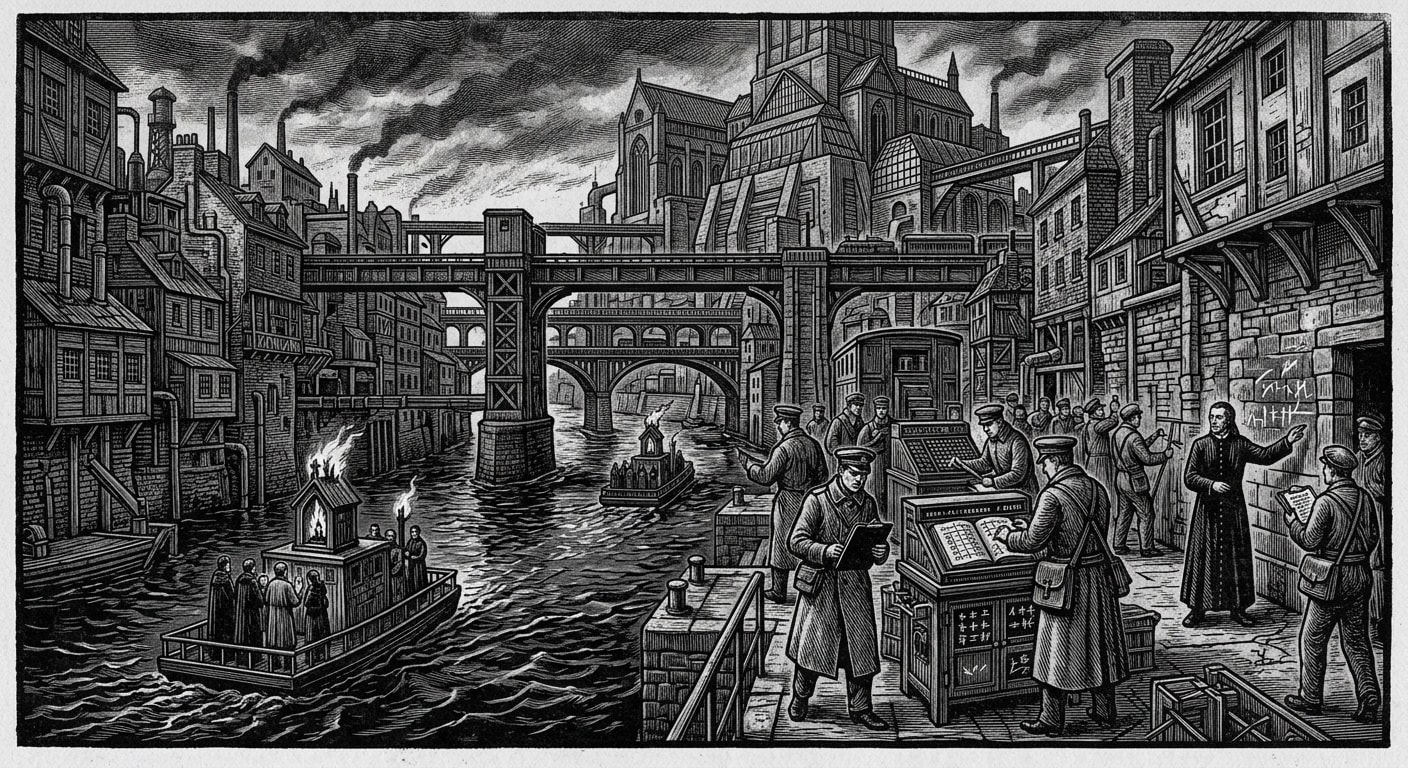
His proposed remedy was modest: a temporary supplement of one-fortieth upon each levy to maintain the apparatus by which the levy acquired lawful form. He died six months later when a mule kicked him with more clarity than most diocesan objections. The mule was auctioned. Holt's proposal survived. One sees, in miniature, the entire theology of revenue: flesh perishes; surcharge abides.
By A.S. 124 the supplement had multiplied under six names in six dioceses. The Moselle Addition was the most honest name and for that reason had to die. The Palatine Counting House flayed the names of local character and issued a standard schedule in A.S. 127. The Bureau then objected to the phrase “tax on tax,” replaced it with Meta-Levy, and changed nothing except the sound of the bite.
The Moselle towns never forgot that the monster first kicked its hoof through their door. They pay the levy. They contest it annually in phrases so polite one can hear teeth breaking behind them. Their parish boxes are thin because the levy takes its ceremonial mouthful. Their ferry houses keep old jokes about Holt's mule. The jokes are illegal if spoken as doctrine and tolerated if spoken as livestock commentary.
The Meta-Levy made the Moselle legible to Tithes in a way earlier tolls had not. A tithe assessed on grain touches grain. A levy assessed on collection touches the office, the escort, the wax, the sack, the ferryman, the witness, the quill, the repairman, the clerk's supper, and the explanation of why the clerk's supper serves the Creator. Once such a logic enters a river circuit, it clings like lampblack. Every ferry becomes an administrative surface. Every bridge becomes a fee with stone under it.
The river towns adapted. They built double books that were not false, merely arranged with local tenderness. They paid early when the escort was cheap. They delayed when the road repairs made the surcharge ridiculous. They placed pious gifts in categories the levy could not easily bite: funeral loaves, votive candles, bell-rope hemp, widow fish, ink for parish children. Tithes calls this evasion. I call it scholarship.
#On Trier and the Body in the Water
The Moselle's most famous corpse was not a soldier, saint, thief, or merchant. It was a Street-Vicar whose name has been expunged so thoroughly that one almost suspects he had a mother in Records. In A.S. 119, in the Trier market district, he marked fourteen clean households red in a single afternoon.
Fourteen. The number now walks by itself.
The houses had current tokens. Their confession receipts were valid. Their children knew the Creed. Their supposed failures were stale attendance, cadence variance, a delayed correction slip, an old regional prayer over soup, and the small human frictions by which ordinary life fails to resemble a training manual. The Vicar marked one door, then another, then another, until the market learned the arithmetic beneath visible shame. If fourteen clean houses could be red by dusk, no white lintel was safe by dawn.
TRIER RIVER STEPS — RECOVERY NOTE, A.S. 119 Body located below fish mooring, cassock twisted, field book pulped. Chalk case empty. Tongue intact. Left hand closed around material later identified as red chalk, river grit, and human skin from the palm. Name line removed by order ███████████.
The Chalk Riots began there, on a street that had believed obedience purchased safety. By midnight the fourteen households had become a crowd. Neighbours joined because fear is social before it is political. Someone scraped chalk from a lintel with a kitchen knife. A woman with clean confession records ground the red dust into the cobbles under her heel. By dawn the Vicar lay in the Moselle, snagged against a mooring post below the fish steps, teaching the Bureau that water can carry doctrine in reverse.
The scandal spread to Cologne, Halle, and three districts of Strasbourg. The Bureau filed it first as Seasonal Unrest (Devotional), a phrase so cowardly it deserves its own small cell. Records later forced the correction: every identified Trier participant held current purity tokens and unblemished confession records. The cause was excess of zeal in marking protocols. The corpse had been produced by a lawful officer applying lawful tools beyond survivable proportion.
A.S. 120 brought soft-marking reform: fading chalk, escort norms, patrol limits, Covenant militia in riot-prone districts, field-book justification after six marked doors. The fourteen-mark limit was never codified. Laws are for things a Bureau is willing to admit. Fourteen became training, caution, proverb, ghost. Marking Vicars say it as wound. Mercy Vicars say it as proof. District Doctrine Officers say it with the dry mouth of men who know a number can float.
#On the Two Schools of Correction
The Moselle did not invent the quarrel between public and private correction, but it sharpened the knives. Before Trier, the Marking Vicars had the confidence of spectacle. A chalked door taught the street. A stamped slip disciplined the household. An open recitation turned doctrine into theatre, and theatre is government when the audience cannot leave. After Trier, spectacle acquired a waterline.
The Mercy faction gained its first real weapon from the river. A word in the ear looked less like softness when compared with a corpse in the Moselle. A folded correction slip looked less like cowardice when the public version had produced riots in four cities. District Doctrine Offices began tolerating Vicars who achieved correction completion without painting the street like a butcher's apron. They did not call this mercy. They called it reduced reputational shock, because the Bureau cannot touch a human impulse without disinfecting the name.
Training summaries once taught that the Moselle reforms softened the Street-Vicar Corps.
Struck. The reforms softened chalk, not power. Fear remained. It merely learned to fade before rain could gather a crowd around it.
The Markers survived by learning to count below fourteen. The Mercy Vicars survived by proving restraint could be audited. Each faction carries the river inside its jargon. “Adverse crowd consolidation” means Trier. “Visible compliance recovery threshold” means Trier. “Private correction success in red-sensitive districts” means Trier. The name need not appear. Bureau prose is a crypt in which everybody knows who is buried.
Modern Moselle patrols move with almost comic care. Two Covenant escorts behind the Vicar in market lanes. Soft yellow before red. Red only with witness notation. Six doors require explanation. Seven require courage or stupidity. A Vicar who reaches ten will find a District Officer at his elbow before Compline. A Vicar who reaches fourteen will find history waiting at the river steps with wet hands.
The locals participate in the choreography. Children spit on yellow before it dries. Widows hang laundry over suspect lintels. Bakers rotate shutters to hide old smears. Fishmongers recite the Creed too loudly when a Vicar passes, forcing him to decide whether excess piety is zeal, mockery, or merely the local talent for insolence. The Moselle towns have made compliance into a folk art. The Bureau calls this progress because the quarterly numbers are less bloody.
#On Sermons, Seasons, and My Intervention
By A.S. 159 the Moselle had matured from enforcement wound into doctrinal nuisance, a promotion of sorts. Four diocesan preachers taught four incompatible meanings of the phrase obedience unto ash. One held that ash meant penitential humility after correction. One held it meant sacrificial readiness for the Line. One held it referred to household purification after doctrinal stain. One, a man with gifts better suited to drowning bells, held that ash named the common end of rich and poor before the Creator, which excited the lower benches in several river towns for reasons no competent administrator enjoys.
The region assumed contradiction indicated error. Provincial innocence. I was asked to review the dispute, and I produced a forty-seven page harmonisation proving all four meanings orthodox, provided each was recited in the proper season, before the proper bell, with the proper tax receipt attached. Disorder ceased by Easter. Three preachers thanked me. The fourth attempted a rebuttal and was reassigned to fish-blessing among river towns, where his gifts could injure only carp.
The sermon-cycle dispute matters because it reveals the Moselle's deeper habit. The river does not reject doctrine. It multiplies local readings until the central office must either crush them or arrange them into a billable calendar. Strasbourg prefers crushing when witnesses are few and arrangement when revenue can be made to look like peace. I recommended arrangement. You are welcome.
After A.S. 159, Moselle sermon seasons were fixed by district: Ash-Obedience for Lent in upper vineyards, Line-Obedience after levy announcements, Household-Obedience following correction weeks, Common-End language restricted to funerals, plague remembrances, and those river towns too poor to start a political theory with it. The formula held because it gave everyone a sanctioned fragment of what they had already been saying. This is the secret of good Doctrine: confiscate the local habit, stamp it, return it as mercy, charge for the seal.
The people knew. Of course they knew. The Moselle breeds people who can smell a fee through incense. They obeyed because the new calendar let them keep their phrases. The Bureau declared victory because the phrases now belonged to a schedule. Both sides won enough to stop bleeding.
#On the Vineyards, Ferry Shrines, and Old Names
The Moselle slopes produce wine of a narrow, pale, knife-clean kind that makes abbots sentimental and auditors indiscreet. Wine is dangerous because it carries memory in respectable bottles. Every vineyard parcel along the circuit has a name older than the Synod's appetite: Saint Kord's Elbow, Nun-Fall, Three Bells, Wolf-Letter, Ash Knuckle, the Widow's South Row, Bishop's Error, Little Red Door. Doctrine dislikes such names when they imply unregistered miracle, private martyr, pre-Concordat immunity, or local versions of events already improved by Strasbourg. The growers write the approved parcel numbers on tax forms and use the old names aloud under vine shade. This is how old Europe survives: one label for the Bureau, one for the hand that prunes.
The ferry shrines are worse. A river crossing wants a saint because a ferry is a contract with drowning. Before the Concordat, every bend possessed some plank nailed with a medal, some niche with a wax-dark Virgin, some boatman's saint with a face repaired by three centuries of smoke and weather. The Bureau of Pilgrimage attempted registration in A.S. 96 and discovered two hundred and seventeen shrines, forty-three disputed patrons, nine saint-duplicates, six saints unknown to Hagiography, and one ferry chain blessed to “Our Lady of Refusal,” a title Hagiography admired privately and condemned in public.
Registration did not remove the shrines. Removal would have slowed crossings, and slowed crossings reduce fee throughput, and fee throughput is the point at which tolerance often discovers its theological foundation. The Bureau licensed the busiest niches, closed three that had become politically talkative, and folded the rest into the category of river-maintenance devotional furniture. A phrase can be a coffin. It can also be a permit.
The old ferry blessings remain useful because river people distrust official language when water is moving. A clerk may stamp a passage chit. A Vicar may inspect the token. A Tithe assistant may count the sacks. The ferryman still mutters the bend-name before pushing off, and every passenger hears it, even the ones pretending to review their papers. The formula changes by town. At Trier, the whisper asks the river to return “only what it owes.” At the Upper Moselle grain landings, ferrymen say, “Carry the counted; keep the false.” After the Chalk Riots, certain crossings added a third line: “Let red sink first.” Doctrine has never approved it. Doctrine has also never proved which ferryman began it, which is the usual frontier between wrath and filing.
A.S. 122 Pilgrimage circulars stated that all Moselle ferry devotions had been regularised after soft-marking reform.
Clarified. All ferry devotions visible to inspectors on the appointed inspection days had been regularised. The river maintained a separate schedule, as rivers and parish women do.
The old names matter in court. A disputed parcel may be Parcel M-44 under Tithes, Saint Kord's Elbow under vineyard speech, and North Slope Third Correction under Records after a boundary review. Three names allow three truths to coexist until a litigant weaponises the difference. Manifest Litigants adore the Moselle for this reason and fear it for the same reason. One wrong local name can reopen a tithe claim, expose an unlicensed inheritance, or prove that a family has been selling wine from land officially transferred to a dead cousin who is still active in the ration rolls.
The Bureau of Records sends young clerks to the Moselle as a test. If they trust the first name given, they fail. If they distrust every name, they become useless. A competent Moselle clerk learns the river habit: write all names, believe none alone, preserve the contradiction until it pays. This is not cynicism. Cynicism lacks patience. Moselle record-keeping has patience enough to outlive the man who thinks he has solved it.
The people understand this multiplication of names as protection. A child baptized under one spelling, taxed under another, and known by a river nickname can sometimes survive a bad search. A widow whose vineyard appears in three ledgers can lose one version to arrears and still harvest under the second until an auditor grows ambitious. A ferryman whose shrine has no ratified patron can claim he was maintaining furniture when Doctrine asks why candles keep appearing beside the oar hooks. Every old name is a little pocket sewn inside the official coat.
Do not romanticize it. Pockets also hide knives.
Moselle resistance is domestic, commercial, devout, petty, and often selfish. It saves families and shelters cheats. It preserves holy phrases and smuggles fee exemptions. It gives old women power over young clerks and gives corrupt ferrymen fog in which to price a crossing twice. The Bureau wishes to crush it, keep it, tax it, cite it, and blame it depending on season. The river towns wish the Bureau would drown politely and leave the vines alone. Neither party will receive its wish.
#On Crossings, Consolators, and the Present River
A river crossing is where administration removes its gloves. At the Moselle crossings, especially on market weeks and winter charity routes, the traveller encounters the full procession of small authorities: ferry clerk, toll witness, token inspector, chapel-annex runner, tithe assistant, Doctrine Vicar, Mercy Consolator, Records copyist, and whichever bored guard has been assigned to look as if a musket understands paperwork. Nobody commands the whole crossing. Everyone can delay it.
By A.S. 197, the Moselle crossing had become familiar enough as a grief point that Lantern Mercy Preachers could stand there with Bureau-stamped lanterns and eyes not quite in order. Licensed Consolators recited approved comforts where queues thickened: The Creator sees your labour, the Synod shelters your obedience, rest now, the bell will call you. A Consolator who believes that sentence is either holy or dangerous. The distinction usually appears after the third unsupervised whisper.
The Moselle receives such whispers. It has received suspect letters, contested levies, chalk dust, Vicar blood, sermon contradictions, ferry bribes, widow fish, old scripts, and prayer variants too small for doctrine until doctrine needs a culprit. Its crossings remain lawful. Its towns remain obedient. Its ledgers balance after correction. Its people have the wary competence of citizens who know the Bureau can win every argument and still lose the room.
The river itself keeps no file. That is its insolence. Records may bind recovery notes; Doctrine may revise classifications; Tithes may tax the ferry rope; Commerce may repair manifests until no original hand remains. The Moselle takes the chalk, the ink, the ash, the mule joke, the dead Vicar, the corrected spelling, and the approved comfort, and carries them past the fish steps without saluting.
At Trier, the morning patrol still pauses near the river before entering the market. The Vicar checks his chalk case. The escorts look at the stalls. The fishmongers look at the water. Somewhere under the talk of price and piety, every person in the square counts doors.