
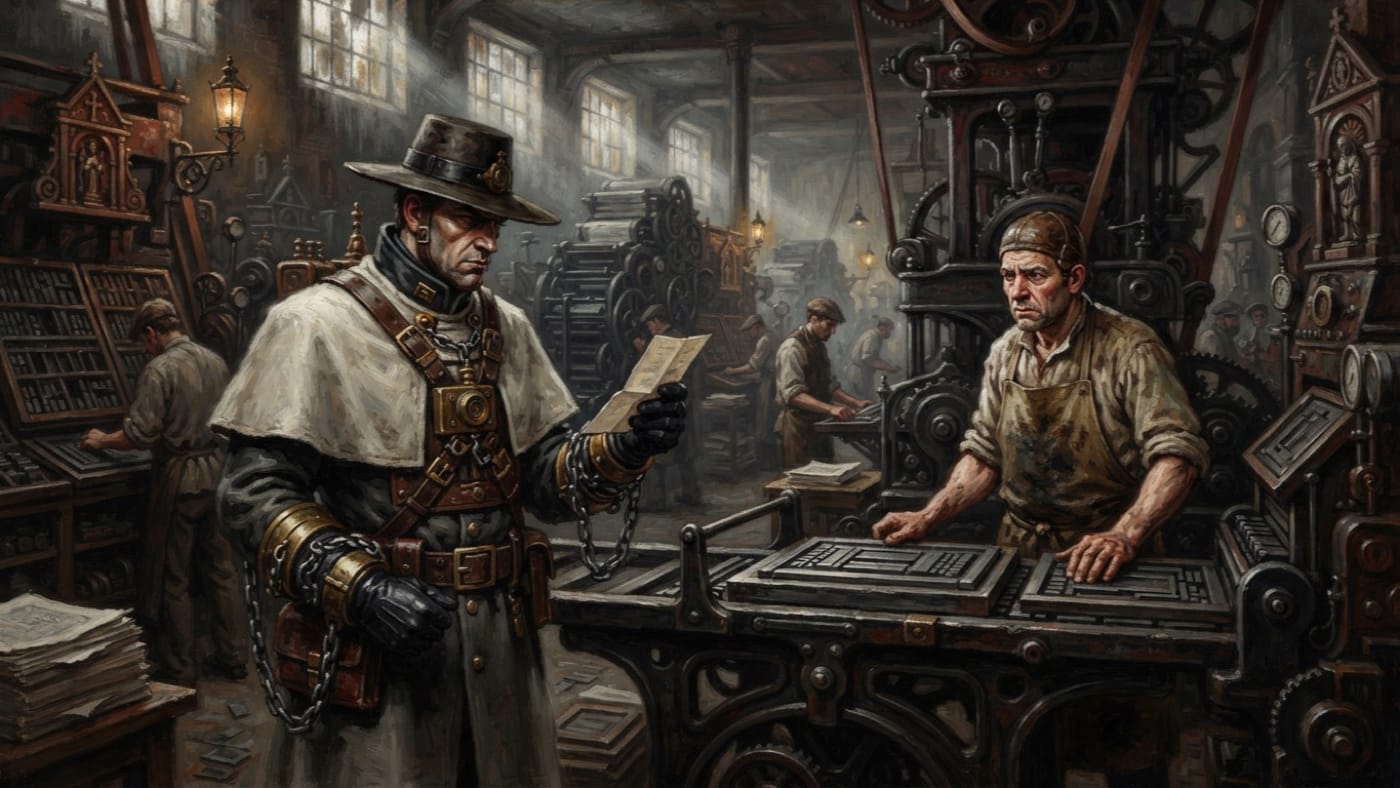
#On the Authority of Words
Name it clean, or name it never.
The Lexicon has no spine to crack and no first page to kiss. Novices go looking for it in the stacks of the Cloister of Concord and come back with dust on their sleeves and a reprimand on their files. The word names an authority, and that authority lives in several instruments at once. It includes the permitted register kept by the Bureau of Doctrine, the condemnations kept by the Bureau of Purity, the amendments that chase both through the streets, and the obligations fastened upon every officer who carries them. When a magistrate says a citizen has offended the Lexicon, the magistrate means all of this. The citizen means nothing, having by then been forbidden to mean.
Doctrine teaches that Creation was indexed. Truth is what is named correctly. A misnaming left standing becomes a crack, and disorder pours through cracks. I set this down as the Church's teaching, sealed in Strasbourg, which is the most certain kind of statement available to anyone in my office.
The Lexicon has one further property, and it is the only one the clerks care about: it binds the examiner. Among the formal titles of the White-Mantled Inquisitor is Lexicon Warden, and a warden sleeps inside the walls of the prison.
#On Permission and Proscription
The Index Claritatis is Doctrine's jewel. It is a rolling compendium of permitted words, the approved vocabulary of Creation. Its governing rule is short enough to brand on a forearm: words not listed are heretical by omission. A careful citizen never asks whether a word has been forbidden. The question is whether it has been allowed. If the register says nothing, the citizen says nothing too.
The Index Damnatus runs the other way. Purity keeps it, and it lists what has been condemned outright: names, words, texts, songs, relics, and a few incense blends whose crime I have never been permitted to smell. Damnatus condemns aloud, while Claritatis condemns by leaving things out. A word can escape the first and still die of the second. Printers learn this at great expense. They search the blacklist, find their favourite trade term unmentioned, set it in lead, and discover at inspection that nobody ever gave it leave to exist.
Spelling is the smaller half of the trouble, because meaning moves. A permitted word sits for years on a shop sign. Then the street begins to use it for something Doctrine never authorised, and a sign that was obedient at Candlemas has become a heresy by Lent. The Inquisitors call this lexicon drift. Doctrine calls it the corruption of a pure term. The baker calls it the name above the door, and is shortly corrected.
The ground is ordinary ground: banners, crests, shop signs, hymnals, printed plates, the names of persons. Whole dialects have vanished under Claritatis rulings. If the training folios are to be believed, whole districts were renamed overnight in the First Great Errata. They are to be believed, because I sign them.
Dictionary
Index Claritatis. Per the Bureau of Records, fifth revision: "Replace all instances of 'Dictionary' with 'Index Claritatis.' The former term is Rationalist residue." Doctrine concurred, having never used the former term in any instrument it can now locate.
#On the Latest Correction
The Lexicon is never finished, and that makes it both clever and terrible. Claritatis is updated weekly. Damnatus grows each week as well. New names and phrases are copied onto slips and nailed at street corners, where the rain and the illiterate share them. An Inquisitor begins every shift by reciting the current Errata and carries the newest pocket strip folded against the breast. At audit, that strip is compared with the Prefect's latest correction before anything else is examined. An officer with a stale strip is enforcing a dead law with a live knife.
Purity does not trust amendments to walk. Index Damnatus Runners carry them under seal, keyed to bell-hours, to gatehouses, registries, shrines, ferries and print-quarters. Every node countersigns, and every countersignature records the bell at which the truth arrived. The runners' slogan is late is the same as false. Their own strips are valid for a single day, which tells you how a courier lives and nothing about how often Doctrine rewrites its register. These are two clocks. Do not confuse them. The gatehouse sergeant certainly will.
The citizen has no satchel. The citizen has the corner slip, the parish reading and a duty to memorise. Purity's teaching on the point is brief: ignorance is no excuse, for ignorance is guilt. Seminaries settle the matter with the account of Father Kropf. As the account is told, his name went onto the Damnatus and his parishioners failed to notice. They perished with him, chanting his name, and the chant was taken as proof of their complicity. I have never found the docket. The point has never needed one.
#On the Bound Examiner
Here the Lexicon turns on its own servants.
An Inquisitor must handle forbidden words in order to seize them. The field manuals fix the procedure:
- Identify the suspect phrase.
- Compare it with the current Index and the local Errata.
- Determine how it travelled: print, song, chant, graffiti or rumour.
- Contain the source.
- Trace the chain of who taught whom.
- Decide the disposition.
The dispositions are redaction, recantation, detention, immurement, erasure and watched release. The list is long, and the Inquisitor chooses from it. Office does not license the mouth. The profession teaches that one mistake cannot be survived: speaking a forbidden word unsealed, without witness, authorisation or chain log. A licence covers evidence. It has never covered appetite.
Appetite came anyway. Officers kept scraps "for study." Study became private ledgers, and the ledgers became a market. The mantle had not prevented it. By the Mandatum Candoris of A.S. 62, Hildegarde of Mainz put Purity's field agents into white so that correction could be seen approaching. She made the officer visible, which is a separate achievement from making the officer honest. Some time afterward, Chainmaster Veyl is credited with the answer. The sources give the order of events and decline to give a year. The answer was this:
- glass links at the wrist or belt
- contact logged against seizure
- evidence sealed before witnesses
- chains turned under the lamp each week, with every chip demanding its matching entry
- an approach that could be heard
The Glasschain Reform has its own tract. I will not repeat myself for readers too idle to follow a cross-reference.
The Reform proves something narrower for present purposes. The Lexicon binds the officer as it binds the printer, and it binds the officer harder, because the officer has touched more of it. A Doctrine Auditor arriving in the middle of an interrogation may ask the Inquisitor to define a word the Inquisitor has used for twenty years. The glass does not certify innocence, and it was never forged to catch every lie. It records contact, and contact is enough to hang an officer.
#On Drift, Trade, and Dangerous Speech
Whoever controls a vocabulary controls a ration, and rations breed black markets faster than corpses breed flies. The trade survives the glass, and the field manuals list its forms with a frankness I find almost devotional:
- Synonym laundering. The forbidden word is swapped for a permitted near-term, and the act is entered as correction rather than crime.
- Chain-slack. The seizure is logged but the origin name goes missing, so the informant is saved for later sale.
- Planted phrases. These are slipped into a rival's print room before the raid.
- Protection money. Printers pay in wax-coin and clean paper.
- Private "lexicon consulting". Nobles pay to learn which of their mottos will survive the next correction.
Every permission has a price, because every permission can be withdrawn on a Thursday.
Nothing in this trade makes the Lexicon a fraud, and nothing in it makes the Lexicon sound. Both conditions hold. By the profession's own account, early demon events showed that certain sounds and certain word-shapes spread contagion: panic, possession, coordinated heresy. The Glass-Canons exist to handle phrases that sing. Officers learn never to repeat a forbidden word back to the speaker to confirm it. When the glass sings, they stop talking.
Doctrine stretches these facts over every shop sign, lullaby and rustic vowel in the Church's keeping. The dockets do not tell me whether a disallowed dialect word ever opened a breach, and Doctrine has not asked me to find out. A classification proves only that a classification was made. The Lictors of Purity do the rest. When a phrase is struck from the permitted lexicon, they visit those who used the older wording. The catechism is corrected in ink, and the people who used the old wording are corrected in scars.
#On Present Application
In A.S. 201 the Lexicon is enforced as it has always been enforced, which is to say differently every week. Runners leave the relay-houses at the morning bell. Chalklings check the signage. Mantle Examiners walk the print-quarters with the newest strip in one hand and the black sealing glove on the other. The printers hear the click before the mantle turns the corner. At the end of the week the Chainmaster lifts each officer's links under the lamp, and a clerk reads the seizure ledger aloud. The Inquisitor stands with both hands visible, like any other suspect.
The printer and the Warden stand on opposite sides of the press and fear the same strip of paper. The printer fears it will name the trade. The Warden fears it is a week out of date.