
#On Lor and the Storm Roads
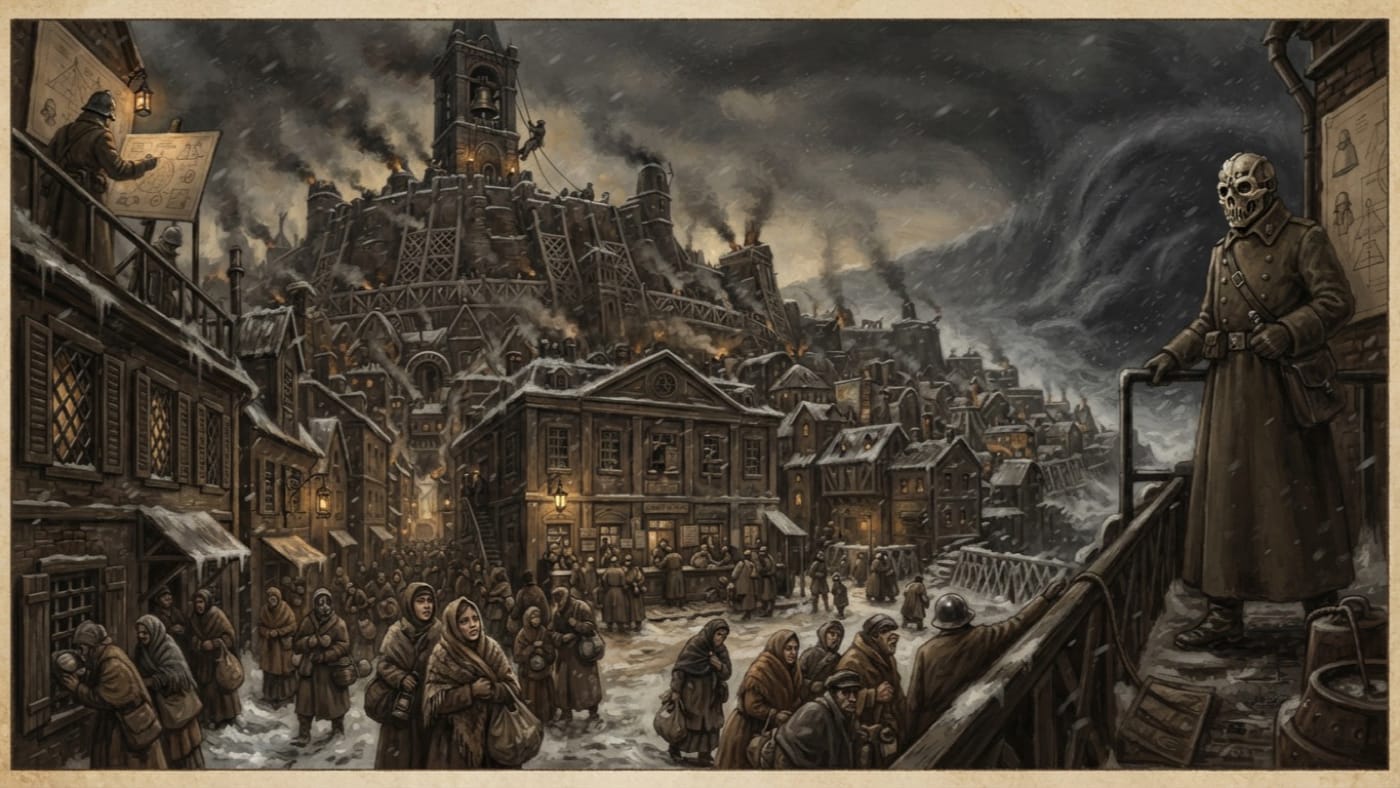
Lor is what the convoys call it, and the convoys have no time for the rest. The Bureau of War files it as Lor Stormworks. Engineering keeps it as Storm-Shelter Node 14-C. The Bureau of Records gives it the full title, The Bone-Lattice Warrens of Black-Snow Lor, and the street cuts that down to Black-Snow, which is a weather report rather than a name. All of these are one town. The longer survey of the Warrens of Black-Snow Lor holds its architecture and history at length. This entry is the municipal abstract. It is written for the reader who arrived from the Wardens, found Storm Wardens there reading black-snow charts, and wondered what kind of town would let them.
Lor sits on a windward ridge above a trench-fed ravine, on the Carpathian edge of the Sagittal Line in Zone 4. Around it lie ash flats and bonefields that erosion keeps returning to daylight. One rail spur and one supply road tie it to the Line's quartermasters. Drift buries the spur and closure shuts the road, often in the same week. The town exists to shelter convoys and to make what the Line chokes without: masks, shutters, lattice panes and storm crews trained to seal a room before the drift reaches it. Its work goes forward to Bastion-Przemyśl and to wherever else officers have learned to fear the air.
#On the Protected Town
The town is built of soot brick, rust-iron and bone-lime. Its lattice is rib and reed stiffened with marrow glue, and wax is pressed into every seam. Outer storm berms ring it. Inside them the Warrens sit low and dense, roof against roof, and the whole town hunches on its ridge with its back to the wind. The dedicated survey puts the population at about nine thousand six hundred, and the refugees keep raising the figure.
Seven districts divide the work. Filter Gate processes entry. Maskers' Row carves the masks, and the Latticeworks weave the shutters. The Breath Market distributes rations and sells what it claims to distribute. The Storm Pits take in the ash the berms catch and give back bones. The Warrens house the majority. The Ribwatch Towers watch the horizon and carry the bells. I have read two counts of the towers that disagree, so I give neither.
Filter Gate handles permits, de-ashing, breath-stamp checks and filter inspection. Getting through it puts a person inside Lor, and that is all it does. Shelter lies behind a second line, the Breath Cordon, which is a ring of safehouses, sealed passages, shutters and filtered vents. Its repairs are done by hand and its places are allocated by ledger. A stamp gets you into the town. A place behind the Cordon is a separate account, and newcomers usually learn this at second bell. No document I have opened gives a founding year for the gate, the Cordon or the present bell network. They grew up alongside the storms.
#On the Bell and Its Officers
On paper three bodies govern Lor: the Frontier Chapterhouse, the Line quartermaster office and the Storm Warden command. They share jurisdiction the way three dogs share a bone.
In practice every argument ends with Storm Warden Ilex Marr. The closure bells sound in three stages. The first warns. The second sends the town to prepare. Shutters come down, stalls are dragged under, families with permits make for shelter, and families without permits make for the families who have them. The third orders Filter Gate locked and the Cordon sealed. These are three stages of a single signal, and nothing in the records obliges me to believe in three instruments.
The third stroke seals nothing by itself. Gatekeepers throw the locks. Householders drop bars into brackets. Riggers keep the bell-lines knotted. The Bone-Guild keeps the wax sound, the lattice tight and the screens clean enough to pass air. A perfect closure rung over rotten wax shelters nobody. Marr gives the order, and the town's hands either carry it out or the town dies of their neglect.
The Storm Wardens wear bell pins and keep the forecasts, the tower relays and the closure diagrams. Marr wears a full-face bone mask that has never come off in public. The explanations offered for it run from piety to disfigurement, and the evidence supports none of them. The Bureau of Purity keeps a file on the mask. It has not yet asked for the mask.
#On the Price of Shelter
Breath Comptroller Juno Varr holds the ration accounts and, through the Breath Office, controls access to the Clean Room. More than one Bureau claims the Office and none acknowledges it fully, which suits the Office. Rib-Mother Sael holds the other half of survival. She controls the making and repair of every mask, shutter and seal, and she knows the vents better than she will ever put on paper. Marr ends the interval before closure. Varr sells it. Sael decides whether the room you bought it for will hold.
Breath stamps serve as identity papers. Filter cloth, lamp oil, shelter rights and storm-window tokens pass through legal allocation and through bribery at the same counters, sometimes in the same hand. The tokens are called clean minutes, and Lor's own records disagree on what one is. One reading makes it tradable time before closure. The other makes it guaranteed breathable shelter. The Office has kept both readings in use for years, and I suspect it has a reason. I enter the clean minute as an administrative claim on storm timing and protected air. Its worth depends on capacity, on the seals and on the bell. After the third stroke, the shutter does not honour the Office's promises.
Breath debt keeps the labour supply full. A debtor pays in berm shifts, filter laundry, ash-sled duty or surrendered names. The ledgers record that last practice and do not explain it. A debtor may also forfeit shelter rights and move down to the lower rooms, where the air is warm because too many people have breathed it already. Shelter Priority lets officials seize rooms for the common good. The Soot Kites move filters, people and news through the under-warrens for those the law has priced out. Distribution is equal on paper. In the Warrens, the rich breathe longer.
The Market says Varr sells the same air twice. No audit, confession or proven double entry has reached any Bureau, so the charge remains an accusation. Sael has threatened a Guild stoppage over cloth supply and non-Guild permits. It has not begun.
#On the Failed Forecasts
Lor's storms once came in what the Wardens call ledger-cycles, and the charts in the towers, in use for generations, predicted them. Since A.S. 199 / 1909 CE the storms have come off-cycle, and the charts failed three times between A.S. 199 and A.S. 201. Black snow falls in storms and sometimes from a clear sky, and it now clogs filters faster than it used to. A particulate-density assessment was filed in A.S. 200 / 1910 CE. Whatever number it carried did not survive reclassification. Marr requested filter cloth, lamp oil and bell-riggers. The Bureau of War approved the request in principle. Nothing has been delivered.
The Wardens entry says that Storm Wardens in Lor lie monthly because the charts began lying first. I wrote that line. "Monthly" describes their character, and anyone treating it as a reporting schedule has misread me.
Late in A.S. 199, an off-cycle storm arrived and Marr rang closure before the Breath Office had posted its warning. People were still outside the Cordon when it sealed. The Office protested. Marr replied on a single page that the Office's timing would have buried three hundred. That is a count of a crowd that never died, and no clerk can verify it. The amended judgment records both findings: the closure was procedurally excessive, and it was correct.
A Chapterhouse digest reported Breath Office memorandum 199-B as a finding against Marr's closure.
Corrected. Memorandum 199-B was a protest. After casualty review, the amended judgment holds the closure procedurally excessive and correct. The digest clerk has been introduced to the vents, which teach the difference between a complaint and a verdict faster than any seminary.
Lor remembers the opposite failure as the Nine-Bell Night, when the towers rang late and a district suffocated after it was sealed in. No record I trust gives it a date. The town has a name for a late bell. For an early one, it has a memorandum number.
Other accounts reach the Bureau and are filed as reports. Launderers say clogging spreads inward from the room side of the screen, in patterns like fingerprints. Vent-runners say the drift moves upwind. Some wearers say a mask worn too long begins to whisper. The vent spine runs through the bonefield vaults, and no survey has established how far they extend, who built them or what they hold. Doctrine treats the arrangement as a question of theology. Engineering treats it as a cloth requisition. Lor also fears a storm it has not yet met, the Thirteenth Drift, which no chart can predict and no token can price.