
#On the Office in the Lower Districts
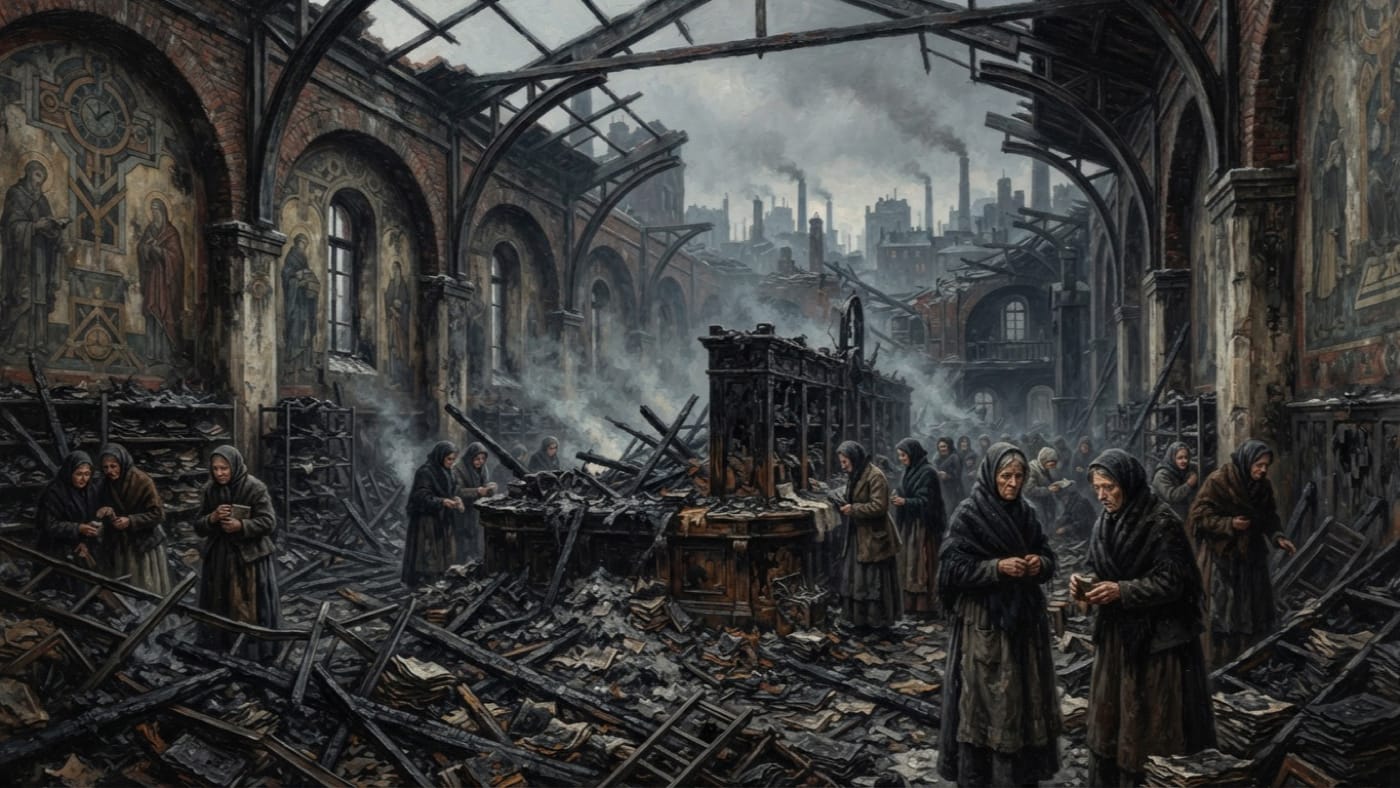
The Lower District Tithe Office stood in the lower districts of Bastion-Königsberg, the Baltic anchor of the Sagittal Line. It burned in A.S. 139, during the three days of the Widow Riot. Everything else in this entry hangs from that fire like seals hang from a writ.
The file delivered to my desk gives no founding year, no architect, no plan of rooms and no street. It does not name the clerk who held the keys. I have been asked to write a place article about a building whose most precise surviving measurement is its ash. Very well. The Bureau has built whole careers on less.
It was a collecting house of the Bureau of Tithes. Provincial readers who picture it as a lesser chapel of the Palatine Counting House should correct the picture. The Counting House in Strasbourg is the Bureau's seat, where silver is counted after it has stopped belonging to anyone. The lower-district office was the place where it stopped. Households came to its counter, or the counter came to them with escorts, and the small sums of the poor became entries the Synod could rely upon.
#On the Work of the Counter
The file does not inventory the office. The profession inventories itself, and every Tithe Assessor learns the same procedure, in the same order, with the same terror of skipping a step.
First comes the household roll, supplied upstream by Records: heads, status, marriages entered, births entered, deaths awaiting belief. From the roll the Assessor calculates the due, and the due is demanded in coin, salt, goods or labour tokens. Then comes the moment that justifies the whole apparatus. The Assessor issues either a sealed receipt, which proves payment, or an arrears mark, which proves its absence. The receipt is a household's only defence against being assessed twice. The arrears mark does more harm than any debt. It denies permits, schedules seizures and flags the name upward, and it follows a family through marriages and inheritances like a second surname.
The instruments are those of duework everywhere. Scales and measure rods sit beside the seal cords. Receipt blanks are counted aloud at the start of each shift, because a missing blank ends a career. Brine-testing stones allow an Assessor to pronounce a household's salt impure and its due unpaid, which is a miracle of sorts. Chalk serves the doors and ink serves the ledgers.
Such rooms smell of brine, old grain and wet wool. Their music is the scratch of quills, the clack of the scale pan, escort boots on stone, and the distant bells of Königsberg, which in a collecting district always sound like a sentence being read.
#On the Cessation of Pity
Two documents must be kept apart, though lazy students staple them together.
The first is the Brenn Memorandum of A.S. 138. In it Assessor-General Kaethus Brenn found that pity exemptions for widows, granted unevenly by district and by clerk, had swollen beyond what the northern ledgers could carry. He proposed a reduced universal bereavement due, small and mandatory, and receipted like any other.
The second is Directive 91-B of A.S. 139, issued under the title On the Cessation of Pity Exemptions. It revoked the old exemptions and made Widow's Pennies compulsory. A proposal is one man's arithmetic. A directive is the Bureau's will, and the office in the lower districts received the directive and was required to execute it.
Students ask why so reduced a sum should provoke anything. They ask because they have never stood at a counter. The exemption had been a paper declaring that a grieving household stood, for the present, outside the queue. The directive withdrew that paper. It put every widow back on the roll and back under assessment, receipt and, failing payment, the arrears mark. The amount was the least of it. The Brenn papers themselves rank the act of surrender above the coin. The name fixes no tariff, either. Widow's Pennies names a category, and the Bureau has never allowed a category to bind it to a coin.
Brenn's conscience is filed in his own dossier, crossed out where Doctrine found it inconvenient. Nothing places him at this counter, in this district, or in Königsberg at all in the year the office burned. His arithmetic travelled by courier. It did not require his company.
#On the Three Days
The poor answered the directive with what the poor possess: pots, stones, barricades and fire. For three days the lower districts rang with metal struck on metal, a bell no chapel had licensed.
The profession had always feared exactly this. Its own lore keeps the rare event that ends routes, and sometimes Assessors: a district refusing in unison, doors slamming, pots beginning, a crowd gathering with quiet purpose while the escort captain looks less certain than his wage requires. Assessors call the first warning a widow flare. In A.S. 139 the flare caught.
On this point my instructions and my temperament agree, for once. I will not decorate the fire. The Codex does not hold the hour the office caught or which of the three days it burned on. It names no hand that carried flame and gives no count of the injured or the dead. Ballad-makers have supplied all of these. Ballad-makers are not sworn to the Ledger. The record says the office burned and then stops, and so do I.
No demon is required to explain it, either. The Great Deceiver keeps busy along the Line, and there is always someone eager to credit him with a riot they would rather not have caused. This one needs no infernal author. The Bureau had already written the invitation and given it a number.
What can be said is what the fire meant administratively. A tithe office is where a district's obligations become legible. The rioters could not burn the directive, which existed in Strasbourg in more copies than anyone could count. They could reach the room where it would be applied to them, and they reached it.
#On the Four Hundred Years
The account in the Brenn dossier reports that four hundred years of collection records burned with the office. I repeat the figure because it was reported. I do not certify it. Nobody has shown me what those shelves held, who first filled them, or under what authority the oldest pages were written. A number does not become a provenance by being said loudly at a funeral.
The Bureau mourned the loss in public, as it had to. In the Bureau's theology an archive is a relic, and relics receive the full rite. In private, by the same account, the Bureau calculated what the fire had spared it: a great many old obligations erased at a stroke. I record that contrast for what it is, an institution weeping with one eye on the sum. I have found no order commanding the burning, and I will not manufacture one to make the Bureau look more competent than it was. Opportunism needs no plan. It needs only a clerk who notices.
Hold the next distinction firmly. The fire destroyed documents and repealed nothing. A burned receipt does not discharge a due. It only removes a household's proof that the due was paid. A burned arrears page does not forgive a debt. It only removes the Bureau's proof that the debt was owed. The flames took both parties' evidence in a single armful, and only one party had the authority to decide afterward what that evidence would have said. Whether every account vanished, or copies survived in other hands, is not known.
The records lost at the Lower District Tithe Office prove four hundred years of Synodal collection at Königsberg.
Withdrawn. The formal Synod was constituted at the Concordat of Strasbourg in A.S. 90, forty-nine years before the fire. Whatever the reported four centuries of paper contained, it cannot be four centuries of an institution that had existed for forty-nine. The origin of the older records is not established, and this entry declines to invent ancestors for them. The age of an archive is a claim about the archive. It gives no founding date for the office that housed it.
#On What the Fire Did Not Burn
The directive outlived the office meant to apply it. Widow's Pennies remained mandatory. The obligation the riot refused went on being assessed, receipted and marked in arrears, and the Assessors who walked those routes inherited the duty along with the smell of the smoke.
The profession keeps that memory in its manners. Escaping the Widow Route counts as a mark of status, and widow route breaks men is a common saying. Auditors begin with widow accounts, because that is where compassion and corruption share a column. Assessors who keep a mercy coin for one documented exception a week do so under Saint Ysolt of the Scales, whose official legend weighs tears against grain and whose unofficial memory invented the arrears mark. When each of these customs began is not established here. Their subject is.
Do not confuse this office with the Widow's Pennies Exchange at Griefgate, a pilgrim-road toll town with its own staff, geography and customs. Griefgate taxes grief along a road. The Lower District Tithe Office collected it at a counter in a Baltic district, until A.S. 139.
Enter the office as burned. Carry the widows forward.