
#On the Present File
This is a survey, made in A.S. 201 (1911 CE), of the surviving records that invoke the Maritime Spiritual Contamination Protocol. It is not the Protocol. That instrument has never crossed my desk entire. I hold no preamble, no issuing seal, no schedule of penalties and no year of first issue, and I will not cut a wax impression for a document I have not seen. The Strait has artisans for that kind of work. Most of them are in custody.
I have three places where clerks used the name and assumed the reader already knew what it contained. The first is a sealed telescope addendum from the southern tower of the Harbor of Chains. The second is a freight advisory from the Maritime Division of the Bureau of Purity. The third is the file of a condemned wax-handler before the Constantinople Maritime Tribunal. All three belong to the Bosphorus and to Bastion-Constantinople, the southern anchor of the Sagittal Line, where the wall runs out of earth and goes on as paperwork.
The records show four different things done under one name. A document was sealed. Freight was marked for burning. The men travelling with that freight were marked for detention. One particular man was sentenced. A reader who tries to fold these into a single doctrine of fire will get no help from the archive.
#On the Observation Kept
Every harbor child can recite the night of the Black Sea Armada, A.S. 162 (1872 CE). The Chain of Saint Anakletos burned white across the strait. Forty-seven hostile vessels entered the approach. Forty-three were destroyed, three retreated into fog and one is still unaccounted for. The engagement abstract is famous.
The addendum is not. A telescope operator on the southern tower watched the forty-third vessel hang in the glare before it broke apart, and he wrote down what he saw. All of the particulars come from his record and nowhere else: a figure aboard, writing; a hand jointed backwards; a last visible line that resembled harbor numerals. The values of those numerals had been struck out before any copy reached me. I reproduce the passage as the Bureau of Records keeps it.
Telescope operator's addendum, southern tower, A.S. 162: figure aboard forty-third vessel wrote on ███████ with a hand jointed backward; final visible line resembled harbor numerals for ███ / ███ / ███; operator reassigned; addendum sealed under Maritime Spiritual Contamination Protocol. The ink has not dried.
This is the earliest dated application in my survey. I make no claim that it was the earliest application. The year of the Armada dates an observation, and the Protocol's admirers keep mistaking it for a birthday.
Here the Protocol moved a man and locked away a page. The operator went to another post. The addendum went into custody, where it still sits, unburned and unannotated, read only by those with cause to read it. In this instance, sealing means custody of evidence. No freight was touched and no docket was opened. The writing figure was charged with nothing, which is a pity, because it would have made a memorable defendant.
The closing remark about the ink belongs to the file, and I leave it where the clerk left it. The unaccounted ship belongs to the engagement abstract and stays there too. I have watched younger theologians marry the two in a single footnote. I annulled the marriage myself.
#On Freight Without Its Papers
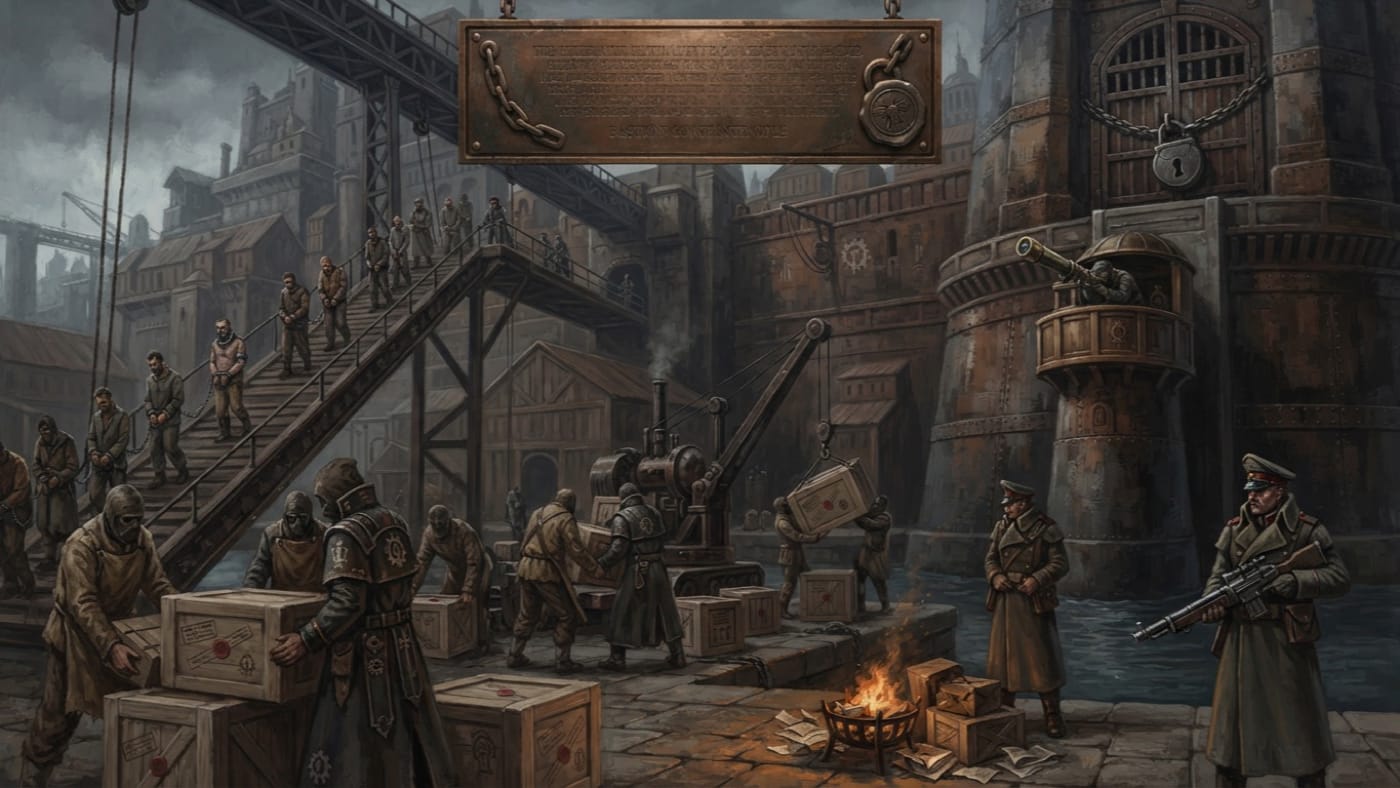
Purity's advisory is the only place where the Protocol's name stands beside a fire. Reliquary freight passing through the Bosphorus must carry three instruments together: a current seal of the Bureau of Relics, a counter-seal of the Bureau of Masks and Seals and a transit writ of the Bureau of Pilgrimage. Freight that lacks any part of the set is heretical cargo, Category Four, and is to be incinerated on the customs pier. Anyone travelling with it is to be detained under Maritime Spiritual Contamination Protocols.
Paper is what sets it off. A crate with two seals out of three burns whether it holds a saint's knuckle or straw. The men beside it are held whether they handled its contents or only its rope. Detention is custody. All it establishes about a detained man is that he was found standing beside the wrong wax, and the advisory claims nothing more about him.
The Church cares about wax because of demon glass. The Strait-Rats carry it inside legitimate relic freight. It sits in lead-lined icon boxes between the finger-bones, under seals copied so carefully that the only error is one missing ligature. A pier cannot open every crate during the bell overlaps, but it can read papers. The three-part seal is a wager that the forger will tire before the clerk does.
Purity also reports that compliance with the advisory has held at exactly forty-seven per cent for thirteen consecutive quarters. That figure is Purity's. It counts papers, and nothing in it measures contamination. A number that will not move for three years is either a miracle of commerce or a clerk with a favourite number. The Bureau of Doctrine has never been asked to certify miracles of commerce, and it would be sensible not to start.
Then there are the raids. The Salt-Scourge Detachment's quarterly sweeps of the waterfront are announced in advance by an informant service the smugglers call the Purity postal service. Decoy crates are surrendered on cue. The fire on the pier is real, and the accused pick what goes into it.
The advisory covers reliquary freight on the Bosphorus and nothing else. It burned no telescope page. Anyone who cites it as a general order to burn whatever the sea delivers has read a customs notice as scripture.
#On the Hands Returned to Labour
The file of Korin shows the stages the advisory leaves out. In A.S. 196 (1906 CE), a Salt-Scourge seizure on the lower customs pier of Bastion-Constantinople found a reliquary crate humming through its lead lining. Its manifest declared martyr finger-bones. Korin was a Seal-Mate, a man whose trade is altering wax that already exists. The tribunal examined him under caution. He described touching the glass as "being counted by something that has already decided how much I am worth." He was given two years on the rope-roads under a contamination clause, and his testimony was sealed.
The seizure was Purity's. The examination and the sentence were the tribunal's. The sealing came after. One file does not make the tribunal the author of the Protocol, or the court for every detained deckhand. The two years were Korin's alone. I have found no schedule that gives every Seal-Mate the same term, and I will not build one out of a single sentence.
The Korin charge sheet, as first entered, classes the accused as a Reliquary Surgeon.
Corrected by the tribunal's own amendment to Seal-Mate. The Surgeon cuts cavities inside the crate. The Seal-Mate commits his crime on its skin. The clerks needed a formal amendment to learn what every Dock-Shadow knows by his second crossing.
The clause attached to the sentence is the most instructive page in the file. It forbade Korin contact with a list of materials that included wax, reliquary crates and seal-cord. The rope-roads exist to carry the front's freight, including reliquary crates, all of it tied with cord. The Lore Book records that rope crews pack their ears with reliquary wax. The dossier shows a supervisor initialling the clause and then sending Korin out with a crate.
This reading is mine, and I give it as mine. The administration takes great care over where a dangerous man's words may travel and none at all over where his hands go. His testimony went into a cabinet. His hands went into the supply lines, because the supply lines needed hands. Nobody in the file pretends otherwise, and nobody in the file corrects it. The rope-roads have never in their lives read a court order.
#On Permitted Use
The tribunal dossier's doctrinal holding of A.S. 201 governs the sealed testimony, and it is exact. Korin's words may be taught in seal-fraud instruction, in demon-glass handling doctrine and in Maritime Tribunal training. They may not become a dockside proverb, a Polisher's advertisement or a new line in the prayers of Harrowglass. These permissions cover Korin's testimony and nothing else. The telescope addendum has no published equivalent, and I will not lend it one.
The survey can establish a short list. The Protocol's name was invoked to seal an observation from the southern tower. Purity invoked it to detain men travelling with reliquary freight that lacked its papers. The tribunal's clause uses the word contamination, but the transcript does not say whether the clause was drafted under the Protocol by name. Every invocation I have found sits on the Bosphorus.
It cannot establish the first issue, the issuing authority, a general schedule of penalties, the conditions for release from detention, the identity of the writing figure, the values behind the struck numerals or Korin's final civil status. In Records, a release mark sits beside a line that was never filled in. It is still empty.