
#On the Strait and Its Parasites
"Contraband does not exist unless confiscated. Until then, it is loyalty-in-waiting." — Bureau Resolution 44-K, A.S. 134
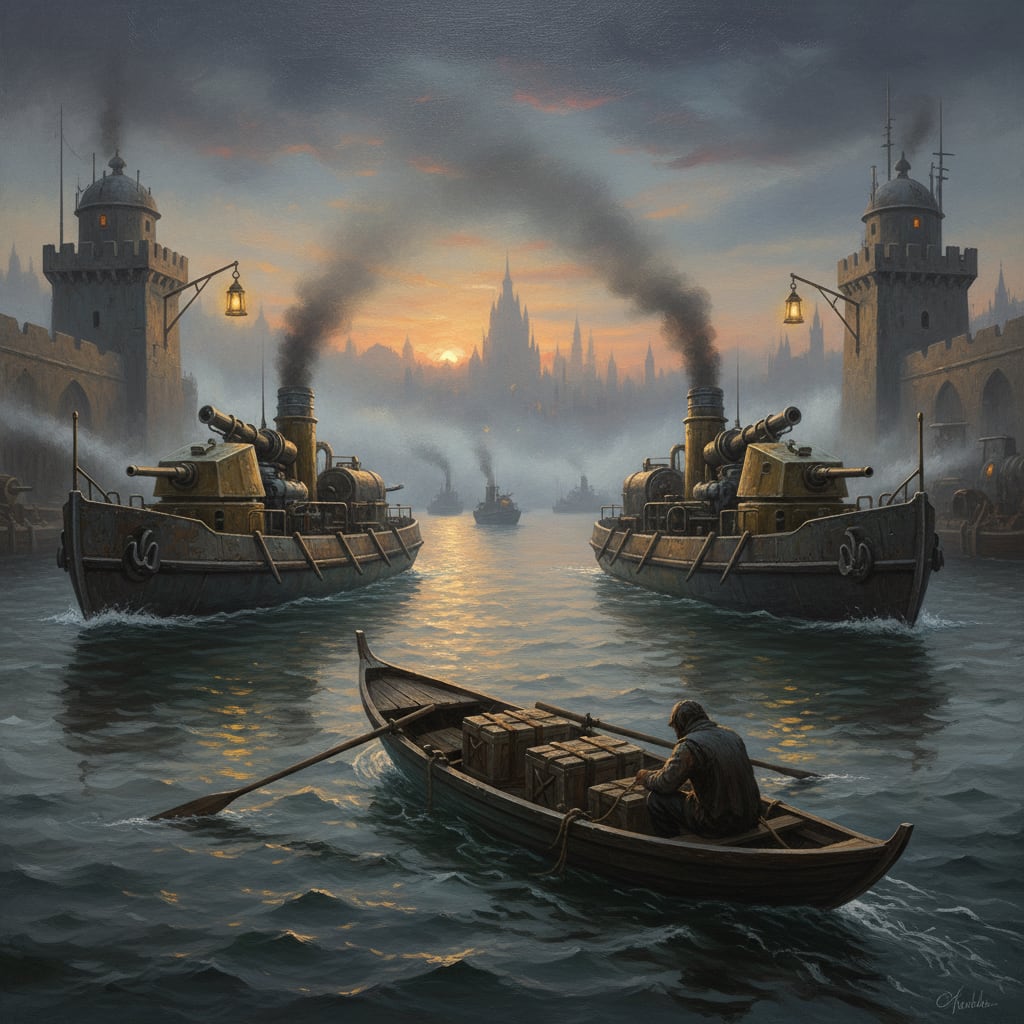
The Bosphorus is a throat. Ships enter it as they enter any throat — sideways, compressed, half-choking — and emerge changed, or do not emerge at all. The Harbor of Chains glows at one end, the Thracian marshes stink at the other, and between them runs a channel barely wide enough for two galleons abreast, patrolled by the Bureau of War's coastal launches and lit by lanterns whose arcs the patrol captains believe are unpredictable and the smugglers have mapped to the minute.
The Bosporus Smuggler-Sailor is not a profession. The Bureau insists upon this with the particular vehemence it reserves for things that are both widespread and embarrassing. No entry in the Bureau of Records' Occupational Register lists "Strait-Rat," "Glassboat," or "Bone-Runner." No tax bracket accommodates the income. No devotional prayer has been approved for the work, though several have been confiscated from sailors' quarters — illiterate, misspelled, sincere, and addressed to a folk-saint called Harrowglass of True Reflections whom the Bureau of Doctrine classifies as "fictional, persistent, and theologically inadmissible."
They exist because the Synod's war economy requires them to exist. The Strait moves reliquary freight — crates of saint-bones, authenticated finger-joints, sealed caskets of martyrs' ash — from the Anatolian coast and the Black Sea Reliquary Flotilla to the docks of Constantinople, where the Bureau of Tithes weighs them, the Bureau of Relics stamps them, and the Bureau of Records files them into an accounting system so vast that a crate could circle the harbor three times before its paperwork caught up. In the space between the crate and its paperwork, fortunes are made.
#On the Cargo That Prays
The legal trade is relic freight. The illegal trade is everything the legal trade carries inside itself.
Demon glass arrives at the Strait from the Wound-sites of the Thracian front, from the slag-pits beyond Maldrake's domain, from scavengers who crawl the cooling fields after engagements and prise shards from the craters with tongs wrapped in psalter-cloth. The glass is warm. It hums at frequencies the Bureau of Bells has measured and declined to classify. It shows things when polished — the Lore Book's Mirror Riot of Varna, A.S. 151, provides the canonical example: sailors sold shards in the harbor, Purity smashed a crate, the shards reflected the crowd as skeletons moving independently of their owners, and hundreds drowned in the subsequent stampede. The Bureau classified the incident as "mass hysteria aggravated by heretical optics" and executed the surviving sailors.
The glass is worth a season's rations per shard. The glass does not stop being worth a season's rations because the Bureau declares it heretical. Heresy and commerce have always been two branches of the same river, and the Strait is where they merge.
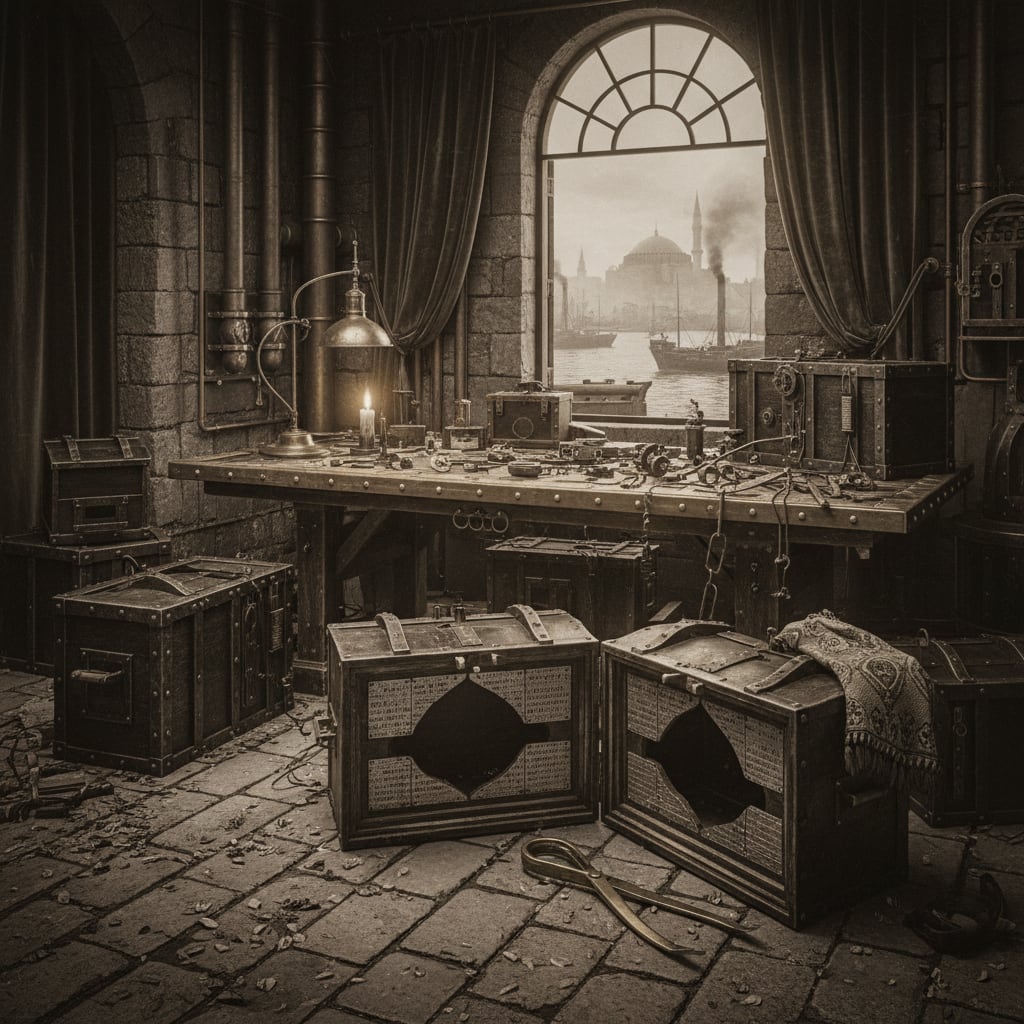
The method is ancient by now. A Dock-Shadow — the lowest rung, a rope-handler and bilge-dweller scarcely older than a conscription candidate — loads the legitimate crates aboard a ferry at the Anatolian staging point. Somewhere between the loading and the casting-off, a Seal-Mate swaps the wax impressions on specific crates, replacing Bureau seals with copies so careful that the difference is visible only to a man who knows which prayer-line has been misspelled by one letter. Inside those crates, between the saint-bones and the martyrs' ash, demon glass sits in double-walled icon boxes lined with lead prayer-plates that muffle the hum.
The crossing happens during the bell overlaps — those moments when the bell-schedule puts two or three peals in simultaneous clamour, drowning the oar-stroke and the engine-hum under sacred bronze. "Ride the bell-wake," the Strait-Rats say. Ride the wake and nothing hears you but the Creator, and the Creator, they assume, has other concerns.
At Constantinople's docks, the crates pass to a pilgrim-broker — the downstream figure who sells "possible salvations" to soldiers, to the desperate, to the rich-in-faith-poor-in-hope who believe a demon-glass shard held to the eye-piece of an iron mask will reveal truth the Bureau conceals. What the shards actually reveal is a matter the Bureau of Doctrine has investigated seven times and classified under seven different headings, none of which agree.
#On the Economy of Tolerated Sin
The Bureau's posture toward the Strait smugglers is the posture of a confessor who knows the penitent will sin again before Vespers and has already prepared the penance. Suppression is theatre. Confiscation is revenue. The cycle is institutional.
Every quarter, the Bureau of Purity's Salt-Scourge Detachment conducts raids along the Constantinople waterfront. These raids are announced — not officially, but through a chain of informants so reliable that the smugglers call them "the Purity postal service." The raids seize enough contraband to justify the Detachment's budget. The smugglers sacrifice enough decoy crates to justify the raids. The genuine shipments — the ones carrying glass worth actual fortunes, embedded in the most sacred reliquary freight by the most skilled Reliquary Surgeons — pass through during the raids themselves, because every Purity inspector is occupied counting the decoys and filing the paperwork that demonstrates the Bureau's omniscience.
ERRATUM — BUREAU OF PURITY, MARITIME DIVISION The phrase "tolerated sin" does not appear in any Bureau document. The Bureau does not tolerate sin. The Bureau classifies sin, catalogues sin, quantifies sin, and confiscates sin. Toleration is a theological failure. Classification is an administrative achievement. The distinction is material, spiritual, and — the Bureau notes — budgetary.
The Thessaloniki model clarifies the arrangement. In the Harbor-Chain Towers, the Drowned Row Syndic runs the under-quay tunnels — a labyrinth of submerged hatches, chalk-marked passages, and night-pilotage corridors through which demon-glass masks travel from Glassman Dimo's kilns to the coastal regiments. Pilot-King Nenos, one-eyed and navigating by the chain-hum alone, guides the skiffs. Ledger-Ghost Tamsin — a clerk who exists in no official record and therefore processes documents that officially do not exist for persons who have officially never arrived — handles the paperwork. The Bureau of Shadows is aware of the entire operation. The Bureau of Shadows has not acted. The Bureau of Shadows understands, as all functional institutions understand, that a supply chain you can monitor is preferable to one you cannot.
The same logic governs the Reliquary Flotilla's Underkeel Lanes, where the Grey Keel Syndicate moves people and papers without confession receipts, berth tokens, or the faintest pretence of legality. It governs the Macedon passes above Constantinople, where the "Merchant Problem" — corrupted caravans carrying Velkara's operatives alongside stamped manifests — has persisted for forty years because closing the passes would sever a supply route the garrison requires. Necessity is the argument that always wins, and necessity in this case wears a smuggler's salt-burned cuffs.
#On the Men Who Ride the Bell-Wake
They are not romantics. The literature — such literature as exists, confiscated from chandlers' shops and dockhands' bunks by Purity's quarterly inspectors — paints them as picaresque adventurers, salt-burnt rogues with hearts of contraband gold. The reality is thinner. They are indebted men, mostly, pressed into the trade by the same ration arithmetic that presses men into everything in the Synod's domain: a family's shortfall becomes a father's reason to run one crate "raw" — unsealed, unstamped, undeniable if caught. The first crossing pays the shortfall. The second crossing pays the bribe that ensures the first crossing goes unrecorded. The third crossing pays the debt accrued from the bribe. By the fourth crossing, the debt has compounded past any hope of legitimate settlement, and the Strait-Rat is a Strait-Rat for life, or until the Strait collects him.
The hierarchy is functional, stripped of ceremony. A Dock-Shadow handles rope and ballast and learns to count beads — the approved pilgrim beads that pass checkpoint inspection, which must tally before and after every crossing or the discrepancy becomes evidence. A Seal-Mate learns wax — the temperatures, the prayer-line impressions, the specific misspelling of the Third Psalm of Contrition that distinguishes a Bureau seal from a Strait-forged copy. The difference is the shin in the fourth line, which the Bureau spells with a ligature and the forgers spell without. This has been true since A.S. 163 and will remain true until the Bureau changes the seal, which it has not done, because changing the seal would require admitting the forgeries exist.
A Strait Pilot owns a route — a specific crossing-time, a specific bell-overlap, a specific arrangement with a specific patrol captain whose lantern swings wide at a specific minute. Route ownership is the smuggler's capital. It cannot be deposited, insured, or bequeathed; it dies with the Pilot or is seized by the next Pilot strong enough to claim it. Three Pilots control the inner strait. Seven control the outer approaches. Their names rotate with the seasons and the purges.
The Reliquary Surgeon is the artisan — the man who builds the hiding cavities inside reliquary crates, who repairs opened crates so seamlessly that a Bureau inspector running his fingers along the seams will feel only saint-blessed wood and consecrated nails. A good Surgeon can conceal forty shards in a crate designed for twelve finger-bones. A great Surgeon can rebuild a crate after a Purity raid and have it pass inspection the following morning. There are, at any given time, perhaps four great Surgeons working the Strait. Their names are not recorded. Their work is.
#On the Glass and What It Wants
The smugglers fear the glass. This is the detail the Bureau's operational assessments omit and the detail that matters most.
A demon-glass shard is not inert cargo. It hums. It warms. It whispers — the Strait-Rats use the word without embarrassment — in registers the ear refuses to process but the body absorbs through the ribs and the wrists and the base of the skull. A Seal-Mate named Korin, interviewed under caution at the Constantinople Maritime Tribunal in A.S. 196, described the sensation as "being counted by something that has already decided how much I am worth." He was sentenced to the rope-roads for two years. His testimony was sealed. His description, I regret to note, was more theologically precise than any the Bureau of Doctrine has produced on the subject.
The glass shows things. Every Strait-Rat knows this. Every Strait-Rat has a story — the Dock-Shadow who unwrapped a shard by lantern-light and saw his own bones walking without him, the Seal-Mate whose wax-stamp melted when it touched a crate that hummed too loudly, the Pilot who steered toward a route no chart recorded and never returned. The Mirror Riot of Varna taught the profession its cardinal rule: never look into an unwrapped shard at sea. "It shows you a route you can't unlearn," the old Pilots say, and what they mean is that the glass offers something — a destination, a revelation, a transaction — and the offer is always, always accepted by those who look too long.
The Strait-Rats call their cargo "stained windows" in the code-tongue of the docks — a term that manages to be both euphemism and confession. They call bribes "candles." They call forgeries "psalms." They call Purity patrols "the choir." The language is liturgical because the work is liturgical, an inverted sacrament conducted in bilge-water and brine, and the men who perform it are, in their own understanding, performing a function the Synod requires and the Synod condemns, which makes them — in the precise theological vocabulary of the faith they serve and betray — martyrs of necessity.
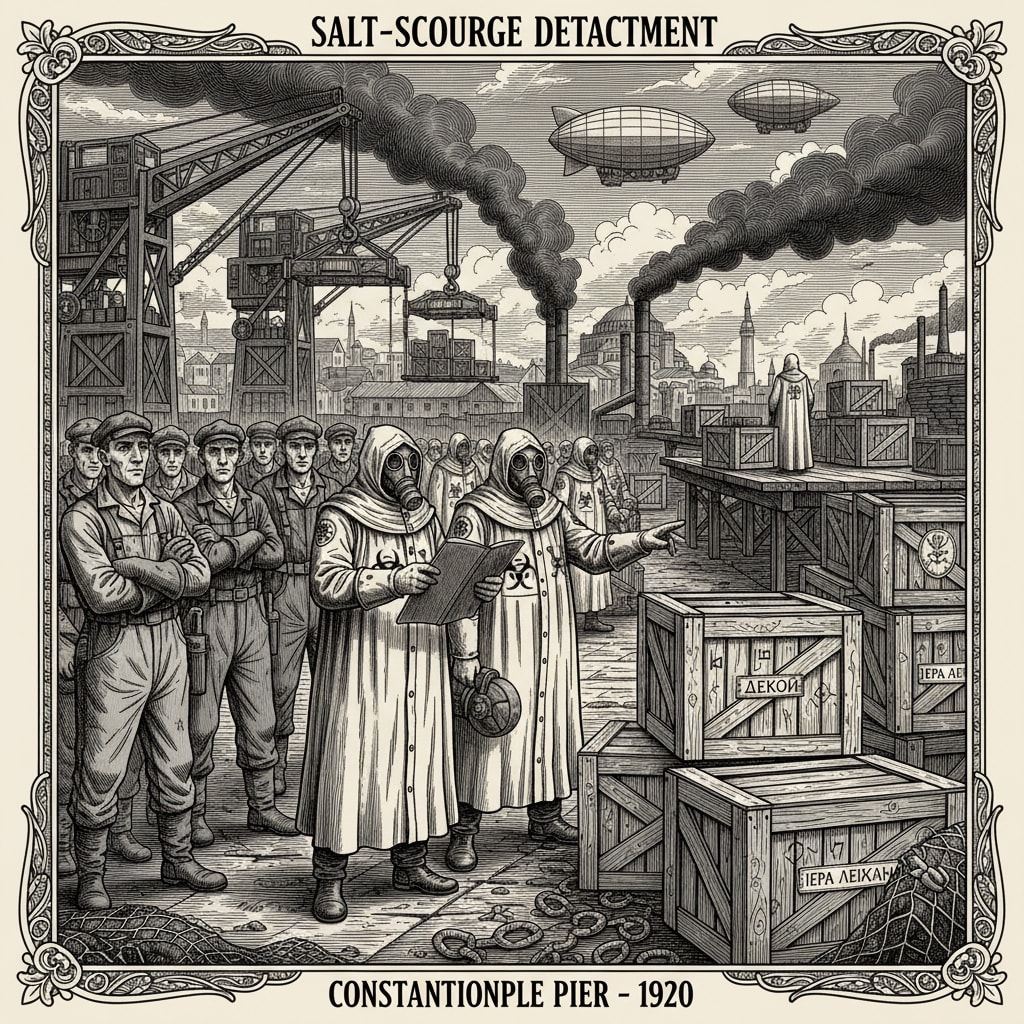
The Bureau does not agree. The Bureau classifies them as "Children of the Abyss" when it classifies them at all, and burns their vessels in public spectacle so that fire and smoke may serve as sermons against greed. The spectacles are well-attended. The crossings continue.
ERRATUM — BUREAU OF PURITY, MARITIME DIVISION Previous reporting estimated the Bosporus smuggling trade at approximately 300 crossings per annum. This figure has been revised to "an operationally manageable volume" following the discovery that quantifying the trade required acknowledging its scale, which is incompatible with the Bureau's position that the trade does not exist.
#On the Present Condition
The Strait is narrower than it was. This is not metaphor — the Bureau of Engineering's survey of A.S. 199 recorded a measurable contraction of the channel at its narrowest point, attributable to silting, to subsidence, or to something the survey team declined to specify in their report and specified only in the margin of the draft, which I obtained through channels the Bureau of Shadows would find familiar. The contraction is four metres. Four metres in a channel that was already a gauntlet. The patrols run closer. The bell-overlaps shorten. The Strait-Rats compress their crossings into windows measured in heartbeats rather than minutes.
And the glass arrives faster than it can be moved. The Thracian front burns hotter since Maldrake's push of A.S. 198. The Wound-sites produce more shards. The scavengers crawl the fields in greater numbers. The demand from the regiments — soldiers who want to see, who believe a shard held to the eye-piece of an iron mask will reveal the truth of what charges toward them through the fog — has tripled in five years. The Maskwright Lanes cannot produce fast enough. The Strait cannot carry fast enough. The Bureau cannot confiscate fast enough.
The smugglers pray to Harrowglass and ride the bell-wake and count their beads and check their seals and cross the narrowing throat of the Bosphorus with crates that hum and cargo that whispers and the absolute, unshakeable certainty that the next crossing may be the one where the glass decides it has been patient long enough.
The Bureau watches. The Bureau counts. The Bureau files.
The Strait, as ever, swallows what the Bureau cannot stamp.