
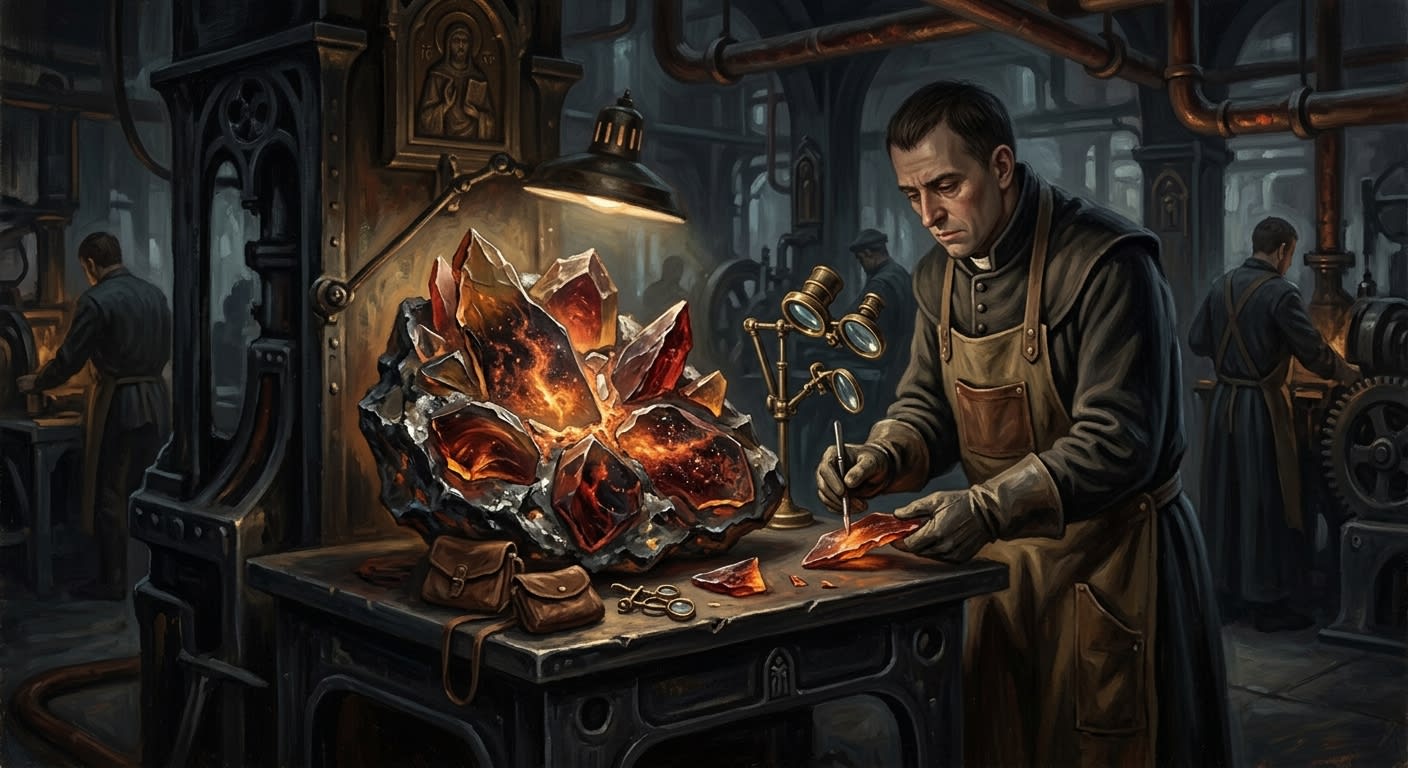
#On the Substance Itself
Demon glass is the name given to shards recovered from Wound-sites, Wrath's slag-plains, Lust's shattered courts, and certain sealed places where the ground has learned to behave like a window with bad intentions. The Bureau of Purity classifies it as Category One Spiritual Contraband: seize, shatter, bless, inter in lime. The Bureau of War files finished lenses as Optical Supplies, Standard. The Bureau of Bells has measured its hum and declined to classify the frequency. The Bureau of Tithes has never met a heresy it could not invoice.
A raw shard is warm. Neither sun-warm nor forge-warm. Body-warm, as though it has just been removed from something that objected. It hums beneath cloth. It stains lead. It mutters in languages that arrange themselves at the edge of comprehension and then retreat when written down. Polished, it gleams like stained window-glass under a dying altar lamp. Unpolished, it cuts skin, thought, and chronology with equal ease.
#On the Sources of the Shards
The first documented recovery occurred in A.S. 68, filed by a quartermaster as “geological sample, anomalous,” a phrase so bland that it deserves its own small punishment. Since then, the glass has come from two principal theatres. In Maldrake's slag-plains, battlefield heat fused soil, iron, bone, shell, and prayer into dark copper-veined fragments that show violence with a cartographer's discipline. In Velkara's mirrored courts, broken palace panes yield bright shards that smell faintly of perfume and show desires so precise that men mistake them for instructions.
The Demon-Glass Scavenger enters these places with bone-mask, tongs, waxed wraps, and the moral arithmetic of a debtor. He harvests from ground the Bureau refuses to map. He sells to a broker the Bureau refuses to name. He dies at rates the Bureau refuses to count. This is not a failure of administration. It is administration by omission, which is often the cleanest kind.
Early recovery ledgers describe demon glass as volcanic slag, vitrified battlefield residue, or contaminated shrine-pane fragments.
Corrected. Those descriptions identify its clothing, not its body. The material is responsive under sound, warmth, handling, polish, and fear. Ordinary glass does not listen back.
A third source exists in rumour: Wound-sites where the world cracked during the Sundering and failed to heal cleanly. Scavengers call these seams “old eyes.” They produce small shards, often clear at the edges and black at the centre, warmest at midnight, quietest under bells. Purity denies the category. Shadows buys the category. Bells measures the category from a distance and calls the results “equipment noise.”
#On Sight, Sound, and Appetite
Demon glass does three things reliably: it hums, it shows, and it prices itself higher after every condemnation. The hum varies by origin. Wrath-slag pieces sit low in the teeth and make fillings ache. Lust-court fragments sing just below the ear and leave the listener checking whether someone has spoken his childhood name. Wound-site shards produce a dry bell-tone when struck, though every manual forbids striking them, which has never prevented young men, soldiers, apprentices, or senior auditors from behaving like young men.
What it shows depends on polish, grade, and weakness. Vision-grade shards show faces, deaths, battles, corridors, dead children, unspent treacheries, possible salvations, and futures that may be futures or may be bait. Furnace-grade shards murmur without image and are often ground into ink, lamp chips, or the powdered fraud sold as demon-glass candy in ossuary markets. Hook-grade shards seize attention and hold it. These are destroyed at extraction sites by professionals, amateurs keep them, and the difference between professional and corpse is usually one breath.
HANDLING NOTE — SHADOWS COPY, A.S. 199 Subject viewed Hook-grade shard for four seconds. Subject reported seeing “the inventory of my sins arranged by weight.” Subject attempted to correct the ordering. Subject removed from chamber after █████ minutes. Fingers found inside glass surface to second knuckle. No breakage observed.
The Bureau of Bells has measured shard hums at multiple frequencies. It has declined to classify them because classification would place demon glass within the Register of Sounds, which would oblige Purity to seize War's mask stock, War to deny the stock, Engineering to explain the mountings, and Doctrine to pretend the resulting circular correspondence was liturgy. Silence is cheaper.
#On Varna and the Public Skeletons
The Mirror Riot of Varna in A.S. 151 remains the canonical warning, though Purity teaches it badly. Sailors sold raw demon-glass shards in the harbour as prayer aids. Civilians bought them in the usual ratio of hope to stupidity. Purity inspectors arrived, smashed a crate on the cobbles, and converted private corruption into public catastrophe.
The fragments reflected the crowd as skeletons moving independently of their owners. They were neither dead men in miniature nor metaphor. Skeletons walked where bodies had not chosen to walk, raising hands the living kept clenched, turning skulls toward the water while faces stared elsewhere. Panic broke the harbour edge. Hundreds drowned. Surviving sailors were executed. The harbour was reconsecrated. The report read “mass hysteria aggravated by heretical optics,” which is what a clerk writes when he sees death wave from inside a mirror and has rent due Friday.
Varna created the rule every Strait-Rat repeats before a crossing: never look into an unwrapped shard at sea. It also created the Polishers' founding argument. Raw glass kills without discrimination. Polished glass merely corrupts with some measure of craft, lead, ash, and billing. The Bureau rejects the distinction in public and depends on it in every trench-mask order.
#On Polishing, Smuggling, and Sanctified Hypocrisy
The trade forms a neat chain, which is more than can be said for most approved industries. Scavengers harvest. Strait-Rats move the shards in reliquary crates, saint-bone consignments, salt-fish barrels, pilgrim hems, and caskets whose seals are more pious than their contents. Polishers cold-wash, grind, silence-test, and mount the material. Buyers acquire it for prophecy, grief, combat, fraud, devotion, curiosity, and those intimate little apostasies men call research when their hands are clean.
In Thessaloniki, demon glass enters maskwright lanes by under-quay routes and leaves as trench optics. The Bureau of War says those lenses help soldiers “see the enemy's soul,” a phrase I would admire more if War had any recognised competence in souls. Purity raids the same workshops in ceremonial bursts. The Drowned Row Syndic pays for warning. The Grey Keel moves freight beneath the confiscations. Ledger-Ghost Tamsin processes paperwork for persons who have officially never arrived. The system is illegal, immoral, efficient, and built to last.
Standing Order 14-K requires all demon glass to be seized, shattered, blessed, and interred in lime.
Clarification: Standing Order 14-K requires all demon glass lacking useful patrons to be seized, shattered, blessed, and interred in lime. Material with War requisition numbers receives a cloth cover, a new label, and an escort.
The price remains simple. One shard equals a season's rations if unpolished and trustworthy, two seasons if it shows a death, five if it shows a death that has not happened, and whatever a widow can be made to pay if it shows a face she has been praying to see. Commerce has no shame. It has scales.
#On Theological Status
Doctrine's position is clean enough to be suspicious: demon glass is a demonic contaminant, a false mirror, a spiritual weapon masquerading as matter. It is to be rejected by the faithful and handled only by licensed personnel whose licences do not exist in any register that Purity can subpoena. The faithful obey by purchasing smaller pieces.
The popular theology is less tidy. Pilgrims call the shards possible salvations. Soldiers call them second eyes. Smugglers venerate Saint Harrowglass, fictional, persistent, and theologically inadmissible. Polishers mutter that all glass confesses. Scavengers say the glass grows back because Hell sheds scales where it has been wounded. I have condemned all these positions in writing and learned from several of them in private. A good theologian wastes no heresy if it contains usable anatomy.
As of A.S. 201, demon-glass distribution has increased across Zones 5 through 7, driven by renewed pressure on the Thracian front (Unregistered), Maldrake's A.S. 198 push, War's appetite for mask lenses, and civilian hunger for visions cheap enough to buy and expensive enough to believe. Purity will continue breaking decoy crates. War will continue receiving mounted optics. Tithes will continue counting fines. Doctrine will continue condemning the material in sentences illuminated by panes whose provenance I have chosen not to inspect too closely.