
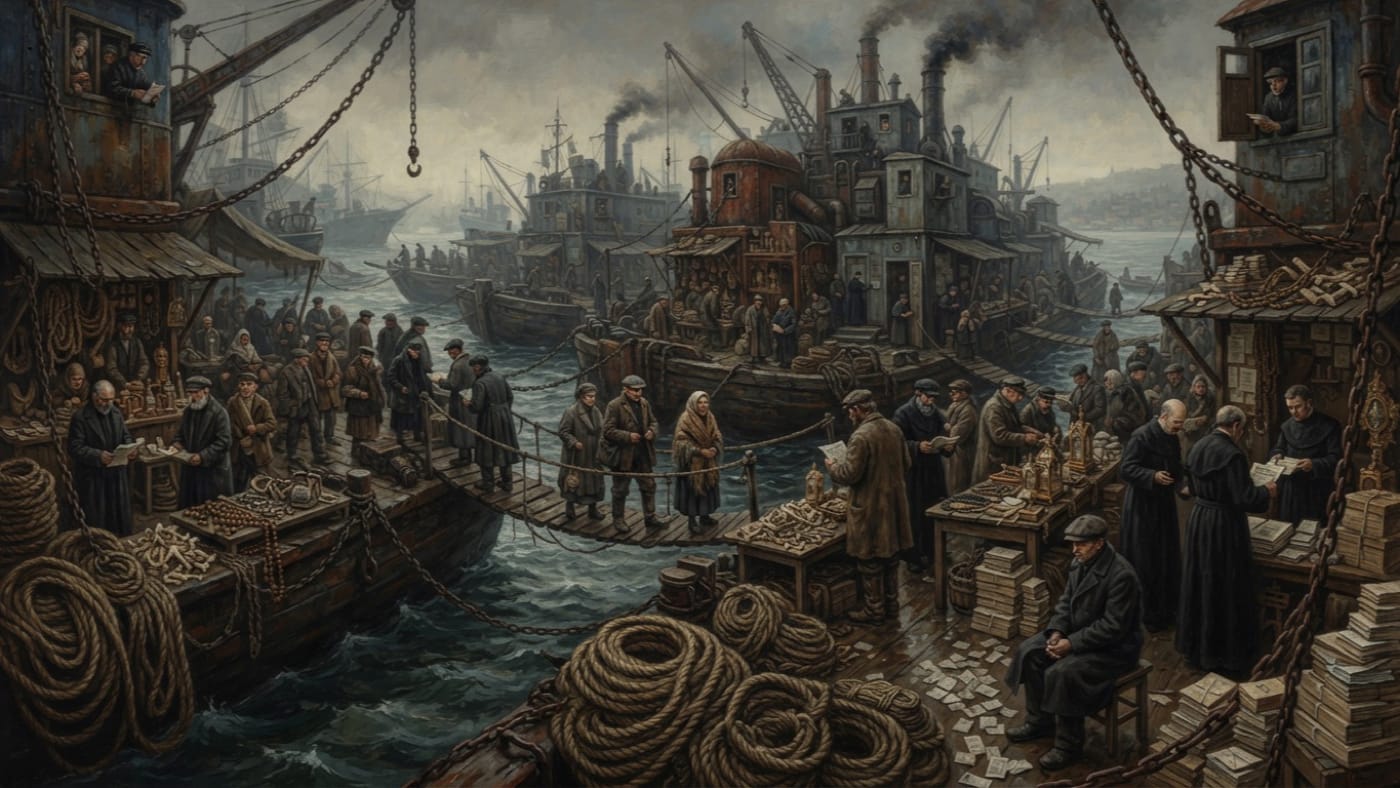
#On a Market That Will Not Hold Still
This survey, entered for the Codex in A.S. 201, records the Market of Anchors as it trades at present: its goods, its brokers, and the frauds it keeps as patiently as a confessor keeps a recurring sin. It does not record the market's founding, its first licence, or the hand that lashed its first stall. No document in my possession records them either, and I do not invent ledgers. I merely correct them.
The market is a trade bazaar of the Black Sea Reliquary Flotilla, which the street calls Saints Afloat: chapel-barges and platforms chained into one drifting reliquary somewhere in the Black Sea and Bosphorus approaches. Constantinople is the nearest great name a sailor will give you when he wants to sound oriented. The market has no shore. It has timber, wet and complaining underfoot, and rope bridges that sag between decks. It has chain that bleeds rust on everything it touches, and a smell made of fish oil, spice and that same rust, which a visitor stops noticing after an hour and cannot wash from his cuffs after a week.
Business is done at midday, alongside the tribunal sessions and the confession queues. The currencies are coin, stamped paper, salt chits, berth tokens and prayer beads. The beads buy fresh water when coin will not. Pickpockets work the crowd with an indifference to jurisdiction I would call ecumenical if I were feeling generous. I am not.
When a storm snaps the lashings and the Flotilla re-parishes, a stall may wake in a different jurisdiction from the one it closed in, owing tithes to new clerks and confessions to new booths. The market does not move so much as it is reassigned. The merchants are used to this. They keep their prices and change their prayers.
#On Beads That Are Bones and Bones That Are Beads
The Market of Anchors sells relic fragments as prayer beads and prayer beads as relic fragments. Both directions of the trade are attested. Both are profitable. The difference between them is a matter of paper.
The arithmetic runs thus. A relic fragment declared a relic is a sacred object under the Bureau of Relics, which controls recognition and custody of the holy remains and requires any shrine that wishes to display one to apply first for an Authenticity Writ. Such an object must be registered, witnessed, sealed and taxed. Drill the same fragment, string it and sell it as a bead, and it becomes a devotional trinket. Devotional trinkets pass the chain gate with much less conversation. That is the first fraud: holiness smuggled in the costume of piety.
The second fraud runs the other way. Take a bead of bone-lime, say, or plain wood, and give it a story, a wax impression and a certificate in a competent hand. It becomes a fragment of some saint, and its price rises to match. The buyer believes he has bought a relic. What he has bought is a provenance, and the provenance is the expensive part.
The Bureau's Authenticators understand this better than anyone. Their own instruments are the provenance record, the certificate, the seal press and the custody ledger. Their own saying, seal the object; seal the story, admits in six words what the market practises in public. A certificate establishes that someone with access to wax was persuaded. It does not establish what lies beneath the wax. The Bureau maintains, in its most quoted formula, that a relic authenticated is a relic made holy. The market agrees with enthusiasm and supplies the authentication.
For the record: no permanent office of the Bureau of Relics is attested in the market, no resident examiner, and no particular forgers' workshop. The certificates arrive from somewhere. The Codex declines to guess where, a courtesy the certificates do not extend to their buyers.
#On the Men Who Sit Beside the Rope
Among the stalls of salt chits and old rope sit the brokers of the Grey Keel Syndicate. They do not advertise. They keep no awning, raise no cry, hang no painted board. A pilgrim can buy a coil of frayed hawser from the man beside one and leave the Flotilla unaware that he stood within an arm's length of a second maritime government.
The seating is well chosen. Salt chits are small change and rope is cheap goods. Nobody lingers over either, and nobody remembers the man who did. A broker beside a relic stall would catch the eye of every inspector hunting a provenance scandal. A broker beside a rope seller catches flies.
The procedure, as the Codex has already recorded it, has a liturgical shape. A customer states his need sideways, as an insult, a fish price, or a line of hymn cut short after the fourth syllable. These are the attested forms. They are not a password list, and I will not print one. I do not possess one, and any I printed would be changed before the ink dried. The broker answers with a tide-name. If the tide-name is wrong, the customer leaves. If it is right, the customer also leaves, and someone follows him beneath the Saintward steps.
The Codex does not record what happens there. The follower is unnamed and the later stages are undisclosed. I have formed opinions. Opinions are not evidence, however handsomely they are expressed.
The Syndicate's working ground lies elsewhere, in the Underkeel Lanes: skiff alleys beneath the platforms, reached through submerged hatches and marked in chalk that salt ought to erase. The Lanes are a separate district, and the market is no tunnel. It is the counter where the Lanes take orders.
Grey Keel influence is confined to the Flotilla's Underkeel Lanes.
Correction, already entered in the Codex tract on the Syndicate and here extended to particulars. Grey Keel brokers keep seats in the Market of Anchors, in daylight, at deck level, beside the rope. Confinement was a statement made under oath, and the oath has since dried out.
#On Papers, Parishes and the Price of Going Below
The customers who approach the rope sellers with an insult ready are rarely looking for rope. The Flotilla runs on documents. Parish papers identify a soul, berth tokens locate a body, and confession receipts double as travel tokens. A man without them is Cut-Loose, and the Cut-Loose do not cross the Flotilla by bridge and booth. Chainwardens check papers at the visible crossings. The Bureau of Tithes, like every lesser office with a cashbox, takes its fee at each.
Grey Keel sells the other way across. Its attested services are forged passage, movement by skiff beneath the platforms, the removal of a name from a list, and an inspection downgraded before it can do harm. Storm reparishing sharpens the demand. When the districts realign, a man may find his debts reassigned to a new court and his papers belonging to a parish that no longer lies where his berth does. Official maps lag behind the water, and in that gap the market's quietest seats fill.
The Bureau of Shadows is reported to watch such routes as it can. The published account of the Syndicate lists surveillance, selective seizure and public denunciation as the permitted response. By that same account, one proposal for full suppression would have required, among its many labours, the questioning of the Market of Anchors. It remains a proposal. I add only that questioning a market is a great deal of work, and the Bureau prefers its work to arrive pre-stamped.
#On Three Purchases, Two of Them Reported
I bought three items in the Market of Anchors on my last inspection tour. I enter them here as my own report, which the reader may weigh against my reputation and find heavy.
One was genuine. One was fraudulent. I will not say which stall sold which, what either object was, or how I judged them. A Warden of the Sacred Ledger does not publish his methods for men who might acquire them.
The third began humming in my cabin at two bells.
I carried it to the rail without troubling the Bureau of Relics, an examiner, a choir or a confessor. I put it over the side, and I filed no report. What it was, I cannot tell you. It carried no certificate. After the rail it carried no owner. The sea has never once answered a Bureau summons.
#On the Present Condition
The Market of Anchors trades as it traded before this survey and will trade after it. Fish oil is sold beside spice. Beads buy water. At one stall fragments become beads, at the next beads become fragments, and the certificate is the only part of the sale anyone thinks to examine. Beside the rope, a man with no sign waits for an insult he recognises.
The Church floats on such arrangements. The Creator, I am assured, keeps account of every one. The Bureau keeps account of those that pay the tithe.