
#On the Citation
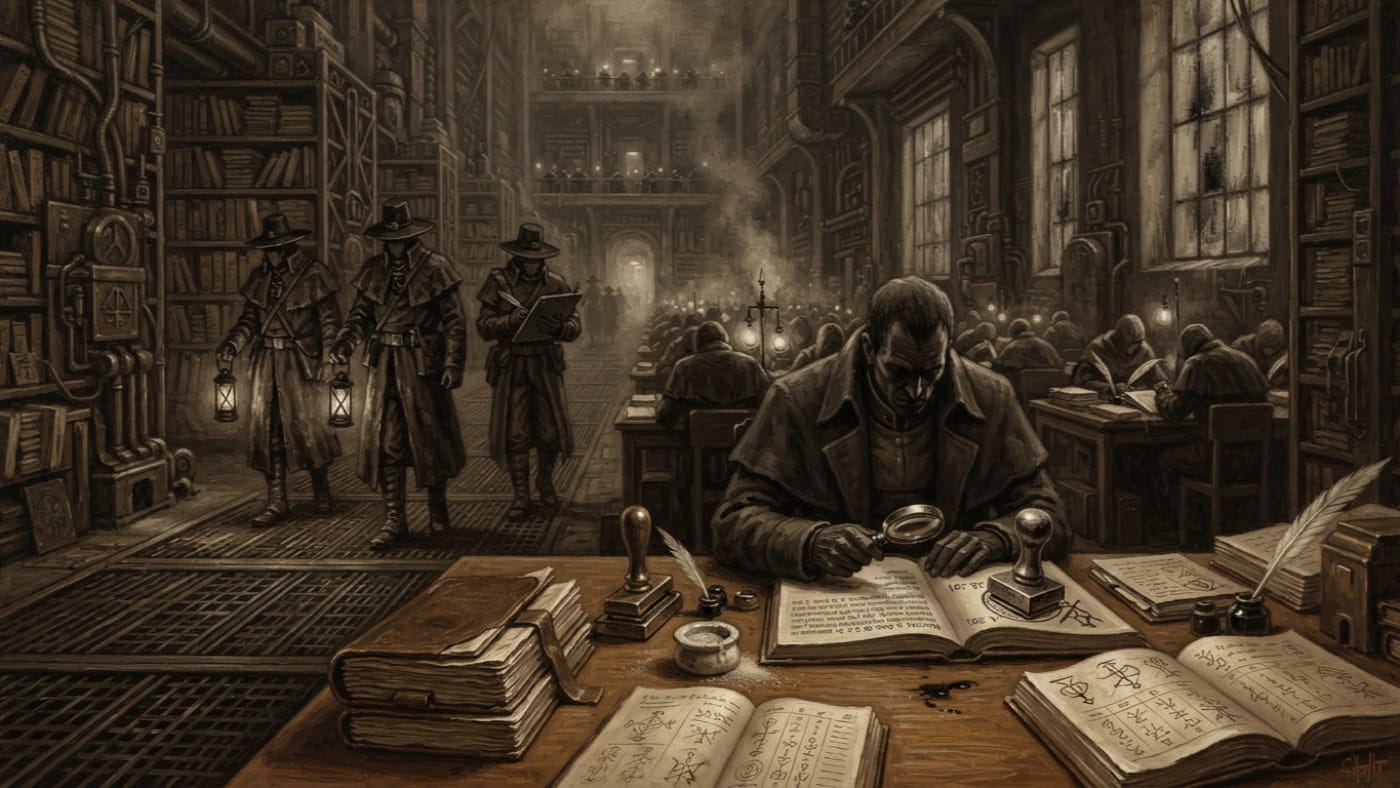
Martial Code 22-B reaches my desk the way most law reaches anyone: secondhand, by citation, folded inside another office's paper. Before me lies my survey of the Lantern Brotherhood, A.S. 201. A pounce pot holds down one corner and my seal-press the other. Inside it is the only sentence on the subject I am prepared to swear to. Records Standing Order 14-V, revised in A.S. 199, provides that a Circle exceeding thirty licensed operatives is reclassified as an "unauthorised gathering" under Martial Code 22-B.
That is the whole of my evidence. I quote a Standing Order, and the Standing Order quotes nobody. It says what a Circle becomes when it crosses the number. It does not reproduce the code's wording or name the hand that drafted it. It does not give the year the code was sealed, or say what is done to an unauthorised gathering once one has been declared. Those matters belong to the full text, which the Standing Order does not quote. Neither shall I. A Hieromnemon who invents statute to fill a page has mistaken his office for a print-shop.
What follows is commentary on one application only: where a tolerated Circle ends and a thing the Synod has another word for begins.
#On the Toleration
Two instruments govern the Brotherhood, and careless readers weld them into one.
The first is the Curfew Ordinance of Quiet Hours of A.S. 94, by which Vicar-General Anselm Rihn standardised the Rhineland's curfew routes. It never names the Brotherhood. It contains a subordinate clause admitting "auxiliary vigil personnel, locally licensed, subject to revocation without notice or appeal." The Brothers had been walking the alleys for decades before Rihn noticed them. They climbed into that clause and have lived there ever since. The ordinance grants permission. It says nothing of thirty, and nothing in it enacts 22-B. Rihn wrote a curfew. Whoever wrote the cap, no record I hold names him.
The second instrument is the licence itself: a writ of toleration from the nearest Warden-Captain. It lets a Brother carry his ash-oil lantern past curfew, question whoever he finds abroad after the Ninth Peal, and detain. Detain. Arrest belongs to the Bureau of Purity, which guards the prerogative as a canon guards his choir-stall. The Brothers hold no Bureau commission and no officer rank. A detained man and an arrested man may share a cell and a bucket. Their files will never share a drawer.
Under the clause, the writ may be withdrawn without notice or appeal. Every patrol the Brotherhood has ever walked has walked on that condition. The cap is a second condition laid on top of the first.
#On the Thirtieth Name
The threshold is exact, and clerks earn their bread on exactness. Thirty licensed operatives make a tolerated Circle. Thirty-one make an unauthorised gathering. The order says "exceed," and thirty does not exceed thirty. I have examined the word under a lens.
Mark the noun as well. The count is of licensed operatives. It does not cover the lanterns in an alley, the listeners at a dusk sermon, an escort beside a procession, or the bread queue a Nine Wicks patrol is herding toward the hall door. That queue may run to three hundred souls without making the Circle one man larger.
Beyond that, the order does not say who is counted. Is a Wicker, carrying chalk and oil and no blade, a licensed operative? Does a Brother laid up with lung-smoke still count? If two Circles share a lane, do they share the man who walks it? I have these questions on a slip of vellum pinned beside my lamp. Records has not answered them, and I do not legislate in the margins of other men's orders.
Records did append a note to the same order: the average Circle reports exactly thirty members. When the average of a set equals its permitted maximum, no return can sit below it, and none can sit above it without confessing itself unlawful. The Brotherhood's own account of a Circle runs from twelve men to thirty. The returns have apparently never met twelve. Divide eight thousand four hundred Brothers by thirty and you get two hundred and eighty Circles. That is the fewest that could hold them lawfully, and, if both figures are honest, exactly the number that exist. The Bureau of Settlement's audit cut confidence in the first figure by forty per cent. Nobody has audited the second.
#On the Record
Classification happens on paper, and the Brotherhood is, among other things, a machine for producing paper.
Its patrols walk as a Triangle of Witness. The Anchor stands fixed at the chokepoint, the Blade pair searches, and the Echo keeps one lane over, out of sight. When something happens, the Echo writes the first report, the Anchor confirms it and the Blade supplies the body. A Trench-Court Clerk who receives three signatures from three plausible positions files them without lifting his eyes. Three agreeing signatures are the nearest thing to truth a clerk is paid to recognise.
So the Brothers have taught the Synod's clerks to trust what is written over what is seen, and the lesson binds them as tightly as it serves them. The Echo's report says what happened in the alley. The Circle's return says how many licensed men the Circle holds. Once Records accepts a return of thirty, every office that consults the figure will treat the Circle as thirty until a later paper says otherwise. Enter thirty-one, and the sentence that tolerated the Circle reclassifies it, though no lantern in the alley has burned any brighter.
The Brothers understand this perfectly. Nobody files thirty-one.
#On Useful Disobedience
Keeping under the cap buys nothing more than being under the cap. A Circle of twenty-nine with a clean return is still a Circle under a writ, and the writ can still be revoked.
Nine Wicks shows the matter more plainly than any treatise. It keeps the market wards and ration queues calm, and every Warden-Captain prizes calm. It pays for that calm by selling stallholders light permits: certificates that certify nothing, bought with coin that is entirely real. It also keeps a locked drawer of blank confessions and pre-signed citations, the Confession Closet, for nights when heresy will not meet the quota. None of this touches 22-B. All of it touches the writ. A Circle that is that useful and keeps that drawer gives its patron every reason to protect it and every ground to disown it. He may choose between the two on any evening he likes, and he owes nobody an explanation.
The Cologne Schism of A.S. 178 showed the same precariousness at the scale of doctrine. Three watch circles split over whether quietly shielding the Lantern Mercy Preachers made the shield complicit. The Preachers' sermons had made the alleys calmer and the patrols lighter. The quarrel concerned mercy and routes, and no 22-B proceeding arose from it that I know of. It belongs here because it showed what Brothers do when the work and the order part company. They do the work, then tell the paper whatever keeps the writ alive.
#On Present Application
The position at this survey, A.S. 201, stands thus. The Bureau of Doctrine assigns the Brotherhood's patrols a category. A Warden-Captain grants each Circle its writ and may take it back between the Ninth Peal and dawn. Purity keeps the arrests. Records keeps the count. Under Standing Order 14-V, the count decides whether a body of armed men walking the curfew is a Circle or an unauthorised gathering under Martial Code 22-B.
ERRATUM — Docket of this Commentary This commentary was first docketed under Category C/44, "Moral Rectification through Shadowed Vigil." Records merged C/44 with C/12, "Auditory Catechism Enforcement," in the Third Revision. The docket now reads C/44 (merged C/12). The correction changes the drawer this paper is kept in. It amends nothing in Martial Code 22-B, whose text no Bureau has yet shown me.
The order does not tell me what becomes of an unauthorised gathering, so I will not tell you.
In the street the Brothers carry blades, lanterns, citation slates and the bearing of men with authority. That authority amounts to a writ on a Warden's desk and a number on a Records return. My clerk has just set this quarter's return for a Rhineland district on my blotter. It says thirty.