
#On Cologne's Craft
Cologne keeps its money in vaults, and masons build the vaults. The bankers of the Rhine Heartlands prefer to forget this, as a bishop prefers to forget the man who carved his throne. An archive-bank needs walls that do not settle, floors that do not sweat, and arches that will carry a ledger-room's full load for a century without once asking to be thanked. The masons supply all three. They are rarely thanked either.
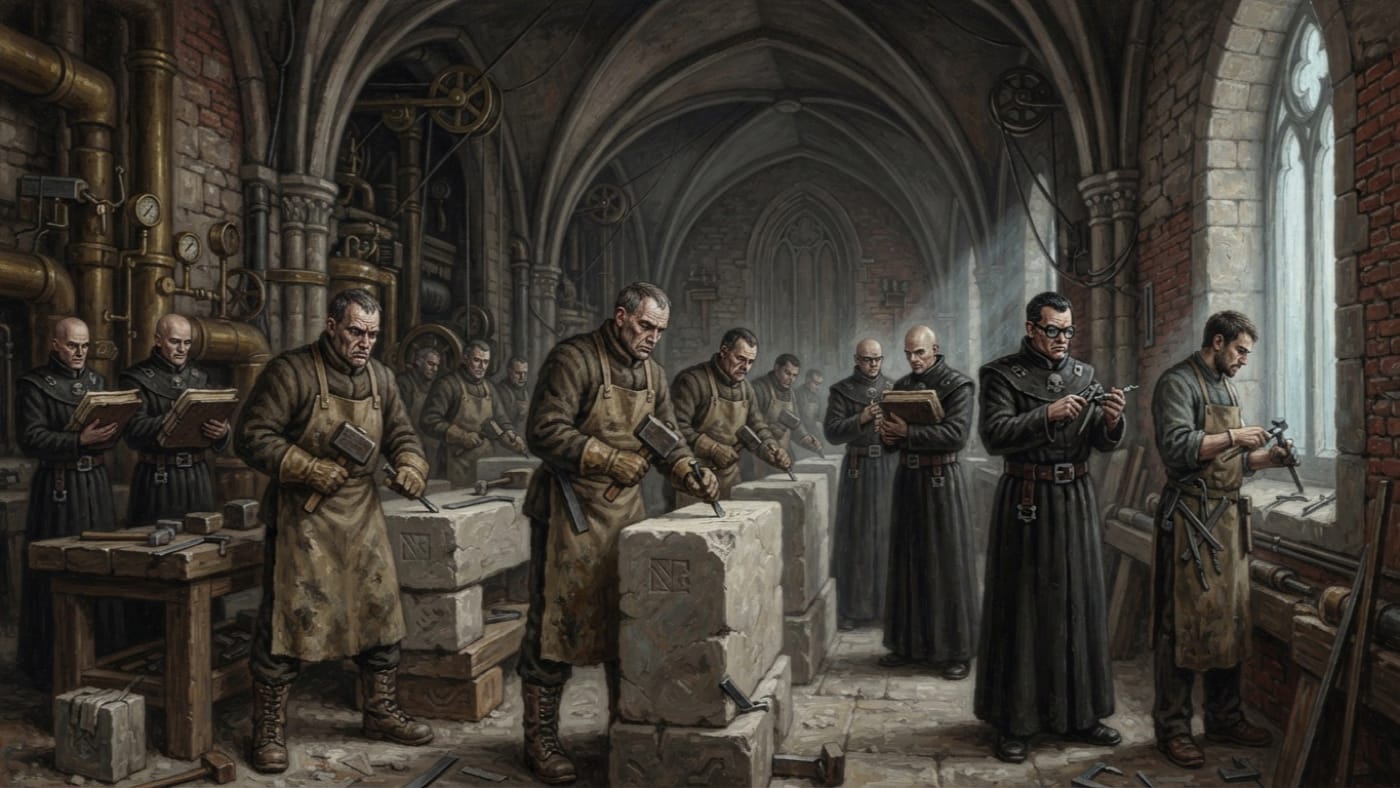
The Masons of Cologne are that city's masonry craft guild: hewers, setters, carvers of moulding, and the masters who decide which of these may use the guild's name. Their instruments are humble. Point and claw chisel, mallet, straightedge, plumb-line, the mason's square, and the board template hung on a nail by the workshop door. Their product is not humble at all. A dressed block with a true face, laid so close that the joint refuses a knife blade, argues for permanence, and Cologne pays well for the argument.
Most of a mason's knowledge sits in his hands. How deep to set a bed joint. How long freshly quarried stone must dry before it will take a carved edge. How to turn the head of an opening so the load runs around it and down into the piers instead of through the glass. Masters taught these things to apprentices over years at the bench, with the odd blow to the ear by way of commentary. Such knowledge is indispensable, and indispensable men grow proud. Proud men forget that holding a skill and dictating the terms of its use are two separate estates. The second can be taken without touching the first.
Münster took the second. The guild kept its chisels.
#On the Window Tariffs
The quarrel with the Glasswrights of Bruges began in A.S. 93 / 1803 CE. When the delegations gathered at Münster it was twelve years old, which outlasts most marriages and several heresies. Its rate, its collecting authority, its wording and the identity of whoever struck first in ink all lie outside what I hold. The posture survives. In A.S. 105 the Masons of Cologne sent brothers to Münster, and those brothers would not sit beside the glasswrights.
What follows is my reading of the ground, offered as commentary. A window is a natural battlefield. The mason makes the opening and the glasswright fills it. Somewhere between jamb and pane an assessor has to decide whether a window is a hole in a wall or a sheet of glass with a wall around it. Any clerk who has tried knows how it ends: petitions, counter-petitions, and two trades each certain the other is undertaxed. The real tariff may have been about something duller. Most tariffs are.
The bench interests me more than the tariff. These men travelled to a cathedral where the obligations of their descendants would be settled, and their first business was a dispute over where to sit. That tells the historian a great deal about their sense of rank. I read it as craft pride: the pride of men who cut the stone that holds the glass up, and who regard that as an order of precedence fixed by the Creator at the laying of the world's foundations. Whether the glasswrights answered is not recorded.
#On the Münster Obligation
The Second Concordat of Münster met in A.S. 105 / 1815 CE beneath the west vault of Münster cathedral. That was fifteen years after the Concordat of Strasbourg made the Synod formal, and five years after the Council of Cologne. I mean the council of A.S. 100, which the careless confuse with the nine September days of A.S. 27 held in the same city. Archon-Mediator Havel of Tithes, Canon-Praelate Odmar Voss of Doctrine and Guild-Commissioner Elsbeth Renn presided over a table laid with grey vellum and silver basins.
The Concordat of Münster was concluded in A.S. 231, in the long maturity of the Synodic order.
Corrected: A.S. 105 / 1815 CE. The earlier figure added more than a century to the compact. It has been returned to the clerk who supplied it, together with the century.
The compact was signed in blood, and the blood was real. Nine hundred and ninety-nine guild signatures went onto the vellum. Each chief artificer opened his thumb and signed for his organization. The masons of Cologne were among the delegations bound. No Cologne impression has been picked out among the red columns, and I will not invent one to improve a paragraph.
The thousandth artificer refused. His objection was to hereditary craft registration, the clause that bound descendants not yet born. By dawn his district of Münster was gone. The files record the event as "clerical adjustment." What became of its people, and by what means, remains unestablished. No evidence I possess gives the Masons of Cologne any part in it. They were occupied with a bench.
One man at Münster refused the substance of the compact. The masons refused a seat. Their grievance concerned furniture. The compact concerned their grandchildren.
#On the Registered Hand
The blood-mark bound craft, household, apprentices, descendants, tools, debts, patents, secret methods and every future improvement. For a trade whose authority had always been passed from master to apprentice in the workshop, each clause took something specific.
Take the guild roll. The roll recorded who was a master, who a journeyman and who was still sweeping chips. It had been the guild's own book, kept in the guild's own chest. Under Münster the rolls entered Synod custody with the Bureau of Records. A man's rank in his trade became an entry in another institution's archive, and anyone who has worked with an archive knows what that does to a man's sense of rank.
Apprentices were registered from birth under projected craft-value. Before, a master chose his apprentice: a nephew, a widow's boy, a quarryman's son with good shoulders and no talent for quarrelling. Under the compact the clerk made that choice first. A child born into a bound household entered the register before he had held anything heavier than his mother's finger. He was assessed against the trade he was expected to follow, and his future debt to the Synod was reckoned by the stone he had not yet cut.
Tool-patterns went to Records. That meant the profile board on its nail, the template for a moulding, the proportions of a favourite chisel. Methods came under the interpretation of the Bureau of Doctrine. The art of turning an opening, which a master had always kept to himself or shown to the boy who earned it, was now valid only in the form Doctrine accepted. Later practice under the compact named a withheld method heresy by omission. Few masons are theologians. Under Münster every mason became answerable to theologians.
Then the marks. Masons have always cut a private sign into the blocks they dress, so the paymaster knows whose hand did the work and whose to dock. It is the plainest signature in Christendom's— [struck by the author] in the Church's possession. Münster standardized those marks, licensed them and made them taxable. The sign that once said this is mine came to read this is assessed.
Debts passed down. Households passed down. The guild had always called its members brothers. After Münster that brotherhood was inherited, compulsory and payable to the Synod.
#On the Work Owed
The yoke came with a manger. The settlement guaranteed contracts, and the war economy wanted stone more steadily than any banker or burgher had ever wanted it. A master who had once waited for commissions now had requisitions in hand. The guilds complained and prospered, in that order and at the same time, which embarrasses the complaint.
The prosperity collected at the top. Masters held the contracts. The obligations fell on apprentices and households, the people registered at birth who would never sign a contract and had never had the chance to refuse one. Compact practice added production schedules, annual thumb-verification and reassessment whenever a method improved. The Bureau of Tithes assessed and extracted. The Bureau of Purity dealt with anyone who looked insufficiently grateful. A clever mason who found a better way to set an arch had found the Bureau a new line of assessment, and was rewarded with the right to pay it.
That brings us back to the window. In A.S. 93 two crafts fought over who should bear the tariff on an opening and its pane. After A.S. 105 the mason and the glasswright both owed their blood to the same table under the same compact. Whatever fell between jamb and glass went to the Synod from both sides of the joint. The masons had spent twelve years guarding their precedence against Bruges. They had failed to notice the Bureau, which had no interest in precedence and took a share from both of them.
The brothers of Cologne did get their wish. They never had to sit beside the glasswrights.
The Bureau told them where to sit.