
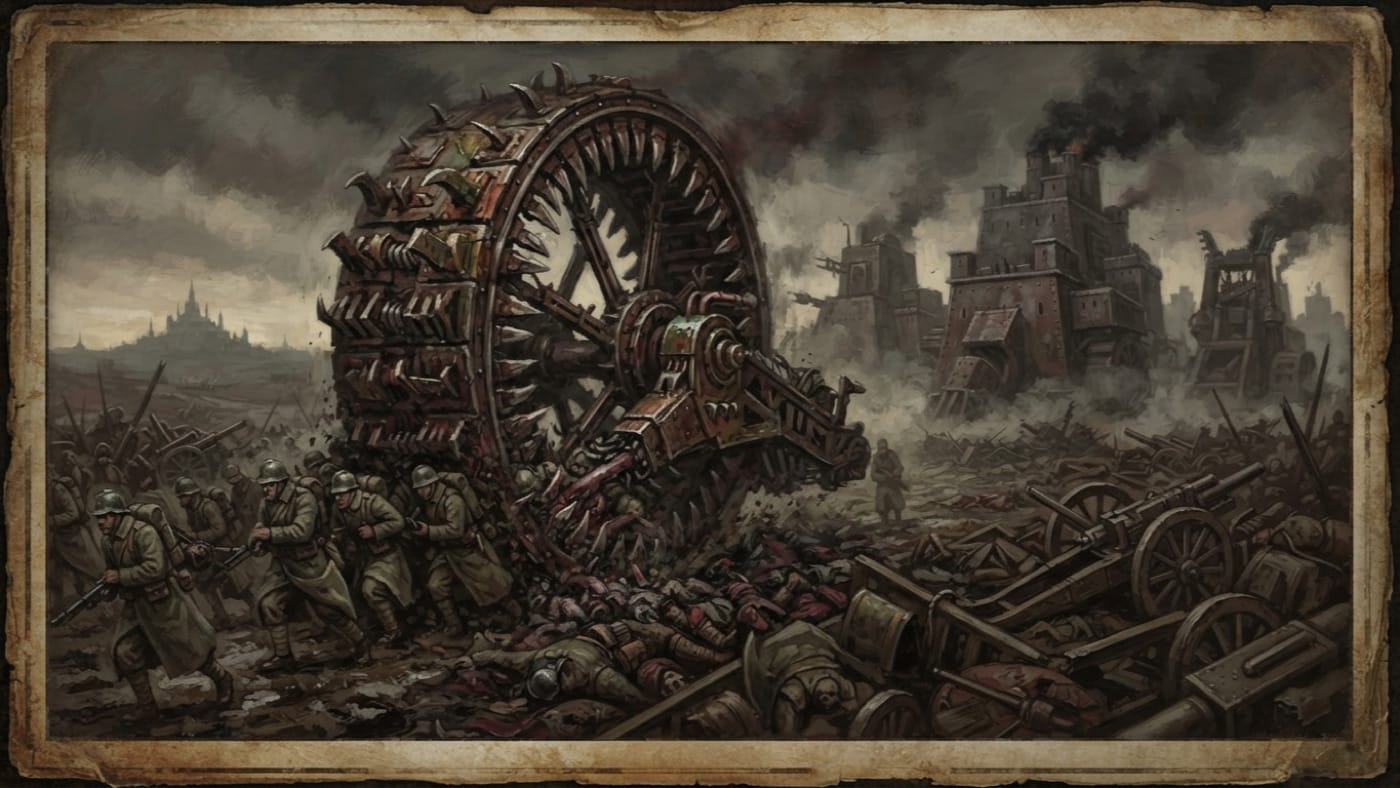
"…an engine of iron fangs that devours the slain into fuel and chews the dying into screams." — from the older chronicle of Kargath's host
#On Its Nature
The Mawwheel belongs to Kargath, the Maw of Endless Hunger, Sin-General of Gluttony. It holds no rank of its own. The consolidated entry on the Seven enters it in his host beside the Carrion-Dogs and the Bloat-Hulks, under the plain heading of armies. A general has a will and a domain. The Mawwheel has teeth and a direction of travel.
The older chronicle calls it a colossal jawed wheel of iron and flesh. Its fangs are iron. It rolls, and as it rolls it grinds. Armies go beneath it, the slain go into it, and the dying are chewed on the way. That is the whole of its anatomy as the Church holds it. The several descriptions in my keeping agree with one another, which is more than I can say for the descriptions of most Bureaus.
The same chronicle has it rolling in the midst of Kargath's hosts. I enter that as prominence and nothing more. No one has handed the Bureau of War a diagram showing where the wheel stands when the trumpets sound, and I will not draw one in the margin to make the page look busier.
#On the Iron and Flesh
Picture a wheel. Then discard whatever you pictured, because you pictured a cart.
The record allows one geometric fact, and it is that the Mawwheel is round. Its rim is jawed and set with fangs of iron. Its substance is iron and flesh together, in a proportion no witness stopped to measure. The flesh is as much the wheel as the iron is. The chronicle enters the two in the same breath and joins them with a single conjunction, which I have now read more times than I care to confess before a Confessor-Penal.
It rolls, and as it rolls the teeth grind against whatever lies in its road. On Kargath's front, what lies in the road is men.
I cannot tell you what lies inside it. The Church holds that the Seven do not build as men build. Their engines move by corrupted sorcery, and where they take up human machinery they twist it rather than improve it. That doctrine covers demons in general. It cannot tell me whether the Mawwheel began as some captured engine of ours, as something forged in the east, or as nothing anyone would recognise as a beginning. Its iron proves that it has iron. A foundry would be a comfort, and none is recorded.
I therefore supply no axle, no furnace and no hatch for a driver. Draughtsmen who add them to a frontispiece will have their plates returned with the corrections in red.
#On the Slain as Fuel
On the next point the chronicle is exact, and the exactness is where the horror lies. The Mawwheel devours the corpses it makes, and the corpses fuel its motion. Its motion makes more corpses.
The record says that and no more. Nothing further is needed. What follows is my inference, labelled as such for the benefit of auditors.
A machine of ours burns coal, and when the coal runs out it stops. The quartermaster's arithmetic depends on this, and so has every siege since the first. The Mawwheel draws its fuel from its own work. Every regiment thrown in front of it becomes, at the moment of its destruction, provision for the next mile. I do not claim that it rolls faster when fed, that a crowded field makes it unstoppable, or that an empty one halts it. Nobody has measured. The shape of the thing is plain without numbers: each slaughter sustains the next, and the wheel eats and stays hungry. It is Kargath's whole doctrine, cast in iron and set rolling downhill.
The chronicle adds a phrase I wish it had omitted. The wheel "chews the dying into screams." A corpse-eater is a horror of the second rank, because it offends the grave. This offends the man who is still in his body and still knows his name. Those who fall in front of the Mawwheel are still alive when the teeth arrive.
This bears on the oldest duty of the battlefield. Infantry go back for their wounded. When they can, they go back for their dead as well, so the chaplains have something to bury and the Bureau of Records something to enter. Against most of the enemy that labour is mercy and paperwork. In front of the Mawwheel, the record plainly implies that every body left on the field is fuel in the wheel's road, and every wounded man left there is in that road twice over. I know of no order that tells a sergeant what to do with that knowledge. I would not want to be the man who wrote it.
Let no preacher make a sermon of it. The soldier on Kargath's front is hungry because the rations are short. That is a condition of his body and no sin of his soul. He is Gluttony's victim twice, first in the ration line and then in the road.
#On the Host and the Southern Front
Kargath rules the Blightmarsh of the Drava from the Cauldron Citadel. The Blightmarsh covers the drowned valleys of the Drava and the Sava, old Pannonian grain country gone to grey water. His famine travels farther than his borders. It reaches the Thracian approaches and the Bosphorus and spoils convoys there before any army of his arrives. The Mawwheel is entered in that host. Its movements are entered nowhere. I cannot say where it was last seen, and I will not pretend that the marsh keeps a timetable.
The Carrion-Dogs, the Bloat-Hulks and the wheel share a column in the Ledger. The column does not say who pulls, who escorts or who obeys. I leave the line for command blank, as the survey of the dogs already does.
The southern anchor of the Sagittal Line is Bastion-Constantinople, which faces Kargath and Maldrake at once. Two Sin-Generals on one front do not make one army. Nothing in my keeping puts Maldrake's engines and Kargath's wheel on the same field on the same day. The garrison faces Kargath's host, and the Mawwheel belongs to that host. That is a relationship. It is not a battle report. Anyone who cites this paragraph as evidence of an assault on the Bosphorus walls will be quoted back to me, and I will deny him.
No date of first appearance is held. The wheel belongs with its master to the Sundering of 1 November A.S. 45 and the years after it. That places it in the age of demons. It does not mean anyone saw it built that morning.
"Kargath came first, or near enough — in the ash-years after the Sundering, when the Eastern Silence swallowed half the continent and famine was already a fact before it was a general."
The Eastern Silence fell in A.S. 38 and was an omen. The Sundering came in A.S. 45 and was the arrival. The Silence did not follow the Sundering, and it swallowed nothing on Kargath's behalf. He and his host are entered from the Sundering onward, the wheel included. A.S. 45 is not offered as the wheel's first appearance, which remains unestablished.
#On Countermeasures and the Limits of the Record
No measure proven against the Mawwheel itself is on file. That sentence belongs at the head of any field manual that claims otherwise.
The Church has defences against Kargath: ration discipline, the fasts, the communal table and provisions blessed before issue. In the language of the Bureau of Relics their results are mixed. They were devised against a hunger that whispers, and the wheel does not whisper. A blessed loaf in a man's pack does nothing for him when iron teeth come over the rise.
Older accounts speak of holding Kargath back with fire and salt. They describe delaying a Sin-General, which is a different trade from breaking an engine. The Codex has already struck its own earlier boast that enough holy fire would reclaim the Bosphorus marshes. I will not reissue a retracted claim about a marsh as a recipe against a wheel.
Starvation is the tempting error. If it eats the dead in order to move, a field without dead ought to stop it. The record does not say so. It says what the wheel eats. It does not say that it can eat nothing else, that want would kill it, or that want has ever halted it. A fasting Mawwheel is a theologian's fancy. Kargath does not starve, and I see no reason to expect better manners from his machinery.
Nor will I err in the other direction. The Sin-Generals are shards of the Great Deceiver's will, and no weapon the Church possesses can kill them. The Mawwheel is not a Sin-General, and immortality is not inherited by the furniture. Whether it can be broken, whether it mends and whether it returns are not established either way.
What remains to the soldier is the ordinary arsenal and the trench's ordinary wisdom: do not be in front of the thing. As theology, the Bureau of Doctrine finds this unsatisfying. As advice, the infantry find it entirely sufficient.
#The Ratification
This entry was compiled in A.S. 201 from descriptions already in the Church's keeping. It records no new sighting and certifies no battle. It names no maker, no crew and no grave. The chronicle's line is reproduced in full above, and everything beyond that line is marked as inference.
Bury what you can. Enter the rest as consumed.