
#On the City-Stomach
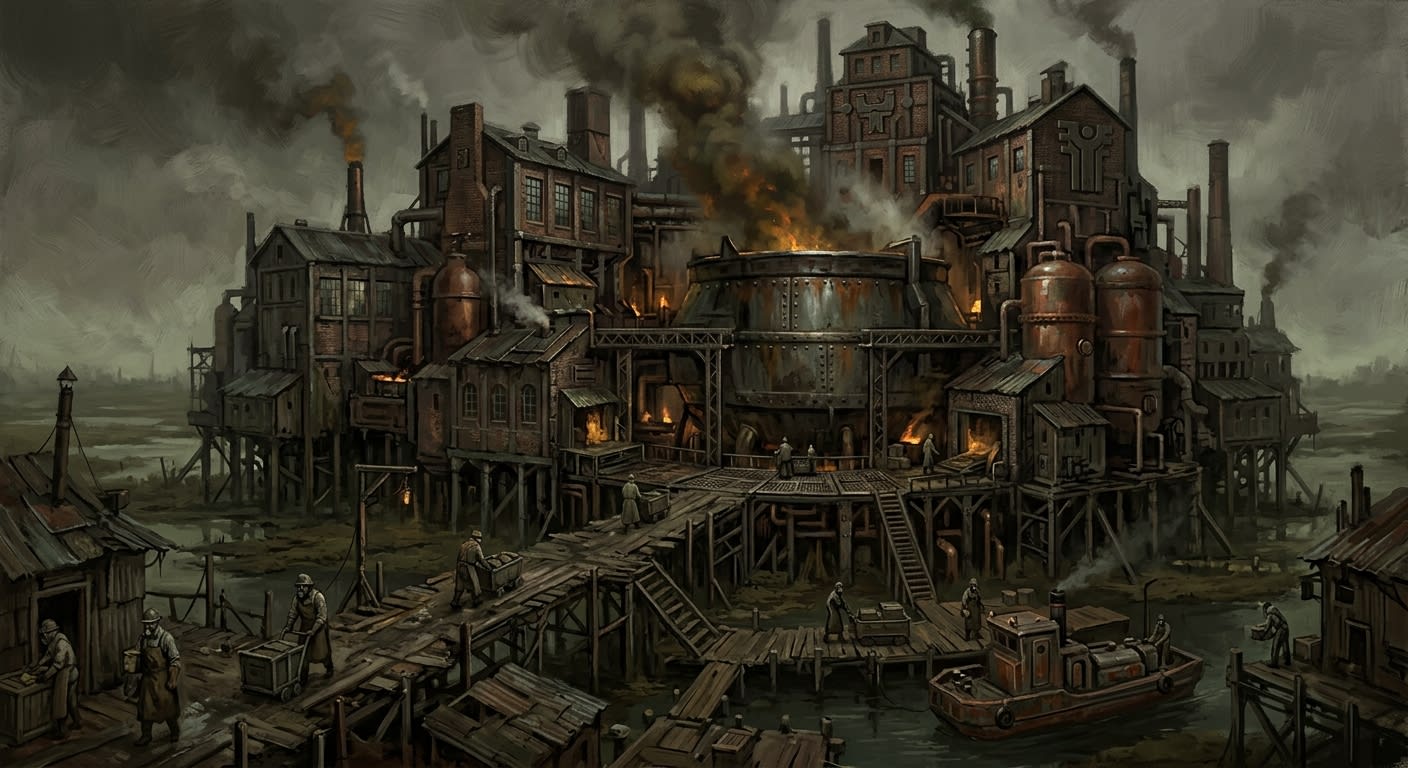
At the approximate centre of the Blightmarsh stands the Cauldron Citadel, more organ than fortress, granted towers, markets, work shifts, smoke-stacks, and a municipal appetite. The Bureau of Doctrine calls it Kargath’s forward infrastructure. The Bureau of War calls it a strategic objective. The soldiers of Bastion-Constantinople, who are closer to truth because fear has boiled the vanity from them, call it the Pot.
They are correct. It cooks what the Marsh has eaten.
The structure is assembled from drowned cities fused together like bones in a mass grave: civic halls, bell-towers, granaries, butcher courts, roofless churches, and the upper storeys of houses whose lower rooms have been digested by grey mud. Its stacks belch smoke visible, on clear days, from the southern watch-lines. The smoke rises black, turns yellow, and then vanishes without spreading. The Bureau of Alchemical Standards has declared this “meteorologically impolite.” A better phrase exists. It requires confession after use.
#On Its Construction
No mason built the Cauldron Citadel. The Marsh assembled it from what it swallowed. This is visible in the outer wall, where incompatible stones meet without mortar: Hungarian brick beside Venetian marble, village timber beside iron bridgework, church copper beside bone. The whole thing holds because Kargath’s dominion dislikes waste. In a sane country, this principle produces thrift. In his, it produces architecture.
The towers lean inward. Every survey plate shows this. The Bureau of Cartography insists the lean is within tolerances, though the tolerances were revised after each survey, and after the third revision the tolerance table was sealed as a morale hazard. A tower that leaned west in A.S. 188 leaned north in A.S. 196. The Citadel may be settling. It may be turning. It may be listening for the nearest granary.
Earlier tactical sketches labelled the Cauldron Citadel “ruins.”
Amended. Ruins have stopped working. The Citadel has not.
The Drava seeps around it in channels the colour of meat broth. Barges move there. This detail appears in the sealed intelligence and in three private nightmares of mine, which I mention because the sealed intelligence has better handwriting and less honesty. The barges are low, wide, and loaded with matter covered by tarpaulins. Some cargo kicks. Some weeps. Some is already being portioned.
#On the Markets and Bakeries
The only first-hand interior account comes from a Bureau of Shadows operative captured in A.S. 188, released or expelled under circumstances the Bureau has classified because “escaped” flatters the wrong party. The report runs nine pages. Seven are Seal Amber. Two were read aloud to a closed War session. Three attendees requested indefinite leave.
Those two pages describe a city that functions.
Markets operate beneath awnings made from stitched uniforms. Bakers draw loaves from ovens that never cool. Slaughterhouses work without pause. Butchers sharpen knives on stones that look like altar steps. Overseers keep tallies in grease. Labourers haul dripping material from pits to presses, from presses to vats, from vats to ovens, from ovens to tables, from tables to mouths that receive and receive and receive.
Everyone is starving.
Extract, Shadow Report CC-188, permitted fragment: “Currency replaced by caloric exchange. One child equals ███ ration-units if whole, ███ if separated, ███ if already blessed. Market clerk objected to blessing surcharge. Clerk eaten by customer. Transaction honoured.”
The bakeries are the theological centre. The bread is real. It steams. It tears. It carries the crust-sound that makes soldiers disobey orders. It fills the belly and nourishes nothing. Every loaf is an accusation against mercy: food made useless, labour made endless, giving made predatory. This is Kargath at his most precise. Gluttony devours, then organises devouring into civic life and calls the result plenty.
#On the Feasts Within
The Citadel’s central hall is known in several reports as the Hollow Court, though that name also attaches to a related chamber, a demonic jurisdiction, and at least one military intelligence headache. There are tables. They do groan with food. Servants never stop bringing courses. The diners never stop eating. They grow thinner.
No testimony places Kargath clearly at the head of the table. This absence is itself instructive. Kargath need not sit where appetite already governs. A king does not stand beside every tax collector. He has invented the office.
Popular sermons describe Kargath feasting visibly upon a throne of bones within the Cauldron Citadel.
Withdrawn from instructional use. The throne may exist. The visibility is the error. Witnesses see the effect of his presence: endless courses, shrinking diners, servants whose arms are only trays with elbows. The Bureau will not certify scenery merely because preachers enjoy furniture.
The feast is not celebration. It is sentence. Some diners wear uniforms recognisable as eastern militia. Some wear merchant chains. Some wear aprons. Some wear nothing but napkins tied like ceremonial bibs around necks so thin the cloth hangs loose. They eat with discipline, panic, reverence, fury. They beg for the next course before they have swallowed the last.
#On the Deferred Bombardment
The Bureau of War has received the Citadel’s location on three separate occasions. It has declined to act each time, citing insufficient operational confidence. The phrase has a fine polish from repeated handling. It means the guns cannot reach, the airships cannot survive, the infantry cannot approach, the maps cannot be trusted, and no one wishes to write “we are afraid” in a memorandum that may outlive them.
Bombardment proposals exist. One recommends nine thousand shells over seventy-two hours. One recommends sanctified incendiaries dropped from Vigil Ark altitude, a suggestion filed after the Sanctissima Vox had already demonstrated the Marsh’s opinion of aerial sermon. One recommends damming the Drava. This last plan was returned with a single annotation: “With what continent?”
There is also the matter no memorandum addresses cleanly: what happens if the Citadel is struck and opens. The Mire Collapse of Debrecen taught the Line that the Marsh remembers street-plans. The Cauldron Citadel remembers cities. Shelling may break it. Breaking it may feed it. Feeding it may be the intended outcome of the plan, though not by the planners.
#On Its Present Appetite
As of A.S. 201, the Cauldron Citadel continues to smoke. It continues to process what the Blightmarsh consumes. Its markets operate. Its bakeries run. Its slaughterhouses work without pause. The economy remains intact, if one permits economy to mean the orderly conversion of life into hunger.
The Citadel is not waiting for conquest in the old style. It is already governing territory the Synod once thought lost, then thought recoverable, then thought regrettable, then stopped thinking about at dinner. Its law is caloric. Its liturgy is chewing. Its census is taken by weight before and after rendering.