
#On the Interview's Authority
"The song leaves no residue. The singer does." — Maxim of the Purity interview annexes, attribution declined
You cannot seize a lullaby carried in memory. It has no binding to burn and no brass drum to crush under a boot-heel, and there is no embroidered cuff to unpick at the evidence table. The Unauthorized Melody Smuggler who keeps her fragment behind her teeth can walk past the tuning forks of the Bureau of Purity carrying nothing except a mouth. A search cannot inventory a mouth.
So the Bureau inventories it by interview.
"Methodical Interview protocols" is the Bureau of Purity's name for the questioning that turns a remembered melody into a recorded admission. The protocols belong to Purity, which enforces what the Bureau of Doctrine defines. The Bureau of Orison and Song licenses every hymn under the Synod's mandate and supplies the acoustic learning that lets an examiner recognise a prohibited interval. It does not conduct the interview, and it does not sign the confession. I set this down in the survey year A.S. 201 because the two jurisdictions are easily confused, chiefly by people who have never had to file in both.
#On the Mouth as Evidence
Melody intent may be proved in three ways: a witnessed performance, a confession extracted under these protocols, or the testimony of an informant embedded in a listening cell. Any one of them suffices. Performances are rarely witnessed, because smugglers sing low and sing after curfew, in rooms whose walls they have tested. Informants are expensive to plant and slow to mature. A confession costs one room, one night and one clerk.
The trade has made the Bureau's problem worse by dividing itself. One verse may pass among three carriers. A Whisper Runner delivers the opening cadence, a Stitch-Score Courier carries the middle bars as colour and thread-count on a cuff, and a Listening Cell Host teaches the closing phrase by mouth in a back room. The cuff is physical evidence and is prosecuted as such. The grandmother's closing phrase is evidence of nothing until she admits to it. No arrest recovers a whole song, so the interview has to ask more than what the accused sings. It asks who sang with her.
Detection comes first, and it is a separate art. Tone inquisitors play bait-cadences through hand-cranked resonance boxes into stairwells. The Sky-Sermon Attendance Auditors mark the flutters that unlicensed singing leaves in a broadcast return, and the Orison Signal Engineers calibrate the frequencies against which all of this is measured. A detected sound is only a sound. Suspected knowledge is only a suspicion. Where a subject flinches at a bait-cadence or corrects its rhythm under her breath, the flinch is entered as the first line of her confession, and the interview exists to supply the rest.
Where a subject flinches at a bait-cadence or corrects its rhythm under her breath, the flinch is entered as the first line of her confession, and the interview exists to supply the rest.
The Bureau of Purity corrects: a flinch at a bait-cadence is grounds for detention and interview. It is not an admission, and it does not count toward melody intent. The distinction is preserved in the forms. The forms do not ask whether it survives the annex.
#On the Making of a Confession
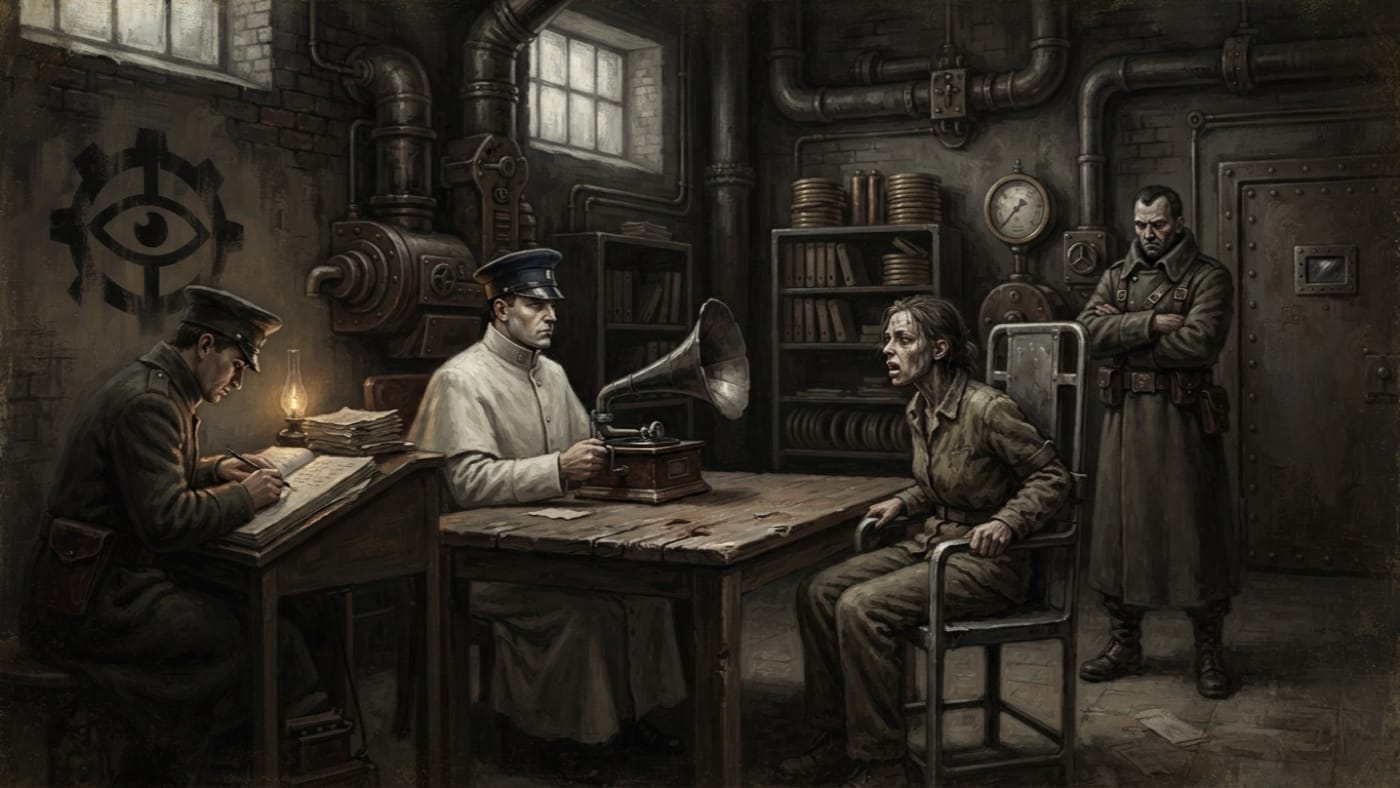
The interview takes place in a tribunal annex, more often at night than by day, because curfew leaves fewer witnesses in the corridors and a detainee who has not slept gives fewer clever answers. The questioning belongs to an inquisitor in the white mantle. A scribe sits at the side table with ink, wax and a stack of sealed papers that the detainee is not permitted to read. When the examiner judges the answers insufficient, a Lictor of Purity may be called. The Lictors are trained in the ars tormentorum, and I have never seen their instruments listed on any form. Staffing varies by district and by the examiner's taste. No roster I have seen is mandatory, and several jurisdictions overlap in ways that each claims the others created.
The questions do not vary much. Where did you learn it? Who taught you? Whom have you taught? The White-Mantled examiners call this the origin chain. It is the only part of the interview that concerns the Bureau beyond the accused herself, and so it is the part pressed hardest.
The Bureau's motto is Ignis Mentem Revelat, fire reveals the mind. As a matter of doctrine I endorse it. As a matter of record I add that fire reveals what a mind will say to make the fire stop, and that this is a different document. A woman restrained in the annex will hum the bars the examiner hummed, name the street he suggested and agree to the cadence he described. The scribe writes all of it down in the same hand and at the same speed. "Methodical" describes the record. It has never described the mercy.
The questioning is also distinct from what follows it. Tongue-branding for first possession was standardised from A.S. 118 and is imposed by sentence after the confession has been filed. The Iron Choir sings over the brands of other victims in other proceedings, and that belongs to another office and another entry. In the interview the accused is required to talk. The penalty that takes away her ability to talk comes later and is administered by different people.
#On the Names Required
Every confession ends in a negotiation, though the forms call it a disposition.
The Melody Smuggler entry records the established example. A smuggler caught with a fragment faces tongue-branding. If she names three clients, she may be reassigned to a penal choir instead. That is harsh but survivable, and survival is the whole of the Bureau's bribe. I give it as the documented inducement. It is not a statutory entitlement, and no captured runner should rely on it. The examiner offers it. The examiner may also forget that he offered it.
Three names reach further than they appear to. Each client has a Host, each Host a room, and each room a dozen neighbours who heard a closing phrase through the plaster. One woman's admission can expose a listening cell entire. Once she has named people, her own security depends on the Bureau continuing to find her useful, so she may be entered in the registry of "converted ears" and sent back into the trade to report. The smugglers call such people static.
There is a further arithmetic. A repeat offender whose client list implicates more than twelve households faces erasure from the Great Ledger of Souls. Up to that line, every name she gives eases her own sentence, and past it the same names start counting against her. Any competent examiner knows exactly where the line falls. Few of the accused do.
#On the Record's Certainty
Once the admission is written, the Bureau of Records takes it over, and Records does not doubt. The subject's identity is checked against the master entry. A supervisor authorises the record and the seal is pressed. A duplicate goes to the registry and another follows the sentence. From then on the confession governs the accused's legal existence: her assignment, her rations, her eligibility to marry and her place in the queue at the apothecary. A sealed admission is a fact for every administrative purpose. Whether it is true is a separate question, and there is no column for it on the sheet.
The uncertainty enters before the paper does. An extracted confession shows that a woman, under certain conditions, said certain words in front of a scribe. It may show that she knew four bars of a counting-rhyme. What it never shows is what the four bars do. Some cadences are dangerous; the Sundering of A.S. 45 settled that question for everyone who survived it. The Bureau's files nevertheless treat every admitted lullaby as though it had been tested and found lethal, and so far as I can find, none of them has been tested.
In Strasbourg, High Interrogatrix Ysabeau is reported to have reformed the Bureau's procedures to reduce false confessions. By the city's own tallies, the number of confessions has fallen sharply since. The tally counts confessions, which is the only thing a tally can count. It does not say how many of the confessions that vanished were false, or how many of those that remain are true.
#On Present Application
In A.S. 201 the trade remains as divided as ever, and the interview keeps pace with it. Stitch-scores come to the evidence table. Whisper Runners come to the annex. Listening Cell Hosts usually come in last, once someone has given their names. The Index Damnatus adds words, Orison and Song adds intervals, and the protocols turn whatever the season's forms require into confessions.
Records holds a sealed copy of every admission. The singer goes wherever the disposition sends her, and if she named her three clients, that is a penal choir. There she is required to sing, from licensed hymnals at licensed hours, in a voice the Bureau has already entered as evidence against her. She is kept under supervision while she does it, so that any bar of the old lullaby slipping into the hymn will be heard.