
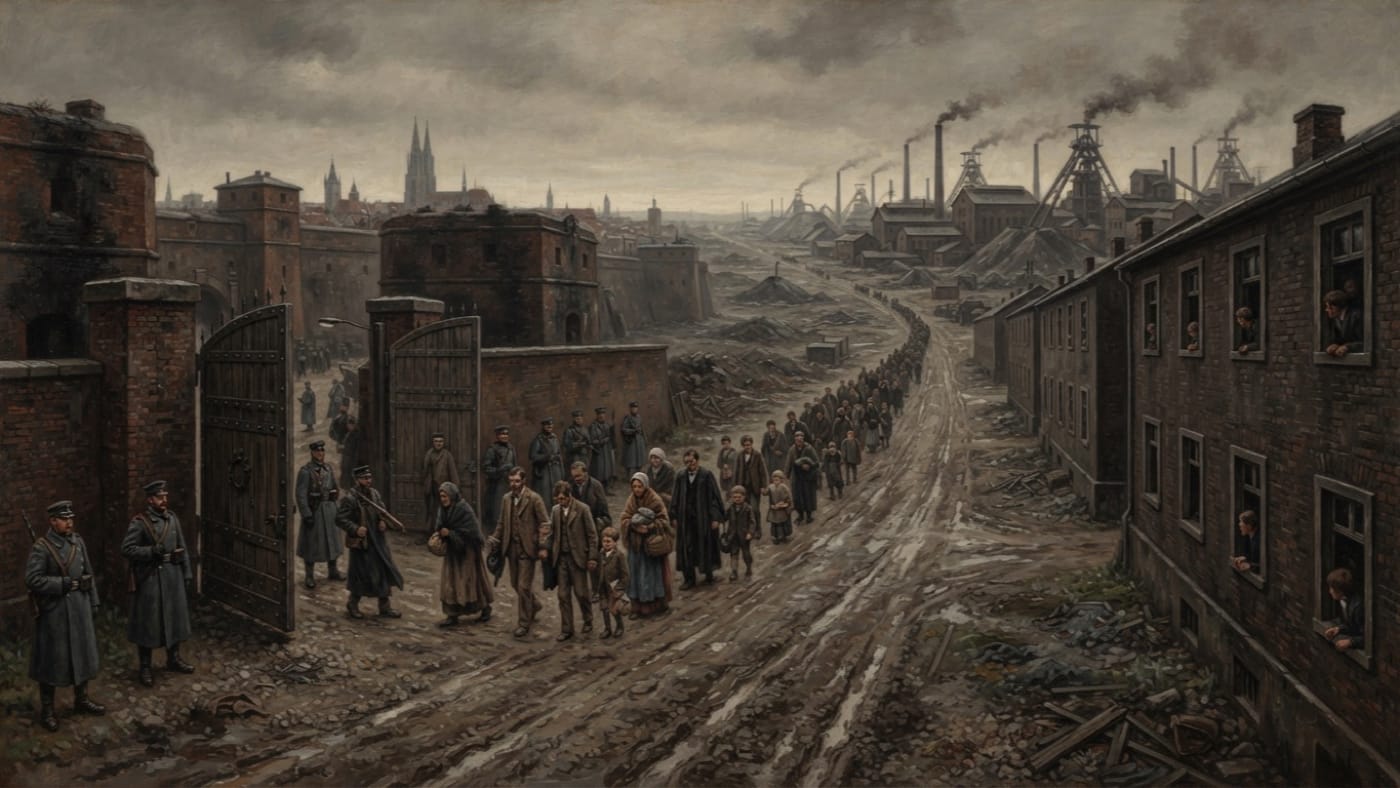
#On the South-East Road
Ulm keeps several roads, and each has its own kind of traffic. Pilgrims use the one to the cathedral, where the tallest church tower in Europe tells them to look up. Carters use the lanes through the Press Yards, which smell of lampblack and glue, and they haul the sanctioned stock on which the city prints the Index Damnatus. Students walk the short distance from the Old Faculty Rows to whatever lecture Doctrine has licensed that term. The Mine Road runs south-east through checkpoint gates, out past the city proper, toward the galleries of the Paper Mines.
Citizens do not stroll there.
That is the municipal description in full, and I find it adequate. The Ledger does not give me the road's length or width, its paving, the number of its gates, or how long a convoy takes between the last house and the first gallery. A surveyor's apprentice once asked me for these figures. So did a novelist, and so did a woman who wanted to know how far she would be walking. All three got the same answer. The Ledger records what the road is for. How long it is matters to the people walking it.
The road is ordinary, and that is what makes it ugly. Ulm is a working Heartlands city. Its bells keep the hours, its presses run at sanctioned volume, its colleges teach under watch, and its market stalls sell turnips to people who will die in their beds. The Mine Road is part of that working order in the same way the drain is part of the cathedral. Nobody admires it. Everybody depends on it. A city that has been properly corrected does not hide its machinery. It simply arranges for its citizens to stop looking.
#On the Gates and the Convoys
The road carries condemned scholars, heretical scribes and doctrinally irregular clerks, and it carries their families. The Mines receive convoys twice weekly. That figure comes from the receiving end, and the Ledger tells me nothing about the departing end. It names no weekday, no hour of departure, no count of carts and no strength of escort. I have seen apprentices in the copy-rooms try to fill these gaps with numbers they find plausible. I have them recopy the page, and while they copy it I explain that a plausible number is a forgery that has behaved well at school.
What I can certify is the road's place in the order of custody. Behind every convoy stands a pronouncement made under the jurisdiction of the Bureau of Doctrine. At the end of every convoy the Bureau of Silence waits to take the labour into production custody. The Bureau of Records handles the documentary side, and it is the only party involved that never gets dust on its shoes. The road runs between the verdict and the gallery. None of the offices that use it has put its name to it, and I have found no instrument that assigns its ownership. In the Church's arrangements a thing nobody owns is usually the thing everybody uses.
The gates are checkpoints, and a checkpoint lets the right people through in the right condition. The record does not say whether papers change hands at each gate. I would be astonished if they did not, but astonishment is not admissible. The guards stand at the gates without names in any file before me, and I leave them that way. On this road it is a courtesy that cuts in more than one direction.
The galleries send traffic back the other way: archival paper, sermon stock, penitential forms, emergency writ sheets and redaction-grade vellum. The loaded carts leave the complex. The Ledger does not say which road they take to the offices of the Church. I will not put the paper and the people on the same stretch of stone just because the symmetry would please a preacher. The symmetry exists without my help. The sheets reach every desk in the Synod, and the people who stocked those desks walked out of Ulm by the south-east gates.
#On the Hostels
The Nameless Hostels stand along the Mine Road. They house relatives awaiting derivative disposition. Their windows face inward, and curtains are forbidden.
Derivative disposition means guilt that has been passed on. Doctrine holds that certain intellectual crimes spread through household benefit. A professor's son who ate bread bought with a heretical salary has consumed derivative error. A daughter who learned her letters from condemned books has received contraband literacy. Neither of them had to hold an opinion. The bread was enough, and so was the alphabet. A family that once thought a scholar's salary would protect it learns at the roadside what that salary actually bought.
The people in the hostels are relatives. They have not yet been numbered. The Ledger distinguishes lodging pending disposition from admission to labour, and I keep the distinction even where the Bureau's own primers have been careless with it. A woman at an inward window still has her surname. Her file may be heavier or lighter than her neighbour's, and the hostel's roof does not prove that everyone under it faces the same sentence. Its inspectors can only prove that everyone under it is waiting.
Disposition is usually intake.
A parish primer still in circulation states that Anonymous Productive Penance is reserved for principal offenders, and that dependants are lodged apart in the hostels of the Mine Road pending review.
Corrected. The Codex has already struck this claim from the record of Anonymous Productive Penance, and the Mine Road entry upholds that correction. The hostels hold relatives awaiting derivative disposition. They hold no exemption for anyone. Disposition is usually intake. The review is a queue.
#On the Name at Intake
The road ends where the procedure begins. That procedure takes place at the Mines' intake. Walking through an Ulm gate does not take anyone's name away, whatever the citizens whisper to frighten their nephews. The name goes at the clerk's table.
There the surname is suspended. It is kept in case kin need to be cross-referenced, and kin always need to be cross-referenced. The given name is sealed. A number is assigned. From then on the labour is recorded under Anonymous Productive Penance, a phrase with two adjectives and a noun, each of which has a job to do. The clerk records category, fitness for labour, class of doctrinal contamination, and whether the subject can still read.
Literacy increases quota.
What the road carries back, the Ledger does not tell me. I have asked Records for the discharge register that ought to match the warrants. The answer came in the form of a form. I do not call the Mine Road a one-way road, because nothing on file entitles me to. I call it undocumented in one direction, which in a Bureau archive is a separate condition and occasionally a worse one.
The convoys walk toward this table. The rest of the procedure takes place below, and its mechanism has been withheld from me in writing. The name of the Mines is not a figure of speech. The Bureau has explained nothing beyond the output.
#On the Lesson Set Before Students
The Concordats of Ulm were signed in A.S. −55, 1655 by the old reckoning, fifty-five years before the calendar the Synod later adopted. Twelve professors and academic dignitaries freed inquiry from theological supervision, founded a congress and devised a seal. Ulm has paid for that seal ever since in a currency it prints itself.
On the anniversary of the signing the city keeps a penitential observance. Students process barefoot from the university court to the cathedral. There they recite the Litany of Twelve Errors and kiss a blank page of Ulm stock. During these observances they are also made to watch the convoys.
These are separate acts in separate places, and I keep them separate. The procession goes from court to cathedral. The record does not send it down the Mine Road, through its gates, or alongside any cart. Wherever the students stand to watch, they are standing in the city with their shoes off, and the convoy is going where convoys go. The record gives one verb, watch, and that verb carries the whole pedagogy.
Ulm still runs colleges. They are supervised, chartered and staffed by lecturers whose syllabi have survived audit. The renunciation concerns unlawful learning, and the distinction is the whole of Ulm's present settlement with its past. A student may read. A student must read the right things, in the right hall, under the right eye. The convoy shows him the alternative, and the colleges do not have to put it on the syllabus.
The blank page is Ulm stock. It sometimes warms under the mouth. That belongs to the rite in the cathedral and to nothing on the road. I attach no explanation to it, and the municipal extract attaches none either. On this point Records and I are in rare and uncomfortable agreement.
#On the Present Use
In A.S. 201 Ulm is loyal under supervised correction. The Mine Road is in use. The convoys run twice weekly to the receiving galleries. The hostels are occupied, and their windows face inward. The gates are kept. Somewhere in the city's account books the road is presumably classed as a fixture, like the cathedral's drains and the Press Yards' gutters. Somewhere in the Synod's offices a tribunal is writing out another warrant on stock that came from the galleries at its far end.
The road has no shrine and no plaque, and no saint is said to have walked it. Ulm builds monuments to its tower and has rites for its compact. For its road it has a chin pointed south-east and the word that way.
The citizens of Ulm do not stroll there. They know which road it is, and they have been well taught.