
#On the Sentence Without a Name
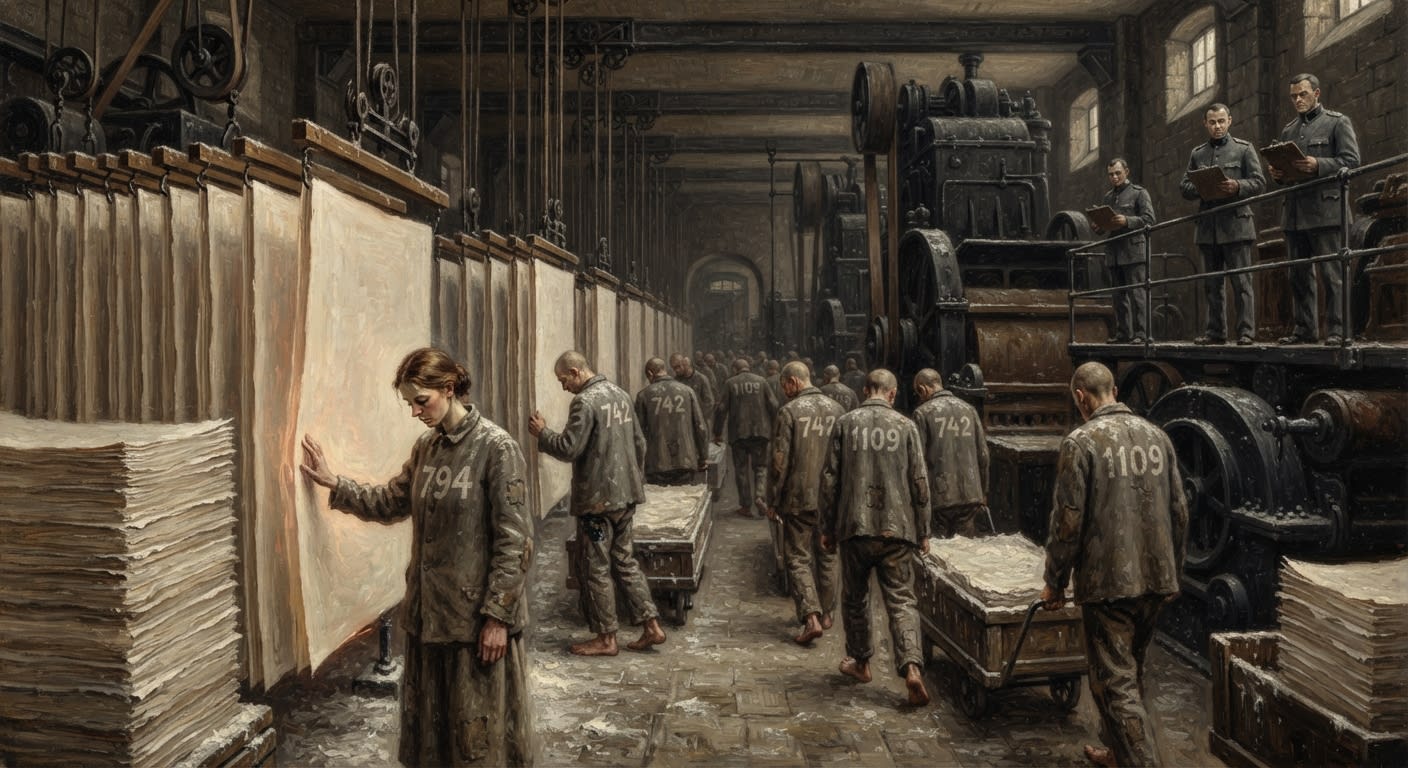
Anonymous Productive Penance is the category under which the Bureau of Doctrine records the labour of the condemned at the Paper Mines of Ulm. It is two adjectives and a noun, and each carries a duty. Anonymous, because the Bureau removes the name before the work begins. Productive, because the loss can then be invoiced. Penance, because Doctrine insists the condemned are being repaired, and repair requires no consent from the object repaired.
I have searched for the founding instrument. The Ledger holds the sentence in use and no sentence establishing it. The surviving public files supply no statute, no ratifying council and no author. The earliest confirmed practice is no later than A.S. 114, when Gerda Weil died in the galleries outside Ulm under a number. Before that year the record is silent, and a silent record in the Bureau's keeping is rarely an innocent one. The Synod's most durable instruments are often like this, already in use by the time anyone thinks to write down where they came from.
The sentence is issued under Doctrine's jurisdiction and carried out under the production custody of the Bureau of Silence. The tribunal pronounces it and the Mines fulfil it. Nobody in between is required to know who the prisoner was, and the procedure goes to some trouble to make sure nobody does.
#On Intake
The condemned arrive at the intake hall with their belongings, their spouses, their titles, and a last conviction that a name is something a person owns. The clerk relieves them of all four.
The surname is suspended. It is kept in case Purity needs to cross-reference kin, which Purity always does. The given name is sealed under black wax in a register the labourer will never see. Prior titles are converted to weight: professor, copyist, assessor, midwife, lecturer, apprentice, wife. Each is entered as a figure against expected output. After that the clerk records four things only: category, labour fitness, doctrinal contamination class, and whether the subject can still read. Literacy increases quota. The Bureau reasons that a mind which once consumed paper can now be made to return it.
Guilt at Ulm spreads outward through the household. A son who ate bread bought with a heretical salary has consumed derivative error. A daughter taught her letters from condemned books has received contraband literacy. A debtor whose promissory note was written on a scholar's desk has touched the desk. Article 9 of the Catechism of Obedience allows a heresy to be discovered after the fact. Anonymous Productive Penance allows the punishment to begin before anyone has settled who is being punished.
A parish primer still in circulation states that Anonymous Productive Penance is reserved for principal offenders, and that dependants are lodged apart in the hostels of the Mine Road pending review.
Corrected. The hostels on the Mine Road hold relatives awaiting derivative disposition. Disposition is usually intake. The review is a queue.
#On Productive Labour
The day is counted in reams. A numbered labourer sorts rag, cuts fibre, stirs vats, trims sheets, feeds presses, hauls pulp and counts. Between these duties the labourer breathes the white dust that settles on every surface in the drying halls, including the lungs. Night shifts are forbidden to sing. They sing anyway, and the process reports ask for more ash in the mix.
The finished sheets go up the hill in sealed carts: archival paper for Records, sermon stock for the doctrinal colleges, redaction-grade vellum for Silence, penitential forms, emergency writ sheets, and the blank intake forms by which the next scholar will become the next number. The sentence prints its own paperwork. A tribunal in some Heartlands town condemns a lecturer on Ulm stock, and the stock was pressed by the lecturer's former colleague, who once graded his dissertation.
Letterforms send people here as reliably as ideas do. Under the Triune Alphabet, literacy is licensed, and in A.S. 182 the Augsburg calligraphers received five years in the Mines for suggestive serifs. Five years is written on the warrant. I asked Records for the discharge register that should go with it. The clerk said he would have to find the form for requesting the form.
APP WORK CARD — GALLERY SERIES, UNDATED Line 1: number, shift, quota (reams) Line 2: contamination class; literacy mark Line 3: prior designation ███████████████ (sealed; do not transcribe) Line 4: conversion stage ██████████████████████████████ Line 5: output credited to Bureau of Doctrine account Note: cards returned blank at shift end are to be pulped with the batch
#On Useful Anonymity
Every Bureau that touches the sentence gets something out of it, which is why the sentence has lasted.
Doctrine gets an exemplary punishment that never has to be staged. Silence gets redaction stock that drinks black wax until the line underneath is less than absent. Records gets paper that lasts, and a clean place to send the clerks who read it too carefully. The Bureau of Purity gets the thing it values most: a sentence with no name on it for anyone to martyr. An execution leaves a grave, a widow and an anniversary. Anonymous Productive Penance leaves a delivery receipt.
The receipt does not always hold. Gerda Weil was a Halle midwife. During the Fever Winter of A.S. 112, her willow-bark and boiled-water treatment brought garrison fevers down. In A.S. 113 the Bureau of Medicine issued Protocol 7-C(E), which used her knowledge and left out her name. By A.S. 114 she was dead in the Mines, under a number, of the fever she had taught others to survive. The sentence worked as designed. The Ashen Circle made her a martyr anyway, working from the gaps the Bureau left in the record.
The later intakes follow the same pattern. Reports that are too accurate to disprove end with their authors in the vats. The operators of the Quiet Engine Heresy went to Ulm in A.S. 147 because their engines ran without certified cant. The staff of the Bureau of Agriculture went there in A.S. 158, when their Bureau was abolished for being right about the harvest at an inconvenient time. Aldric Venn, Assistant Copyist in Records' Auditory Correspondence Sub-Registry, went in A.S. 187 under speech restriction. His memorandum on Pale Chanter phrase recurrence had been withdrawn and his name struck. The apprentice from the Ash-School Scandal went the same year, despite Engineering's formal objection. Between A.S. 195 and A.S. 200, forty-seven captured Ashen Circle operatives went down the same road. They now make pulp for the documents that suppress what they spent their lives preserving.
#On Defects in the Sheet
The Bureau calls the product obedient. It is obedient where it can be seen. Ulm stock takes ink well, dries quickly, resists damp and accepts the Triune Alphabet without complaint. Emergency writ sheets survive rain, blood, coal smoke and moderate screaming. The printers of the Index Damnatus prefer it to all other stock.
In private, some batches misbehave. Some are warm to the touch in a cold press hall. Some refuse a name, and the ink beads and slides off like fat on a cold plate. Some whisper when held above a candle. Some show watermarks that no plate-master authorised: an initial, a hand, a face pressed thin. Some, according to clerks who later requested transfer, answer.
The test is simple. A clerk writes a dead man's name in the lower left corner. If the name stays, the sheet is cleared. If the name vanishes, the sheet goes to Records. If the sheet replies, the clerk goes to Mercy, and the sheet goes on to its intended office, because procurement is procurement.
In A.S. 156, in Gallery Three, a shift of numbered labourers who had been blinded by white dust recovered their sight after passing near an unlabelled wrapped relic later associated with Saint Aldebrand. It happened underground, under custody, with no congregation present. Records filed it as occupational recovery. The miners called it a miracle, which is a word they are not licensed to use. For the following two years, one recovered name appeared faintly in the watermark of penitential forms. Records put this down to fibre contamination. Nobody has explained how fibre contaminates a sheet with a name that intake had sealed under black wax.
I do not explain it either. The mechanism by which the Mines produce paper is withheld from the public file, and I am in no position to say which parts of the prisoner end up in the sheet.
#Final Holding
As of A.S. 201, Anonymous Productive Penance is active at Ulm. The Bureau's public word for it is productive, and in the Bureau's mouth that word does the work of an absolution. No founding date is asserted. No release procedure is published. No discharge register has been produced on request. The sentence and the product are the same thing, a person made nameless and then made useful.
In the drying halls, the sheets hang in white ranks and wait to be written on. One of them is warm.