
#On the Rows and Their Present Use
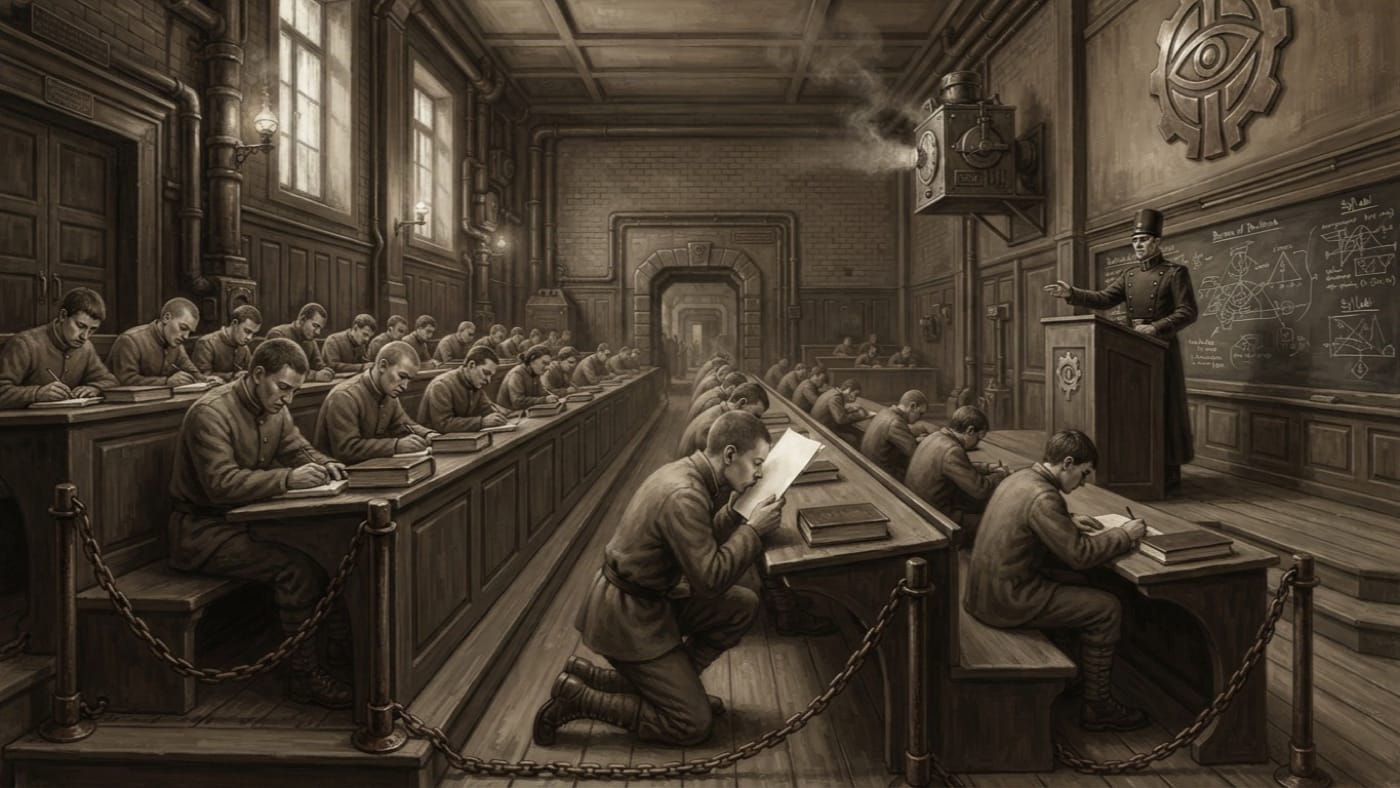
The Old Faculty Rows are the quarter of Ulm where the city still goes to class. Doctrinal schools occupy the former halls of the Rationalists. Students arrive on the hour, take their places, open approved texts and copy what the lectern tells them. A visitor from 1655 would recognise everything except the syllabus and the chains.
The lecture desks are chained to the floor.
As usual, the municipal description states this fact and gives no reason. The parish explanation holds that furniture which once held up heresy must be kept from wandering back toward it. I have heard a lecturer of the Rows say, with a straight face, that the chains prevent theft. Nobody in Ulm steals a desk. Nobody in Ulm wants to be found owning one.
The Ledger does not give me the boundaries of the Rows, the number of their halls, or which street enters them first. It gives me their use. Students walk from the Rows to whatever lecture Doctrine has licensed that term, and then they walk back. A quarter that is defined by its desks has no need of a surveyor.
#On the Former Faculties
Ulm's universities grew up around the older ecclesiastical precincts, the way learning once grew up around the Church before it learned to bite. Three existed when the Concordats of Ulm were signed in A.S. −55, 1655 by the old reckoning. Two more followed within a decade. These figures count the city's universities. They do not show that five schools stand in the Rows today or that five buildings survive, and I decline to arrange them into a campus for the convenience of engravers.
The compact took shape in faculty common rooms and in the taverns where faculties drink. Twelve professors and academic dignitaries freed inquiry from theological supervision, bound their institutions to a shared curriculum and an annual congress, and then wrote to everyone. Correspondence was their sacrament. By 1700 the congress drew delegates from thirty-one institutions. Direction passed to Amsterdam, where De Vera Luce appeared in A.S. 0, and Ulm became a relay station where it had been the source. Its presses ran, its halls filled, and sealed packets left the city under university marks.
During the Rationalist ascendancy those halls taught secular authority as a discipline. Priests were questioned in faculty chambers, where the chairs were comfortable. The record names neither the room nor the priest, and I invent neither.
What survives is the common room as a type. After the correction, the rooms where the compact had been drafted were consecrated, exorcised and turned into doctrinal instruction halls. No surviving room in the Rows has been certified as the chamber of signing. Guides who point one out are selling something, usually themselves.
Ulm's municipal histories once described the Concordats as "an educational reform document later misused by extremists."
Corrected. The Concordats were an institutional heresy from the moment they were signed. The Rows teach this as the first lesson of the first term, in the very rooms where the reform was supposed to have been innocent.
#On Corrected Instruction
Correction came after the Sundering of A.S. 45, once the Church's public emergence had hardened into administration, and within the order that the Concordat of Strasbourg made formal in A.S. 90. I give no year for the dissolution of Ulm's universities, for their exorcism or for their reopening. The files give me the sequence and withhold the calendar: dissolved, reconsecrated, reopened under doctrinal charter.
The charter is what matters. Under it, the halls of the Rows teach what the Bureau of Doctrine pronounces. Every lecturer's syllabus must survive an audit by the Bureau of Purity, which keeps the Index Damnatus and reads a reading list the way a customs officer reads a trunk. The texts come off presses supervised by the Bureau of Silence, which governs forbidden texts and lawful printing alike. Doctrine says what is true. Purity checks that nobody has smuggled in anything truer. Silence owns the ink.
Within that arrangement, study is permitted. Grammar, law, history and the crafts of scribe and clerk may all be taught, provided the teaching confirms the Covenant. A lecturer may still explain how an argument works. The lecturer must finish by explaining why this one failed.
The Rationalists believed instruction would free the mind from supervision. The Rows kept the instruction, restored the supervision, and report excellent results. Attendance is high. Handwriting is legible. Examination papers come back complete, on approved stock, with nothing in the margins.
Visiting clergy delight in the reversal. The city that taught Europe to read without permission now trains the readers the Church cannot do without. Clerks, copyists, registrars, catechists, and the men and women who will one day fill in the Bureau's forms in triplicate all come out of the Rows. The quarter has kept its vocation and turned its authority around. The lectern still speaks downward. What has changed is whom it speaks for.
#On the Students' Observance
On the anniversary of the Concordats' signing, Ulm keeps a penitential observance. Students walk barefoot in procession from the university court to the cathedral. There they recite the Litany of Twelve Errors and kiss a blank page of Ulm stock.
The record does not place the university court inside the Rows. I leave it where the record leaves it. The procession is legible enough without my help.
During these observances the students are also made to watch the convoys. That is a separate act, and I keep it separate. The procession runs from court to cathedral. The record does not send it down the Mine Road. It does not say where the students stand to watch either. The verb is watch, and Ulm has found it sufficient.
The page they kiss is blank. The doctrine of the observance is written elsewhere, in the files of their families.
That last clause has teeth. Doctrine holds that certain intellectual crimes pass through a household to everyone who benefited from them: the son fed on a heretical salary, the daughter who learned her letters from a condemned book. Such relatives wait in the Nameless Hostels along the Mine Road for derivative disposition. They keep their names while they wait. Surnames are suspended, given names sealed and numbers assigned only at intake to the Paper Mines. A student, a hostel resident and a numbered labourer are three conditions, filed under three procedures. The student is the one with shoes to put back on.
#On the Quarter in A.S. 201
The Rows are at work in A.S. 201. Lectures are licensed by the term. Syllabi are audited. Desks are chained. Students arrive, recite, copy and sit their examinations, then leave with certificates that will one day admit them to an office, a parish register or a press.
The paper they write on has a history. Mine-produced stock reaches Ulm's doctrinal colleges. The supervised colleges need examination sheets, and the galleries at the end of the south-east road supply them. The Bureau has declined in writing to tell me how a sentence becomes a sheet, and I do not supply what the Bureau withholds. I certify the delivery and leave the manufacture to its custodians.
Ulm prints its own catechisms, its own denunciation forms and its own copies of the Index. The Rows teach young men and women to read all three. A corrected city needs compliant subjects. It also needs trained readers, and compliance alone has never taught anyone to read. An illiterate cannot complete a denunciation form. A Rationalist completes it against the wrong person. The Rows aim between the two.
At the end of the day the lecturers lock the halls. The students go home to households that have, so far, benefited from nothing they should not have. The desks stay where they are, because that is what the chains are for.