
#On Narbonne in the Toulouse File
Narbonne is a city of the French south. The registers have not given it a row of its own, so I place it myself in the Western Heartlands, the breadth of France west of the Sagittal Line. There the war against the Great Deceiver arrives as levy notices, tithe schedules and the occasional sealed coffin returned at public expense. I stand by the classification. Nobody else has offered one.
The Codex indexes the city at A.S. 93 / 1803 CE. That is the year Narbonne entered the file of the Witch-Hunts of Toulouse. The city is far older than the file. How much older is a question for antiquaries, and antiquaries do not hold seals.
My archive holds two papers that carry Narbonne's name, a hundred and eight years apart. In the first, the city is spoken aloud under questioning at Carcassonne. In the second, its school primers travel to Toulouse to be read by the heirs of people who were questioned themselves. Between those two papers lies the whole education of the south.
#On the Word Spoken at Carcassonne
The fire began in Toulouse and belongs there. Maël Aucourt, a licensed printer of funeral notices, kept a shop near Saint-Sernin. He slid fragments of a Rationalist tract between notices for plague burials and grain allotments. The file outgrew his shop before the shop had finished burning, and it travelled by confession. Toulouse named Albi. Albi named Carcassonne. Carcassonne named Narbonne first among seven, ahead of Béziers, Montauban, Cahors, Rodez, Nîmes and Foix, with a river shrine trailing after them whose name was later struck.
First among seven. A citizen of Narbonne, had anyone told him, might have taken this for precedence. In a list drawn out under questioning, the order records only how a frightened mouth found the words. Perhaps, perhaps, Narbonne was the largest name within reach, or the nearest, or the one the interrogator had already offered. The record gives no reason, and I keep the record.
The list records accusation and nothing else. No courier's ledger shows a rider leaving Carcassonne for Narbonne because of it. No subscriber roll puts a single Aucourt fragment inside the city. I have searched the file for a Narbonne printer, a Narbonne household, or a Narbonne shelf holding the wrong pamphlet. It contains none of them.
The naming did something simpler. Before it, Purity's commission reached as far as the Toulouse docket could be stretched. Afterwards it reached Narbonne, because in A.S. 93 a name spoken under questioning was a warrant waiting for its clerk. The city entered the campaign the way a gathering enters a binding, by the awl and without consultation.
The Bureau of Purity counts the campaign at eleven cities. That figure is theirs, and I report it as theirs.
Certain Bureau tables carry the Toulouse campaign, and every city named in it, under A.S. 3.
Corrected. A.S. 3 / 1713 CE marks a Rationalist-era bundle of offences that was attached to the Toulouse file afterwards. The armed campaign that named Narbonne belongs to A.S. 93 / 1803 CE, three years after the Concordat of Strasbourg. Purity prefers the older date because it makes the Bureau look older. Narbonne gains nothing from it except an extra ninety years of suspicion.
#On What Inclusion Required
The campaign used one procedure for every name on the list, and Narbonne received the same procedure as the rest. Writs of cleansing came folded inside military dispatches, in the same leather bags as the levy rolls. Parish priests were ordered to read the lists from the pulpit. Households had to carry out their printed matter, written matter and matter remembered in a form that could be repeated, and present it for inspection. A household that failed to present a memory was presumed to be keeping it.
The offences grew new categories as they went. Textual contagion covered pamphlets and anything that had lain beside one. Domestic retention covered unregistered devotional objects. Residual Rationalism covered old slogans remembered too exactly. Mercy obstruction covered sheltering the accused, which made a neighbour's kindness a crime.
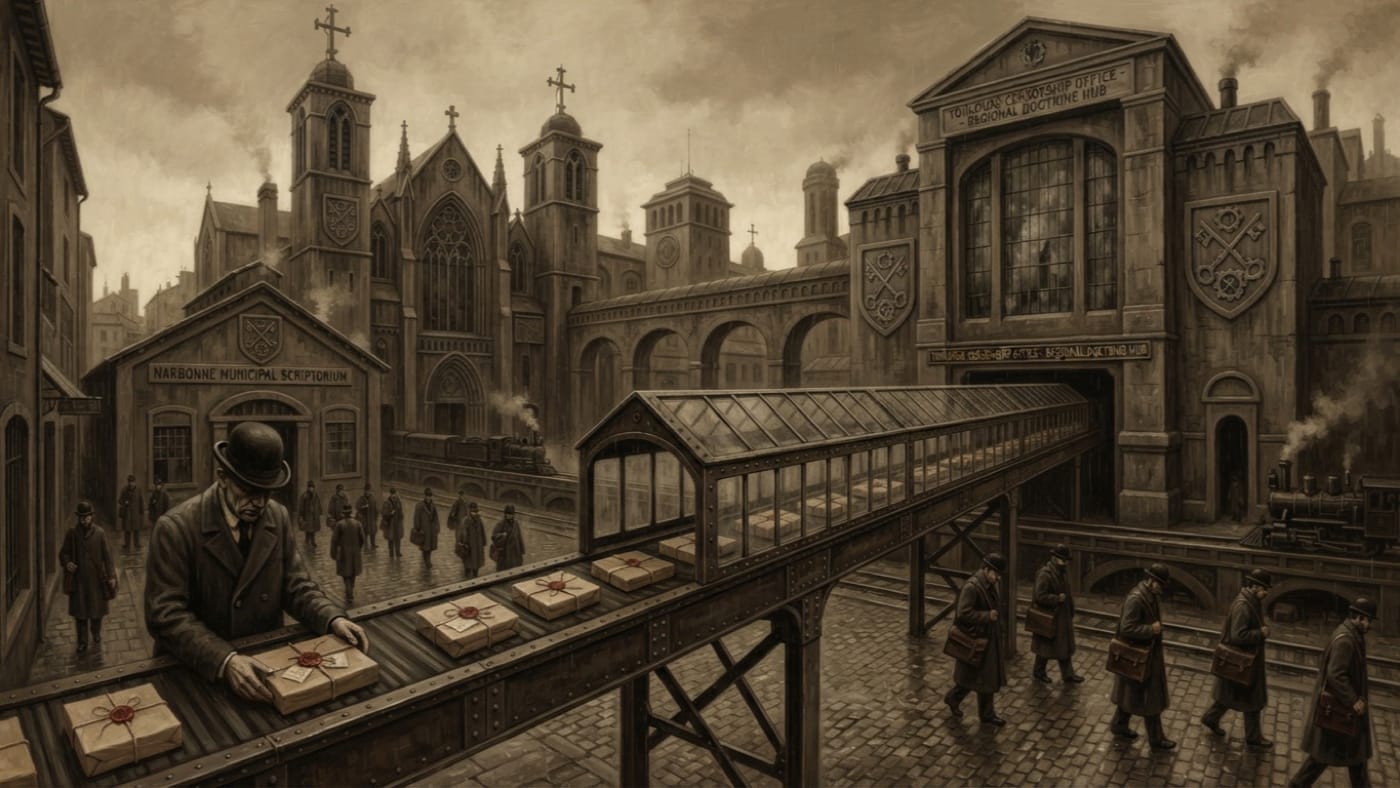
The labour was divided by Seal, as it still is. Doctrine said what an offence was. Purity enforced the definition. Records copied the result until the copies outnumbered the accused. The confiscated matter went toward Toulouse in string-tied packets sealed with red wax. Those packets were additions to the Index Damnatus, which Purity had been building since A.S. 80. The Index did not begin at Toulouse, whatever Purity's memorial tablets claim. Toulouse made it fatter.
The campaign also taught Purity to burn paper in the square, question people indoors, and send selected accused back to the square bearing marks. Those crude marks are the ancestors of the script of the Lictors of Purity. No Narbonne brand-roll has reached my desk. No account tells me which Narbonne church read the list, which households carried out their shelves, or whether anyone in the city was taken indoors and came back marked. I record the procedure. I will not stage a Narbonne square to decorate it.
#On the Priest Who Carried the Name
One officer of the campaign carried the city about with him. Father Ostel of Narbonne was a priest among the correctional agents of the A.S. 93 Hunts. He is remembered chiefly for a green robe, which he claimed was liturgically inherited. That is his claim, and I file it as his. No testator, rite or sacristy supports it.
The name ties him to the city and gives no further detail. "Of Narbonne" might mean he was born there, held a cure there, set out from there, or merely offended someone there memorably. It gives him no command over Narbonne and no jurisdiction in it. It does not prove he walked through the city during its own part in the campaign, or that he was even nearby when Carcassonne spoke its name. His fate is unrecorded. Narbonne lent him a surname and got nothing back.
Purity suppressed every sketch of him. That is my account, and I give it as mine. The Bureau would brand a bookseller and call it instruction, but it would not allow an officer to be preserved in charcoal looking absurd. Elsewhere I have compared Ostel to a vegetable. I will not repeat the comparison in a place entry, where the city might take it personally.
His full dossier belongs to his own entry. This one notes only that Narbonne's name rode into the campaign twice, once in a confession and once on a man.
#On the Primers Sent to Toulouse
The second paper belongs to the present, A.S. 201. The southern route offices now treat Toulouse as what its own entry calls a sorting conscience for the safer provinces. Several kinds of matter go there for preliminary opinion before Purity decides, in the entry's phrase, "whether to smile or bite": suspect books from Marseille, disputed relic labels from Carcassonne, and school primers from Narbonne.
Consider what a primer is. It is the first book a child is permitted to hold. It carries the alphabet, the prayers and the catechism answers, and it sets the order in which a citizen first meets the written word. A Synod that lets its first book go unread has stopped reading. So the primers go to Toulouse, where the clerks can detect Rationalist syntax under three coats of parish varnish. Those clerks learned the skill the hard way, in their grandfathers' squares.
The direction of travel has reversed. In A.S. 93 Narbonne's name went toward the fire as an accusation. In A.S. 201 Narbonne's paper goes toward Toulouse as a question. Purity hears both as the same request for a ruling.
The docket shows a referral and nothing more. It names no academy, printing house, condemned lesson, teacher or dismissed schoolmaster, and it records no verdict on any primer. Preliminary opinion comes before judgement, and it is not judgement. If a Narbonne primer has ever been burned, the burning is filed somewhere I am not, and I will not borrow it to give this paragraph an ending.
What the docket does establish is reach. The apparatus that once needed a confession to cross Narbonne's walls now receives the city's schoolbooks by routine post. Nobody has to be questioned to send them. The council at Mainz made Purity's Toulouse functions permanent in A.S. 93. A hundred and eight years later the city's own clerks wrap the primers themselves, tie the string and write Toulouse on the label.