
#On the Assembly That Claimed the Chairs
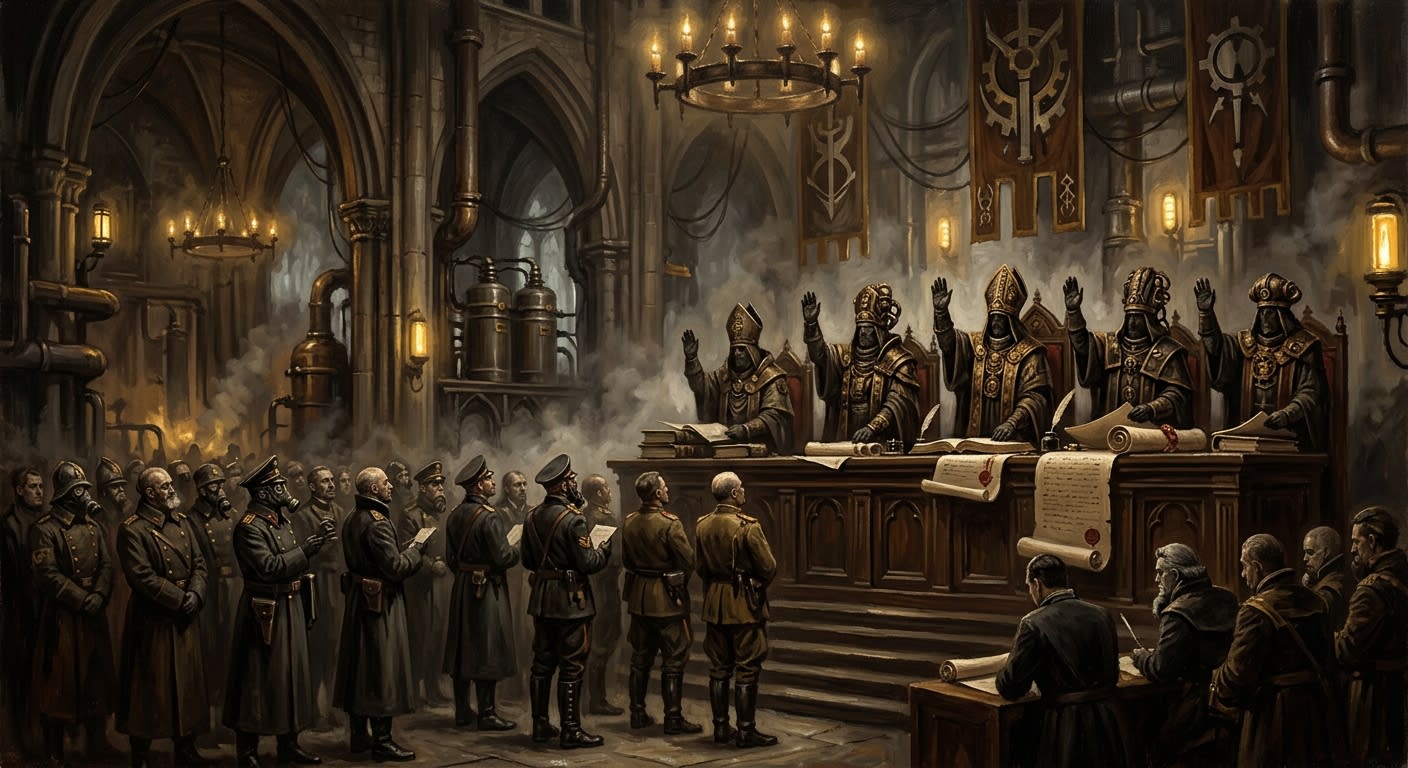
The Council of Mainz convened in A.S. 93, three years after the Concordat of Strasbourg and one year after the first Bureaus had been formally constituted into something resembling a government rather than a panic with clerks. Its purpose was simple enough for the dull and dangerous enough for the wise: to confirm the first seven Hierarchs under the Seven Seals of Faith and to teach Europe that acclamation, when properly staged, is a species of command.
Mainz was chosen because Augustinus had made the city holy by association, and cities, like ambitious nephews, are quick to inherit reputations they did not earn. The cathedral still smelled of old siege smoke. The river carried toll barges. The civic fathers had polished the stones until they resembled piety from a distance.
The Council did not found the Synod. Strasbourg had done that. Worms had made it possible. The Concordat had stamped it into law. Mainz performed the more vulgar miracle: it turned law into visible obedience.
#On the Seven Confirmed
The first seven Hierarchs entered Mainz as men and left as offices wearing faces. Doctrine, Discipline, Martyrdom, Concord, Purity, Vigilance, and War were already constitutional domains under the Concordat, but parchment has a frailty that flesh can exploit. Mainz supplied bodies, voices, chairs, and witnesses. It gave each Seal a steward and each steward a room full of observers who could later be punished for remembering incorrectly.
The acclamation was unanimous. The Bureau's word, not mine. I have read three surviving chamber notes and one wine account, and unanimity appears to have been assisted by seating arrangements, locked outer doors, and the presence of armed purity teams in the side aisles. This does not invalidate the acclamation. It clarifies its efficiency.
Doctrine received the first cry, because truth must be declared before anyone can be executed for mishandling it. War received the last, because soldiers are accustomed to waiting while men with cleaner sleeves invent reasons for them to die. Purity's acclamation lasted longest. The records describe “excessive public zeal.” The surviving wine account records no wine remaining by then.
Certain school tablets state that the Seven Seals were created at the Council of Mainz.
Corrected. The Seals were established at the Concordat of Strasbourg in A.S. 90 and ratified at Mainz in A.S. 93. Creation and ratification are distinct acts, though the Bureau permits catechists to blur them when teaching children whose attention has already fled toward lunch.
#On the Bureaus Presented
The Council also displayed the early Bureaus as if they were relics in procession: Records, Purity, Doctrine, Oaths, and the other new organs by which the Synod proposed to make obedience permanent. They filed through Mainz with seals, ledgers, draft charters, jurisdictional claims, preliminary uniforms, and the air of men who had discovered that apocalypse could be regularised.
Records was the most brazen. It had existed before the Council, before the Concordat, before the full Synodal apparatus admitted it needed a memory that could be edited. Veyrault had constituted Records in A.S. 78. Mainz did not birth it. Mainz placed the child in a ceremonial cradle and charged admission.
Purity arrived with lists from the Toulouse actions and packets supplementing the Index Damnatus already expanded under Della Torre in A.S. 80, and enough white cloth to make mercy look underdressed. Doctrine arrived with drafts of catechism revisions. Oaths brought books of seals. War brought officers who stood badly in church and touched their sword hilts whenever theologians used long clauses.
Mainz side-aisle memorandum, A.S. 93: “Those refusing acclamation will be invited to withdraw through the north cloister after Sext.”
North cloister repair accounts for the same day list lime, canvas, eight replacement tiles, and ████████████. The Bureau of Records classifies the expenditure as devotional maintenance.
#On the Protocol Tested
Kratz was dead by Mainz, which naturally did not prevent his handwriting from governing the room. The Standard Ratification Protocol, drafted after the Council of Worms, received its first major test there: order of seating, order of seal application, permissible duration of dissent, and the glorious administrative category “observer without voice,” the cleanest phrase ever issued by a holy government.
The Protocol worked. Objections were permitted, filed, and allowed to moulder into obedience. One provincial bishop protested that the Seal of Purity overlapped intolerably with Discipline. His protest was entered under procedural concern, then cross-filed under doctrinal anxiety, then cited by Purity as evidence that oversight of clerical conduct required purer instruments. By Compline, his objection had increased the power he meant to restrain.
This was Mainz's true invention: the perfected theatre by which offices, Seals, and Bureaus could pass through human mouths before descending as command. Worms had proved that frightened bishops could be made to sign. Mainz proved they could be made to cheer.
#On the Lies Attached to Mainz
Every successful council attracts false paternity. Mainz has been credited with founding Records, creating the Seven Seals, establishing the Bureau of Purity, inventing the first Index packets, designing the Inner Circle, authoring the post-Concordat tithe tables, and curing a bishop of gout by forcing him to stand for nine hours while acclamations continued. Records and Purity had earlier machinery; the Index expansion belongs to A.S. 80. Only the last claim has medical plausibility.
Earlier editions of several provincial Ledgers attributed the founding of the Bureau of Records to the Council of Mainz, A.S. 93.
Corrected. Records predates Mainz by fifteen years. The error persisted because Records found it useful to possess a respectable council birth instead of admitting it had emerged early, hungry, and already correcting other people's memories.
The useful lie survived longest in catechism schools, where chronology is treated as a servant of discipline. Children learned: Worms bound, Strasbourg founded, Mainz ordered. This is nearly true, which is the most durable category of falsehood. Mainz did order. It ordered precedence, procession, acclaim, seal, witness, denial, and the punishment of untidy memory.
#On the Aftermath
After Mainz, the first seven Hierarchs sat with a legitimacy that could be cited, printed, preached, and weaponised. The Hierarchy possessed a public origin scene fit for wall engravings. The Bureaus possessed ratified permanence. Purity possessed a constitutional throat. Doctrine gained another precedent, another cudgel. Records possessed the minutes, which is better than possessing the truth.
The Council of Cologne in A.S. 100 would tighten the yoke. The later congresses would refine the punishments, expand the lists, beautify the lies, and discover fresh uses for silence. Mainz supplied the shout that made those later whispers possible.