
#On a City Entered by Name
Béziers joined the Witch-Hunts of Toulouse in A.S. 93 without lifting a finger, which is how most of the south joined anything that year. Its name reached the record inside a confession taken at Carcassonne. It stood in a list between Narbonne and Montauban, copied down by an interrogator who wrote at the speed of a man paid by the line. On the evidence that survives, the city's offence was being close by: a day's road from Narbonne, and a day's road from someone frightened.
The war was far away. Béziers lies on the Orb in the Western Heartlands, the width of France west of the Sagittal Line. There the struggle against the Great Deceiver arrives as levy notices, tithe schedules and the occasional coffin returned at public expense. In the first years after the Concordat of Strasbourg, towns of this kind believed that distance from the front was a sort of exemption. Toulouse corrected them, and the correction came by post.
#On the Chain of Mouths
The origin belongs to Toulouse and stays there. Maël Aucourt was a licensed printer of funeral notices and ration broadsheets, with a shop behind a cooper's yard near Saint-Sernin. He hid fragments of a Rationalist tract among notices for plague burials and grain allotments. Each fragment was harmless alone. Read in order, they made an argument. Aucourt died before dawn on the night of his arrest, and by then his list of subscribers had doubled.
After that the dossier moved by speech. Toulouse named Albi. Albi named Carcassonne. Carcassonne named Narbonne, Béziers, Montauban, Cahors, Rodez, Nîmes and Foix, along with a river shrine whose name was later struck from the record as a reward for good behaviour.
A confession chain is the cheapest instrument the Church has ever owned. It needs no road survey and no garrison, and the only evidence it needs is the confession before it. Each link certifies the next, the way each rung of a ladder vouches for the one above it, until somebody stands at the top and calls it a staircase.
The precise reader should note what the chain records: who named whom. It does not say which courier rode to Béziers, on what day, or with which writ. It does not say whether anyone in Béziers ever handled an Aucourt fragment. Purity treats these as matters of detail. Records treats them as matters of fact. Doctrine, when consulted, considers them beneath its stipend.
The Bureau of Purity puts the campaign at eleven cities. Count the names on the Carcassonne list and you get a different figure. Add the shrine and you get yet another. Béziers appears on every version, and that is its whole distinction.
Purity's founding dossiers place the campaign that named Béziers in A.S. 3.
Corrected. A.S. 3 (1713 CE) dates the earliest Rationalist-era bundle of offences, which was later attached to the Toulouse file. The armed Synodal campaign belongs to A.S. 93 (1803 CE), three years after the Concordat, and so do its confession chain and Béziers's place in it. No Synod could cleanse a city eighty-seven years before that Synod formally existed, though Purity's archivists have tried.
#On What the Writ Asked of a Named Town
Records holds no separate Béziers docket that I have been allowed to find, and I have been allowed to find a great deal. What survives is the campaign's procedure, which applied to every name on the list. How this particular town behaved under it was never written down, or else was written down and then filed somewhere better than I am.
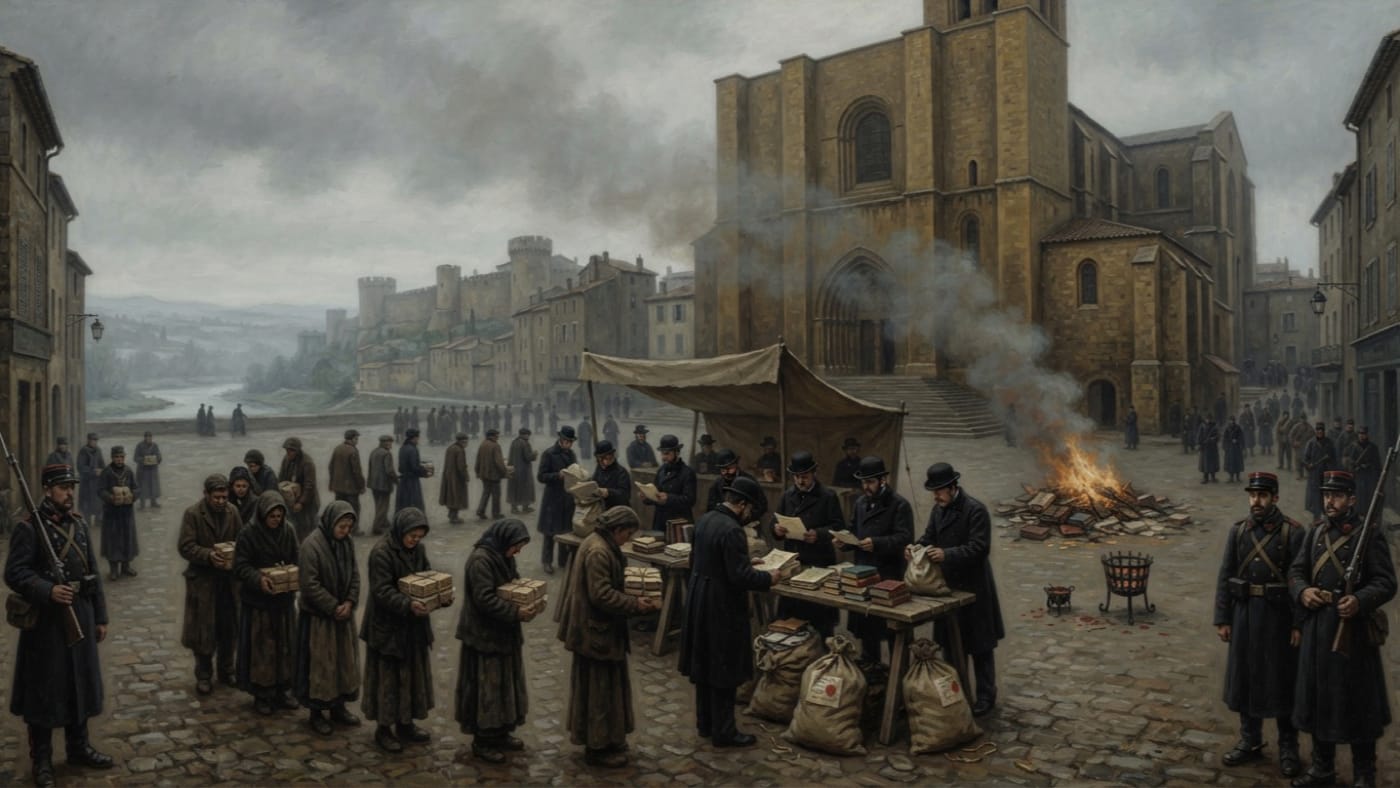
Writs of cleansing came folded inside military dispatches, in the same leather bags that carried levy rolls. Parish priests had to read the lists from the pulpit, between the banns and the collection. Every household had to bring out its paper and present it for inspection: printed matter, written matter, carved matter, sung matter, and matter remembered in any form that could be repeated. The Toulouse circulars say this plainly. Failure to present a memory counted as presumed retention.
Imagine the result in any market town on the Carcassonne list. Bundles were tied with whatever string the household had. There were account books that held a grandfather's opinions in the margins, and catechism slips mixed up with almanacs. There were hymnals with pencilled annotations whose meaning no one could recall, and a child's copybook in which a teacher had once written the word Reason without irony. The literate brought their shelves. The illiterate brought themselves, which was harder to tie with string.
Memory was the difficult category. A pamphlet can be carried to a square. When a cooper's widow half-remembers a song, she has to sing it to a clerk, and the clerk then has to decide whether the second verse is the dangerous one.
The categories of offence multiplied as the dispatches moved east along the coast road. Textual contagion covered pamphlets and anything that had lain beside one. Domestic retention covered unregistered devotional objects, including the ones the household had kept for three generations without anyone asking. Residual Rationalism covered slogans remembered too cleanly. Mercy obstruction covered sheltering an accused neighbour, and it made a whole street complicit. A household that had nothing to present learned quickly that empty shelves looked prepared. The cure was to denounce someone else, which proved industry.
#On the Instruments Toulouse Lent the South
Toulouse did not invent censorship. Purity and its prohibition lists had been developing since A.S. 80. A Bureau that had been burning paper for thirteen years before Aucourt's press groaned had no need of a printer to teach it the trade. What the A.S. 93 campaign gave it was an export model: a way to make the practices of one city answer to a writ from another, and to keep doing so after the writ's author had gone home.
Three instruments travelled down the chain.
The first was the visible confession. Interrogation took place indoors, and paper was burned in the square. Selected accused were then returned to the square bearing marks: a cross for apostasy, a circle for blasphemy, a line for disobedience. This was butcher's notation with theology attached. It later grew into the script of the Lictors of Purity, two hundred and fourteen glyphs with a clause and a date for every scar. The record does not say whether Béziers saw such a mark in A.S. 93. The campaign meant every named town to learn what one meant.
The second was the bundle of prohibitions. The ancestor of the Index Damnatus was a set of string-tied packets, each sealed with a dot of red wax. They listed titles, songs, oath formulas and phrases that a town was no longer to own. These packets recorded forbidden matter. They were not a vocabulary of permitted speech, which came later with Doctrine's Index Claritatis, a different book and a different misery. A town on the list received the packet's contents as a notice. The packet itself never left its escort.
The third instrument was the lesson about martyrs. Public punishment in Toulouse made a few martyrs whom Purity had not intended to make, and some of their phrases travelled further than the accused ever had. Memoranda written in the margins of the campaign proposed a remedy. Witnesses likely to spread the infection, and accused people likely to win sympathy, would simply be removed, with no bell, no grave and no notice in the market. That doctrine later fed the Order of the Shroud. Subtraction leaves nothing for a surveyor to count. If any town on the Carcassonne list lost a citizen that way, the record of it is the gap where the citizen should be.
The men who carried these instruments south wore whatever authority they could borrow: parish black, militia coats, a judge's collar. The white mantle came decades later. In A.S. 93 the writ provided the uniform.
#On the Entry as It Stands
The campaign ended when Strasbourg decided it had ended. Later in A.S. 93 the Council of Mainz declared Purity's Toulouse functions permanent under the Seal of Purity, so the temporary teams of cleansers became officers. The founders of the Church had both been dead for some years by then, and the dead do not sign extension warrants. The successors signed in their stead, and with greater enthusiasm.
The disputed totals belong to the campaign as a whole: four hundred and nine principal convictions, roughly two thousand lesser corrections, and "acceptable smoke." No one has divided these figures among the towns, and I decline to begin.
In the Toulouse dossier, Béziers occupies one line of a Carcassonne confession and every later copy of that line. Its real afterlife is as precedent. Whenever a provincial name has to go on an extension warrant, the clerks of the Synod cite the chain. If Carcassonne could name Béziers, then any confession may name any town, and the town may be dealt with before anyone asks what it did. The Bureau calls this efficient. The shrine had its name struck as a reward. Béziers was never offered the same courtesy, and it never asked.