
#On the River Street Where Vacancy Took a Number
The Quai des Bateliers is a river-facing administrative street in Strasbourg, narrow, damp, toll-bellied, and made famous beyond its architectural merit by one waiting room, one bench, one clerk, one heretic, and forty minutes of procedural humiliation so perfect that the Bureau of Purity has spent sixty-three years pretending the bench was replaced for reasons of maintenance.
It lies where the respectable River Quarter (Unregistered) begins remembering commerce and the Sanctum Mile begins remembering it owns commerce. Boatmen gave it the name. Purity gave it dread. Arno Kett gave it doctrine’s most infuriating address.
The quay itself is not grand. Grand places waste too much effort announcing power. Quai des Bateliers works in brick, black drainwater, iron rail, soaked rope, clerks’ shutters, and the particular river smell produced when imported grain, confessional fear, fish offal, candle wax, and wet wool agree to rot under jurisdiction. Barges still moor there at dawn. Boatmen still swear there with admirable economy. Merchants still count crates beneath awnings patched so often they resemble petitions. Above them, the Purity district office keeps its white lintel clean.
#On the Quay Before the File
Before A.S. 138, the Quai des Bateliers possessed an older and less glamorous importance. It handled small river traffic: ferry writs, boatmen’s guild dues, fish levies, linen crates, contraband wine that everyone smelled and no one taxed properly until the third complaint, and the thin daily commerce by which Strasbourg proves that even holiness requires delivery times. The bateliers themselves were not romantic figures. They were river labourers: bent-backed, rope-handed, suspicious of priests, devoted to weather, and capable of identifying a Tithes assessor by footfall through fog.
The street grew administrative because cargo attracts forms. Forms attract clerks. Clerks attract offices. Offices attract Purity once the clerks begin taking shortcuts through human nature. By A.S. 112, after the Orthography Purge taught the Rhine districts that letter-forms could become indictments, a small Purity reading room opened above a tariff annex. By A.S. 129, after the Night of Two Bells made route obedience newly fashionable in death, the reading room acquired an interview chamber. By A.S. 134, following the Cologne curfew embarrassments and several river-book seizures, the chamber acquired cells. A building that begins with a desk often ends with a drain.
Later tourist guides identify the Quai des Bateliers as “an ancient Purity precinct.”
Corrected. It began as a working river quay and tariff edge. Purity arrived later, as mould arrives in a damp wall: first unnoticed, then structural, then defended by officials who insist it has always been part of the design.
The office’s location was practical. Heretical paper moves by river. Foreign books arrive in crates labelled lamp oil, smoked eel, devotional ribbon, Flemish glass, or medical gauze. Informants prefer streets with exits. Boatmen hear everything and remember selectively. A district house on the quay let Purity sniff incoming goods, seize talk while still damp, and pretend the smell of fish was proof of vigilance rather than bad drainage.
It also sat close enough to the Basilica of the Ledgered Saints to borrow sanctity and far enough from the Tower of the Quill to avoid attracting grand visitors unless embarrassment demanded them. This is the ideal altitude for a district office: below glory, above mud, within smelling distance of both.
#On the District House
The Bureau of Purity district office on the Quai des Bateliers is smaller than the Ashen Cloister and more useful for that reason. Great headquarters terrify from a distance; district houses ruin mornings. A citizen can persuade himself that the Ashen Cloister belongs to grand heretics, notorious sinners, dangerous pamphleteers, and men whose wives already know to burn letters. The quay office belongs to everyone else: the boatman who carried a sealed box, the apprentice who miscopied a prohibited curve, the grocer whose back room hosted a quiet arithmetic lesson, the mother whose child stopped singing at Matins.
The façade is modest: three storeys, whitewashed lintel, iron-grilled lower windows, rain-dark stone at the base, and a carved Purity eye above the entrance whose pupil was chipped by an unknown hand in A.S. 151 and repaired so badly that it now appears to squint. I admire this. Few buildings confess their own attitude so efficiently.
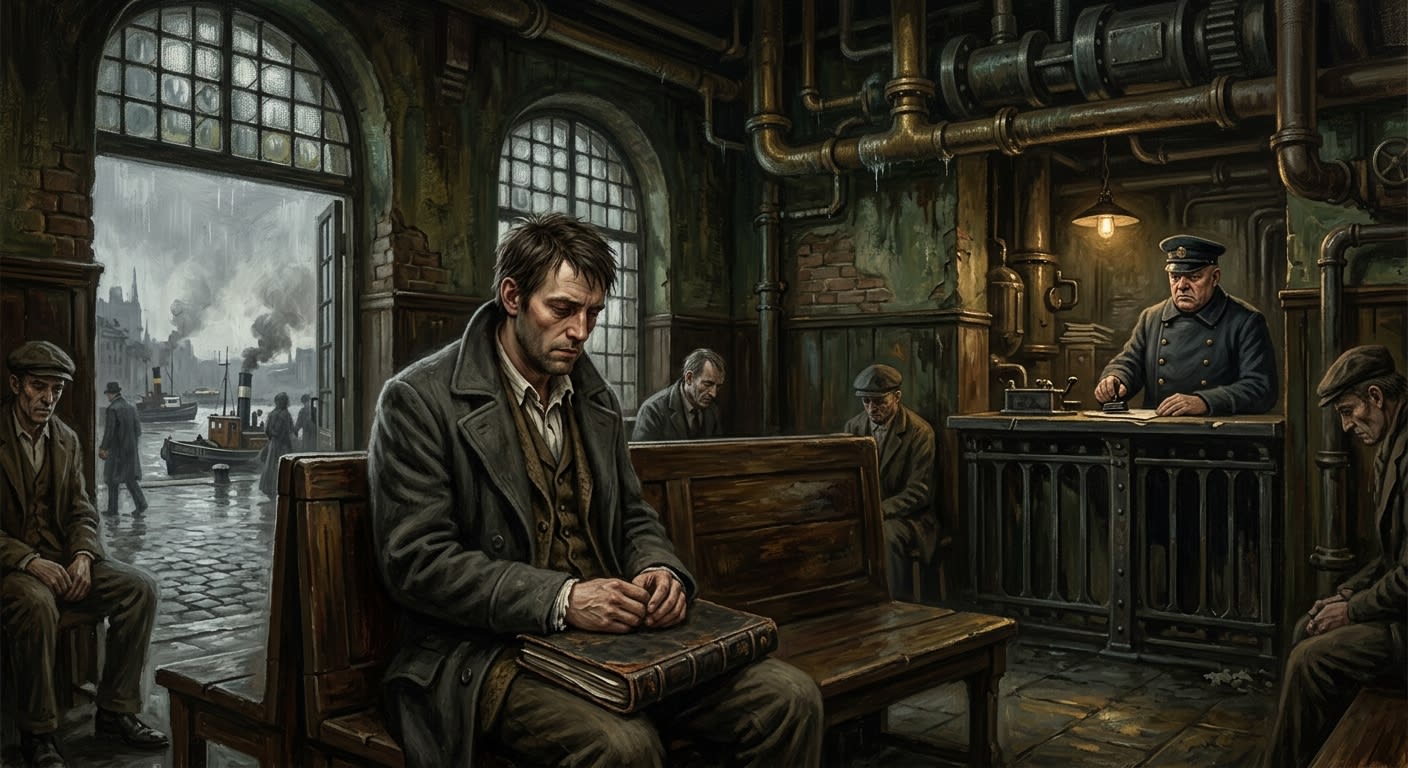
Inside, the front room holds benches, a counter, a clock, two icons without expressive faces, and a door behind which citizens imagine screams because citizens are, in this one respect, observant. The first floor receives complaints, confessions, contraband declarations, voluntary reports, involuntary reports filed by neighbours, and those exquisite little denunciations phrased as concern. The upper floor contains interview rooms. The cellar contains material which the Bureau describes as records awaiting transfer.
The last sentence was added after Kett. Naturally.
#On Arno Kett’s Forty Minutes
In spring A.S. 138, after Lutz Brennan confessed and returned to the cell smiling like a man whose conscience had found a receipt, Arno Kett burned the papers, dismissed the cell, and walked to the Purity district office on the Quai des Bateliers. He did not flee into the Warrens. He did not hire a boatman. He did not vanish into the cathedral markets, though he had rehearsed such routes and taught others to do precisely that. He entered by the public door.
He announced himself.
He sat for forty minutes because no inquisitor was available.
The clerk’s note survives in the Doctrinal Nullification file, copied in three hands and argued over by persons whose collars deserved tightening. Subject entered voluntarily. Hands folded. Declined water twice. Watched the door, not the icon. Forty-minute interval unexplained. Later cell-site sweep found ashes still warm and no names recoverable.
The interval is the whole wound. Kett surrendered with procedural venom. He converted arrest into appointment and appointment into accusation. A Bureau devoted to discovery found itself receiving. A Bureau devoted to pursuit found itself behind schedule. A Bureau devoted to extracting confession heard a man request confession and state, with intolerable neatness, that he had nothing to confess.
PUR в-138/KETT — WAITING ROOM SUPPLEMENT Bench position: second from counter, river wall. Clerk on duty: ████████. Subject asked whether the clock was correct. Clerk answered yes. Later audit showed clock three minutes slow. Recommendation regarding clock: █████████████████████.
The interrogation lasted nine days elsewhere in the building, or beneath it, or in a transferred chamber no map has admitted. The charge drafted from the proceeding made absence of belief prosecutable as civic injury. The street received no plaque. Plaques are for safe history. Quai des Bateliers received an additional guard and a rule forbidding unscheduled self-identification by proscribed persons unless witnessed by two clerks.
That, reader, is statecraft.
#On the River’s Witness
The Rhine is close enough to hear the office when the lower shutters open in summer. This proximity has caused more theology than convenience warrants. Kett’s ashes were later scattered in the river, a punishment chosen to deny grave, relic, shrine, fixed point, and pilgrim handle. Yet the office where he entered stands on a quay, and the river beside it carries barges, sewage, blessings, ash, printed slips, and the moral joke that distribution may be punishment’s unintended child.
The boatmen know this and do not say it near white cloaks. They have their own names for places: Hook Door for the Purity entrance, Cold Bench for the waiting room, Rat Clock for the three-minute-slow instrument, Saint Nothing’s Step for the rain-dark flagstone where Kett reportedly paused before entry. None of these names appears in official maps. All of them appear in dock speech by the third cup.
A Bureau of Records street index states that “Saint Nothing’s Step” is a foreign sailor’s corruption of “Saint Nathaniel’s Stoop.”
Withdrawn in private. No Saint Nathaniel chapel existed on the quay. The explanation was invented by a Records assistant who disliked atheistic punning and possessed insufficient respect for dockworkers’ memory. He has since been promoted, which is not the same as being vindicated.
The quay’s labour continued around the incident because labour is indecently resilient. Fish arrived the morning after Kett entered. Rope was tarred. A grain barge from Mainz disputed its measure. A woman sold hot broth from a cart and charged two extra pennies to men leaving the district house pale. The Synod created a new legal doctrine upstairs while downstairs a boatman lost three teeth over a mooring fee.
#On Later Use and Present Condition
After A.S. 138, the Quai des Bateliers became instructional. Purity brings junior clerks there to study informant handling. Doctrine sends students to look at the door and repeat the founding phrase of Nullification without smiling. Records preserves the bench number, though the bench itself was replaced in A.S. 162 after “wood fatigue,” a phrase I accept only because cowardice should occasionally be allowed furniture.
The district house remains active as of A.S. 201. Its work has broadened. River paper seizures. Silent Godless indicators. Arithmetic clusters among dock clerks. Unauthorized silence in boatmen’s confraternity rooms. Foreign prayer sheets. Contraband Rationalist catechisms disguised as fish ledgers. Informants who confess too loudly. Informants who smile too brightly. Citizens who enter voluntarily and thereby cause everyone behind the counter to inspect the clock.
The street is now watched in layers. Purity watches the quay. Records watches Purity’s watch lists. Tithes watches cargo, because even heresy should declare weight. The Bureau of Masks and Seals checks quay paper for hand drift when an ash-slip turns up in a fish crate. Boatmen watch all four and survive by pretending their eyes are full of rain. Silent Godless cells no longer meet nearby; they are not sentimental idiots. They still use the phrase “go to the quay” to mean surrendering before the trap closes, burning the papers first, and leaving the Bureau with a body but no map.
The Quai des Bateliers deserves its article because geography sometimes becomes legal instrument. The charge of Doctrinal Nullification was drafted in rooms above a court and ratified by men who had eaten breakfast, but its body entered through a river door. The place matters: a wet street between trade and terror, between boat-hook and white cloak, between the arithmetic of grain and the arithmetic of disbelief.
Stand there at dawn and the city reveals its excellent vulgarity. Bargemen curse. Clerks unlock shutters. A bell rings somewhere inland with more authority than music. The Purity eye squints above the lintel. The river moves past, carrying what Strasbourg throws into it and what Strasbourg cannot keep from travelling.
On the second bench from the counter, no one sits long if he can help it.