
#On the Unmarked Wagon
"Supply transport, routine." — Bureau of Records, standing entry for movements after the final peal
A disappearance has mass. A man taken from his kitchen at the second hour of night still weighs what he weighed at supper, and someone must lift him, and something must carry him. The doctrine of the Bureau of Shadows would prefer that he simply cease, in the manner of an annulled clause. Bodies are less cooperative than clauses. They need an axle.
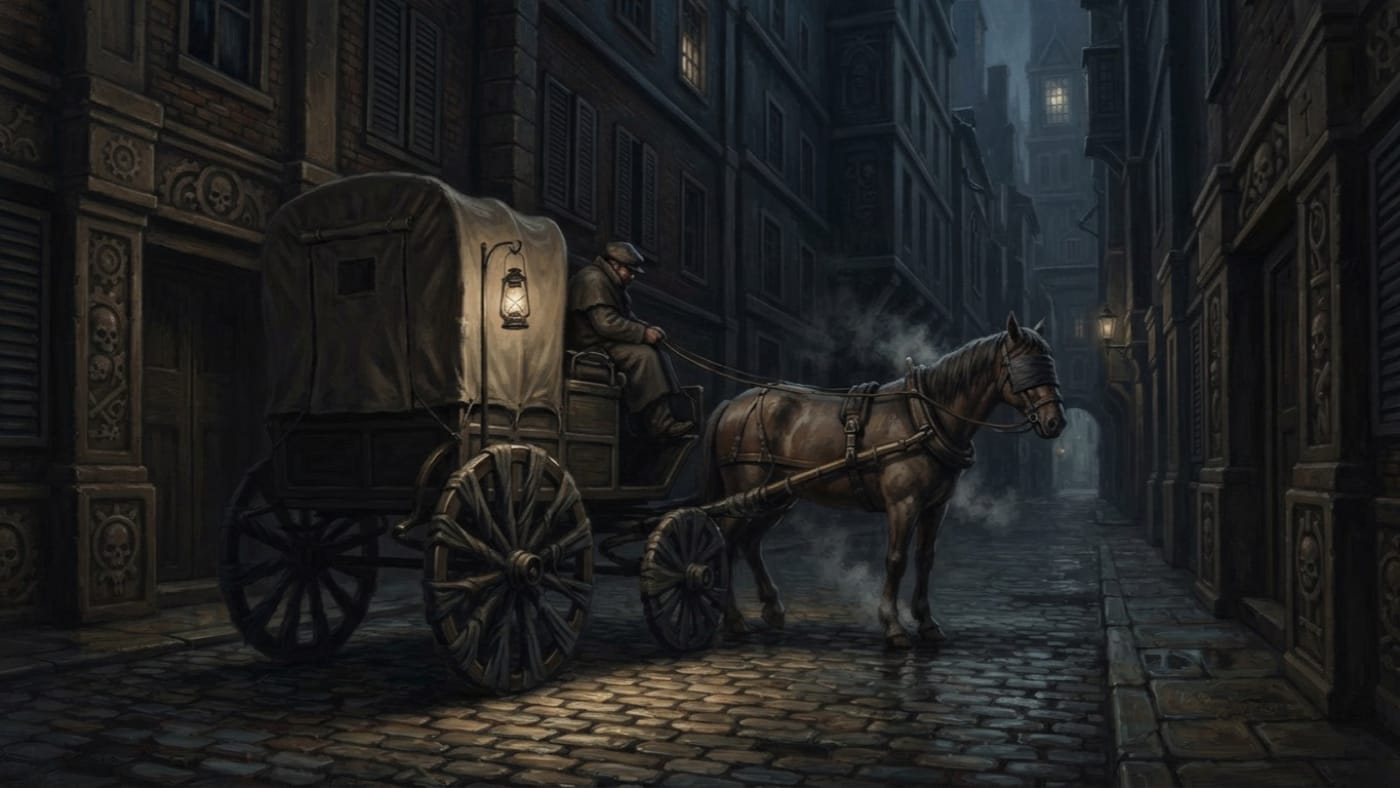
The Night Wagon is that axle. It is a horse-drawn cart of no particular pattern, with a covered body, its canvas lashed tight, a seat for the driver and a compartment behind him that is checked before every collection. It carries no insignia. Its driver wears no uniform the Bureau of War would recognise. No manifest rides with it. The Bureau of Records enters its movement, when it enters it at all, under a phrase so dull that no clerk has ever read it twice.
The Synod keeps its sacraments in gold and its theology in vellum. Its absences it keeps in a cart that smells of horse.
#On Its Fittings
None of the following is secret. Any stablemaster in Strasbourg could list it, and several are paid handsomely not to.
The wheels are wrapped, spoke and rim, so that iron does not ring on cobble. The wrappings wear through and must be replaced, and the drivers carry spares the way a priest carries a second stole. The axles are greased against the squeal that would otherwise announce the whole enterprise to every shuttered window on the street, and a squeaking axle is reckoned, among the men who drive these carts, a worse fault than drunkenness.
The horse is blindfolded. I am told this is done to keep the animal from shying at what it might see on the road, and also from refusing what it might see in the compartment. The ordinary harness is taken off at dusk and a quiet one buckled on, leather in place of chain wherever leather will hold. The lantern is hooded so that it lights the next yard of road and nothing else. Even the keys are wrapped, so that a ring of them at a driver's belt makes no more sound than a purse of wool.
The depots are kept behind the fronts of tariff chapels, which have the advantage of large doors, regular deliveries and a congregation no one visits voluntarily. Inside, the air holds wet straw, cold iron, horse sweat, lamp soot and the sweetish mineral note of grey wax, which comes in on the hands of whoever brought the night's instructions.
No two wagons are alike, and I can supply no blueprint, no dimensions and no figure for how many persons a compartment holds. The Bureau of Engineering has not been invited to measure. A cart that matched a published standard could be recognised from one, and the whole purpose of the thing is that it resembles every other cart in the city until the moment it stops outside your house.
#On the Negative Route
The driver's work begins in daylight, with ordinary carting. Fuel, chapel ash, sacks for a depot: honest labour, done slowly, so that the neighbourhood grows bored of his face. Late in the day the harness is changed, the wheels are wrapped, the lamp is hooded, and the compartment is inspected for straw, splinters and whatever the previous night left behind.
The route is chosen by subtraction. The Night Wagon Driver calls it driving the negative: a path defined by the gates he will avoid, the bell-towers he will not pass beneath, the watch lanes he will not cross. He does not use the same gate twice in a week. Where a gate cannot be avoided, its keeper has already been paid, and paid again, since the first coin buys passage and the second buys forgetting. A favoured trick is to fall in behind a sanctioned grain convoy, so that the guards remember the lawful wagons and fail to count the extra one at the tail. The trade calls this the Shadow Convoy.
Collection belongs to others. A Gauze-Masked Custodian takes the person; the wagon receives what the Custodian delivers, at a door someone else has oiled. Wagon Hands and Corridor Runners see to the staging, the sealed doors and the timing. The driver drives. These are separate offices with separate ladders, and the Bureau keeps them apart so that no single man can describe the whole night.
Then comes the handoff, at a bridge station, a depot chaplain's yard, or one of the unmarked doors of Strasbourg that open onto corridors absent from every plan of the city. Where those corridors lead I cannot say.
Papers do travel with the wagon. A Night Papers Courier may meet it with grey vellum under grave-wax, and the order may carry a dawn deadline that turns an ordinary collection into a race. Those slips are authority. They say who may act and until when. They never say what was loaded, and the drivers hold the carrying of a written manifest as their one true sin.
The wagons go out after the final peal and come back before Matins. Between those two bells lies the whole of the trade.
#On the Eleven Wagons
The best-attested convoy belongs to the Year of Smoke, A.S. 180, in Lübeck.
Eleven unmarked wagons left the harbour district at night. The harbour-master counted them and wrote the count in his log, and the next morning men in black gauze took the log away and left no receipt. He was transferred, in time, to a lighthouse on the Frisian coast, from which he writes pleasant letters about birds. Within the month three merchant guilds had dissolved themselves, two aldermen had withdrawn into contemplative life, and a fire had consumed forty years of the city's records.
What the eleven carried, I do not know. Where they went, I do not know. Nor can I give the order in which those consequences followed one another, or swear that each followed from the wagons at all. The surviving accounts record only "administrative material, nonspecific," a phrase I would admire if I had not drafted several like it myself.
Lübeck is no founding date. Wagons ran for Shadows before that night, by every account I trust, and I can name no first wagon, no first collection, no first driver. The carters keep a story about a First Carter of Strasbourg, old and nameless, waiting beneath a bridge with his lantern hooded in felt. They tell it the way soldiers tell of a saint who walks the trench at night. It is folklore of the trade. What Lübeck gave the city was a number, and the city has been counting wheels after curfew ever since.
#On What Returns
I have written elsewhere that I do not know what the wagons carry, that I asked once, and that the asking was noted. That remains my testimony and I will not improve on it here.
The drivers' own lore is less shy, and I report it as theirs. They speak of persons, of bodies bound for ossuaries, of sealed orders and relic-fragments boxed for removal. They joke about cargo and empty seats. They do not joke about dawn. Of any particular wagon on any particular night, I can say only that something was in it.
Two reports trouble the stables more than the cargo. A wagon goes out full and comes back empty. A wagon goes out empty and comes back heavier than it left. The heavier return is spoken of among drivers and Custodians alike, always quietly and never with an explanation. I have no explanation either, and I will not invent one to fill the space. Drivers also speak of stretches of road that behave wrongly, which they call road-wounds and mark with scratches beneath their seat boards. Private route maps are forbidden. Every driver keeps one.
The cleaning, at least, is known. The tracks are raked out of soft ground. The straw is burned or replaced, because, as the drivers say, straw remembers. The wheels are washed, the wax is scraped from beneath the nails, and the gate-man is paid. If two people later remember the same wagon in the same lane, the Bureau settles the contradiction, and the drivers put it no more precisely than that.
"Supply transport, routine." — Bureau of Records, standing classification for unmanifested night movements.
Corrected: the movement is real, the transport is real, and the cargo is unmanifested by design. "Supply" names nothing that was supplied. "Routine" is the one accurate word in the entry, and it is the one that should frighten you.
The silence that follows a Night Wagon is manufactured. It costs straw, water, coin, threats, and a neighbourhood's willingness to disagree at breakfast about whether it heard anything at all. No miracle produces it. A shovel and a purse produce it, and so does a man nobody wants to be the second witness against. Those are the forces that hold a street quiet.
#On the Present Traffic
As of this survey, A.S. 201, the wagons run. In Strasbourg they cross the midnight bridges and work the river quarter and the Warrens, where shutters close early and residents have perfected the art of sleeping through hoofbeats. They run through the port districts, where Lübeck's lesson was learned first. They run along the rear roads of the Sagittal Line when Night Papers come down in floods and some commander must be reached before sunrise. On the Queue Road, where curfew shutters the booths and patrols squeeze the lanes, residents whisper of a "tag cart," and they do not mean the grain.
The traffic runs on supplies like any other. Wrapping cloth, axle grease, grey wax, fodder, lamp felt, a stable corner, a fresh bribe for every gate captain who has discovered his own price. When those run short the wagons slow, and the Bureau of Records finds itself with a contradiction it cannot file.
The people inside pay the whole of the cost. A family wakes to find a chair empty and the parish roll in agreement with the chair. The neighbours recall a cart, or a wind, or nothing. By noon the straw has burned.