
#On the Northern Review
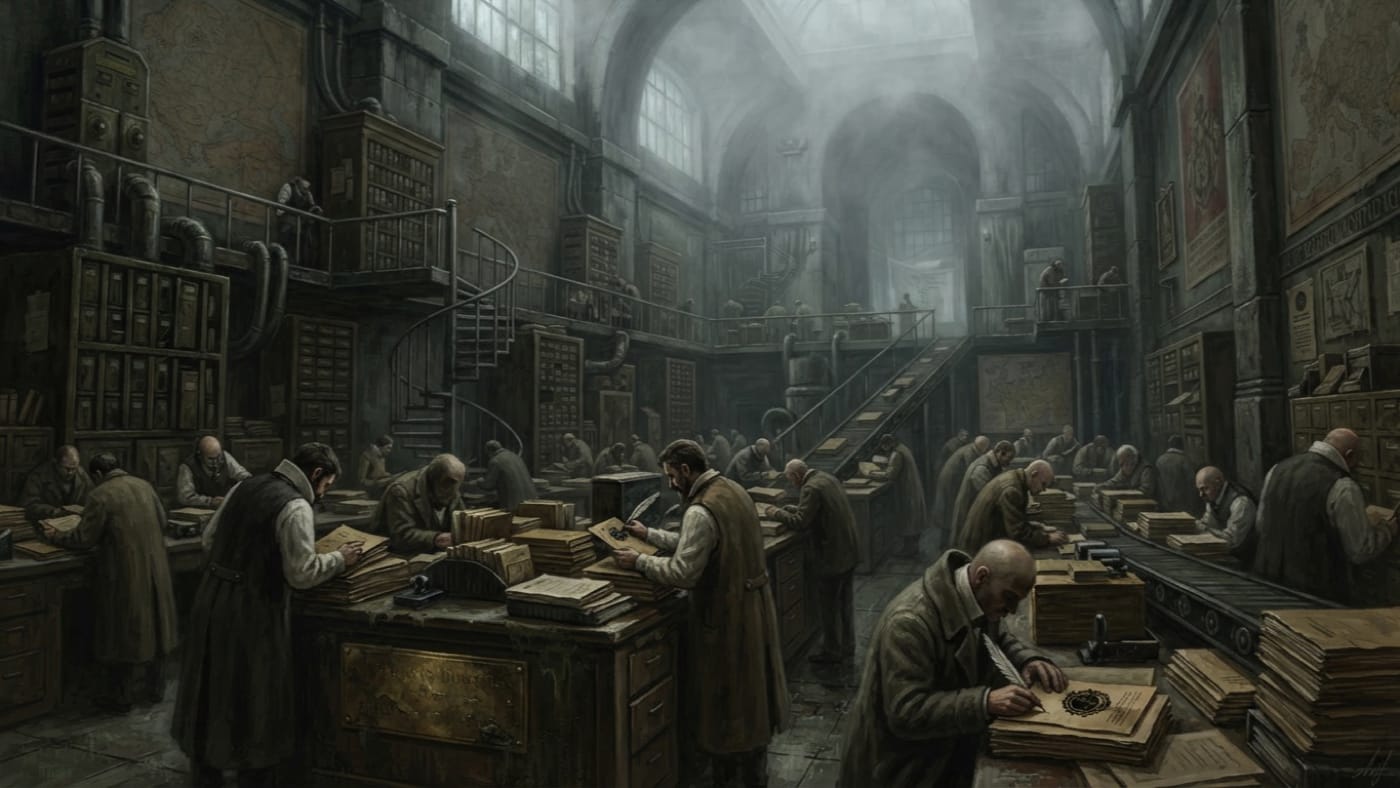
The Northern Office enters the Codex the way a bishop enters a parish ledger: as a seal on other men's business. I hold two dossiers in which it acts. In one it prevented a stupidity. In the other it tried to commit one. The files I am entitled to cite say nothing about its charter, its rooms, its roll of clerks, or the hour its candles are put out. I will not furnish an institution with chairs because the reader is uneasy among bare walls.
What the files do show is enough to be going on with. The Office sits somewhere in the administrative world of the Bureau of Doctrine, whose seals close both dossiers. Northern testimony reaches it after the other Bureaus have handled it, shaken it, and stamped it, and the Office then decides whether the next act may go ahead. Doctrine is the Brain that Defines Truth. On the evidence of two files, the Northern Office is the part of that Brain which reads the letters from Bastion-Königsberg and has to decide what Truth can be made to sign.
That is harder than it sounds. A procedure built for heresy assumes the heretic has a proposition. The north mostly sends fathers, choristers, and fog.
#On the Testimony Sent Upstairs
The Dreher case passed through four hands, and the reader should keep them apart, because the clerks did not.
The first hand is the witness. Dreher is a fisherman of the Harbour Quarter. In A.S. 198 his son vanished during a northeast fog tide, and three days later a boy walked back down the east quay wearing the same coat. Dreher refused him. His reasons, as he gave them, were small and domestic. The boy reached for rope from the wrong side. He gutted herring without cursing the stink. He slept facing northeast. He knew the price of northern lamp-oil before anyone told him. On the second night he sang, in his sleep, a tune from Dreher's father, half a bar before Dreher himself remembered it. That is Dreher's testimony. It remains his.
The second hand is Purity. It examined the boy and found him consistent with his registered identity: pulse, pupils, teeth, holy water, all in order. It then examined the father and found grief-induced perceptual deviation. Dreher broke the interviewing clerk's nose.
The third hand is the appendix. It records that the witness was restrained, the clerk was treated, and the file was sealed pending Northern review. Those four words are the Office's first appearance in the case, and all they establish is a referral. They do not show that the Office examined the boy, wrote the diagnosis, or ordered the restraint. Purity did its own work and has to answer for it.
The fourth hand is Records, which had an idea.
#On the Oath Withdrawn
Records proposed that Dreher settle the matter by paternal oath. If he swore acceptance, the identity would be considered settled.
The appeal is obvious to anyone who has spent thirty-six years among registers. A disputed identity is an open line, and an oath closes it. The Synod rests on sworn declarations. Fatherhood is a declaration the Ledger has always taken on trust, since it can be witnessed, contested, and very rarely proven. Put the father's mark beside the boy's name and the column balances. Mercy could then have the grief, Purity the clerk's nose, and the archive could stop smelling of fish.
The Northern Office reviewed the proposal, and Records withdrew it.
That is the strongest act in the record, and I will not inflate it. The file does not preserve the Office's reasoning. Here is mine, and it is attributed to me. To force a fisherman to swear that a counterfeit is his child is to put oath, fatherhood, and the Grey in one proceeding and lock the door. An oath under compulsion is already a corrupted instrument. An oath of paternity, sworn to something Dreher holds to be a replacement, is a corrupted instrument aimed at the one relation the Grey has apparently taken an interest in imitating. I do not know what such an oath would do, and neither does Records. The Office, whatever its motives, declined to find out at the expense of a Harbour Quarter household.
The withdrawal decided very little. Dreher has not recognised the boy. The boy has not been reclassified. The mother still feeds him, some neighbours still cross themselves, and the children still run when he smiles. In substance the file is as open as the day it was sealed. The Office did not explain the case. It refused to let the case be falsified.
The first draft of this survey credited the Northern Office with the dossier instruction "do not compel oath; do not remove returned subject without Castellan approval."
Amended. The record credits the Office with one act only: review of the Records proposal, followed by its withdrawal. The final instructions sit in the dossier holding under Doctrine's seal and are not individually attributed. I extended the Office's credit beyond its paperwork, which is a courtesy the Office has never extended to mine.
#On the Chaplain Who Would Not Speculate
The second file shows the Office pointed the other way.
Wendelin Grau has been Rector-Chaplain at the Cathedral Close of Königsberg since A.S. 186. Since A.S. 188 he has kept the Choir of the Northern Standard: twenty voices in twelve-hour rotations, singing hymn cycles calibrated by the Bureau of Bells and approved by Doctrine, while the fog beyond the Sea Wall sings them back note for note and sometimes ahead of time. Grau's discipline is simple to state and very costly to keep. Finish the authorised verse. Mark the clapper delay. Ignore the second voice. Starve speculation in the confessional, because fear can be absolved and decorated fear becomes doctrine.
The Northern Office asked whether Grau's reluctance to speculate showed doctrinal poverty.
I answered that speculation is cheap in heated rooms and dear on cold walls. My reply was filed under Tone, Improper.
That is the whole of the record. I find no hearing, no charge, no tribunal, and no penalty to Grau. Nothing shows the question was formally withdrawn, and nothing shows it was pursued. Grau's dossier names his affiliation as the Bureau of Doctrine / Northern Theater Clerical Office. I will not declare that office and this one the same body just because both face north. The proposal to promote him Northern Liturgical Inspector and move him to Kanzleiburg was denied by operational necessity. No file I hold puts the proposal or the denial at the Northern Office's door, so neither goes there.
#On the Limits of a Northern Finding
Put the two files side by side and the Office does not look consistent. With the fisherman it treated a forced declaration as the danger. With the chaplain it treated a withheld declaration as the fault. In one case it protected silence, in the other it questioned it, and in neither did it explain what it was looking at.
The reader may ask for a principle. I can offer an observation instead. The Office's powers, so far as two dossiers show them, are the powers of a desk. It can permit or withhold an administrative act, ask a question and file the answer. Those powers are real, and in Dreher's case they were used well. They do not reach the Grey. Nothing in either file shows the Office knowing why the boy sleeps facing northeast, or how a hymn comes back before it has been sung, or what the Grey is, wants, or numbers. The Office handled paper about the north. The north took no notice.
That is where the Office's competence stops. When it refused a false closure, it was doing its job. When it suspected a chaplain who refused to make one, it had mistaken the edge of its own categories for a defect in the man standing at that edge.
The wider constitution of the Office lies outside this survey: its reporting line, its jurisdiction over the Fractured North, its standing under the Concordat, and its place along the Sagittal Line. Northern drafts circulate with numbers of districts, cellars, schedules, and memoranda. Until they are confirmed, they remain rumours with letterheads.
#On the Present Disposition
As of A.S. 201, Dreher is monitored and has not been made to swear. The returned boy works nets under supervision in the Harbour Quarter, with no hostile act recorded against him. He cannot be removed without the approval of Castellan-Warden Halvorsen, who has authorised nothing, forbidden nothing, and is keeping her options open.
Grau stays at the Cathedral Close, where he is needed. The Choir still sings, the fog still answers, and the question about his doctrinal poverty sits filed in the same drawer as my reply.
The Grey goes unexplained in every file, this one included.