
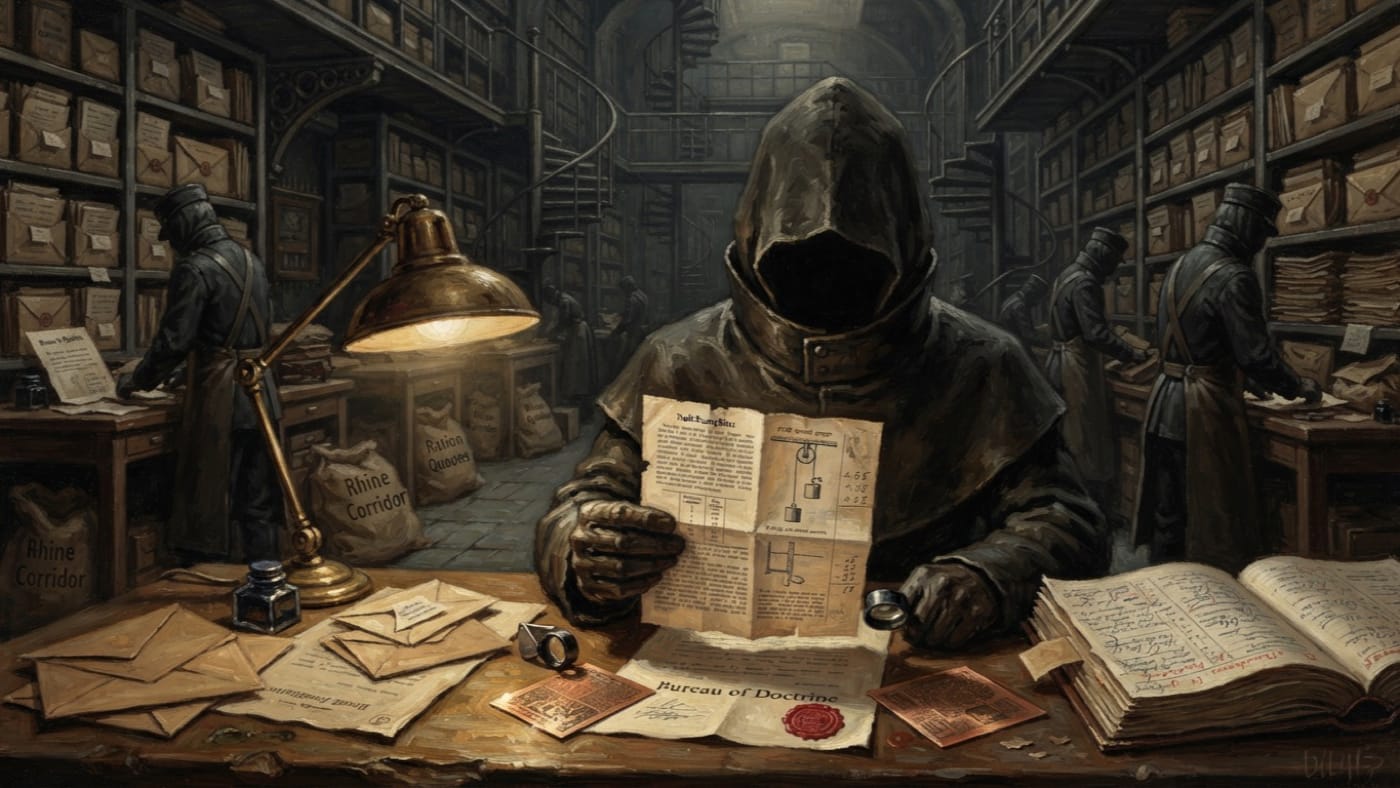
#On the Sheet
A Null-Pamphlet is a piece of cheap paper. I record this first because the Bureau of Purity, in its circulars, prefers the words vector, instrument and doctrinal incendiary. Each of them flatters a sheet that a ration clerk could fold into the lining of a cap. The paper is poor and the ink is whatever ink could be had. The sheet bears no title the Bureau has been able to treat as an edition, no printer's mark, no date and no name. The Silent Godless give it no special name of their own, which is how they treat everything they value.
Any parish censor who has seen one of these sheets will recognise the next: the diagram, the small type, the conspicuous absence of a prayer. Finding the person who made it is a separate discipline, and the Bureau has spent a great deal of wax learning the difference. A sheet can convict the person holding it of possession. It tells the Bureau nothing about who made it, and its makers have taken care that it never will.
#On the Demonstration
The pamphlets never take up the existence of the Creator. They are about rope. A sheet takes a reported wonder, usually one that moved, spoke or rose, and sets beside it a plain drawing of what a man would need to produce the same effect by hand: a pulley, a counterweight, a length of cord running behind a screen to someone who was paid in bread. Healings get the same treatment. The sheet asks who chose the sufferer, who stood nearest him, and how often the same faces return to the front of the crowd from one festival to the next. Then come the sums of convenient timing. They count how many promised interventions fall in the week a levy is proclaimed or a tithe raised, and how many fall in a week when nothing is wanted from anyone.
In the sheets I have examined, the argument stops there. The reader gets a column of figures and is left to add it up.
The sermon is the weaker instrument here, and the reason is plain. A sermon asks to be believed. A diagram asks to be checked, and every carter, bell-ringer and stage-hand in the Rhine corridor knows how a pulley works. The Bureau can forbid a preacher his pulpit in a single afternoon. It has no instrument for forbidding a man to look at the ceiling of a chapel and wonder where the beam is.
The Bureau of Doctrine holds that godlessness is a symptom of demonic exposure, correctable through catechesis. That is Doctrine's finding, and I sealed this entry under it. I will add, as a matter of record and with no pleasure, that the arithmetic in the sheets I have examined is correct. A correct sum about a cord tells you about the cord. Whether the Creator was in the room is a question for theologians, and the Silent Godless have never shown the patience to become theologians.
#On the Making
The tools are known. The Bureau has confiscated copper microprint plates no larger than a playing card, etched with text too fine to read without a lens. I have held several under the Bureau's lamps. They are handsome, which irritates me, and very small, which irritates the Bureau, because a playing card is easy to hide. How a given plate becomes a given batch of sheets is a matter for the examiners and their files. The examiners have not explained it to me, and I would not repeat it here if they had.
Inside the network, the printer is called an Ink-Mouse. The name suits the work: cellars, print-crawlspaces, rooms behind rooms, soot under the fingernails. Like every member of a cell, the Ink-Mouse has one job. That separation matters to the Bureau more than anything else about him. An Ink-Mouse prints sheets. He does not necessarily write them, carry them or know who reads them, so a captured printer is a damaged press and only rarely a confession about anything else.
The paper must be got from somewhere, and paper in the Synod's Europe is scarce, counted and valuable. Among the Silent Godless it serves as cover and as currency. They buy it from clerks who control the flow of blank stock, and those clerks are their weakest point.
Two neighbouring objects are regularly confused with the pamphlets in Bureau reports, and the confusion damages prosecutions. Arno Kett's question slips were written by hand, left-handed, in a script he invented so that it could not be traced. Masks and Seals spent two years looking for the press that printed them, and no such press existed. Kett served an apprenticeship in a print shop, and the Bureau keeps treating that coincidence as evidence. No record I have read connects him to a single Null-Pamphlet. The burner catechisms are approved prayer books with their prayers left intact and operational microtext packed into the margins. A burner catechism hides inside devotion. A Null-Pamphlet is printed with no devotion in it anywhere.
#On the Passing of Copies
The published accounts place the pamphlets in two settings, the ration queue and the military post. A queue gives the network a crowd, a wait and a reason to stand close to a stranger. The military post gives it a sack of letters addressed to men who have every reason to doubt whether the bell is heard, and the Synod has not learned to read every letter a soldier receives.
A copy passes through hands that are kept apart from one another on purpose. A Threader may carry pamphlet slivers to a dead drop without knowing who printed them or who will collect them. The person who collects them may know one face and no names. The network's rules require scraps to be burned at the end of each day, and the Bureau's seizure files suggest the rule is kept less faithfully than the network would like. Copies tend to survive in the hands of exactly the people least able to explain them: the reader who meant to burn a sheet tomorrow, and the soldier who kept one because it was the only thing in the post that was addressed to his intelligence.
The person holding the sheet is the person who will be questioned. Whoever wrote it may be in Mainz, in Cologne or nowhere at all.
#On Confiscation
The Bureau of Purity runs the hunt, and the White-Mantled Inquisitors do the walking. They search the print quarters, pattern routes and phrases, and send informants into confession booths, which Doctrine prohibits and Purity routinely does. Their best method against the pamphlets is paper-source tracing. A sheet's stock leads to a ream, the ream leads to a supplier, and the supplier leads to a clerk with a ledger. The clerk may never have read a line of heresy in his life. The ledger does not care.
The Bureau of Masks and Seals examines confiscated microprint. It compares plates against sheets and type against type, and it reports to Purity in a form I am permitted to read and not to quote. Doctrine's task is the public explanation. When a sheet has gone round a district, Doctrine answers with a declaration. When a reported wonder has been taken apart on paper in a district, Doctrine answers with a fresh account of that wonder. The pamphlet's sums are never answered with better sums. They are answered with stamps.
Fume-Inspectors and Orison wardens sometimes pass relevant observations up the chain. The pamphlets are not their office, and they are not to be blamed for what the post brings.
The Bureau of Purity's closing account of the Great Inquest of Names, A.S. 173, reported the Rhine corridor cells as effectively neutralised, an account this Codex formerly repeated.
Correction: the Inquest destroyed approximately forty per cent of the Rhine corridor cells. An estimated three hundred and twelve organisers were erased, immured or forced to confess. The surviving cells reconstituted within eighteen months, and the Bureau of Purity's own assessment of A.S. 175 records that the network had adapted faster than the Bureau's response cycle. These figures concern the network. They do not show that the pamphlets ran in an unbroken series, and I do not claim that they do. They show only that someone was still buying paper.
#On the Copies Still Circulating
This survey is made in A.S. 201. Sheets are still being taken from the Rhine corridor, from Strasbourg to Mannheim, and they still have no name, no date and no author the Bureau can place in a cell.
The Bureau's difficulty is clerical, and it is real. A confiscated pamphlet is evidence only while it can be read. A sheet that can be read is a copy. Every case file is therefore a small library of the thing the case is meant to suppress, and every inquisitor who checks a sheet against a plate has done what the reader in the ration queue did and followed the cord to the end. Purity keeps its sheets under seal. Masks and Seals keeps its sheets under lens. I kept mine in a locked drawer in my office in Strasbourg, beneath the Rhine window, for the eleven days this entry took to write.
They have been returned to the Bureau of Purity in the envelope they came in, under my seal. The covering note certifies that I examined them for form and content. It certifies nothing about the sums.