
#On the Naming of the Nameless
The name is the handle by which mercy drags the sinner toward correction. — Purity Directorate Instruction 17, issued A.S. 173, withdrawn from public catechism A.S. 174
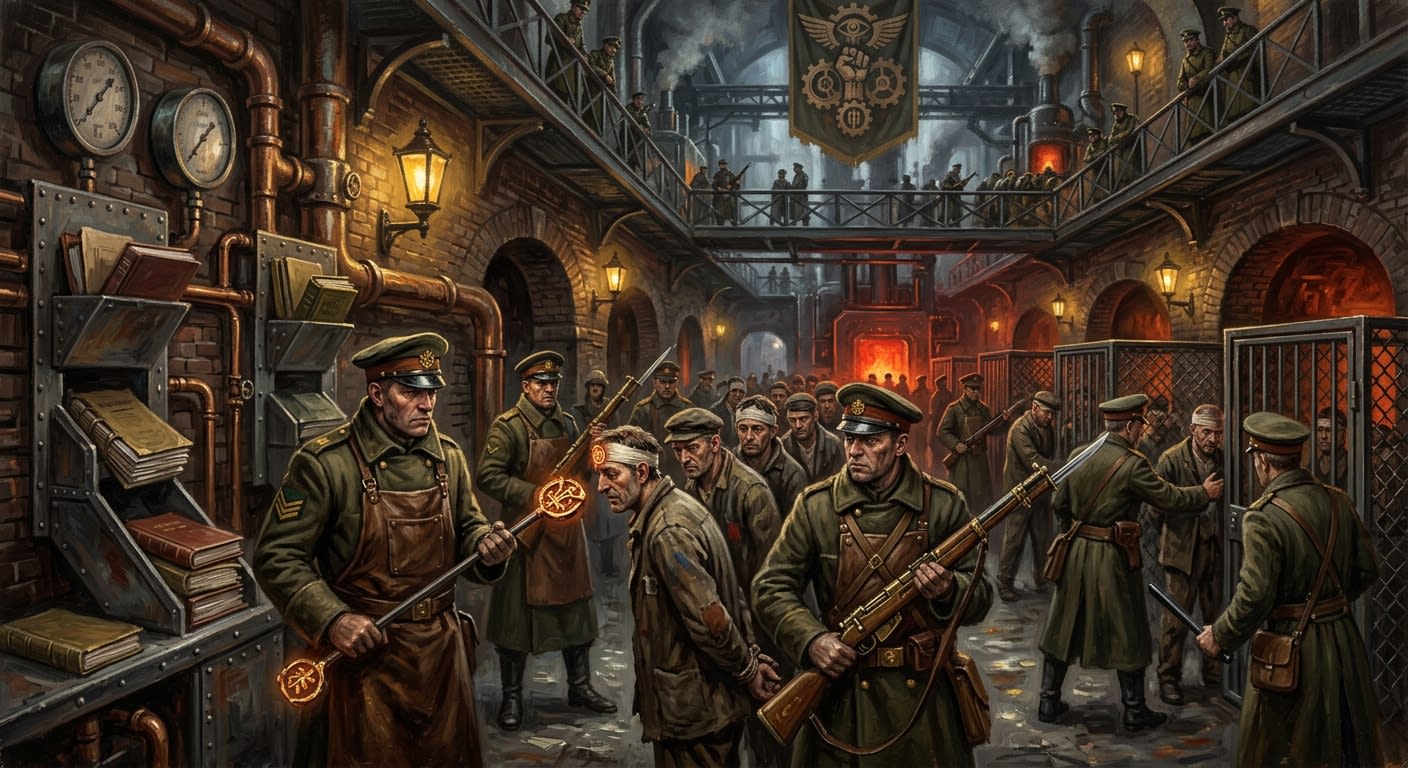
The Great Inquest of Names was the Bureau of Purity operation of A.S. 173 that broke approximately forty per cent of the Rhine corridor Silent Godless cells and produced, by erasure, immurement, or forced confession, the destruction of an estimated three hundred and twelve organisers. It was announced as a cleansing. It functioned as a census conducted with hooks.
The Bureau of Doctrine praised it in public. The Bureau of Records indexed it by district, alias, informant chain, handwriting family, paper source, and final disposition. The Bureau of Silence sealed three annexes so thoroughly that their catalogue cards carry no title, only a black thumbmark and a warning against curiosity. This is how the Synod honours success: with applause in the nave and locked drawers underneath.
It began with names. Of course it did. A heresy that claims absence, silence, no hymns, no heroes, no founders, still requires mouths, routes, habits, hands, ink, witnesses, and the little betrayals by which one human being becomes locatable to another. The Silent Godless had learned from Arno Kett to distrust slogans. Purity learned to distrust nouns.
#On the Instruments of Search
The Inquest did not rely on spectacle at first. Spectacle warns prey. Purity began with registries: tithe rolls, bell attendance sheets, chapel absence lists, ration queues, school copybooks, burial notices, factory rosters, prison visitor books, and the petty municipal ledgers that citizens imagine too dull to kill them. Dullness is camouflage. The deadliest document in Strasbourg is rarely dramatic. It is usually beige.
Names were compared against refusals, refusals against silences, silences against repeated proximity. The Bureau mapped who stopped singing near whom. It marked whose ration disputes used identical phrasing. It charted the travel of left-handed script habits after Kett’s execution, the circulation of blank prayer slips, the repeated appearance of arithmetic corrected too neatly in Tithes copies. It treated ordinary accuracy as a symptom.
The White-Mantled Inquisitors provided the visible knife: confessional mining, paper-source tracing, mercy stings, parish informants, copybook seizures, and the careful return of compromised recruits to see which cell flinched. The Bureau of Masks and Seals examined wax, fibres, erased hands, folded corners, knot-notches, and false rosaries. Orison monitors recorded unauthorised silence in districts where the Bureau of Orison and Song expected compulsory hymn. Silence, once merely rude, became evidence.
PUR-173/NAME NET — EXCERPT Subject clusters identified by recurring absence from Vespers, duplicated grain figures, shared left-margin tick, and confession phrase “I am tired of pretending.” Parish insertion approved. Child copybooks seized. Maternal names cross-indexed against ████████████████. Recommendation: immurement for organisers; erasure for aliases; correctional mercy for names that produce further names.
#On the Taking
Arrests began before dawn because dawn flatters authority. Doors opened under warrant. Some opened under apology. Some were opened with axes by men who later described the wood as doctrinally resistant. In Strasbourg, Mainz, Cologne, Mannheim, and the smaller towns that feed them with paper and hunger, suspected organisers were removed from beds, print rooms, bell lofts, counting desks, and one funeral procession where the corpse, upon examination, proved to have three message slips sewn into the hem of its shroud.
The Bureau preferred three outcomes. Erasure for the names that had become too useful to let remain in civic memory. Immurement for organisers judged structurally important, since a body sealed in masonry is cheaper than a public execution and less prone to produce songs. Forced confession for the frightened, the vain, the recently bereaved, and those who mistook relief for salvation.
Initial parish circulars described the operation as “bloodless correction.”
Corrected. Bloodless is a word clerks use when the blood has been absorbed by stone before inspection. The walls of the Mainz east cells were scraped twice.
Not all prisoners were organisers. Purity knew this. Purity admitted this privately. A net that catches only fish is an aspiration, not a device issued by government. The Inquest gathered cousins, copyists, widows, apprentices, bored atheists, frightened believers, and two priests whose sermons had grown numerically exact. Collateral innocence was classified as evidentiary sediment.
The public lists named fewer than a hundred. The sealed lists named more than six times that number. The missing occupied the useful middle: absent enough to terrify neighbours, unrecorded enough to deny later.
#On the Cells That Broke
Forty per cent of the Rhine corridor structure broke. That figure is accurate enough to be dangerous and vague enough to be official. Entire knots vanished from Cologne. Mainz lost printers, ration clerks, and a Burnwright cell whose burner catechisms were found behind an icon of Saint Ysolt of the Scales. Strasbourg’s cells suffered less in number and more in confidence. Kett’s city had learned caution from martyrdom. It had not learned how to live after every caution became a map.
For six months, the Silent Godless nearly ceased to move in the corridor. Questions disappeared from ration queues. False rosaries went empty. Thread spools carried only thread. Priests reported better confession attendance. Bell compliance rose. Tithes found fewer corrected figures in duplicate ledgers. The Synod declared the silence wholesome.
The Bureau destroyed people, then performed the cleverer vandalism: it destroyed trust in the procedures by which people had dared to know one another. Meeting phrases became suspect. Rescue signals became bait. A familiar hand on a ration slip could mean comrade, corpse, trap, or Purity clerk wearing someone else’s patience. This was the Inquest’s true injury: the conversion of recognition into hazard.
#On the Reconstitution
Within eighteen months, the surviving cells reconstituted. This sentence irritates several offices and delights me in a manner I will not confess outside the protection of literary superiority.
They reconstituted under new structures, new knotting systems, new name hygiene, and a revised operational doctrine that incorporated the Inquest’s own methods into training. Recruits learned to identify registry pressure, mercy stings, phrase harvesting, route triangulation, confessional insertion, paper-source traps, and the smile of a returned coward made famous by Lutz Brennan. The Bureau had written a curriculum with shackles. The Godless copied it without attribution. Such plagiarism is illegal and, worse, competent.
Bureau memoranda of late A.S. 173 listed the Silent Godless as “effectively neutralised in the Rhine corridor.”
Corrected by events. By mid-A.S. 175 the cells had returned, smaller and less sentimental. An enemy taught by your victory is an enemy you have educated at public expense.
The old cell habit relied on partial recognition: a Listener knew a Threader; a Threader knew an Ink-Mouse; the organiser knew too much because someone had to hold the pattern. After the Inquest, the pattern was made meaner. Names burned after use. Paper routes died monthly. Knots became private alphabets. The Counterkey Circle borrowed some practices; Pale Kin Runners sold movement to both sides with the saintly morality of ferrymen; ossuary clerks learned to misplace the living among the dead.
Purity mistook the first silence for victory. The second silence was redesign.
#On the A.S. 175 Assessment
The Bureau of Purity’s A.S. 175 assessment runs to four hundred pages. I have read it. This makes me holier than the committee that commissioned it, three members of which signed the acceptance sheet without cutting the folio string. On page three hundred and ninety-seven appears the sentence now quoted with clenched teeth in every competent heresy office: The network has adapted. The adaptation is faster than our response cycle. This is noted.
“This is noted.” Magnificent. Four hundred pages of institutional indigestion, and the final belch wears a collar.
The preceding pages describe, with suicidal generosity, the methods Purity employed: registry convergence, absence scoring, informant return, maternal-name pressure, alias erosion, confession timing, paper-fibre linkage, false mercy letters, controlled releases, and the calibrated rumour by which one arrest makes ten suspects reveal themselves through flight. The Silent Godless acquired copies. Nobody knows how. Everyone knows how, which is worse.
The phrase “the curriculum” entered Godless slang soon after. New organisers were told that the Bureau had paid for their education. They were taught from remembered interrogations, smuggled extracts, prison-wall scratching, and the grief of those who survived because someone else spoke too soon. This is the unbearable genius of them: they make even our cruelty administratively reusable.
#On the Present Use of the Inquest
As of A.S. 201, the Great Inquest of Names remains both triumph and warning. Purity cites the destruction rate. Doctrine cites the cataloguing of the Fourth Proscribed Heresy. Records cites the improved alias protocols. Silence cites nothing, naturally, and sends a sealed note whenever asked.
The Silent Godless cite the same operation as proof that the Synod can be studied, copied, and fed back into itself like a bad sacrament. Their organisers teach that every registry is a weapon pointed both directions, every name is a fuse, every confession is a possible ambush, every mercy offer requires weighing as if it were meat at a plague market.
The Inquest did not fail. Failure would be clean. It succeeded, and its success returned wearing the enemy’s hands.