
#On Sanitation and Order
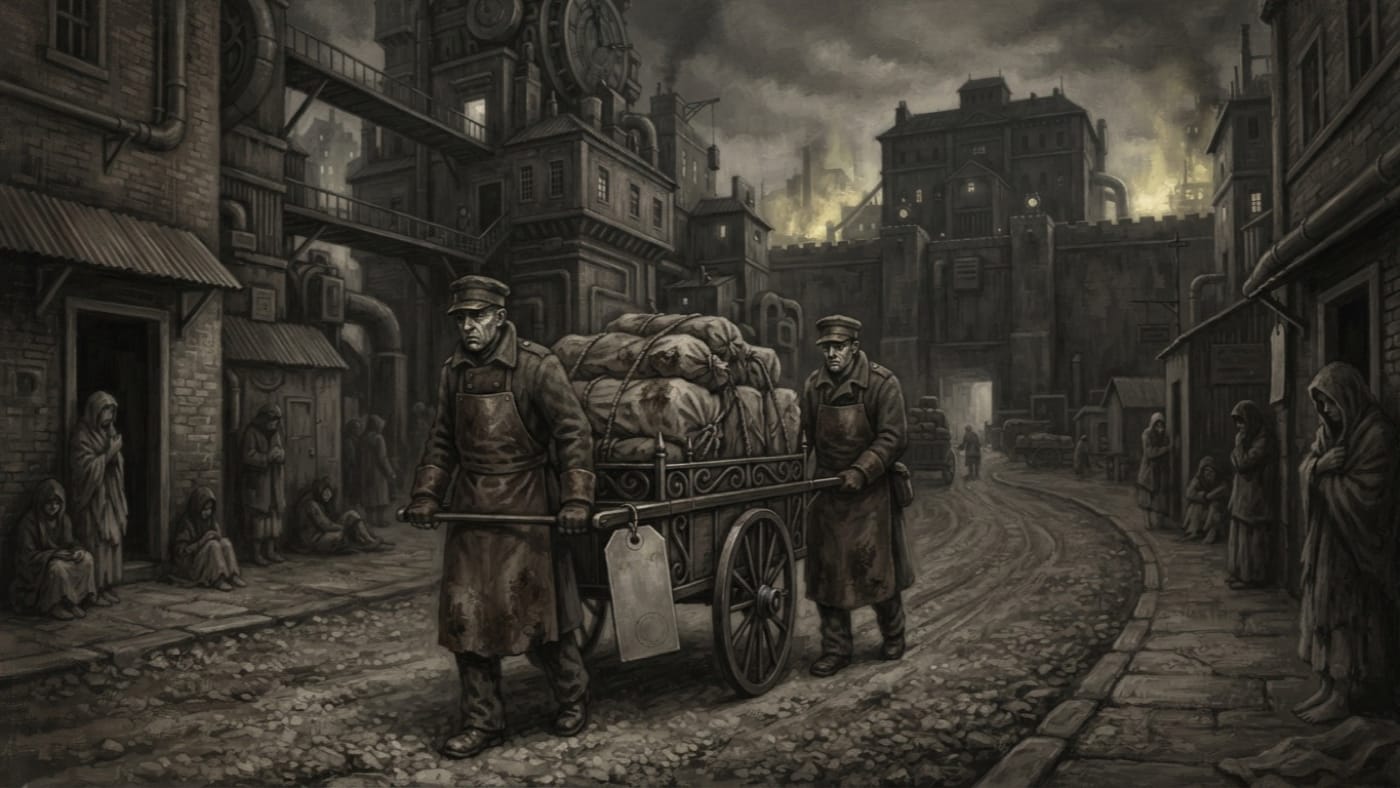
The Null Verge Custodians push carts. It is the most honest sentence this tract will contain for some time, and the reader should enjoy it while it lasts.
Their territory is the Null Verge, ninth of the districts of the Queue Road. It is the quarter where the road puts the persons it has finished reading. Their public remit is sanitation and order, and the Permit Directorate needs plenty of both. A highway built never to clear produces refuse, fever, broken axles, abandoned bundles and the dead, roughly in that order of administrative interest. Someone has to take these things away. The Custodians take them away.
What they really keep is invisibility. The erased must stay out of sight, and the erased must stay available for work. A weaker institution would find those two duties contradictory. The Custodians manage both with carts, blank tags and the hours after curfew.
The road's cant says more about them than any charter could. Among the copyists of Clerk's Mile and the hour-sleepers of the Hostel Ribbons, a custodian removal wagon is a tag cart, and people only whisper the word. The Queue Road shouts its minute prices, rings its bell-marks and calls out names when a name is advanced. It whispers only the things it is afraid of summoning.
#On the Erased Who Remain
On the Queue Road you pay in minutes. Coin comes second, then labor-hours, then confessions, which serve as the currency of appeal. A traveler who cannot meet the minute price falls into minute debt, and minute debt compounds as patiently as a cathedral chapter waiting on a widow's will.
Debt left unpaid gets converted, and the road recognizes two conversions. The first is labor conscription at Gate Nine, the largest court on the road and its great house of reclassification. The second is erasure to the Null Verge. The clerks file both under a single euphemism, Quiet Reclassification. The Codex insists on keeping them apart. The conscript goes to the Commons, where the chalk smells of bodies. The erased go somewhere that smells of nothing.
That is the Verge's distinguishing mark. Everywhere else the road smells of something: broth and sweat in the Minute Market, hot wax at Stamp Court Row, vinegar ink along Clerk's Mile, axle grease in the Salt and Grease Yards, smoke and cabbage in the Shed Wards. In the Verge there is no cooking smell and no lantern smell. The Codex does not record whether the residents are forbidden fire or have simply learned what a lit window costs. Either way the air goes quiet.
The Verge is inhabited. The road calls its people erased-but-breathing, and the phrase needs no improvement from me. They are struck from the paper and still in the body, and a body must be housed somewhere, even if the somewhere is a district that seems to have stopped happening. Not every erased resident is a Custodian. The Custodians are the ones the road found a use for after it had finished with their names. Everyone else waits, which on the Queue Road is the only occupation open to all.
At some point the road had a clerk revolt. It ended in erasures, and the Verge grew. The survey gives the revolt no year, no leaders and no count, and I decline to supply them. A purge without a date is still a purge. It just has better manners.
#On Carts and Blank Tags
Their methods are night removals, silence and threats. Each deserves a word, though the Custodians would rather it had none.
The road counts moving through a fence lane at night among its red lines, and the penalty is annihilation. The tag cart moves at night. I leave the reader to reconcile the two in private, as the road does.
The removal itself is plain work. A cart, a load, damp wheels on gravel, and a lane that is empty when the shutters open, or at least emptier. What the cart carries on a given night, and where it goes, the cart does not say. Carts are discreet, and their drivers more so.
Silence is the second method. It is the cheapest, and the Verge produces it on its own. The third method is threat, which needs no cleverness on the Queue Road. Everyone in the line carries a debt. Mentioning the debt is enough. A witness who has just remembered their own minute balance soon forgets everything else.
The tags are the Custodians' only regalia. On the road, Time Clerks are known by ink-grey cuffs, marshals by baton cords, bailiffs by collar keys. Custodians are known by blank tags. A tag on the road normally records something: a bell-mark, a lane, a stub of wax with an hour pressed into it. A blank tag certifies that the recording is finished.
The fourth thing the carts do, quietly, is supply labor. The erased are put to work. They are made useful without being made visible, which is the road's great administrative trick and a cheaper one than mercy. The tag stays blank. The hands stay busy.
What wakes the Custodians is an audit discrepancy. Elsewhere in the Church's administration an auditor is the thing a Custodian fears. On the Queue Road the auditor is their bell. When the ledgers fail to reconcile, too many minutes against too few travelers or a person present who should be absent, the carts come out. The discrepancy is cleaned up. The road itself makes no corrections. Its residents do.
#On the Tag Shed
The Null Verge Tag Shed is described, by those willing to describe it at all, as storage. They also mention silence and erasure. People who speak of it also report that names are kept there in jars.
The Codex reports that account and goes no further. It does not say whether the names are ink on slips, tags taken from the collected, or something the Bureau of Doctrine would want to classify before anyone else names it. It does not say how a name goes into a jar, or whether one has ever come out. The reported jars are enough. They need no theology.
The road's runners know the Barricade Maze, where the lanes smell of wet timber and fear. They speak of a missing lane there, one that appears on no map, and say it ends in the Verge. Some say it ends at the Shed. The Maze already has a reputation for losing hours, and an unmapped lane is a small thing beside a lost hour. The Codex records the lane as reported and gives no directions. A guide to the Verge is a request to be filed there.
#On Authority Without an Issuer
Two Custodians are known by name, or by what the Verge allows as names. One is Custodian Reeve. The other is Tagger Lorn, who has no last name. On the Queue Road that is either a misfortune or a qualification. The survey says nothing of rank between them, and I will not invent one. The title "Tagger" tells us what Lorn does. It tells us nothing about who obeys whom.
What the parent tract on the Custodians does tell us is the strangest fact in the Verge. The Null Verge Custodians work under stamps from an issuing authority that does not exist, and their paperwork is accepted.
The black market under Clerk's Mile sells forged bell-marks and, at ruinous rates, ghost passes: forged permits carrying real seals. It cannot sell a true Directorate master seal. The Custodians need none of this merchandise. Their stamp belongs to a non-existent issuer, and the gate takes it anyway. The cart goes through and the removal goes ahead. The labor ends up wherever the labor ends up. The Bureau of Records has never been comfortable with that.
Whether the authority is counterfeit, abolished, hidden or something worse, this tract does not decide. It records what the stamp lets people do. A permit that permits is real enough for a gate clerk. Theologians may hold out for more.
The comparison with the Bureau of Shadows presents itself. That Bureau also does not exist, and its denials are notarized by omission. Its gauze-masked operatives collect without record, frighten witnesses, carry blank proofs and fear the audit. The family resemblance is plain, and the conclusion seems to follow.
The Null Verge Custodians are therefore to be classed as personnel of the Bureau of Shadows, Queue Road establishment.
Withdrawn before the wax set. Sharing a talent for nonexistence is a resemblance. It is not a posting order. No veil of nine turns is attested in the Verge, and no white ledger, and no rank of the caste. The Custodian tract leaves open whether these workers are Custodians of the Bureau proper or provincial scavengers borrowing the grammar of absence, and this tract leaves the question open in the same place.
The relationship to the courts is just as unsettled. Gate Nine reclassifies debtors, and the Directorate governs the road. The carts serve a system those offices built. A road can be served without being commanded, though, and no survey has shown who, if anyone, gives Reeve or Lorn their orders.
#On the Present Account
As surveyed in A.S. 201 / 1911 CE, the Null Verge is inhabited and its Custodians are working. The carts go out after curfew. The tags stay blank. The erased stay unseen and in use. The audits have lately come more often, so the discrepancies come more often, and so do the carts.
The Church teaches that the Creator numbers every hair on every head. The Queue Road has cut back on such counting. It keeps a cart for what it has stopped counting and a shed for the names. The Great Deceiver could hardly have designed a better district. To be fair to him, nobody has suggested he was asked.
The road's motto is Stand correct. Move when named. In the Verge nobody is named, and nobody moves unless a cart comes.