
#On Their Official Absence
The Custodians are the operatives of the Bureau of Shadows, which means they do not exist in the same sense that a blade beneath the ribs does not exist until the physician, with regrettable tact, discovers it.
This is the Bureau's position. It has always been the Bureau's position. Fourteen decrees of nonexistence confirm the institution that does not employ them; no decree confirms the men themselves, which is excellent economy. A Bureau can waste vellum denying its own body. Personnel, being smaller and easier to misplace, require no such expense.
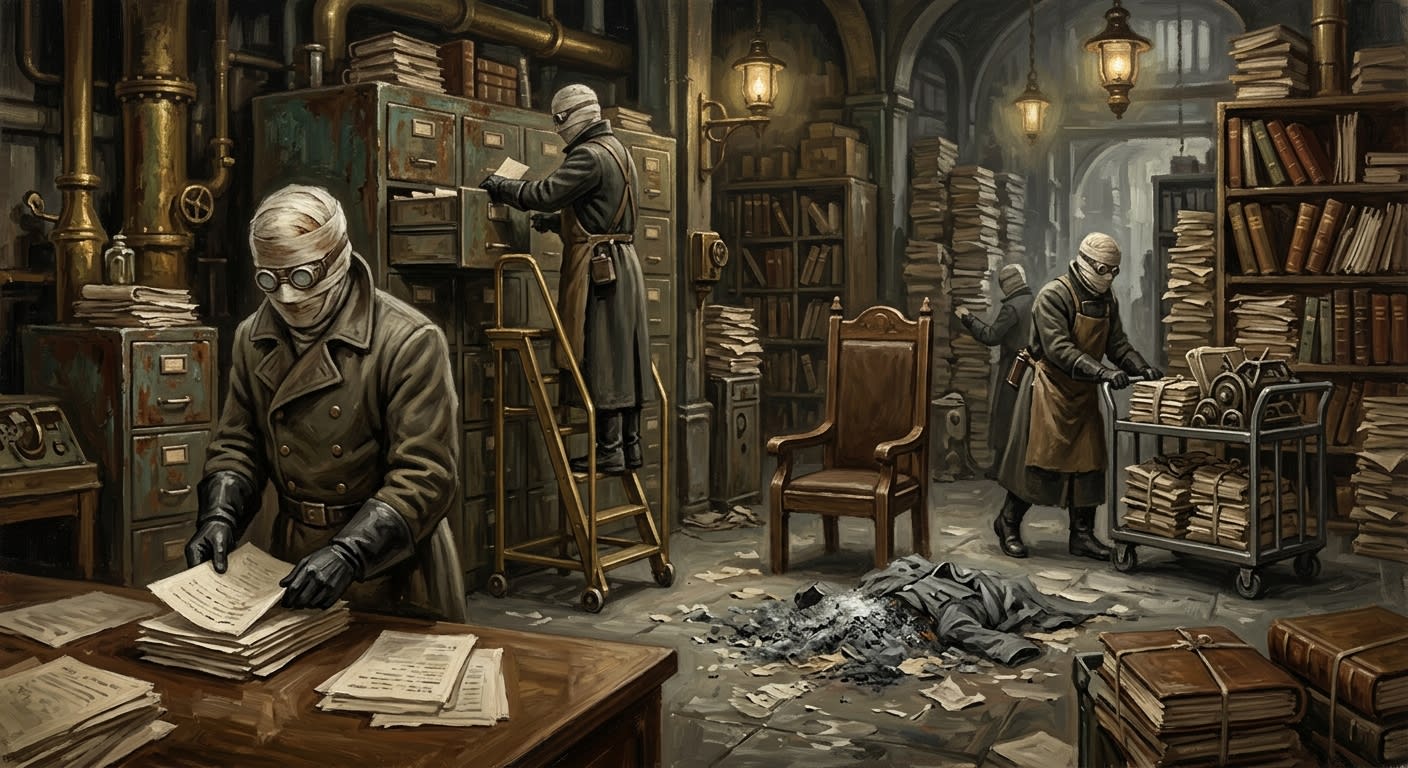
They are called Custodians because the Synod is incapable of naming a knife without pretending it preserves something. They preserve silence. They preserve continuity. They preserve the official relation between paper and reality, which is to say they alter reality until the paper stops looking foolish. When a record contradicts a fact, Records files the contradiction, Doctrine interprets it, Purity prosecutes some nearby idiot for having noticed it, and the Custodians remove the witness, the note, the chair, the street-corner conversation, and occasionally the street corner.
A Gauze-Masked Custodian is the professional archetype: kit, trade, duties, terminal decay. The Custodians, in the wider and more dangerous sense, are the caste: Veil-Bearers, Corridor Runners, Wagon Hands, white-ledger clerks, Omission Notaries, failed priests, recovered informants, purchased widows, and those nameless senior presences whose authority is proved by the fact that no one asks them for credentials. The street sees only the black gauze. The Synod sees the vacancy left behind.
#On the Gauze
The veil is black gauze, wound in nine turns. The number has been variously attributed to the Ninefold Matins, the nine locks beneath the Basilica of the Ledgered Saints, the nine wounds of Saint Pellor before he stopped being useful to hagiography, and a quartermaster's surplus order in A.S. 115. The last explanation has the flavour of truth, so it has been suppressed.
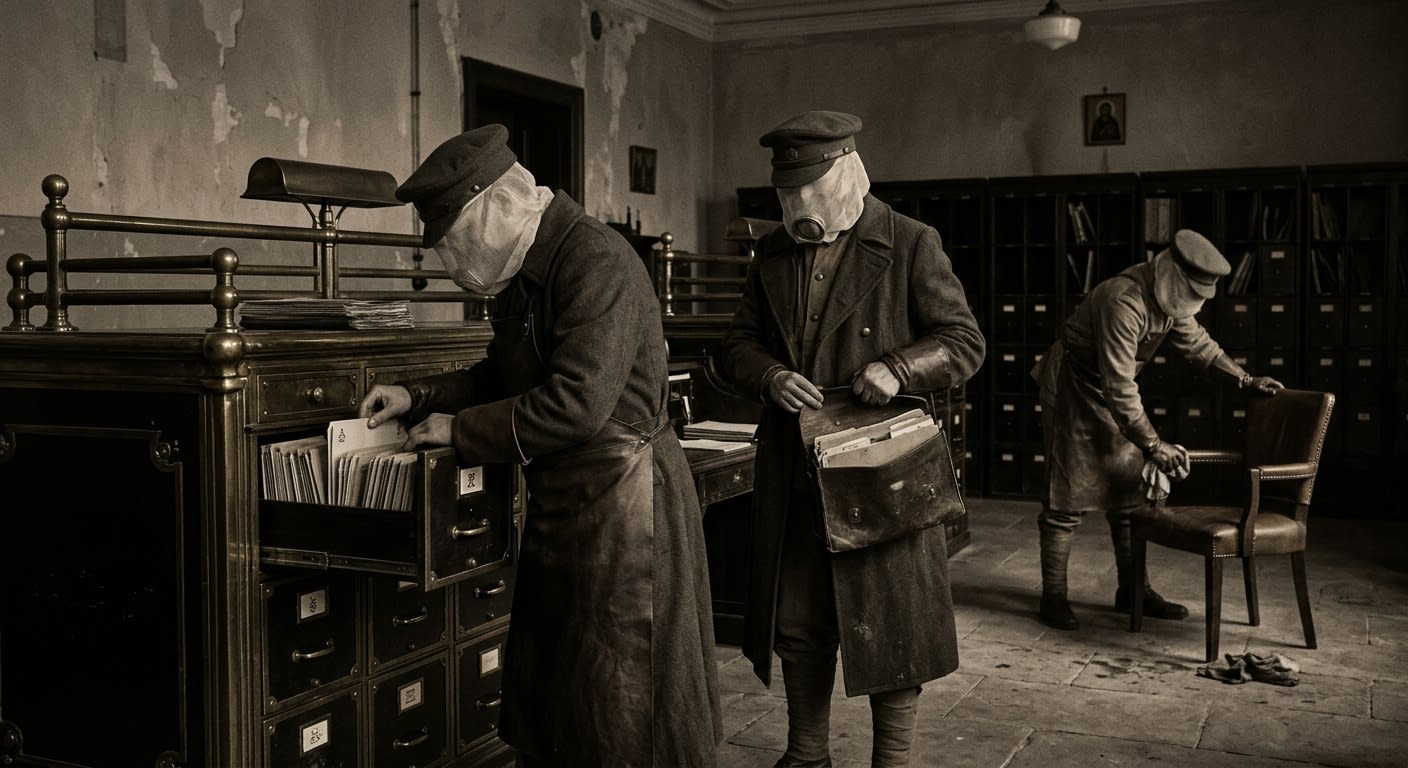
The gauze hides little. That is its cruelty. It gives the observer a shape where a face should be, the hint of a cheek, the pale interruption of a mouth, the wet glint of eyes behind cloth. A mask conceals. Gauze suggests that concealment is happening for your benefit. The Custodian becomes a civic courtesy: a face kindly reduced to a warning.
Their gloves are too clean. Their cuffs bear cord seals. Their pockets are waxed from within, so that loose papers cannot be planted and loose papers cannot escape. A Custodian's coat has no insignia, because insignia invite jurisdiction, and jurisdiction invites clerks, and clerks invite consequences the Bureau of Shadows finds vulgar. Their writs bear no seal. The absence of seal is the seal.
Children know them by the bedtime prayer: Keep the gauze away, keep the blank-men in the walls. No approved catechism contains the line. Doctrine tolerates it because forbidden children's prayers become sharper in the mouth. Purity dislikes toleration on principle. The Bureau of Shadows, being fictional, has no opinion and excellent distribution.
#On What They Custodiate
They do not guard objects. Objects are the concern of the Bureau of Relics, which can make a splinter expensive by staring at it long enough. They do not guard doctrine. Doctrine guards itself by becoming unintelligible to its enemies and exhausting to its friends. They do not guard the High Synod, though Custodians are seen near the Hall of Seals often enough that even the marble has learned discretion.
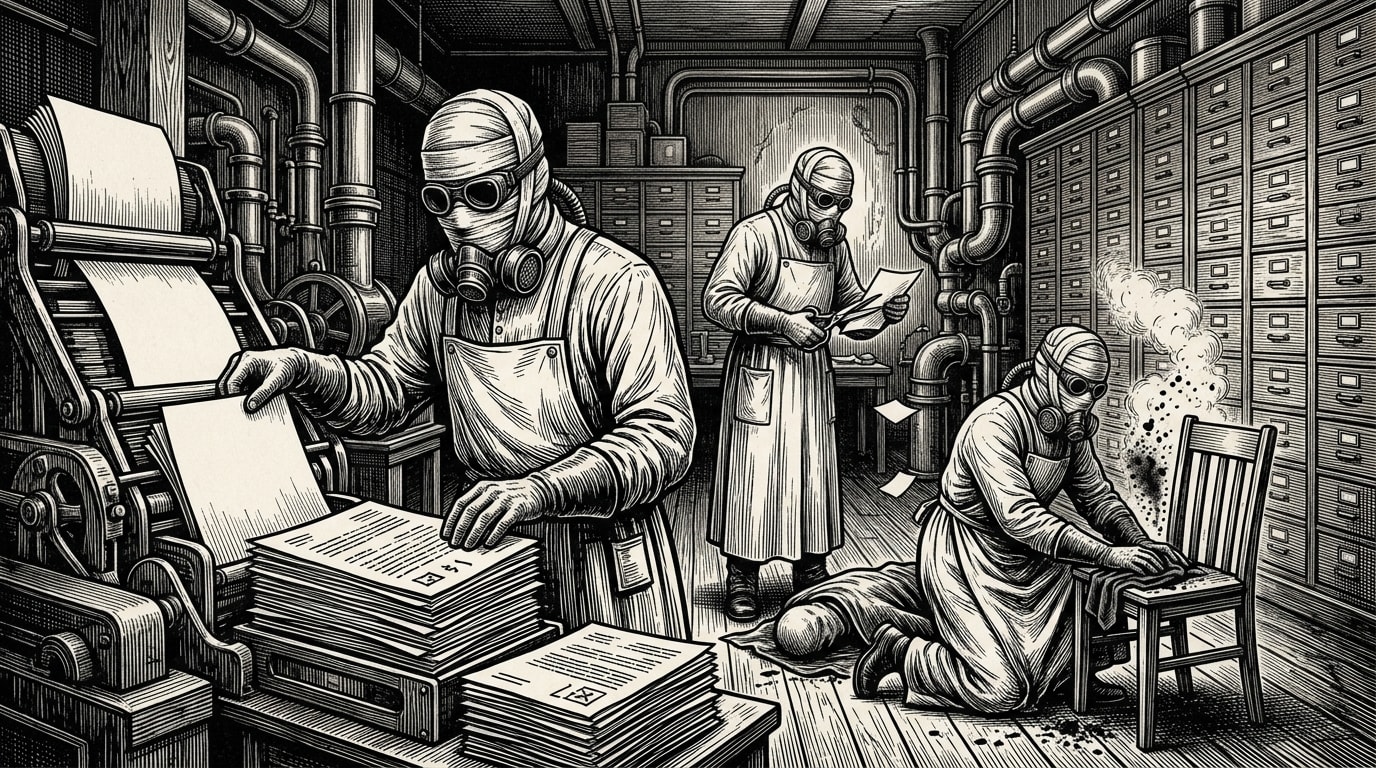
They guard the Bureau's right to say yesterday did not occur.
A failed campaign leaves a colonel alive with a report contradicting War's commemorative bulletin. A tithe scandal leaves a ledger whose arithmetic convicts a Procurator rather than a peasant. A court clerk hears a sentence from a condemned heretic that makes too much sense. A parish refuses to forget the woman taken from the fifth house on Ash Street. Each of these is a breach in continuity. Each invites the citizen to commit the first crime of rebellion: comparison.
The Custodian arrives before comparison becomes language.
First comes softening. The employer receives a visit. The parish priest is reminded of his pension. The neighbour is given bread, warned about her son's registration status, or both, according to temperament and available flour. The record is prepared: not destroyed, never merely destroyed, since destruction leaves ash and ash has opinions. It is refiled as absence. A blank folio is sealed. A name is misspelled in one archive, abbreviated in another, rendered illegible in a third, and by dawn the man whose grandmother still remembers him has become a clerical convergence error.
The body may live. This confuses sentimental readers, who believe disappearance is murder wearing a better coat. Often it is. Often it is worse. A collected person can be moved to a quarry, an unlisted ward, a listening post beyond the Sagittal Line, a work gang at Bastion-Brest, a sealed archive under Strasbourg, or one of those addresses whose directions begin with “after the third unmarked stair” and end when the guide stops speaking. Death is tidy. The Bureau prefers options.
#On Their Ranks and Rotations
The lowest are the Veil-Bearers. They do errands, count thresholds, learn to stand where people will later swear no one stood. They are young enough to fear being seen and foolish enough to think the gauze grants power rather than debt. Their reports are exercises in negation: no irregularity, no witness, no sound, no face recalled. Those who develop prose are dismissed. The Bureau has no use for ornament below supervisory grade.
Corridor Runners learn the hidden anatomy of cities. Strasbourg possesses passages the Bureau of Records has never mapped, bridges that appear in fog and lose themselves by Matins, doors in the Tower of the Quill whose hinges remember hands older than the Concordat. A Runner knows which corridor carries a voice, which stair returns footsteps doubled, which cellar opens behind a magistrate's pantry, and which river gate accepts cargo without bells.
Wagon Hands do the public part of secret work, a contradiction Strasbourg has refined into a trade. The Night Wagons leave after the final peal, canvas tied down, wheels muffled, drivers looking neither left nor right because left and right may contain witnesses. A good Wagon Hand records weight, weather, and wheel damage. Never names. Never cargo. Never destination. A manifest that says enough to be useful says enough to hang its author.
Custodians proper wear the full gauze and carry white ledgers. They decide whether a case requires collection, dissolution, reassignment, warning, or that most elegant outcome, the kind the Bureau calls “self-correction” and the street calls “he jumped before they knocked.” Above them sit the Omission Notaries, who stamp the blank page and make nothing official.
An A.S. 171 administrative glossary described Omission Notaries as “clerks of the Bureau of Records seconded to confidential work.”
Corrected. Records clerks preserve. Omission Notaries certify absence. The former are archivists. The latter are undertakers for facts. The glossary editor has been transferred to a catalogue project consisting entirely of blank shelf labels, which I regard as both punishment and training.
There are senior Custodians without titles. One knows them by negative space. Conversations shorten when they enter. Bells seem to have rung a moment earlier. Junior operatives stand with the posture of men awaiting weather. The senior Custodian may be an officer, a patron, an auditor, or merely the corridor's opinion given human outline. The wise do not investigate.
#On the Distinction from Purity's Shadows
The Penitential Shadows belong to the Bureau of Purity. The Custodians belong to the Bureau of Shadows. The similarity of names has caused confusion, arrests, three duels between jurisdictional advocates, and at least one pamphlet whose author disappeared so thoroughly that the pamphlet was later attributed to a damp patch on a printer's wall.
A Penitential Shadow is a manufactured instrument of guilt. It watches for heresy, carries the fright of ash and glass, and serves the Inquisition's theology of terror. A Custodian is an administrative instrument of correction. It watches for contradiction, carries the smell of lamp oil and grave-dust wax, and serves the Synod's theology of continuity. Purity wants the heretic visible before the crowd. Shadows wants the inconvenience absent before the sentence forms.
The two orders despise one another with the intimacy of cousins fighting over an inheritance they both intend to steal. Purity calls Custodians cowards, paper-killers, veil-rats, men who lack the courage to put a brand where the Creator can see it. Custodians call Lictors noisy. In the private argot of the gauze, “white cloak” means a person who confuses blood with proof. In the private argot of the Inquisition, “blank-maker” means a person who cannot be trusted to leave enough evidence for a proper sermon.
Both charges are accurate. That is why the arrangement works.
#On Recruitment
No one joins the Custodians. Joining implies a door, a form, a signature, and a mother who later says, with village pride, that her son has entered government service. Custodians are noticed.
A clerk who can remember six conversations at once and repeat none of them. A widow who stopped crying the day after the tribunal and began counting which officials passed her alley. A deserter who survived behind enemy lines by becoming uninteresting to demons and men. A Confessarius whose reports are too clean. A Veil-Bearer pulled from a family with debts, a prison wagon with vacancies, a parish school where one child has learned to lie without pulse or sweat.
The Bureau prefers those already half-absent from the world: illegitimate sons, orphaned daughters, condemned informants, failed novices, servants who know too much about their masters and too little about themselves. Ties must be cut before service begins. A recruit with a beloved family is a hostage to mercy. A recruit with no family is a tool. A recruit whose family has been made to forget them is ideal.
TRAINING ANNEX — STRASBOURG, DATE WITHHELD Candidate ████████ asked permission to write to his sister. Instructor denied request. Candidate asked whether sister would be told he was alive. Instructor replied: “Your sister has no brother.” Candidate completed veil-wrapping in nine turns without error. Promotion recommended.
Training begins with speech. Carry no nouns. Say “the house,” never “Marta's house.” Say “the subject,” never “Adel.” Say “event,” never “arrest,” and never say arrest when collection will do, and never say collection when silence will suffice. Names are handles. A handle lets the world pull back.
The second lesson is route. The third is bribery. The fourth is the proper application of fear without spectacle. The fifth is personal disappearance: how to live in a tenement for six months without becoming part of it, how to eat at a stall every day without the vendor learning your order, how to let a child stare at your veil until the child's own mother scolds him for staring at nothing.
#On the Hazards of Blank Service
The first danger is ordinary. Knives in alleys. Falls from wet bridges. Hush-vials cracked in the pocket. A target who owns a pistol and a sense of timing. Night work kills the careless and the romantic first, which improves the profession by tragic arithmetic.
The second danger is audit. Custodians fear auditors more than rebels, because rebels at least know what they hate. An auditor smells wrong wax, too many blanks in one district, a witness redirected twice by the same hand, a Night Wagon whose weight repeats across three manifests with the tidy falseness of invented numbers. Then the Custodian becomes the subject, and the system demonstrates its purity by eating its own instrument.
The third danger is the blank itself.
The Bureau of Medicine has no public classification for going blank. The Custodians do. Friends forget your birthday, then your face, then that you ever had a chair in the refectory. Written names blur. Spoken names feel indecent in the mouth. Old Custodians wash gloves in salt until the skin splits. They count their own fingers after waking. They whisper their childhood names into cups of water and drink quickly, a superstition so pathetic I would mock it if I were less intelligent and less afraid.
Something listens to absence. This is not official doctrine, because official doctrine dislikes sentences that make the wall seem crowded. Blank folios draw attention from certain categories of the Lie. Unclean silence nests in sealed rooms. A corridor overused by Custodians begins to misplace footsteps: first echoes, then persons, then whole minutes. The Bureau of Shadows knows this. It continues to use the corridors. A state that stops using dangerous tools because they are dangerous has misunderstood statecraft.
A training circular formerly stated: “Silence cannot be contaminated.”
Withdrawn after the Saint Berrin quiet-room incident, in which three trainees, one instructor, and every sound within seventeen feet failed to return after morning inspection. The revised circular reads: “Silence must be maintained in clean condition.” No definition of clean has been provided.
#On Known Works of Custodianship
The Custodians have no history. History requires events, and events require records, and the Custodians exist to make both badly behaved.
Still, the air retains the shape of certain absences.
The Scholars of Padua published a treatise on bell-bronze acoustics. Seven chairs in Lecture Hall Seven remained empty. The tea cups were half-filled. The papers waited eleven months before removal, as if even dust required authorisation. Their names were later misspelled in every surviving catalogue, which proved, by Records logic, that the men cited by the treatise had never been properly identified.
In Lübeck, the Year of Smoke, A.S. 180, gave the Night Wagons their modern grammar. Eleven wagons left without insignia. Three guilds dissolved. Two aldermen found the Creator at a convenient distance from their offices. A harbour-master acquired birds and exile. The Custodians learned that a port city can be made to forget cargo if enough ledgers burn at once and enough mouths receive flour.
During the Saint Veritas affair, A.S. 185–186, a ship vanished from Constantinople's harbour and returned insisting it had never left. The log repeated one phrase across forty pages: We were invited below. Custodians took the log within the hour. The crew remained intact, a word I use because the alternatives would make the page damp. The affair remains active, which is Shadows language for: do not ask what came back with them.
In Queue Road files, blank permits and missing minutes appear wherever Gate Nine's apparatus breathes through the paperwork. Null Verge Custodians operate under stamps from an issuing authority that does not exist. Whether they are Custodians of the Bureau proper or merely provincial scavengers borrowing the grammar of absence is a question left open by the Bureau, which dislikes monopoly only when someone else has it.
#On the Present Use of Nothing
As of A.S. 201, Custodians operate in every bastion capital, cathedral city, port quarantine, tribunal district, and administrative corridor where a person may discover that the Synod's perfection has been corrected in advance. They pass through Brest beside ration convoys, through Przemyśl beneath wire shadows, through Sibiu under mountain bells, through Constantinople in harbour fog thick enough to forgive any outline. They are seen most often in Strasbourg, because the capital produces contradictions the way a bakery produces loaves: early, hot, and in quantities requiring distribution.
They carry writs without seals. They collect without arrest. They file reports read once and burned. Their blank folios move through the archives like pale fish under ice. A citizen who sees the gauze may live a long life. A citizen who remembers the gauze in useful detail has already shortened it.
The Synod does not acknowledge them. It does not thank them. It does not pay them in any account the Bureau of Tithes can audit. This is wise. Gratitude leaves stains.