
#On the Assignment
"The Bureau considers these intervals unpredictable." — from The Crimson Concord, On the Macedon Escarpments
The Ordeal-teams are field parties of the Bureau of Purity. The Bureau sends them to the checkpoints of the Macedon Escarpments to examine what passes through for signs of the Crimson Concord. That is their whole documented function. I have put it in two sentences because the documents do not support a third. I can find no record of their strength, their ranks, the order of their examinations, the year someone first thought to send them, or the name of the person who did, and I am cleared to read a great deal.
They exist for counter-infiltration. The evidence that they achieve it is a schedule, and the schedule has been read by the wrong people. The rest of this entry deals with that gap, which is a narrow one. It is still wide enough for a supply column to pass through with every manifest stamped.
#On the Escarpment Checkpoints
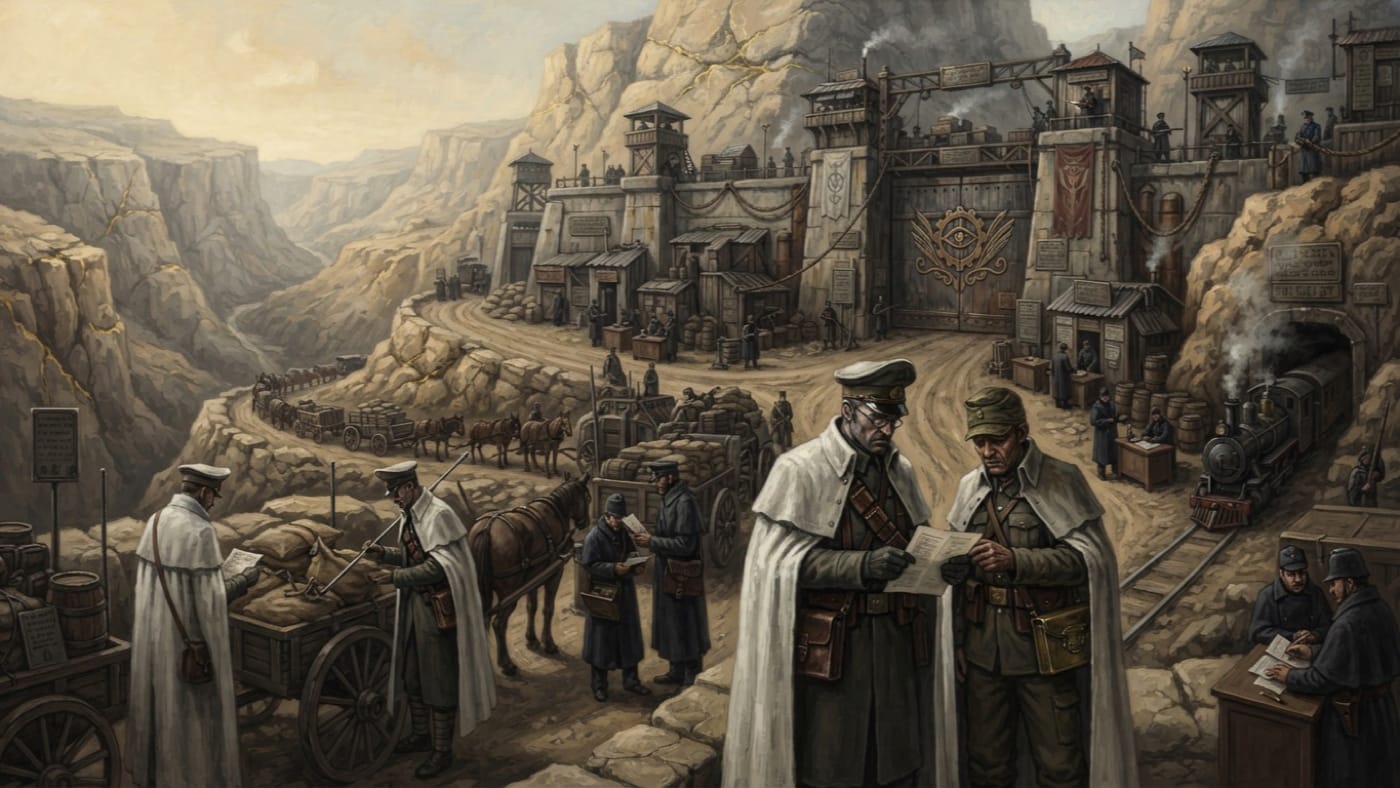
The Macedon routes run northwest of Bastion-Constantinople, up through broken limestone terraces and down into fault-cracked ravines. The rock is veined with gold, and in the afternoon it throws a pale amber light that makes every distance a matter of opinion. The Bureau of Engineering has confirmed this. A sentry cannot tell whether the wagon in the ravine is a quarter-mile off or a mile, and he cannot tell whether the man walking beside it is the man named on the pass until the man is close enough to hand the pass over. By then the question has become a clerical one.
The southern theater's supply depends on these routes. Grain, shot, lamp-oil, replacement officers and pilgrims all come up the terraces and through the gates, and the gates have to keep moving them, because a garrison on the Sagittal Line gets no benefit from a perfectly inspected wagon that has been stopped for good. The ordinary gate trades do the ordinary work. Notaries of passage check identities against manifests. Queue-marshals lay the rope lanes, number the stack, hold the doubtful cart for audit and send the rest through. Their verification lamps and seal-books are made to answer one question, which is whether the paper is correct.
On the escarpments the paper is correct. My report on the Concord calls this the Merchant Problem. Caravans arrive with properly stamped manifests and couriers who answer to their names, and on closer examination they are neither as correct nor as fully personnel as the stamps claim. The goods they carry are classed as complex contraband. The officers who pass through are recognizable. A captain of pilgrims goes into the passes and a captain of pilgrims comes out, with the same face, the same credentials and the same handwriting on the same oath. The account I have recorded holds that something behind the face has changed, and I keep that account as I received it. Whether the change was made by persuasion, by substitution or by the man's own consent, the record does not say, and I will not decide it in a paragraph.
#On the Intervals
The order of events matters, so I set it down in order.
The Bureau of Purity sends Ordeal-teams to the escarpment checkpoints at irregular intervals. The Bureau regards these intervals as unpredictable. The infiltrators have mapped them. The Bureau knows the infiltrators have mapped them.
Each of those four sentences is true. The first is true in the way the Bureau intended. The second was true for as long as nobody on the far side of the gate kept a calendar. The third was achieved by people the Bureau cannot name, using methods it has not described. The fourth is the one that should keep a Hierarch awake. The Bureau has been told, or has worked out for itself, that its enemy knows when the white mantles will come up the road, and the white mantles still come up the road on days the enemy can expect them.
I do not know how the map was drawn, and I will not pretend to. The record names no informer, no signal-fire on a terrace, no forecasting method and no clerk who sold a duty roster for the price of a warm coat. It records the result. A schedule kept irregular inside an institution is still a schedule. It sits in the Bureau's own ledgers, and the Concord's whole method, as I have described it elsewhere, is to staff those ledgers with competent and promotable people. A secret held by an institution belongs to everyone the institution has promoted.
The intervals at which Ordeal-teams visit the escarpment checkpoints are irregular and therefore unpredictable.
The intervals are irregular. The word "therefore" has been withdrawn. Irregularity describes how the Bureau arranges its visits. Unpredictability depends on who else has read the arrangement, and that has been answered against the Bureau. The first sentence stands. The inference has been struck.
#On the Examination's Limits
Assume the map had never been drawn. Assume an Ordeal-team arrives on a day no one expected and finds the gate exactly as it would be on any other. I still have to ask what the team is supposed to find there.
I have no record of how the Ordeal-teams examine anyone, and I will not make one up. Whatever their method is, though, it works on what can be seen at a gate: a man's papers, his bearing, his answers and his cargo. The Concord asset as I have described him is excellent at all four. His devotional attendance is perfect. His commendations are real. His tactical judgment is sound, and his subordinates do well under inspection. Velkara's instrument does not ask him to sabotage anything or to leak anything. It asks him to keep doing his work well while he privately holds a view the Bureau of Doctrine has forbidden him to hold, namely that the war is the Synod's choice and could be chosen otherwise.
Correct conduct at a checkpoint therefore tells the inspector very little about allegiance. This is my own reading of the case I have already made in the Concord entry, not a finding from any Ordeal-team report. A loyal captain and a Concord captain present identical papers, identical posture and identical answers to identical questions, and both will defend Constantinople with the same ferocity when asked. The difference between them is a matter of theology. No lamp, rope lane or field party yet sent up the escarpment has been designed to see it.
I do not say every clearance at those gates is false. I do not say the teams have never caught anything, whether a careless courier, a crude piece of contraband or a man too nervous to suit his papers. They may have caught a good many. The Velvet Choir and the ordinary smugglers of the southern roads do not all work with the Concord's patience. The Ordeal-teams are inspecting for one kind of failure, and the enemy that matters most on these routes has arranged not to commit it.
#On Continued Deployment
The question remaining is why the teams still go.
I have already given my answer and I see no reason to change it. The Bureau of Purity keeps sending the Ordeal-teams because stopping them would require a memorandum acknowledging that they had failed. That memorandum would become a document. It would carry a seal, a reference number, a distribution list and a place in the archive. Once it existed it would be evidence, in the Bureau's own hand, that its counter-infiltration method on the escarpments is theatre. The Bureau is willing to reach that conclusion in private, in corridors and over the third cup of watered wine after vespers. It will not put it on paper.
I do not find this hard to understand. I have spent my life in institutions where a thing that has not been written down has not happened. The Bureau can tolerate a failed method. What it cannot afford is a record of that failure. A record can be cited and appended to a review, and it can be read aloud by a woman whose rank I am forbidden to record in a briefing room where the Bureau of War is keeping count. Every visit an Ordeal-team makes produces a correct report, filed on time, attesting that the inspection took place. That report is the thing the institution guards.
The visits also have practical effects, though I would not call them consequences. The traffic waits. The rope lanes are held and the stack backs up into the ravine while the white mantles go along the wagons. Grain bound for the Line sits an extra hour in the amber light. Then the gate opens again, because it has to, and the column moves on with its manifests correct and its couriers answering to their names. Anyone who wanted to avoid that hour knew which day to avoid.
The routes have to be inspected, and I do not dispute it. A gate on the escarpments with no Purity presence at all would be a confession of a different kind, and one the Great Deceiver's servants would read just as easily as they read the schedule. So the Bureau has settled on a procedure that the enemy can schedule around, the Bureau knows the enemy schedules around it, and the Bureau has recorded none of this, so that on paper the procedure is still sound.