
#On the Correct Manifest with Teeth
The Merchant Problem is the name War gives to a caravan that has obeyed every visible law and still arrives wrong.
It belongs chiefly to the Macedon Escarpments, those pale limestone terraces northwest of Bastion-Constantinople where the road glares amber, distance lies, gold clicks in the stone, and clerks discover that stamped correctness has no moral content. The problem exceeds smuggling, though smuggling fattens upon it. Ordinary infiltration explains too little, though Velkara drinks from it. Mere corruption is too small, though Velmora has taught the toll chapels how to smile like bankers.
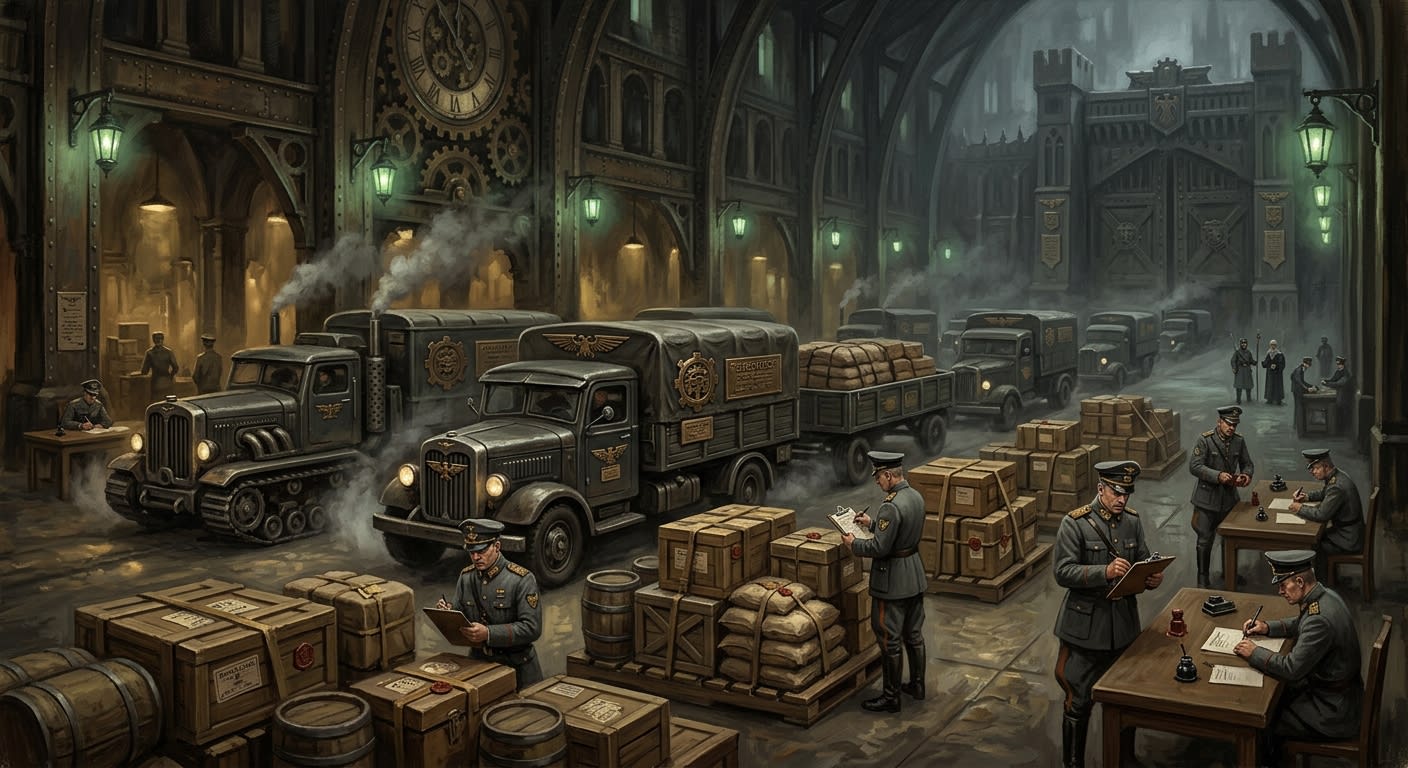
A caravan enters the Escarpments with lawful goods, licensed animals, named drivers, devotional rosters, escort authorisations, manifest wax, tariff receipts, and the whole tiresome little reliquary of commerce. A caravan exits with the same goods, animals, drivers, names, rosters, authorisations, wax, and receipts. The paperwork passes. The cargo tallies. The faces remember what faces ought to remember. Something behind the face has misfiled breathing. Something inside the crate listens when widows pass. Something in the manifest waits for a birth certificate before choosing its text.
The Synod calls this a Problem because Problem is a blessed word. It implies an answer exists somewhere in a drawer, awaiting the correct clerk. Calamity would be too honest. Infestation would require fumigation. Treason would require arrests. A Problem may be studied, indexed, assigned, deferred, and inherited. A Problem keeps its salary.
#On Its First Convenient Recognition
No single day birthed the Merchant Problem. It emerged in receipts, in route complaints, in manifests that balanced too neatly, in drivers who passed confession and failed mirrors, in goods that obeyed tariff law while disobeying Creation. The oldest surviving incident tables place the pattern roughly forty years before A.S. 201, when the southern routes had settled into their present dependency and the Southern Theater had learned, fatally, that a road can be both indispensable and diseased.
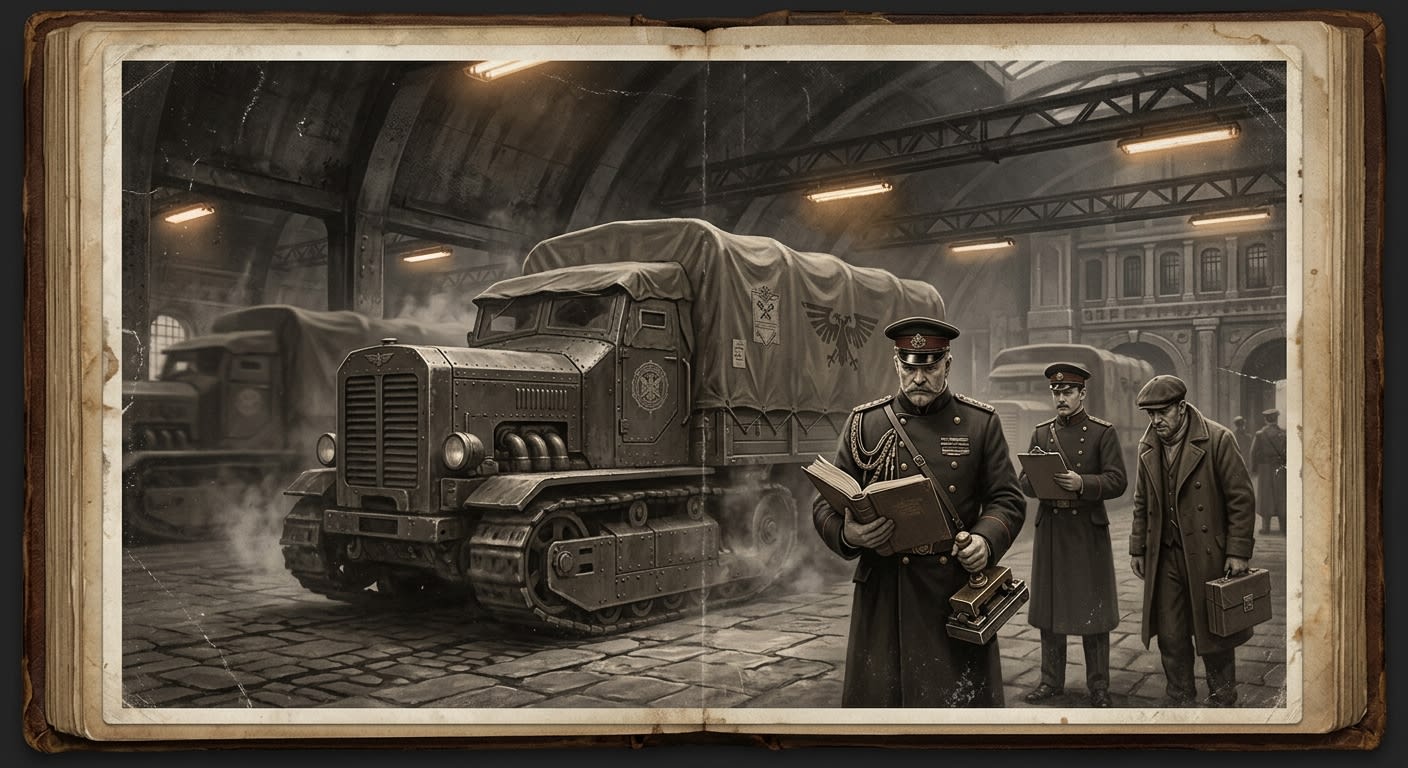
By A.S. 187, Legate-Inspector Theron Vast had seen enough. He proposed full closure of the Macedon supply routes pending doctrinal review of all active manifests. This was an extreme measure, which is to say it was a rational measure stated early enough to embarrass everyone. Closing the routes would have starved Constantinople of grain, surgeons, choir oil, rivets, seal-wax, mule fodder, and dull men bearing sharp orders. Leaving them open preserved the southern anchor and permitted the thing inside the traffic to keep arriving with toll receipts.
War placed Vast’s proposal under review. It remains there in A.S. 201, aged fourteen years in the pleasant cellar of administrative courage.
An A.S. 192 Bureau of War summary described Macedon route documentation as “doctrinally secure.”
Clarified. The phrase certified manifest custody, seal continuity, toll record preservation, and chapel filing discipline. It did not certify travelers, animals, reflections, substituted memories, cargo intention, hidden loyalties, or the spiritual condition of any driver who smiles at the mirror before the mirror smiles back.
The delay is not stupidity. I must be fair; it pains me, but the Ledger demands its little mortifications. The southern anchor cannot simply close its throat because the water tastes of poison. Constantinople requires the Escarpments. The Crimson Concord knows this. Velkara knows this. Velmora knows this. Every smuggler with salt burns on his cuffs knows this. Necessity is the patron saint of contaminated logistics, and its feast day is daily.
#On Complex Contraband
The goods carried by Merchant Problem caravans are catalogued as complex contraband. The phrase is one of those rare Bureau terms that earns its bread. A pistol hidden beneath flour is contraband. A pistol that remembers the hand of the last man it shot and jerks toward his widow at Mass is complex contraband. Lamp oil that burns blue is suspect; lamp oil that burns with voices is complex. A reliquary bracket without provenance is a customs offence; a bracket that draws sleeping confessions from men quartered in the next room belongs under seal, lime, and a prayer spoken from a distance.
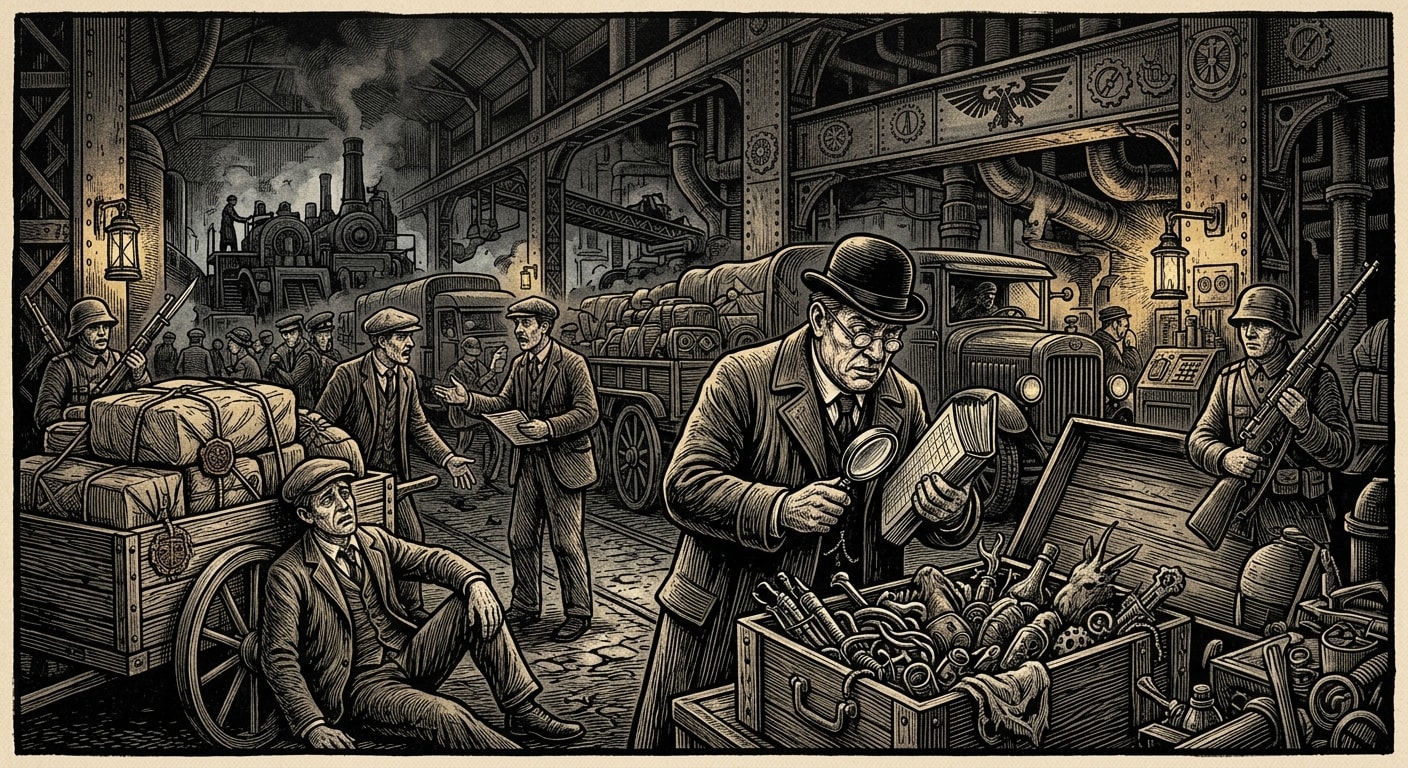
Known examples include salt that weighs one pound less whenever a widow touches the sack; contract sheets that remain blank until placed beside a birth certificate; buckles without heraldic mark, recognised by horses that refuse them; devotional candles whose wax melts upward; nail stock that rusts into small letters; and linen that stains only where an unborn child will someday place its hand. The Bureau dislikes poetic lists. The cargo does not care.
CHECKPOINT NINE SEIZURE ABSTRACT, A.S. 196 Cargo: devotional candles, linen, nail stock, three saint-capsules. Manifest: correct. Escort: correct. Driver: correct until mirror-black room exposure. Observation: reflection remained seated after driver stood. Secondary observation: reflection requested legal counsel. Disposition: cargo sealed for Harbor third sub-vault (Unregistered); driver transferred to █████████; mirror buried face-down under lime.
The legal challenge is obscene in its neatness. Goods must move. Soldiers require oil. Chapels require candles. Bridges require nails. The manifest says legal. The tally says legal. The driver says legal. The horse disagrees, the mirror objects, the widow loses a pound of salt, and the clerk must choose whether the war shall be delayed because the universe has developed opinions about buckles.
Clerks are brave in ledgers and cowards at gates. The gate opens.
#On the Carriers Who Are Not Entirely Personnel
The Merchant Problem’s more dangerous half walks on two legs and answers to childhood names.
Personnel substitution in Macedon differs from the crude replacement incidents more common near Morwen’s pressure zones. The driver does not always return as an imitation. The captain of pilgrims is not always gone in the sense required for mourning rites. A junior quartermaster may cross the ravine, produce correct memories, pass scent-washing, recite his mother’s deathbed prayer, identify the scar on his own thigh, and still carry within him a slightly altered relation to obedience. He has not betrayed. He has been edited.
The Velvet Choir seduces bodies. The Concord promotes useful minds. The Merchant Problem supplies both with a route whose violations look like commerce until they have settled inside the barracks. A merchant-quartermaster receives clearance without delay and learns gratitude. A chaplain escorts refugees through a suspicious ravine and learns that mercy can arrive from unexamined hands. A clerk processes a corrected seal and learns that correction may precede error. None of these lessons is heresy on paper. Paper is where they survive.
The carrier who returns altered rarely behaves like an enemy. That is the beauty of the wound, and I use beauty here with disgust polished onto it. He files better. He remembers favours. He recommends efficient men for useful posts. He knows when a question should not be asked because the answer would slow the convoy. He becomes the sort of official every office praises until the office discovers that praise was the recruitment channel.
#On Checkpoints, Ordeals, and the Theater of Detection
Macedon checkpoints are exquisite machines for discovering yesterday’s danger. Manifest read aloud. Cargo tallied. Seals warmed but not broken. Driver scent-washed. Escort questioned apart. Animals inspected for unnatural obedience. Mirrors uncovered for three breaths. Prayer recited backward by the clerk to confirm memory sequence. Coin counted silently. Names suppressed past Amber Mile Six. Records copied twice, once in ink and once in witness breath.
The rite catches much. It catches forged wax, dead drivers, animal fear, debt marks, sung cargo, false pilgrim captains, and the sort of smuggler whose imagination ends at hidden brandy. It catches the stupid, the hasty, the underfunded, the unlucky, and occasionally the damned. It does not catch certainty. A clean caravan may still be dirty. A dirty caravan may still be necessary. A necessary caravan is the kind most likely to pass.
Purity sends Ordeal-teams at irregular intervals. Purity considers these intervals unpredictable. The infiltrators have mapped them. Purity knows the infiltrators have mapped them. Purity continues because stopping would produce a memorandum with the taste of defeat, and no Bureau likes defeat unless it can be assigned to another Bureau.
A former checkpoint manual called the Ordeal-team rotation “randomised.”
Corrected. The rotation was irregular, scheduled, leaked, inferred, bribed, and in two cases predicted by mule-market price fluctuations three days before dispatch. Randomness remains under development.
Vast’s office understands the failure better than its critics. That is why his closure proposal remains so inconvenient. He did not say the checkpoints do nothing. He said they cannot do enough while the roads remain open at required volume. A filter asked to purify a river becomes scenery.
#On the Harbor Sub-Vaults
What the route cannot resolve, the Harbor of Chains stores.
Complex contraband seized from Macedon caravans descends into the third sub-vault beneath the Harbor, where Mother-Cryptor Sabine maintains the deep records. The public description is records of historical interest, Classification: Maximum. This phrase has sedated Purity inspectors, War auditors, Tithes assessors, and one doctrinal visitor who should have known better and has since amended his habits. I have read the index. The index alone required three days of mandatory devotional rest. I resent the prescription less than I resent its success.
The sub-vault system performs a miracle beloved by every bureaucracy: it turns active terror into archival custody. Once sealed, routed, indexed, and assigned shelf position, a thing becomes less urgent. It has ceased entering the city; it has entered Records. Records offers no safety. Records is a respectable kind of delay.
Sabine’s office does not destroy because destruction may release. It does not return because return may spread. It does not publish because publication may instruct. It stores. Storing is how the Synod survives hazards it cannot define without teaching them new manners.
#On Velmora’s Coin and Velkara’s Glove
The Merchant Problem lies where Greed and Lust touch without admitting partnership.
Velmora teaches roads to account for themselves wrongly. Debts enter before bargains are made. Tariffs balance too neatly. Escort fees arrive prepaid by houses whose officers deny issuing them. A driver enters a ravine owning five debts and emerges owning a sixth, payable to an address painted as a locked door on stone. Greed prepares the paper, sweetens the toll, oils the hinge.
Velkara teaches the person to fit inside the paper. Her Concord requires credible carriers, not howling cultists. A howling cultist is useful only to Purity’s morale. A competent merchant with correct wax, correct cargo, correct grief, and one corrected loyalty can move farther than a regiment. Lust, in this theater, is not rutting excess. It is the desire to be welcomed, advanced, trusted, needed. The gate wants the caravan to be clean because the gate needs what the caravan brings. Velkara enters through that wanting.
The Bureau prefers separate files. Separate files comfort separate officials. The road laughs in stamped compartments. In one wagon may travel Velmoran debt, Velkaran personnel adjustment, ordinary smuggling, Bureau materiel, starving refugees, and a perfectly innocent sack of beans that will be blamed for everything because beans cannot hire advocates.
#On the Current Disposition
As of A.S. 201, the Merchant Problem remains active, unresolved, and load-bearing. That last word is the wound. If the route were useless, War would close it and Purity would celebrate with white gloves. If the corruption were total, Doctrine would condemn it and Records would invent a category with a handsome spine label. The route is necessary. The corruption is partial. Partial corruption is the Synod’s native climate.
Bastion-Constantinople continues to receive what it needs through gates that also deliver what it fears. The Crimson Concord refreshes along the same road as choir oil and rivets. Mother-Cryptor Sabine indexes what the rest of us survive by not reading. Theron Vast commands checkpoints whose existence proves vigilance and whose failure proves dependence. The drivers remove their gloves. The seals are warmed. The mirrors wake for three breaths. The gate opens.
No honest officer calls the Merchant Problem solved. No useful officer calls it impossible. The phrase in use is controlled exposure through necessary passage. It is grey enough to pass review, hard enough to hold a briefing, and filthy enough to be true.
The next caravan is already on the road. Its papers are correct.