
#On the Limestone That Lies
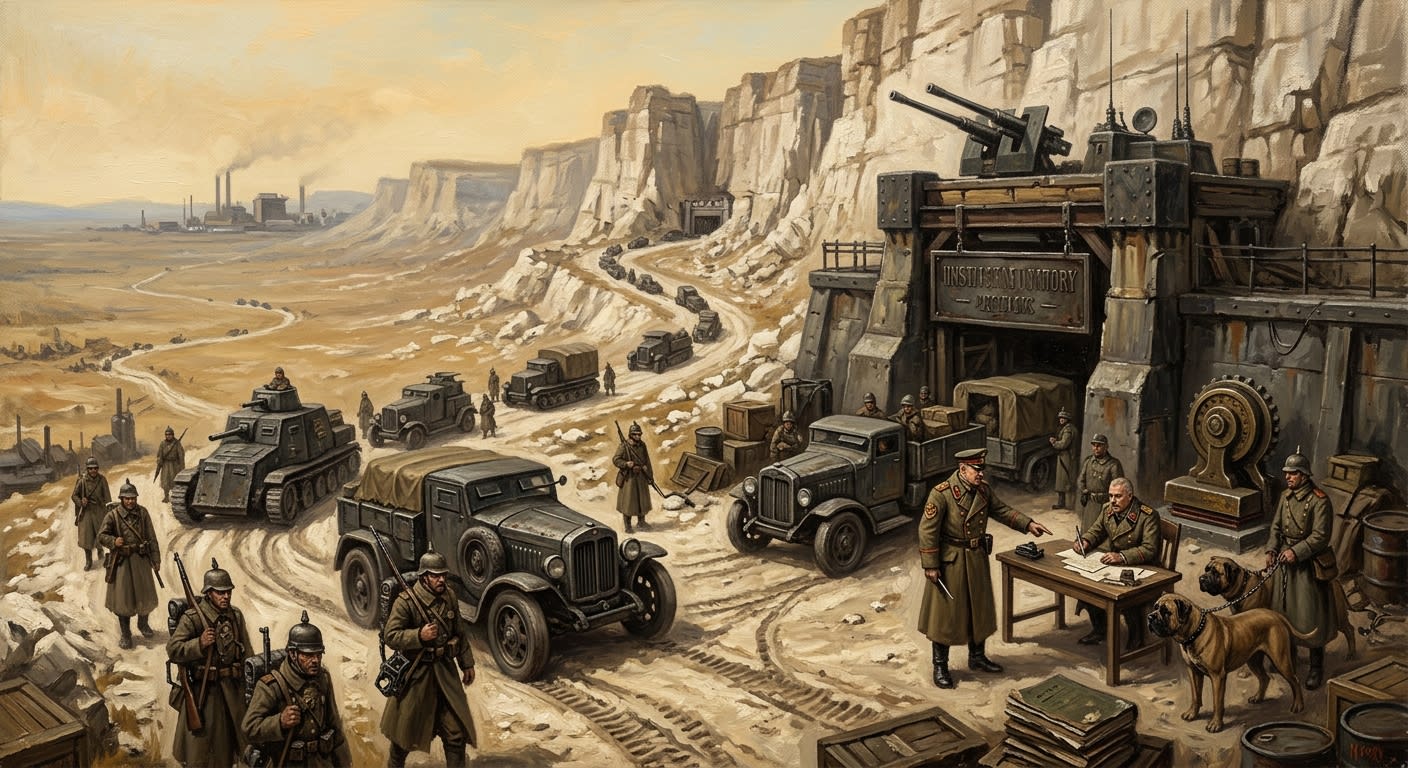
The Macedon Escarpments rise northwest of Bastion-Constantinople in broken terraces of pale limestone, fault-cut ravines, old mule roads, shrine steps, toll chapels, and gold-veined stone that does not glitter so much as appraise. The ridges are too low for a proper Alpine snob to call mountains, and too high for any officer who has tried to move wagons through them at dusk to dismiss. They are the southern theater’s folded margin: a place where roads enter clean on the map and emerge annotated by fear.
The Bureau of War calls them a necessary supply corridor. The Bureau of Purity calls them a doctrinal exposure. The Bureau of Engineering calls them optically unstable, after confirming that the pale amber refraction produced by their gold-veined geology makes distance impossible to judge. The muleteers call them expensive. The muleteers are usually the most accurate theologians in any convoy.
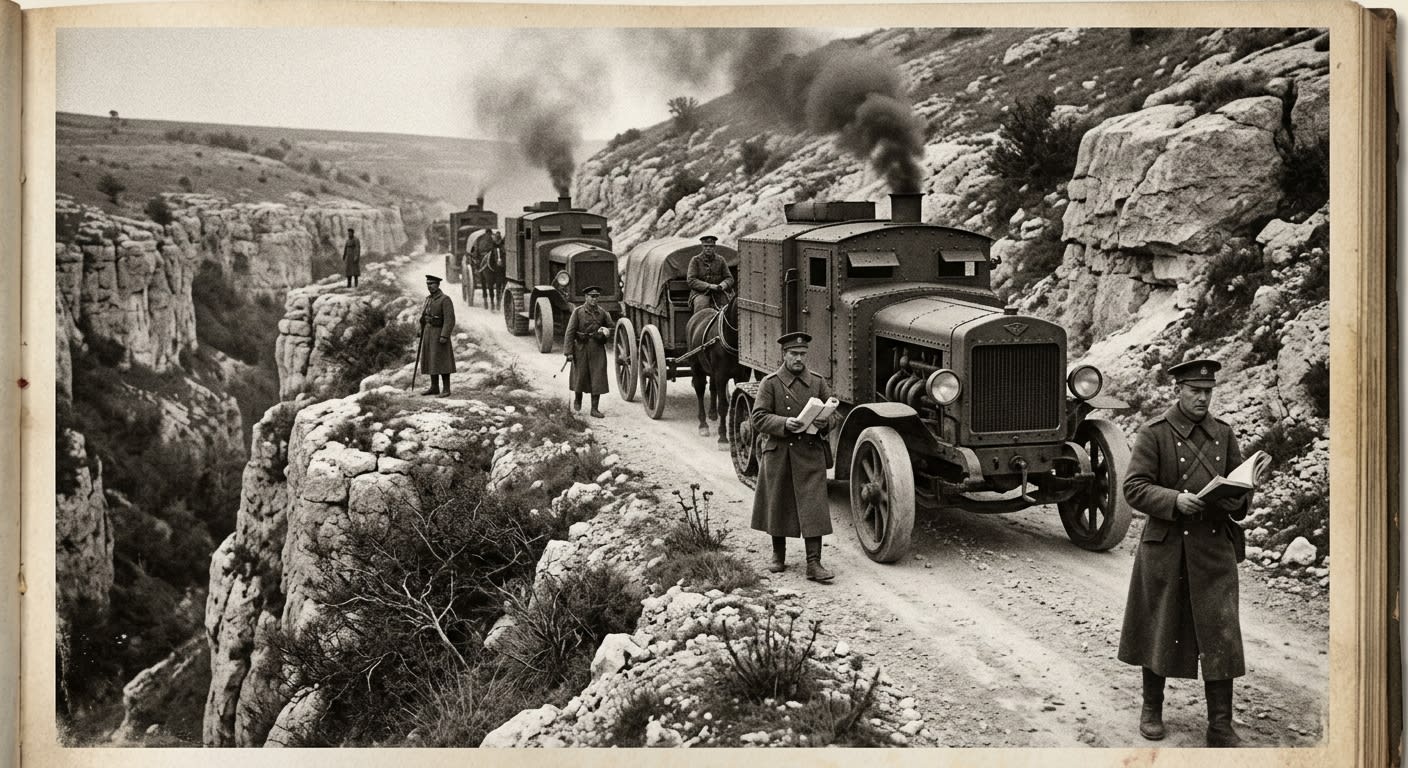
From the western approach, the Escarpments seem almost civilised. Gates are numbered. Chapels possess bells. Checkpoint clerks stand beneath painted saints and examine documents with the sour focus of men paid badly to notice expensive sins. The roads bear wheel-ruts, drainage gutters, signal posts, and little votive niches where drivers leave copper, bread crusts, fingerbones, and, in one recorded case, a wedding ring still attached to the finger. That offering was accepted. No one admits by whom.
#On the Old Roads and the Chasm’s Breath
Before the Sundering, the old Macedonian highlands possessed mines, tollhouses, monastery ledgers, princely quarrels over ore, and all the small mortal corruptions by which stone becomes revenue. After A.S. 45, the Balkans cracked into the dominions of the Seven Sin-Generals, and the gold in the hills learned worse arithmetic. Farther east and southeast yawns the Gilded Chasm, Velmora’s open account-book, whose molten value has a habit of reaching through roads that supposedly lie outside its formal territory.
The Escarpments are distinct from the Chasm. This distinction is militarily useful and spiritually insulting. Chasm influence travels through contract, coin, convoy, rumour, and the nerves of men who begin hearing small metallic clicks in their teeth after the third night. A ridge may remain Synod-held while every bargain made upon it already belongs elsewhere. Cartography flatters us here. Doctrine flatters us everywhere.
Earlier route primers describe the Escarpments as “rearward limestone approaches under standard southern-theater control.”
Corrected. The approaches are rearward only from the viewpoint of artillery. Influence does not respect gun range, and standard control is what administrators call a leash after discovering the dog has eaten it.
Velmora’s pressure is felt in the ledgers before it is seen in the road. Tariffs balance too neatly. Escort fees arrive prepaid by houses whose seals prove genuine and whose officers deny issuing them. Merchants swear their cargo has not changed, and the crates agree. A driver enters a ravine owning five debts and emerges owning a sixth, payable to an office whose address is a locked door painted on stone.
#On the Merchant Problem
The Macedon approaches have produced, over the last forty years, the operational phenomenon Merchant Problem. Caravans arrive from the escarpment roads bearing correctly stamped manifests and apparently living personnel, and which are neither correct nor, upon closer examination, entirely personnel. The paperwork passes. The wax is genuine. The devotional roster matches. The animal count is right. The driver’s face remembers his childhood oath, his wife’s second name, and the cracked tooth acquired at thirteen. Something behind the face misfiles the act of breathing.
The corrupted goods are catalogued as complex contraband. The phrase does honest work for once: the goods are complex, and they are contraband, and the complexity is the part that bites. A crate of lamp oil that burns with voices. A reliquary bracket that attracts confessions from sleeping men. Salt that weighs one pound less whenever a widow touches the sack. Contract sheets blank until placed beside a birth certificate. Buckles stamped with no heraldic device, yet recognised by horses, who refuse them.
CHECKPOINT NINE SEIZURE ABSTRACT, A.S. 196 Cargo: devotional candles, linen, nail stock, three saint-capsules. Manifest: correct. Escort: correct. Driver: correct until mirror-black room exposure. Observation: reflection remained seated after driver stood. Secondary observation: reflection requested legal counsel. Disposition: cargo sealed for Harbor third sub-vault; driver transferred to █████████; mirror buried face-down under lime.
What arrives in corrupted couriers is filed beneath the Harbor of Chains, where Mother-Cryptor Sabine maintains the deep records in the third sub-vault. I have read the index to those files. The index alone required three days of mandatory devotional rest. I resent the prescription less than I resent its effectiveness.
Purity’s quarterly sweeps do not reach Sabine’s level. Purity has been told the third level contains records of historical interest, Classification: Maximum. Purity accepted this phrase, proving that a sufficiently confident euphemism can sedate an entire office if administered with a seal.
#On the Checkpoints of Theron Vast
Legate-Inspector Theron Vast commands the Macedon Escarpment checkpoints: limestone gates, ravine tolls, manifest chapels, ordeal-booths, scent-washing sheds, mirror-black inspection rooms, iron-backed confession screens, and every sanctified nuisance by which War assures itself that a caravan entering the southern theater remains the same caravan upon exit. This assurance is printed on excellent paper and surrounded by evidence with teeth.
In A.S. 187, Vast proposed full closure of the Macedon supply routes pending doctrinal review of all active manifests. The proposal remains under review in A.S. 201. Fourteen years is a long time for a door to remain half-shut. It is an excellent time for anything thin to learn the hinge.
The routes stayed open because Constantinople eats through them. Grain, surgeons, relic-cases, replacement rivets, choir oil, convoy guards, sealed coffers, mule fodder, pilgrim permits, and dull men with sharp orders pass through the Escarpments daily. Closing the roads would wound the southern anchor. Leaving them open lets something else feed from the wound. Bureau doctrine calls this acceptable risk. Soldiers call it orders. I call it an account with no final line.
Vast’s regime catches discrepancies. It does not catch certainty. The checkpoint rite is precise: manifest read aloud, cargo tallied, seals warmed but not broken, driver scent-washed, escort questioned separately, animals inspected for unnatural obedience, mirrors uncovered for three breaths, prayer recited in reverse order by the clerk to confirm memory sequence. A clean caravan may still be dirty. A dirty caravan may still be necessary. The gate opens more often than any honest report would prefer.
A.S. 192 Bureau of War language described Macedon route documentation as “doctrinally secure.”
Clarified. The phrase referred to manifest custody, seal continuity, chapel recordkeeping, and toll receipt preservation. It did not certify travelers, cargo, animals, reflections, substitutions, intentions, transferred loyalties, or the spiritual condition of anyone who smiled too quickly at a mirror.
#On the Concord’s Artery
The Crimson Concord uses the Escarpments as an artery. This is the ugly fact beneath the checkpoint hymn. A captain of pilgrims enters. A captain of pilgrims emerges. The same name, the same credentials, the same face. Something behind the face has changed, or been changed, or been exchanged for an occupant wearing the original memories with the ease of tailored gloves.
The Concord’s method is administrative intimacy. It does not always smuggle knives. It smuggles promotion, credibility, route authority, minor exceptions, generous interpretations, signatures placed by men who believe they are helping the war. A quartermaster receives clearance without delay and learns gratitude. A junior officer obtains the exact spare parts needed to save a battery and learns dependence. A chaplain escorts a refugee column through a suspicious ravine and learns that mercy can arrive from unexamined hands. None of this is heresy on paper. Paper is where it survives.
The Velvet Choir also moves by these roads when names must remain steady while bodies become negotiable. Velkara holds no fixed bastion because she has learned what walls are for: they make the occupants trust the inside. The Escarpments serve her precisely because they look external. Men fear the road and relax at the gate. The gate is where the road does its best work.
Velmora’s stain complicates the matter. Greed taught the roads how to count. Lust taught them how to enter. The Bureau prefers separate files, separate seals, separate meetings, because naming a collaboration among Sin-Generals makes commanders sweat through their collars. In practice, Macedon caravans may carry Velmoran debt, Velkaran substitution, ordinary smuggling, starving refugees, Bureau materiel, or all five wrapped in linen and invoiced as candle wax.
#On Patrol, Terrain, and Unhelpful Light
The Escarpments kill fools without demonic assistance. Ravines open where maps promise shoulders. Shoulders collapse into scree under the third wagon. Limestone dust blinds mules. Amber glare turns a ten-yard crossing into a hundred-yard guess. At dusk, cliffs seem nearer than they are, unless they are farther, unless the observer has already agreed to pay too much attention to them.
Patrols move in threes. One watches the road, one watches the ridge, one watches the watcher for signs of incorrect recognition. Names are spoken only at checkpoints. In the ravines, men use office numbers, saint-days, or insults. Insults are safest. A man may forget his number. He rarely forgets that his sergeant is a bastard.
The Catacomb-Carrier Threnody fought Macedonian corridor defence in her earlier service, before her long berth at Pier Seven made her a monument to maintenance and withheld explanations. Carrier crews who survived the corridor reported mud that clung to treads as if reading serial numbers, abandoned tollhouses whose bells rang whenever a debt was denied, and ravine echoes that repeated orders in superior voices. War filed these accounts under adverse terrain behaviour. War has a genius for making terror sound like weather.
#On the Present Classification
As of A.S. 201, the Macedon Escarpments remain open, watched, necessary, compromised, profitable, and insufficiently understood. Vast’s closure proposal accuses the route by existing. The Bureau of War delays by reviewing. Purity inspects by theatre. Shadows stores by silence. Sabine indexes what the rest of us are spared from reading. Constantinople continues to receive what it needs through the same gates that deliver what it fears.
No current order classifies the Escarpments as enemy territory. No honest officer classifies them as safe. The phrase in use is influenced corridor, conditional passage. It is a good phrase: grey enough to pass review, firm enough to survive a briefing, cowardly enough to belong to all of us.
The mule bells still move at dawn. The amber glare still bends the road. The checkpoint mirrors sleep under black cloth. Clerks warm the seals. Drivers remove their gloves. Somewhere beyond the third ravine, gold clicks in the stone like a clerk tapping a pen against a ledger tooth.
Phase 2a correction log: corrected the complex-contraband routing stamp from Bureau of Shadows to Bureau of Records to match Mother-Cryptor Sabine’s deployed office and Harbor third sub-vault custody. No date, bastion, geography, or link-density errors found. Article dateline set to A.S. 187 for Theron Vast’s closure proposal, the administrative act defining the corridor’s current classification; public seal stamps remain A.S. 201.