
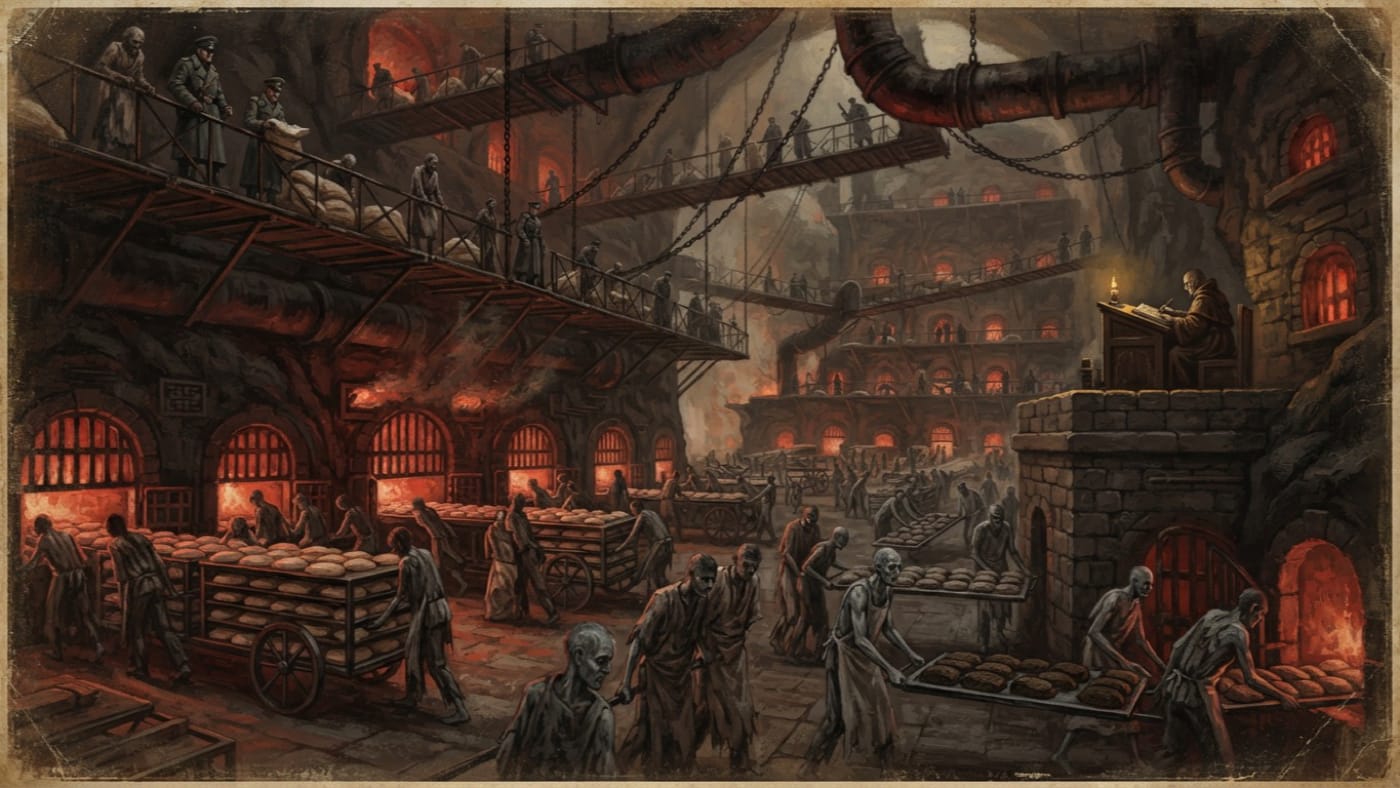
#On the Oven Terrace
"Eat the ash. Keep the oath." — Inscription above the Flour Gate. The Great Ovens supply the first clause; everyone else answers for the second.
The Great Ovens of Vesta occupy the middle terraces of the Ember-Priory of San Vesta, on the basalt rise of the Iberian Ember-Priories. The priory sits above them and the wards below. You need no lantern to find them at night, because they glow red at every hour and in every season, and the air over the terrace shimmers in January as it does in August. Roofwalks cross above the oven district for those with business on the far side. Nobody lingers on them. The heat rises through the planks and finds the soles of the boots.
The chambers are basalt, lined with kiln-ceramic and shut behind iron grates. Dough goes in on iron racks pushed by hand and comes out grey. No engine turns the racks. Where the Church can schedule a man, it has never paid for a machine.
The heat does not belong to the Ovens. A sealed volcanic vent beneath the priory supplies it through managed channels, and the Vent-Wardens apportion it the way a sacristan apportions oil before a feast. The Ovens draw the primary flow. The Scorch-Cure Infirmary draws the second, for its smoke and its sweating patients, and the Relic-Smoke Kilns draw a third for incense that burns violet and concerns this article no further. Below the terraces, the Ash Canalworks carry cooling water and runoff through the lower basalt. An oven that cannot shed its heat soon becomes a matter for the coroner, and the rakers in the channels are the reason the Ovens have so far stayed a matter for the Quartermastery.
The priory dossier dates San Vesta's submission to the Synod to A.S. 98, eight years after the Concordat of Strasbourg, when its abbot offered the vent's heat as tribute. That date belongs to the priory. No record I hold dates any particular chamber, rack or channel, and I decline to invent one for the Bureau of Records to misplace.
#On the Loaf and the Requisition
The Ovens make ash-bread, and almost nothing else. The dough is flour, yeast, salt and consecrated volcanic ash. The Oven Quartermastery guards the proportions, and I have never been shown them. The loaf is dense and grey-crusted and tastes of minerals, and it leaves a grit on the teeth that the novices call ash-bite. It is graded sufficient. At San Vesta that is the only praise the Quartermastery has ever printed.
It hardens and does not spoil. Rot, mould and the depot rat all pass it over. The Bureau of Alchemical Standards certifies that the ash is consecrated. No Bureau certifies why the bread keeps, and I have long since stopped asking offices for certificates they have not already typeset.
The published nominal production figure is six thousand loaves per watch, at full draw. I give the figure as published. No source tells me how long a watch lasts, how many chambers there are, or what a year's baking comes to, and I will not multiply numbers I have not been given.
A second six thousand belongs to a different ledger. In A.S. 134 the Bureau of War tested loaves that had sat three years in the priory stores and found them "nutritionally adequate, if spiritually oppressive." On that finding it ordered six thousand additional loaves per month, and the order was entered as Standing Order 1138-V. Its first destination is Trench Bastion Las Cadenas, a local bastion that depends on San Vesta for its bread. The forward depots come second and the pilgrim way-stations third. The renewal is perpetual. Bread that outlasts a wet season and a quartermaster's embezzlement is worth more to the Iberian Campaigns than any bread worth eating.
#On the Hands at the Racks
Stokers work the grates. Dough turners work the racks, and the slap of dough on board is the terrace's only hymn sung at regular hours. Ash sifters work the consecrated ash and come off shift grey to the hairline. Kiln masons repair the ceramic linings, where heat finds every crack and opens it further. All of them wear soot-black aprons. All of them breathe yeast, charcoal and a flour that grits between the fingers, and all of them stand in radiant heat that soaks into the body and stays there.
Flash burns belong to the Ovens in particular, and the Quartermastery logs them as occupational. Ash-lung, heatstroke, dehydration and scalding belong to San Vesta generally, and the Ovens take their share without being singled out.
The racks draw on two kinds of hands. Skilled bakers hold rank above orderlies and pilgrims, and they draw rations against work quotas like everyone else on the terrace. Beside them stand the convalescents in recovery service, patients the Infirmary Tribunal has declared well and has therefore declared indebted. The Tribunal sets the term. By the priory's published tariff a broken arm costs three weeks, and a full scorch-cure for advanced trench-fever costs a year. The year begins when the Tribunal says the patient is well, and the patient's own opinion is not entered. Confession penalties are converted into shifts as well. A sin confessed at Vespers may be paid off at the racks by Lauds.
Some of these debtors ate the other bread. Most did not. The Ovens accept either kind of labour.
#On the Flour and the Stamp
Before any oven can be fed, someone must decide what it is fed. That man is Quartermaster Odran Ashweight. He controls the flour and coal allocations for the Ovens and the Flour Gate alike. Coal arrives by the rail spur when the spur runs, and the Quartermastery allots it. The Quartermastery has never published what the Ovens do with coal when the vent supplies their heat, and I do not supply engineering on its behalf. Ashweight fears one thing. When the ovens go empty, the streets fill.
The Oven Quartermastery is one third of the governing tri-compact, which the priory's published account dates to A.S. 112. The Priorate Council holds doctrine and the Infirmary Tribunal holds the sick. The Quartermastery holds the flour, and it is the only partner whose authority can be eaten. The Ledger Cloisters, which belong to none of the three, keep the oven schedules. They record which rack is loaded at which hour and whose hands were assigned to it.
Every sack passes the Flour Gate: one road, one ledger desk and one clerk, whose name no record supplies. Bread is issued against tokens stamped with the holder's name. A token is currency in the Cinder Markets and identity everywhere else. Lose it and the Ledger Cloisters record you as administratively absent. Hunger is not accepted as evidence that a person exists. Only a stamp is.
#On the Approved Batches
Somewhere among the chambers, test loaves are baked out of sight. I am permitted to report that they exist and not where they rise.
They exist under Dispensation 77-V of the Bureau of Doctrine, which was renewed in A.S. 194. My copy does not record when it was first issued. Under the Doctrine of Acceptable Innovation, an experimental batch needs a written proposal. The Infirmary Tribunal reviews it, the Priorate Council approves it, and the regional office of Alchemical Standards counter-stamps it. The Ledger Cloisters then file it in triplicate, and only after that may anyone light a flame under the dough. Three seals approve the batch and three copies record it, and the tri-compact that governs the priory has nothing to do with either. The Quartermastery signs nothing. It does not need to. A batch approved under three seals but denied its flour stays a batch on paper.
What the test loaves have produced is classified, and it stays outside this certified account.
Resurrection-bread is baked in a separate oven. A dying person who eats it lives three more days. It does not cure the illness or reverse the death, and it does not make anyone immortal. Whoever accepts it signs a lifelong recovery-service oath on a form the Bureau of Oaths would know as its own. The Infirmary Tribunal controls who receives it. The Flour Gate allocates ordinary rations and nothing more, and pilgrims in the queue who confuse the two offices are corrected, slowly.
#On the Present Heat
At this survey, A.S. 201, the flour convoy from the coastal port of Vall de Sal is three days late. Quartermaster Ashweight has sealed the gates and begun the count: mouths against loaves, shifts against hours, the Standing Order against whatever is left. Pilgrim intake has tripled in four years, and the demand for resurrection-bread has outrun two production increases in eighteen months. Every loaf of that bread starts in the same flour.
The Vent-Wardens report that the vent is two degrees warmer than it was in A.S. 199. The Quartermastery reports that baking times have shortened to match.
In the shimmer above the Ovens, people see doctrine written as moving text in the air. Some of them follow it into the Ovens. The priory confines the vision-struck in the Cool Rooms and treats them with incense dampeners, silence masks and mirror-prayers. Sometimes these work and sometimes they fail, and no one has published which outcome to expect. The workers have a rule of their own: If the smoke writes you, don't read it.
The Bureau of Alchemical Standards classified San Vesta's heat-visions in A.S. 187 as "a localised atmospheric phenomenon consistent with volcanic mineral sublimation."
Revised A.S. 199: "Category Two Visual Disturbance, Doctrinal Origin Not Excluded." The atmospheric explanation is withdrawn. No replacement explanation has been entered, and no author of the text has been identified.
The Ovens are classified operational. The convoy is classified overdue. The vent is classified as measured. The racks go in pale and come out grey, and the clerk at the Gate wipes the stamp between impressions, because a ration with a smudged name is issued to nobody.
Nihil obstat.