
#On the Loaf That Endures
"Eat the ash. Keep the oath." — Inscription above the Flour Gate, San Vesta. Only the second clause is enforced.
Ash-bread is a grey loaf of one and two-tenths kilograms. It is baked in the Great Ovens of Vesta at the Ember-Priory of San Vesta from flour, yeast, salt and consecrated volcanic ash. It is dense and it tastes of minerals. It leaves a film on the teeth that the novices call ash-bite, and the priory's older residents use the same word for shifts owed. It is not good bread. The Oven Quartermastery has never claimed otherwise. Its published classification rests on one adjective, which it has defended against every provincial complaint for a century: sufficient.
In place of flavour the loaf has permanence. Ash-bread does not spoil. It does not rot or mould, and the rat takes no interest in it, which in the depots of the Iberian south is the most eloquent review available. It hardens instead. A month-old loaf will bear a man's weight as a trench-step. A year-old loaf must be soaked in broth overnight and addressed with a bayonet in the morning. A three-year-old loaf, according to the Bureau of War, remains "nutritionally adequate, if spiritually oppressive." The Bureau of War does not joke in its findings. The phrase was meant as an endorsement.
The rest of this article follows from that one property. Bread that keeps can be stored. What is stored can be counted, and what is counted can be owed.
#On the Ovens and the Formula
The priory gave the loaf to the Synod in A.S. 98, eight years after the Concordat of Strasbourg. San Vesta was among the first Iberian houses to submit, and it offered more than obedience: the heat of a sealed volcanic vent, tamed into kilns. The Bureau of Records has misplaced the abbot who made that offer. It has not misplaced his bread.
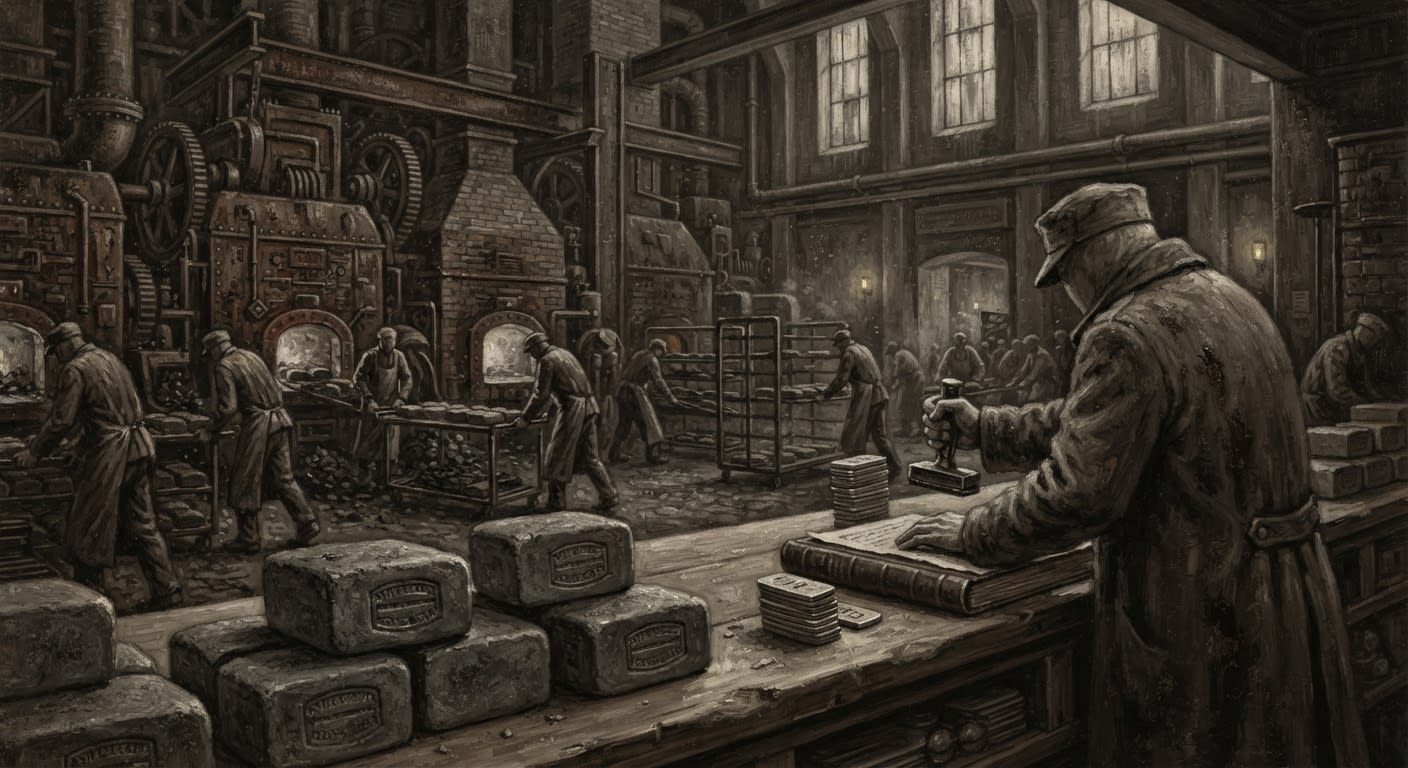
The Great Ovens never stop. Iron racks go in pale and come out grey, and at full draw the Ovens produce six thousand loaves per watch. That is a figure of capacity. The reader should keep it apart from the figure of requisition below, because the Quartermastery certainly does. The workers wear soot-black aprons and turn dough by hand at hours the rest of the Church keeps for Matins. Flash-burns are logged as occupational. Sealed "test loaves," baked in a corner of the Ovens under Innovation Permitted Under Stamp, are logged somewhere else.
The ratio of ash to flour is the Quartermastery's sacrament and its leverage. It appears in no ledger I have been allowed to open, and I have been allowed to open a great many. The Bureau of Alchemical Standards certifies that the ash is consecrated. The Bureau of Doctrine certifies that the consecration is sound. Neither Bureau certifies why the loaf will not rot, and I have learned not to ask a Bureau for a certificate it has not already printed.
Every sack of flour that feeds the Ovens passes the Flour Gate: one road, one ledger desk, one clerk, one stamp. Behind that desk, Quartermaster Odran Ashweight controls the flour and coal allocations. He fears one thing, an empty oven, because at San Vesta an empty oven is followed within a day by a full street.
#On War's Appetite
The Bureau of War came to San Vesta in A.S. 134. It brought a test protocol, pulled three-year-old loaves from the priory stores, and had the grim curiosity of men who had buried too many quartermasters beside spoiled depots. The loaves passed. The Bureau ordered six thousand additional loaves per month and wrote the order into Standing Order 1138-V: renewal perpetual, reviewed every year, never reduced.
Trench arithmetic is simple and pitiless. Flavour weighs nothing on a requisition, and rot weighs everything. A ration that outlasts a wet season, a siege and a supply officer's embezzlement will beat a better loaf that outlasts none of them, and the Bureau of War prefers its victories unpleasant and properly dated. Ash-bread goes first to Trench Bastion Las Cadenas, then to the forward depots, then to the pilgrim way-stations. The wounded come back up the same road to be patched in the Scorch-Cure and put to work at the Ovens that fed them.
The Salt Dues of Marseille paid for the Iberian Campaigns, and the Subjugation of Seville in A.S. 155 took rather more than loaves. San Vesta's contribution was smaller and less comfortable. For fifty-seven years before Seville, the priory taught the Synod how to feed a peninsula by schedule: food as compliance, the loaf as a docket, hunger as an appointment kept on the Quartermastery's hours. When the Synod needed that lesson in the south, it already knew the catechism.
#On Tokens, Names, and Hunger
Inside the priory, ash-bread is drawn against stamped bread tokens, and each token bears its holder's name. The token is the ration, and the ration is the name. A resident who loses a token loses more than a meal. The Ledger Cloisters record that resident as administratively absent. The Bureau of Records has held since before my ordination that hunger is no evidence of existence. Only the stamp is evidence.
Ten days is a long time to be only a body. By the fourth day, most who have lost a token will sign a Bureau of Oaths labour vow to get a replacement, and the Quartermastery keeps a template ready for exactly that willingness. The loaf that never spoils becomes a debt that never spoils.
The black market fills the gap. In the Cinder Markets and the Pilgrim Dormitories, shards of ash-bread change hands as furtively as contraband opiates, and the crumbs serve two purposes. Ground fine and taken in broth, they are a folk remedy for ash-lung. Swept from the floor of a dormitory cell, they are evidence for the Bureau of Purity that someone has been eating off the ledger. The same crumb can cure a cough and hang a smuggler. San Vesta wastes nothing.
#On the Other Bread
Pilgrims and lesser chroniclers often confuse ash-bread with resurrection-bread. The two must be kept apart, and San Vesta keeps them apart in separate ovens.
Resurrection-bread starts as the standard ash-bread mixture. It is then adulterated with compounds from the Relic-Smoke Kilns: bone-ash, consecrated mineral salts, and a resin the Incense Binders describe only as theological. It is baked at temperatures the Vent-Wardens call inadvisable. It comes out looking like the common loaf except for a faint violet tinge along the crust. No one at San Vesta may describe that tinge in writing, and so I have not described it. A dying person who eats resurrection-bread lives three more days. It cures nothing. Its debt lasts for life, and the Third-Day Debtors in the dormitories carry that debt under recovery-service oaths that run long past the reprieve.
The common loaf is the lawful body of the system, and the violet loaf is its scandal. The scandal is only possible because the lawful body already works. The population already takes its name from a token, already owes shifts for its bread, and already accepts that sufficiency is a gift one signs for. San Vesta learned to price a body a century before the violet loaf, at 1.2 kilograms a unit.
Earlier Bureau of Mercy circulars described ash-bread as "the charitable bread of the Iberian monks, distributed to the faithful in token of the priory's devotion."
Ash-bread is a war ration, an instrument of identity and an enforceable schedule, issued against stamped tokens under Bureau of War Standing Order 1138-V. The word charitable was withdrawn at the Quartermastery's own request, on the grounds that charity implies the loaf is free.
#On Present Supply
As of A.S. 201, the arithmetic is failing in the direction the Quartermastery fears most. The pilgrim influx has tripled in four years, and the dormitories have overflowed into the Cinder Markets. Prior Celestín of the Third Ember has twice in eighteen months authorised more resurrection-bread, and every violet loaf begins as a common one baked from the same flour.
The flour convoy from the coastal port of Vall de Sal is three days late. Vall de Sal has always skimmed its shipments, and the Quartermastery has always allowed for the skim. Three days is beyond that allowance. Ashweight has sealed the gates and begun the count: mouths against loaves, shifts against hours, the Standing Order against whatever is left. The Standing Order is counted first. It always is.
The loaf will be baked. It will be stamped with a name, carried down to Las Cadenas and stacked in a depot. It will outlast the depot, the soldier and quite possibly the clerk who signed for it. It has never spoiled, and it has never forgiven anyone. The Bureau of War considers these the same virtue.
Eat the ash.