
#On the Western Stair
"Rank ascends. Settlement descends. Mind the ninth step."
Every cleric posted to Strasbourg learns the city's grammar within his first week. Rank climbs. The Hierarchy speaks from raised benches, the canonical portfolios of the Holy Bureaus keep their offices where the windows are tall and the glass is clean, and a man measures his standing by how many flights he must climb in order to be refused. The Palatine Administrative Wing obeys this grammar faithfully along most of its length. At its western end it parses the sentence backward.
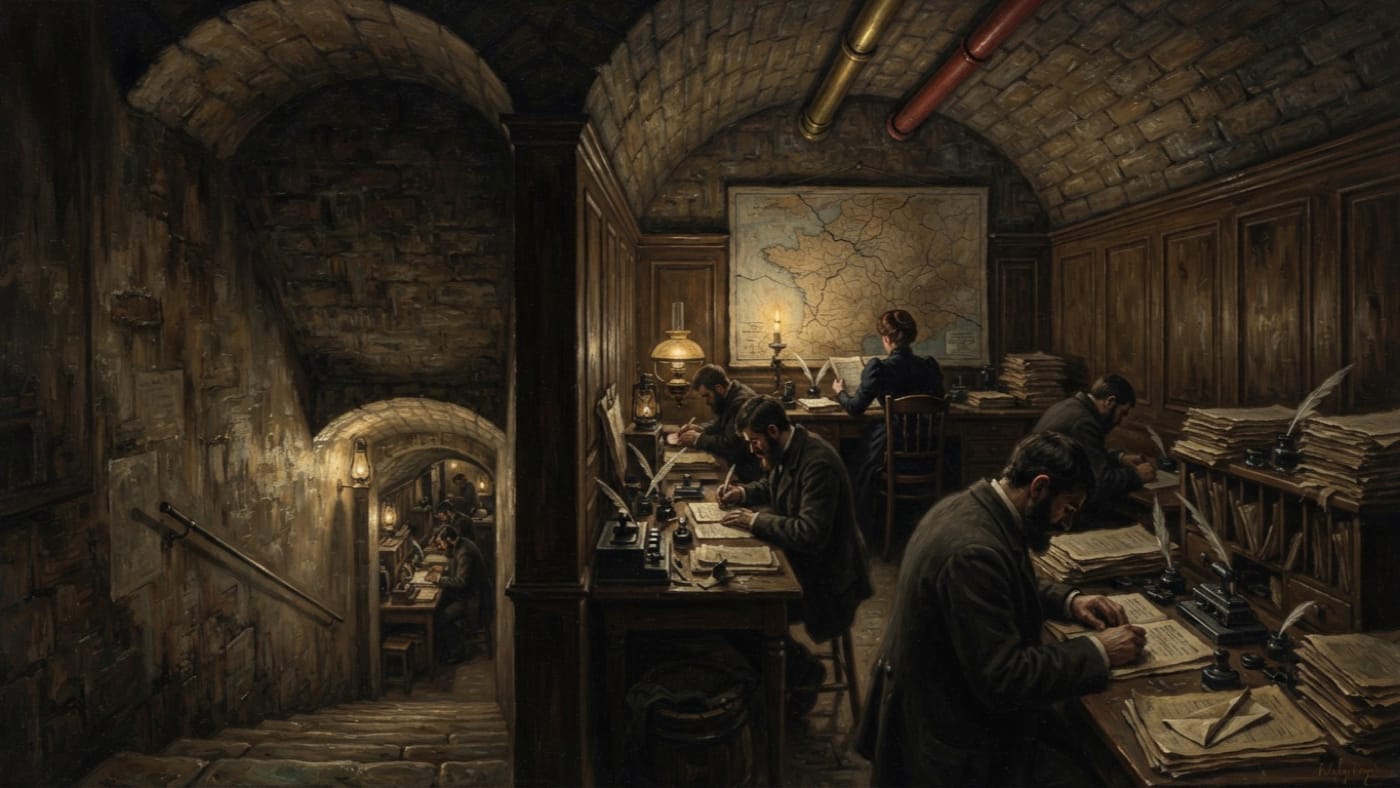
Nobody enters the Bureau of Settlement. One goes down to it. The route is a narrow western stair behind the old Palatine kitchens, a passage built for servants carrying trays and since promoted, without alteration, to carry petitions. The walls remember tallow. No quantity of official ink has persuaded them otherwise.
The first rooms off the descent belong to the Bureau of Tithes. These are counting rooms, and they are well lit, because Tithes has always been able to afford its lamps. Men with ink-black thumbs sit over arrears and do not look up at the sound of a passing cassock, since a passing cassock has never yet paid anything. Below them lies an annex of Records, which Records calls its tertiary archive. The phrase tells you that Records owns at least two better ones. The air in the annex tastes of dust and disapproval in about equal parts.
Below that the stair narrows, plaster gives way to bare stone, and the stone begins to sweat.
#On the Rooms Below
The Wing's own papers call this level Sub-Level III. When a clerk is in a hurry it becomes Sub-Level 3. Both name the same floor, which lies below the point where a visitor stops expecting windows and starts to understand what the Synod believes about air.
These rooms were dug and vaulted to hold Rhenish white. The wine is gone. The ledgers remain. The Wing's papers describe the conversion as partial, which is the Wing's word for unfinished, and the unfinished part shows. Desks stand where casks once stood. Shelving was fitted to vaults that were shaped for barrels and still prefer them. The corridor sweats in dry weather and sweats more in wet. A room built to keep wine at a steady chill keeps paper at a steady damp, and every clerk down here has learned to blot a page before it has had time to be wrong.
I cannot certify how far the cellars run beyond Settlement's rooms. I cannot name who dug them, who stocked them, or in what year the last cask was carried up the stair. The Wing has no plaque on any of these points. When I asked Records, Records sent me a form.
The Bureau's charter is better documented than its cellar. Settlement was constituted in A.S. 92, during the second year of the formal Synod and two years after the Concordat of Strasbourg. The charter assigns its duties and is silent about its accommodation. Nobody has recorded when the Bureau first carried its ledgers down past the kitchens, and I decline to supply a date that the archive has never possessed.
This Codex previously gave A.S. 92 as the year of the Concordat.
The Concordat of Strasbourg was concluded in A.S. 90. A.S. 92 is the year of Settlement's charter and nothing more. The Concordat's founding authors were dead before either year, and neither of them sealed anything for Settlement from beyond that boundary.
#On the Addresses
What happens in this cellar is easy to state and hard to finish. Settlement decides where a subject of the Theocracy may live, whether and when that subject may travel, and what follows when a household changes shape. Its writ covers some three hundred million registered subjects, and the Bureau calls them addresses with the fondness other Bureaus keep for relics. Its clerks will tell you plainly that the three hundred million are not filed in these vaults. I once asked one where they were kept. He looked at me as one looks at a man who has asked whether the Rhine is kept in a bucket.
The cellar handles the decisions. The records live elsewhere, in the Great Ledger of Souls and in Records' authenticated copies. Settlement assigns the residence, and the instrument then climbs the western stair. Records authenticates it in the annex above. Tithes assesses on it in the counting rooms above that. The Wing therefore keeps three Bureaus stacked in the order of their dependence, with the Bureau everyone else depends on at the bottom, in the damp, under everyone's boots.
There are three common kinds of paper.
The residential assignment says where a subject may sleep. A clerk enters it at a desk under a painted map. Somewhere far from Strasbourg, a family then finds out whether it has been given a roof or a road.
The Transit Writ grants leave to move. Settlement stamps it at the origin, Records countersigns it at each checkpoint, and the holder surrenders it at the destination. The writ runs thirty days. An extension takes forty. Arithmetic like that keeps a population still more cheaply than any wall.
The household or vacancy revision is the quietest of the three. A death is filed, a permit is cancelled, an address is released, and a widow's permit is reissued for a household that has one fewer person in it. The form is two pages long. A clerk in this cellar sees more deaths than a parish priest and attends none of them.
The Wing still remembers Mandate 188-A. It remembers forty thousand people moved on fourteen days' notice, and the foundry-town of Keska, which fell between two boundary lines and went unassessed for eleven months. Nobody I have asked will say in which rooms that mandate was drafted, and I will not invent an answer. The reckoning of what it cost was done by the woman who now sits at the end of the corridor.
#On Temporary Allocation Review
The corridor ends at a door marked Temporary Allocation Review. The label has outlasted every promise made about it, and I cannot say whether it names the office or describes the person inside.
Six clerks work in the outer chamber. Their desks were recovered from a dissolved notarial guild, and they still carry the guild's habits: deep drawers, a raised lip to stop wax rolling off, and a surface scarred by a century of other men's oaths. The six do not speak while they work. The only sounds are pen, blotter and a fold. The fold is learned behaviour. Rejected petitions in this room are folded once, along the vertical, before they are returned, and every clerk does it exactly as the Sub-Archon does.
Two speaking tubes come through the wall. A brass one goes up to Records. A red-painted one goes to the Bureau of War, and the Wing believes it will carry nothing unless a superior officer shouts into it. Sub-Archon Provisional Yvette Langres has never shouted into it, and it works for her anyway.
Her own room is small. It contains a painted Zone map behind glass that is cracked at the lower-left corner, and visitors who take its plainness for austerity have misread it. The map is the only icon in the room. A pilgrim prays before a relic. Langres works before territory that can be assigned, and her table is the most current one in the building.
The room's rank sets its procedure. A provisional head cannot borrow authority she does not hold. She answers petitioners with exactness because exactness is the only power that is entirely hers. The visitor log for A.S. 199, as quoted in her dossier, records a Bureau of War liaison admitted at 09:00 and gone by 09:07, having had his requisition amended downward by eighteen thousand four hundred bodies. Seven minutes. The log does not say whether the liaison went back up the stair angry, but it does show that he climbed it carrying a smaller number than he brought down.
Further down the same page, the log records an unregistered woman carrying an infant, with neither permit nor escort. She was admitted shortly after eleven and left with a provisional sleep authorization. The Sub-Archon's note in the margin asks why the woman needed this office, and does not ask how she found it. Most men who have descended that stair never thought to ask either question.
#On the Present File
As of A.S. 201 the door still says Temporary. Langres has been Sub-Archon Provisional since A.S. 194, which makes seven years of review. The Hierarchy has neither confirmed her nor replaced her, because confirming her would admit that Settlement matters as much as the canonical portfolios, and replacing her would require someone else able to hold the population map in one head. The corridor still sweats.
Settlement's annual report for A.S. 200 travelled up the western stair, past Records and past Tithes, and into the upper storeys of the Synod, and as of this year it has not come back down with an answer. The Bureau of Doctrine wrote one annotation on it: Noted. I am of Doctrine, and I recognize the hand of an office that has learned to say nothing in a single word.
The Bureau has made three requests for the coming fiscal year. It wants authority to take a census of the Constantinople Warrens without a War escort. It wants direct access to the amendment queue of the Great Ledger. It wants money for thirty more field Assignors. Tithes, two floors up, objects to the money. War, at the far end of the red tube, objects to the census. Records, at the end of the brass one, objects to the access because directness is, in its phrase, "procedurally inflammatory." I know the speaking tubes carry this traffic because I have stood beside them, and I note that each objection reaches the cellar through the Wing's own plumbing.
None of the three requests asks for a window, for drier stone, or for a sign that says something other than Temporary. The Bureau of Settlement has asked to count the Theocracy properly, and it has not asked for a better room in which to do it.
Langres filed the objections under Evidence.