
#On the Sentence
"Rhythm is a leash." — Bureau of Orison and Song, enforcement placard, A.S. 94
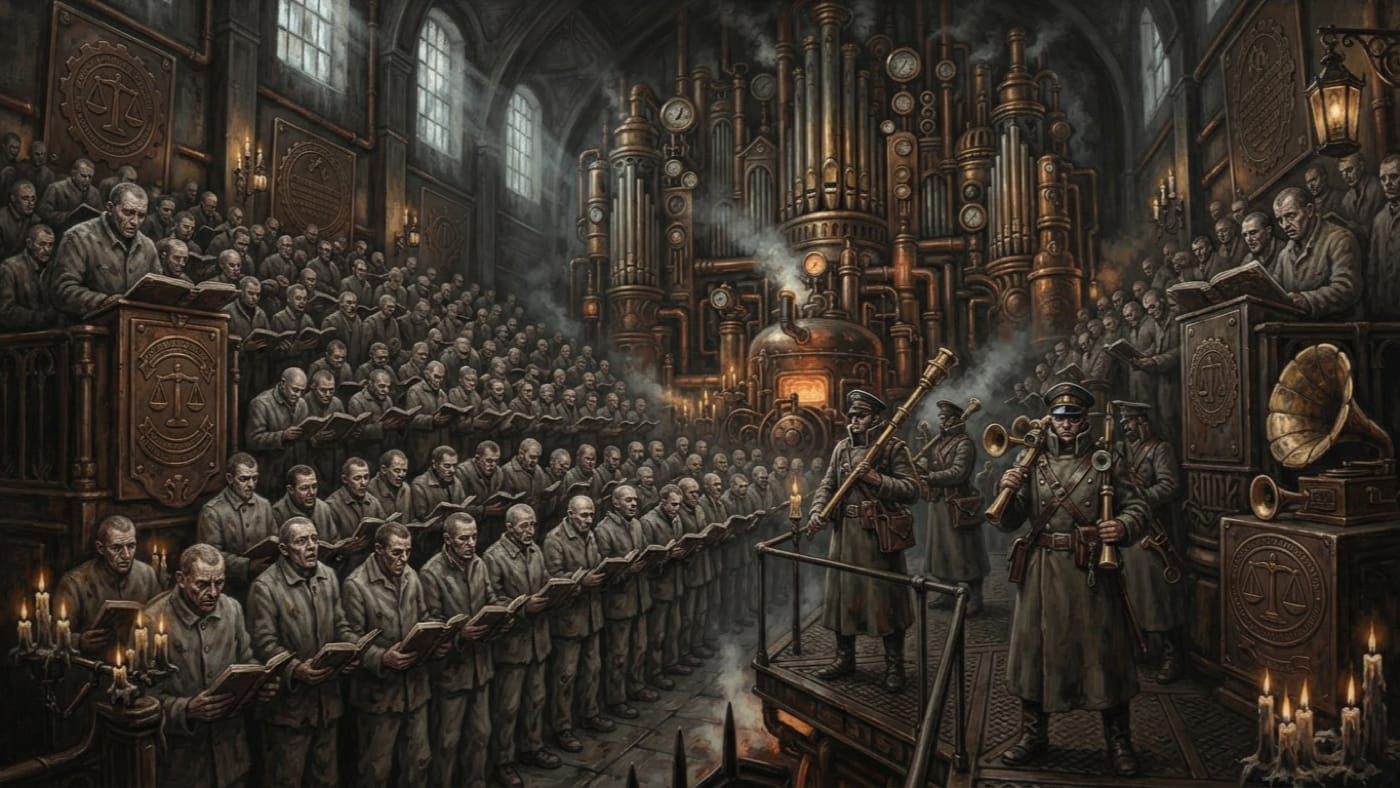
A Penal Choir is a sentence with a hymnal attached. The condemned are put into a choir and made to sing approved doctrine, so the Synod gets from a heretic's mouth the very words the heretic was convicted for withholding. I know of no thriftier punishment in the Synod's repertory. The scaffold uses the offender up and the brand marks him. The choir puts him to work.
Readers who met the phrase capitalised in my entry on the Creator may picture one great order with a mother-house, a prior, a coat of arms and a refectory smelling of boiled cabbage. The Bureau of Records would welcome such a body, because it would be easy to file. The record supports something plainer: a punishment served in choirs, plural, wherever the authority holding the prisoner can supply a licensed hymnal and someone to stand over the singing. I have found no charter, no headquarters and no single command. I have not supplied them out of courtesy.
The subject belongs under Doctrine because what the choir produces is doctrine. The sentenced voice repeats the Catechism's propositions aloud, in licensed measure, for as long as it is told to. A clerk can certify that the correct words were sung. Nobody has yet drafted the form on which a clerk certifies that the words were meant.
#On the Mouths Assigned
Three roads into the choir appear in the published Codex. They are separate roads, and running them together would be a clerk's sin.
The first is doctrinal. The Heresy of the Absent Creator holds that the Creator died at the Sundering or before it, and that the relics twitch like a corpse's heart. The Bureau of Purity classes it as Heresy, Third Degree, punishable by branding, confiscation and reassignment to Penal Choir for a term of not less than seven years. The seven years belong to that heresy alone. I have seen the figure quoted in taverns as though it governed every choir in the Dominion. It governs one offence. Other assignments carry whatever terms their own sentences carry, and I am not going to invent those terms to make the taverns feel orderly.
The second road runs through the Orison Licensing Acts of A.S. 94. Under their penalty schedule a listening-cell host, the person who teaches the closing phrase of a forbidden melody by mouth in some back room after curfew, may be reassigned to a penal choir to sing approved doctrine. The word is may. The Acts give the authority a discretion, and nowhere does the published text oblige it to use one.
The third road is bought. The Unauthorized Melody Smuggler caught carrying a fragment faces tongue-branding. If he names three clients, he faces reassignment to a penal choir instead. The number is three. The ones named are clients, the mothers and soldiers and dockhands who paid him for a bar of comfort.
These are the routes the Codex documents. Others may exist, and I have not catalogued them.
#On Approved Singing
The Bureau of Orison and Song licenses every hymn printed, every choir assembled and every devotional broadcast transmitted within the Synod's mandate. Its wax seal sits in the binding of each approved hymnal, and the serial number lies on file at the Cloister of Calibrated Breath in Strasbourg. A penal choir sings from those books. It has nothing else to sing from, because since A.S. 94 everything else has been Criminal Sound.
That is the whole cruelty, and it is a lawyer's cruelty. Under the Acts, a licensed hymn sung with an altered interval becomes Criminal Sound. The prisoner who was put in the loft for one unlicensed melody stands there each day with the means of a second offence in his own throat. One flattened note, one phrase slipped back towards the cradle-tune he was arrested for, and he has given evidence against himself in front of witnesses. He is guarded first by the licence and only then by whoever happens to be standing over him.
I cannot tell you that a Tone Inquisitor stands in every choir loft. The record doesn't say so, and I won't put one there for drama. What I can say is that every hymn in the loft has passed through Orison's ear before the prisoner opens his mouth, and that Orison's ear is not known for its forgiveness.
The Acts are blunt about the body. Listening-cell hosts reassigned to penal choirs, the text says, sing approved doctrine "until their throats learn obedience or split." I can add nothing to that sentence, and the Bureau has asked me not to try. The voice is a muscle, and doctrine sung under compulsion wears it out like any other labour. What a split throat costs a particular singer, and what becomes of him afterwards, the published record leaves unwritten.
#On the Price of Names
Proving a melody offence is hard, and the Bureau of Purity resents hard things. A song kept in memory leaves no paper behind. To convict for Melody Intent, the prosecution needs a witnessed performance, a confession drawn out under Purity's Methodical Interview, or the testimony of an informant inside a listening cell. Two of those three methods need someone else's mouth.
The choir supplies the price for that mouth. A smuggler facing the branding iron is offered the loft, and the offer is put in a single arithmetic: three names. In my entry on the smugglers I described this as survivability used for bribery, the thing that keeps the informant pipeline flowing, and the Bureau has never disputed it. A man will sell a great deal to keep his tongue unburnt. Purity has noticed this, as Purity notices everything that can be priced.
Beyond the three-client bargain lies the registry Purity calls its "converted ears": former smugglers, former clients and former listening-cell hosts who traded testimony for reduced sentences and now report from inside the trade. The smugglers call them static. The registry and the choir bargain are separate instruments. I have no evidence that every choir singer joins the registry, or that a fourth name buys a fixed number of days off. The Codex records the first bargain and the existence of the second, and that is all I am entitled to say.
"A smuggler who names three clients faces reassignment to a penal choir — harsh, but survivable."
Corrected for precision. Survivable describes the threat as Purity offers it and the smuggler weighs it. It promises nothing about the singer's throat, his health or his release, and it does not protect him from any later sentence the Bureau may hand down. The Hieromnemon regrets a word that sounded like a promise. The Bureau has never regretted making one.
#On Distinctions the Record Requires
Song is used in more than one punishment, and people who confuse them insult every office involved.
The Iron Choir Brand-Singers are a licensed profession. They hold the pitch while confessions are burned into flesh, pacing the condemned man's breath so that the scar matches the form. They are paid singers serving a rite. The penal choir is made up of the sentenced.
The cages of the Iron Choir along the Mainz road held heretics with their throats slit shallow, forced to sing hymns until they drowned in their own blood. That was execution with a melody added. The penal choir, as published, is an assignment that the condemned are expected to serve and that is offered as an alternative to worse.
The scaffold that took the eleven laundry-women of Candlewick was an ending, arranged in public by the Bureau of Festivals. Immurement, the Acts' penalty for distributing forbidden melody, puts the offender inside a wall. The choir keeps him standing in the open, singing.
Last come the licensed choristers, men and women who sing the same hymns from the same sealed books in cathedral stalls of their own will and under Orison's licence. The hymnal is the same and the notes are the same. Their legal position is entirely different, and an attentive listener can tell them from the penal choir by the faces, if not always by the sound.
#On Present Application
As of A.S. 201 the Orison Licensing Acts remain in full force, and the penal choir remains one of their instruments. Doctrine is still sung by mouths that were convicted of refusing it, from hymnals that Orison has sealed, at a cost the published record measures in throats. Whether the Creator receives such singing as praise is above my office, and Doctrine has made no ruling. The Bureau receives it as compliance and files it the same day.