

#On a Title Without a Charter
This survey was compiled in A.S. 201, which the common reckoning calls 1911. That year belongs to the compilation. It does not tell you when the first Permit Warden took a lane on the Queue Road, because no document I have handled says when that happened, who made the appointment or under what instrument. The Wardens turn up in the files the way fence posts turn up in a land survey. They are everywhere and they carry weight, but nobody has ever made them the subject.
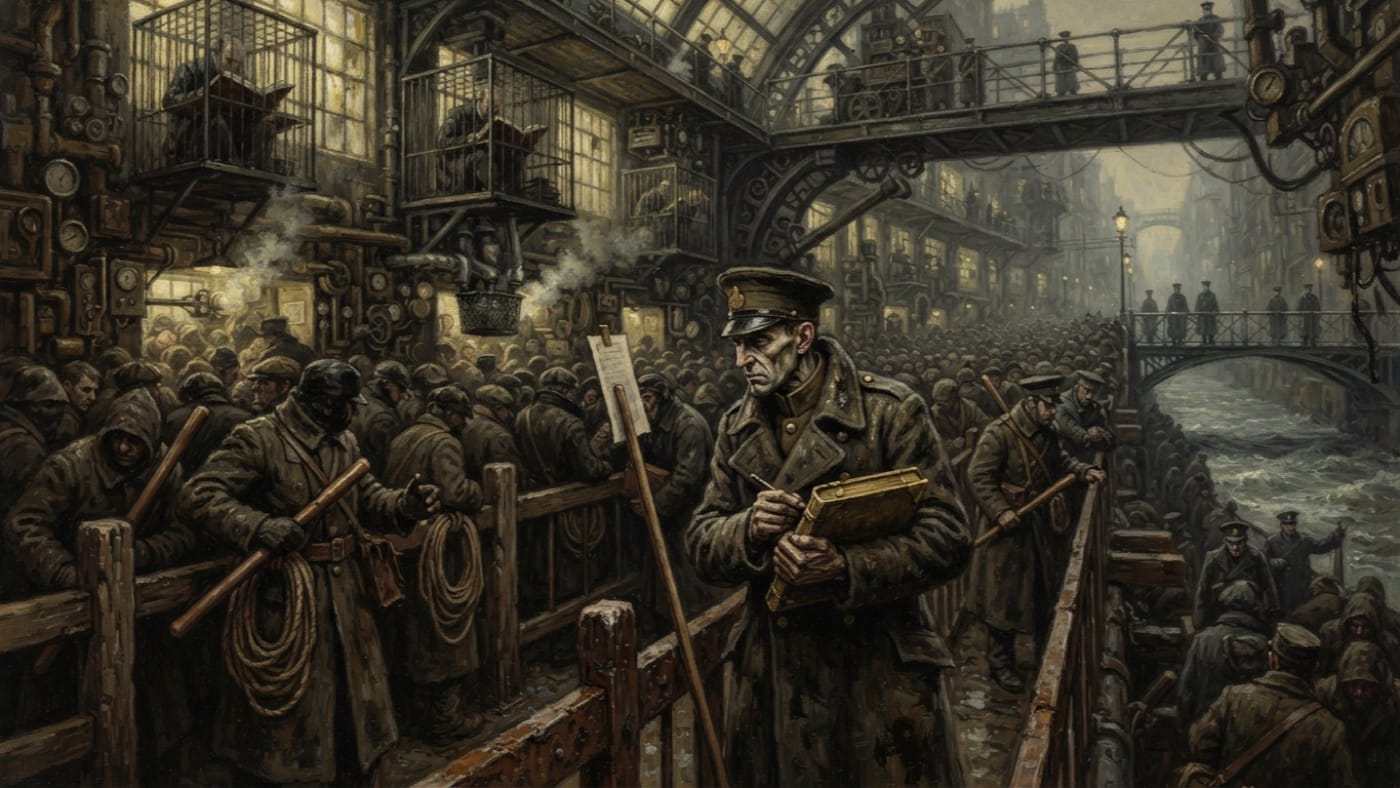
The Road's nine gates are kept by the Synod Permit Directorate and its Gate Courts, and each gate sits as a small tribunal. A traveller passing through one meets four kinds of hands, and copyists keep confusing them. Time Clerks record the waiting and keep the books. Stamp tenders keep the wax hot, the ink wet and the presses clean, and they work the baskets. The Queue Marshals handle the crowd itself with rope, baton and pressure. The Permit Warden holds the lane and examines the papers in it. The Warden stands on the traveller's gravel at the height of the traveller's face, and is the first official to look at a document while its bearer is still holding it.
That is all of the office the record lets me describe. The Directorate has published no rank table for Wardens, no roll of their numbers, no uniform regulation and no oath. One line of the Road's domestic order fixes their place: clerks and wardens draw stable rations. On the Queue Road that line is as good as a patent of nobility.
#On the Pole at Gate Three
The Wardens' work is best attested at Gate Three. It happens under the Bell-Mark Gantry, which more officials watch than any span of iron deserves. At dawn the clerks take their cages and the lane wardens lift the paper poles. Travellers hook permits, passage slips, witness cards and debt revisions onto the poles and raise them toward cages they cannot see into against the morning.
The Gate Three survey gives the Warden one decision: which raised paper is worth a clerk's wrist. It is made at lane level, with the paper damp and the bearer's arm shaking under it. A paper the Warden passes goes up. The clerk above strikes the mark, enters the hour, lane and rate class, and so opens the traveller's minute account. The stamp tender has kept the wax hot beforehand and sends the paper on through the baskets afterwards. At the mouth of the lane a Marshal judges how hard the crowd behind the pole is pushing.
Taken apart, the four acts are simple. The Warden selects, the clerk accounts, the tender seals and the Marshal compresses. None of them can tell the traveller what the hour will cost, because the price is on a rate board nailed above them all.
The surveys do not say what becomes of a paper the Warden leaves down, and I will not write a procedure to fill the gap. They do make one thing plain. Between the lane and the cage, the Warden's eye is the only examination a document gets before it is inked. A clerk may decline a damp paper. A paper held in a shaking hand may be read as a paper with something to shake about.
The Gantry's own survey says wardens tolerate travellers crossing themselves before raising their papers, "because a man praying is easier to strike than a man arguing." I report the remark as that survey gives it. It names no Warden and records no blow.
#On the Plank at Gate Two
At the Second Gate, the Drowning Step, the lane runs out at the water. Fences and rust-iron barriers narrow the approach to single file across the bridge planks, over a river the public maps leave unnamed. Whatever the pamphlets say, it is a different water from the Latch River ford. The duty attested here is narrower than at Gate Three, and a mistake costs more. Lawful passage crosses the planks under the Warden's eye, and the traveller steps forward when named.
The Pinch has no tariff of its own and no special class of permit. Its papers are the papers of any gate. What changes is the price of a wrong call. A misread permit at Gate Three costs an hour. A crowd that leans forward on a wrong call at the Pinch has a river in front of it. The gate court keeps a tally of drownings. The tally has not been released, and I have no figure to give.
Since the spring of A.S. 200, travellers at the Pinch have reported bell-shadows, outlines that cross the planks before their owners are called. Witnesses in the lane attest to them. Nothing I can reach records how the Wardens on the bank deal with a shadow that has crossed without being named.
#On the Maze and the Ordinary Fourth
Between Gates Three and Five lies the Barricade Maze: wet timber, rope-gates, numbered lanes whose numbers change during a surge, and culverts underneath. Overhead, catwalks carry Time Clerks, Permit Wardens, Queue Marshals, runners, and inspectors whose boots stay out of the mud. No sealed map of the Maze exists, and I draw none here. A Warden in the Maze may be holding a lane that was not that lane at dawn. The Marshals move the fences in mid-wave and the surge does the rest.
The earlier survey of the Queue Road had Permit Wardens adjusting "their fence-lines with the delicate malice of a chess player repositioning pawns."
Corrected. Fences, ropes and barriers belong to the Queue Marshals. The Marshals move them, and a Marshal can start a riot by moving one. The Warden holds the lane the fences make and examines the papers inside it. The malice in the original sentence was mine and it stays. The attribution goes.
Gate Four stands somewhere in that stretch. Its site plan and its feeder lanes are not on file, and it holds no jurisdiction of its own. Its Wardens hold lanes the way Wardens hold lanes everywhere on the Road, and that is the most I can certify. The Fourth Gate is famous only for the Unstruck parable of the waiting mother, who loses an hour whether or not a merchant buys it. She has no name and no date, and no Warden appears in the parable. I record that because a copyist will sooner or later put one in, and the Unstruck do not need my help improving their sermons.
#On What a Held Lane Is Worth
The Wardens did not write the arithmetic. In A.S. 97 a false plague rumour at the Latch River ford set off a week-long crush. Records counted three thousand dead in the press and five hundred more in the fevers that followed. The Bureau of War answered with nine gates. The Directorate was constituted in A.S. 102 under the joint seals of Records and War. Minute pricing began in A.S. 104 and had become policy by A.S. 110, under the pressure of the First Continental Levy. From then on, a lane that was held was a lane that produced.
The waiting is marked, entered in the ledger, valued as minute credits and sold to buyers of priority. The merchant who buys is named early and walks across. The traveller whose standing made the minutes stays where they are. The Warden sees both of them from the same distance and owns neither the rate nor the ledger. Wardens set no prices, keep no books and hear no appeals. Compounded debt goes down the Road to Gate Nine for labour conscription or reclassification, and the Null Verge takes whatever reclassification leaves. Gate Nine's hearing line puts a Warden at the third desk, checking cargo and breath. The judgment comes three desks later, from a clerk with a finger on the minute ledger.
The Road's own account of its controls names Wardens alongside Time Clerks, and notes that bribes there take the form of warm oil, food, clean paper and witness signatures. The list names no Warden and sets no price. A traveller who offers clean paper to the official who decides which paper is worth lifting understands the office better than any charter the Directorate might issue. None is on file. The Null Verge survey adds that a Warden waves the Custodians' blank-stamped carts through, because stopping one would mean asking who issued the stamp, and the question would be written down.
#On the Present Lane
In the spring of A.S. 200 minute prices doubled. The Gate Four survey calls the change a Directorate decree. The surveys of Gate Three, Gate Two and the Maze say no decree was published or explained. I have filed both versions. The doubling is a fact, and its authorization remains open. That autumn Gate Nine closed for sanitation, and the pressure backed into the Maze until the queue stood under Gate Three's own windows. A lane held in those conditions carries more bodies to the yard than the Marshals' own compression rule permits.
The Minute Drift, classified in the Maze in A.S. 194, is reported where it is found. Double bells and lost intervals come chiefly from the Maze, premature marks from the Gantry, and bell-shadows from the Pinch. At the Gantry, supervisors confiscate cards stamped for hours that have not yet come. How a Warden at lane level treats a paper raised with tomorrow's mark already on it is not documented.
As of A.S. 201 the Road runs under Amber assessment. At dawn the poles still go up at Gate Three, and at the Pinch names are still called one at a time. Rations remain stable.