
#On the Crossing
"Count your planks, not your minutes." — lane saying at the Second Gate
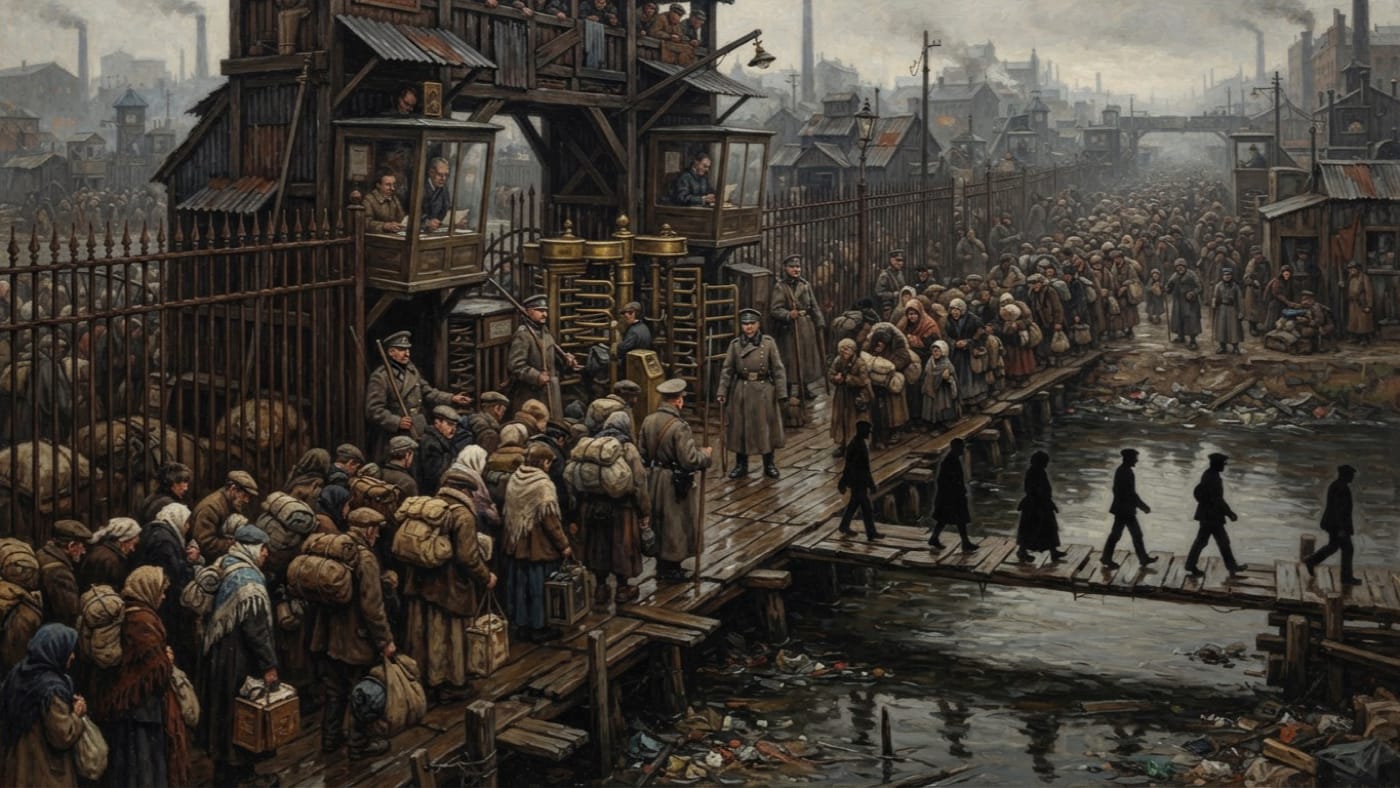
Gate Two of the Queue Road is a bridge the Synod has trained to be narrow. The court registers call it Gate Two Bridge Pinch. The people standing on it call it the Drowning Step, and no register has ever bothered to correct them.
Here the road meets a river and crosses it on planks. The Directorate's public maps do not name the river, and I will not name it for them. Whatever crossing stood here before the Synod took an interest in it, the traveller now meets fences, rust-iron barriers and the timber frame of a gate court, all of them drawing the passage inward until carts, porters, pilgrims, wagoners and the occasional goat must take the boards in single file, at the speed of the slowest paper. The narrowing is deliberate. No flood carved it and no settling of the banks produced it. A man with a rule and a requisition decided how many bodies the planks should carry at once, and his answer was fewer than arrive.
His name, the date he decided it, the length of the span and the number of times the boards have been relaid appear in no file I have been shown. I decline to invent them. The Directorate invents enough for both of us.
No file can remove the smell. The river below the Pinch carries the run-off of a road where forty-eight thousand registered souls live, plus the unregistered, whose run-off the census does not count but the water does. Above it hang wet timber, axle grease, thin broth from the vendors on the near bank, and the sour damp of permits held for hours under coats. In winter the sleet sets on the boards in a skin that no queue marshal is paid to scrape away.
#On the Price of Passage
A sensible reader will ask why a supply artery serving the forward staging depots should choke itself at a river. The sensible reader has not studied the Permit Directorate.
The road's gates came out of catastrophe. In A.S. 97 the panic at the Latch River ford, a different water whatever the pamphleteers claim, became the Queue Road crush: three thousand dead in the press and five hundred more to the fever that followed. The Bureau of War answered disorder the way it answers everything, with gates. The Directorate was constituted in A.S. 102 under the joint seals of War and the Bureau of Records, so it inherited War's appetite for control and Records' talent for making control look like arithmetic. Minute pricing began quietly in A.S. 104. By A.S. 110 it was policy.
From then on, delay was revenue. Each gate court is a customs house, an inspection post and a census office squeezed into one timber frame. Permit Wardens examine papers, Time Clerks enter the waiting in the ledgers, and queue marshals keep the crowd's pressure just below the point of riot. Every minute a traveller stands is a minute the Directorate can record, credit and sell. The merchant who buys those minutes is named early and walks across the planks. The man who earned them by standing stays behind the barrier and watches the merchant's boots.
The Pinch has no tariff of its own that I can find, and no special permit class. It needs none. Most gates have to manufacture their delay. Gate Two has a river to do it for them.
#On the River and the Culvert
The Drowning Step earned its name in the plainest way. A crowd packed onto an approach lane leans forward, as crowds do. Someone at the edge of the planks is pushed by someone who has been pushed. A porter with a full pack goes into cold water and does not come up. Children slip between the rails. Carts lose a wheel on boards slick with sleet and take their drivers with them. The gate court keeps a tally. I have not been allowed to read it, and I will not make up a figure so this paragraph sounds weightier.
Exposure kills too, and more quietly. When curfew shuts the court, the lane stays where it is, and the people in it stand through the night beside water that breathes cold up through the planks. Hunger does the rest. None of this needs anything supernatural to explain it. The river was drowning travellers here long before anyone had reason to look for anything stranger.
Then there is the culvert. Somewhere near the Pinch, where I will not say and in truth cannot, there is a hidden entry into the drainage works beneath the road. Those works were dug to carry water. They have since become the smugglers' highway, joining districts along routes the Directorate's maps leave out. Above them, the "Hatch" Lyd's Runner Union sells passage, and its runners are said to know three ways around every gate the Directorate calls impassable. Who uses the Gate Two entry, how deep it runs and where it comes out are all unrecorded. I am glad of that, because a recorded entry would have a toll on it by morning.
Lawful passage goes over the planks, under the Warden's eye, and is billed. Unlawful passage goes under them, in the dark, and is billed by somebody else.
#On Shadows Crossing First
Until the spring of A.S. 200 the Drowning Step's dangers were those of any badly governed bridge. That spring the minute price doubled without a published decree, and the Minute Drift, which until then had kept chiefly to the Barricade Maze between Gates Three and Five, began turning up elsewhere. Gate Two was one of the places it appeared.
Its sign here is the bell-shadow. A traveller waits behind the barrier with papers in hand and bell not yet struck. Ahead of them, on the planks, lies a silhouette already crossing, and it is unmistakably theirs: the same stoop, the same bundle on the same shoulder, the same limp. The shadow reaches the boards before its owner does. The owner follows later, when the Warden names them, over ground their outline has already walked. Witnesses in the lanes report this. So do the people the shadows belong to, who tend to report it louder.
The other symptoms of the Drift belong to other places, and I keep them where they belong. Double bells and lost days are reported chiefly from the Maze, premature stamps from the Bell-Mark Gantry at the Third Gate, and bodies ageing against their papers from the Shed Wards. The parent record does contain one account that crosses districts. A mother remembers passing through Gate Four with two children and a journey without a break in it, yet afterwards one child's shoes were caked in river mud from Gate Two. I report the mud as reported. It proves no route, no drowning and no mechanism, only that the shoes and the mother disagree.
I make no claim that the Drift drowns anyone. The river has managed that unaided for as long as the Pinch has existed.
The Bureau of Rites continues to classify the disturbance as a Category Two Localized Temporal-Scribal Disturbance. The Bureau of the Hourglass assesses it as Class II-Extractive, sub-designation Alpha, and lists its recommendation for reclassification as pending since A.S. 198. These are two positions held at the same time by two bureaus, and neither has given way.
As for cause, the sealed reports I have described elsewhere, together with the Hourglass's own assessment, trace the Drift to the Apparatus, found by Engineering in A.S. 178 forty-two feet beneath the Hearing Hall at Gate Nine. On that account, waiting is drawn off down the road and sent somewhere the reports do not name. I give the account as the reports give it. The culvert at Gate Two is not evidence of a shaft, conduit or channel to that chamber, and anyone who draws one on a map has drawn a wish.
The Minute Drift is a localized disturbance confined to the Barricade Maze between Gates Three and Five.
Clarified. By every numbering the Directorate uses, Gate Two lies outside the stretch between Gates Three and Five. The Drift is present at Gate Two. The disturbance therefore remains localized, in the sense that Gate Two is a locality. Category Two is retained.
#On the Present Condition
In A.S. 201 the Drowning Step is open, in use, and collecting. Amber operations continue along the whole road and Gate Two continues with them. The bell-shadows have not stopped. The river has not stopped either.
The Bureau of Rites prescribes the same measures road-wide: carry a sanctioned bell-card, say the Queue Prayer at each fence-post, and practise witness pairing, in which two travellers vow to remember the same hour and compare their accounts at the next gate. At the Pinch the third measure has a cruelty Rites did not intend. Two people standing together on the bank can agree on the hour perfectly while one of their shadows is already halfway across the planks. The prescribed measures produce reports, and none of them has been certified as a cure. The Unstruck are said to blunt extraction surges elsewhere on the road by fouling the bell schedules. Nobody has entered them in a Gate Two ledger, and I enter them in none.
The planks are as narrow as they ever were. The water beneath them is as cold. Travellers are named, step forward and cross, and some of them find their outline has gone ahead and is waiting on the far bank.