

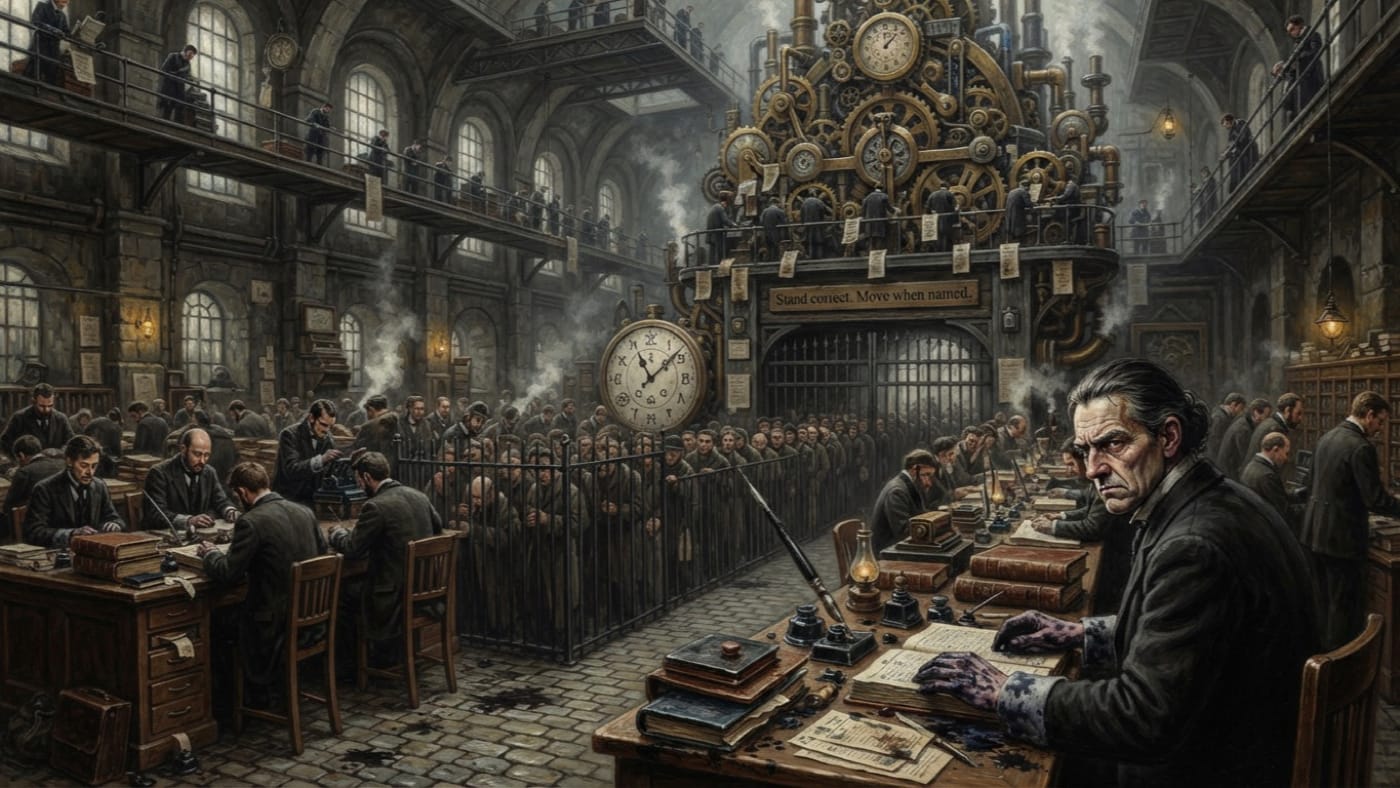
#On the Collegium's Station
"Stand correct. Move when named." — Gate-timber notice, posted from First Court to Ninth
The Time Clerks' Collegium is a guild, and it would prefer that you forget this. Its public claim is accuracy: every hour stamped on the Queue Road is the hour that passed, every minute owed is a minute entered, and the Collegium's ledgers reflect the road's waiting as faithfully as a chancel mirror reflects the candle in front of it. No charter that I have seen states this claim. Clerks repeat it constantly.
Its territory is Clerk's Mile, the ribbon of scribes, notaries and copyshops where the air tastes of ink and vinegar and the cobbles are tacky with both. Clerk-Prime Yoren heads the guild. Among the copyists who serve under the Clerk-Prime is Scribe Mara Lint, whose nails are stained to the quick. That is all this office will report of her, and it is probably all her trade would want reported. A time clerk can be recognised on sight by the ink-grey cuffs. On any other road the colour would be a uniform. On this one it is also a warning.
The Synod Permit Directorate sets the prices. Gate Nine Court hears the appeals. The Collegium keeps the working books through which every price is charged and every appeal is argued. A road of nine gates and forty-eight thousand registered souls (the Null Verge excluded, as the census insists) cannot move a single cart without a recognised entry, so whoever writes the entry decides what has occurred. I once wrote that the clerks "control reality." I meant it in the administrative sense and I stand by it in that sense. They control the version of reality that a gate will accept.
#On the Keeping of Minutes
At the Third Gate the Bell-Mark Gantry stamps each traveller's paper with the hour. The windows call the stamped paper a Bell-Mark Slip, and it opens an account. Each minute between the mark and clearance is waiting, and once waiting has been recorded it becomes money. The minutes are entered as credits that can be traded upward, so that a better-provided traveller can buy the passage another one stood for. Fresh minutes fetch a premium. Minutes that have been flagged for audit or are close to expiry sell cheap, like bread at the end of the market day.
The Collegium watches over this account the way a sexton watches over the parish register. It holds the ledgers and the bell-mark machines. Its working tools are the pen, the blotter and the pause. A clerk's "error" adds a day to a transit, and a clerk's favour takes one away. Everything Clerk's Mile does for a living happens between those two acts. A Minute Permit is reissued. A Lane Reclass Token is approved on the second request. An Appeal Docket that seemed lost turns up, after a small consideration, filed under the correct name all along. The street calls the consideration ink tax. The clerk at the window calls the product a corrected entry and sells mercy under that name.
The trades nearby make use of the same books. Witness Certificates, rented from the perjury houses of Stamp Court Row, can stretch a minute claim to cover hours the claimant never stood. The Runner Union under "Hatch" Lyd sells unofficial passage and black-market timestamps. Counterfeiters work the cellars beneath Clerk's Mile with wax good enough to embarrass the Candlewick Palatinate. No one has proven that any of these trades belongs to the Collegium. All of them operate within a short walk of its windows, and all of them would starve if its books stopped being believed.
The failures belong to the travellers. If you miss a bell-mark or fail an audit, the minutes you owe begin to compound. Minute debt ends in one of two ways. The first is labour conscription at Gate Nine, hauling barricades and copying ledgers until the fingers split. The second is erasure into the Null Verge, where a name becomes a blank tag pinned to undyed linen. The clerk who wrote the failing entry goes home by the catwalk.
#On the Privileges of the Guild
The Collegium has one great date in its history, and it is a date on which the clerks did nothing.
In A.S. 187 the Collegium stopped stamping. No mark was entered for three days. The road, which depends entirely on marks, came to a halt, and the backed-up traffic reached the Rhine corridor. The road is the artery between Rheinscarp and the forward depots of the Sagittal Line, so for three days that artery was clamped from the clerical end. The Directorate gave in within a week. The stoppage lasted three days and the settlement came within seven, and I keep the two figures apart because some chroniclers have merged them into a single heroic week. The clerks were idle for three days. The Directorate needed the rest of the week to admit it.
The concessions were modest. The Collegium received immunity from audit, an additional soup ration, and recognition of its feast day. All three were granted.
No record names the person who called the stoppage or the person who carried the terms to Directorate House. The record lists the terms and nothing else, which is how clerks prefer it. The guild learned a lesson that every sacristan learns in time: if the Church cannot do without your bell, the bell will eventually be used as an argument. Since A.S. 187 the ink-grey cuff has been the safest garment a person can wear on the Queue Road.
Since A.S. 187 the ink-grey cuff has been the safest garment a person can wear on the Queue Road.
The concession of A.S. 187 was immunity from audit, as granted. No instrument this office has read extends that immunity to the bodies of the clerks. The Collegium roster for A.S. 200 is the relevant commentary.
#On Immunity and Examination
The Queue Road lore names the thing the guild fears in plain words: the anti-corruption raid. Auditors from Strasbourg now come through on a quicker rotation than they once did. Each visit makes the same request, and the request has the same answer. The Directorate's master ledger is the true book of minute-rate manipulation, as distinct from minute-rate compliance. It is kept at Directorate House, in the Directorate's own custody, and it has not been produced for external review. The Collegium does not hold that book. It holds the books that would have to agree with it.
In A.S. 200 a visiting Inquisitor subpoenaed three Collegium clerks to testify. Between the subpoena and the testimony all three disappeared from the Collegium's roster. The Directorate filed their absence as "voluntary reassignment." Their families received compensation in minute credits, and the compensation was generous. That is the whole of the public account. It gives no names, no perpetrator, no destination and no fate, and it says nothing of any answer from the Clerk-Prime. The same year saw minute prices double in the spring and Gate Nine close for "sanitation" in the autumn. I do not know where the three clerks fall in that sequence, and I will not pretend to.
Consider what the clerks were, though. They kept the entries that make a person present on the road. A roster is an entry. To vanish from one, someone had to write the vanishing, or at least allow it to stand once written, and the hand that did so is recorded nowhere I have been allowed to read. The Collegium won its immunity by withholding ink. Three of its own members were removed with ink.
Is a subpoena an audit? The guild has not asked any tribunal on the road for a ruling, and none has volunteered one. I give none here. The jurisdiction of a visiting Inquisitor is a question for a higher seal than mine. The road itself takes some care not to put that question in writing.
#On the Present Ledger
The Collegium in A.S. 201 still holds Clerk's Mile and still works its windows, and it still sells mercy as corrected entries. Its influence has not shrunk. If anything the road's tightening has made each entry worth more. When the price of a minute doubles, so does the price of a clerk's pause.
Its instrument has grown less reliable. In A.S. 194 the Minute Drift was publicly classified as a Category Two Localized Temporal-Scribal Disturbance. It was first confined to the Barricade Maze, but drift-lanes have since been reported at the Bell-Mark Gantry itself, where ink has been seen to dry on the stamp before the wax has cooled. A guild whose whole claim to authority is the accurate recording of hours now stamps hours that the hours do not seem to contain. This office has no evidence that the clerks command that disturbance, understand it, or profit from it beyond the ordinary profit of extra stamps. I record only that it has reached their machines.
The Collegium's answer is the one it has always given. It writes the entry, and the entry stands. A traveller's body may insist that a week has passed while the slip says one day. The gate reads the slip.
Clerk-Prime Yoren keeps the books. The Directorate keeps its master ledger. Strasbourg keeps sending auditors, and the road keeps its queue. The three families keep their minute credits, which were generous.