
#On the Pier and the Water Beneath It
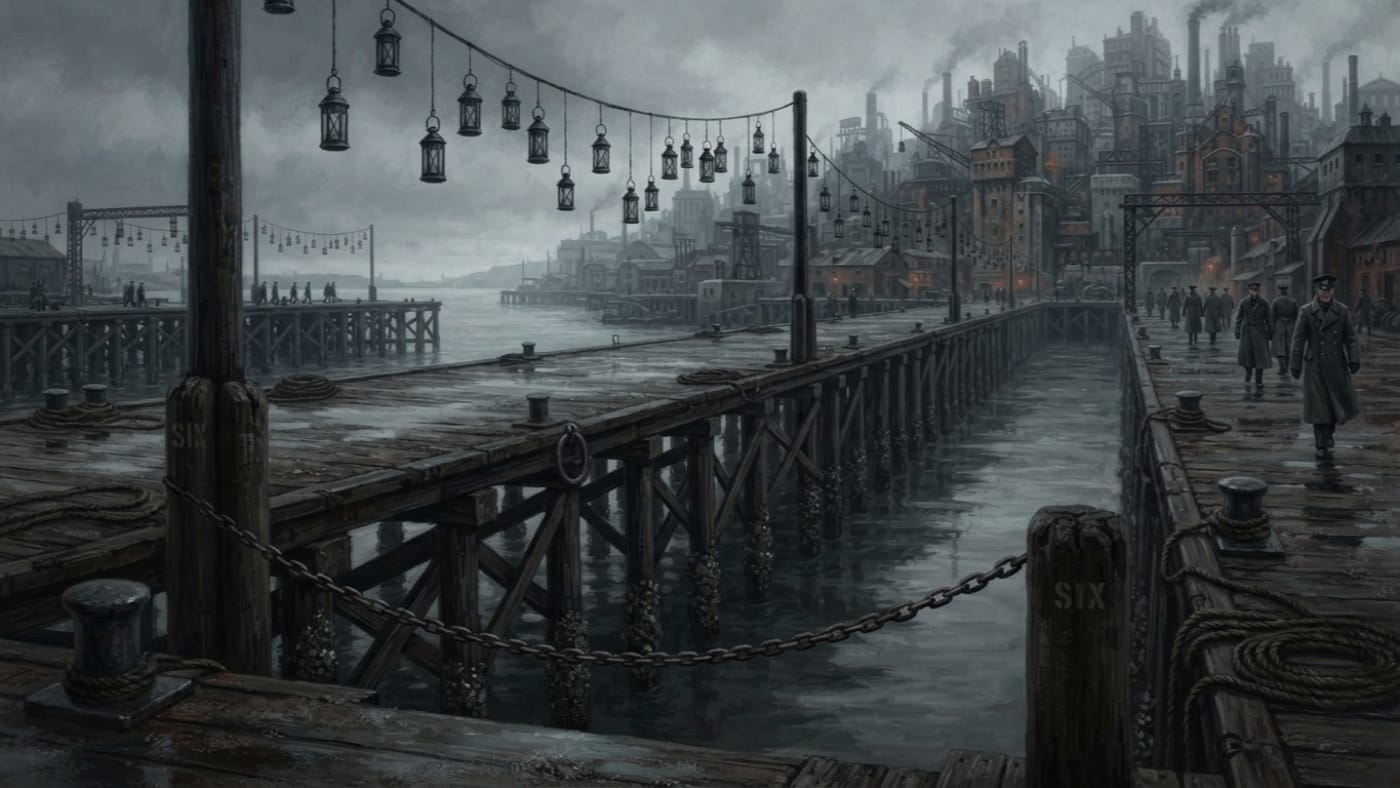
Pier Six is a number. Saffron Bastion keeps a great many numbers along its waterfront, and most of them have the decency to stay numbers: a run of tarred timber, a line in a harbor ledger between a fifth thing and a seventh, boards that have carried fish, rope, quarantine laborers and the odd unclaimed coffin without asking to be remembered. Salt eats the iron. Lantern chains sway overhead. Grey water does what grey water does, which is wait.
Pier Six has failed at this modest duty. The under-pier account preserved in the Codex entry on the Brine Choir says that two singers who vanished into quarantine after the South-Pier Incident of A.S. 199 are heard beneath it on certain calm afternoons. The same account gives two further details, and the Ledger finds them more useful than the voices. No service is scheduled there. No patrol lingers.
Neither phrase is a closure order, and no closure order has reached my desk. A patrol that does not linger still passes. An unscheduled service is still a service, if somebody holds it. The boards stay open to whoever is entitled to walk them. What has changed is how people walk them: a little faster, eyes front, and nobody pausing over the gaps where daylight comes down in strips onto still water and the pilings stand in their own reflection like canons waiting to be called.
#On the Harbor's Ordinary Discipline
Every pier in Saffron lives under the same rule, and Pier Six keeps it. At chain-drop the curfew chains fall across the boards. The lanterns switch to approved patterns. After dark, saying a full name within earshot of open water is illegal, and the citizen gives his registry number like a debtor. Salt lines run along the planking. Ropehands seal their ears with wax. Whistling is forbidden, and so is leaving a lantern untrimmed.
These are harbor-wide precautions against harbor-wide complaints: voices calling names from under piers, lantern flames that bend toward the sea, rope fibers that sing at night, minutes gone missing after a man looks too long into black water. None of the precautions promises anything. The Prefecture's own wording says they reduce. I admire that verb. It has saved more officials from the scaffold than any saint has.
Above the water, authority is crowded. The Quay Chapterhouse speaks for the Synod. The Quarantine Prefecture holds the cordons and the holding yards. Harbor Marshal Command holds the guns. The Lanternline Chandlers' Lodge holds the pattern books and resents everyone else. Each claims the boards. None claims what lies under them.
That lower jurisdiction went to the mourners by default. The sanctioned tide observances of the Bureau of Rites are held above, with a bell, a license and incense to cover the smell. Beneath, standing ankle-deep, the Brine Choir sings: dock widows, ropehands, salvage divers, quarantine laborers and failed Lanternline apprentices, who call themselves the Listeners at the Salt Rail when an officer with a cudgel makes them call themselves anything. They sing at deaths, fever clearances and failed insurance claims. They sing toward the water. The water sometimes sings back.
Earlier coastal notices described the Brine Choir as "a recreational tide-hymn fellowship of no operational significance."
Withdrawn. A fellowship of no operational significance does not set Purity's filing clerks multiplying its cantors, and it does not leave numbered piers along the waterfront that patrols prefer to hurry past. Public description stays "tide-hymn enthusiasts." The Ledger is not the public.
#On the Incident That Attached the Voices to the Pier
The incident happened on the south pier, and the reader should keep it there. The sources do not say the south pier and Pier Six are one structure, and I will not merge them to tidy the file. Two piers are cheaper to administer than one miracle.
In A.S. 199 a sanctioned lureline failed after two lanterns guttered. The operation used a false registry number as bait, the usual practice of the lure trade, and the number was answered by the man who had once carried it. He was dead, cremated and administratively closed, and he answered anyway. The water rose beneath the boards. Cliff Battery Twelve could not bring its guns to bear. The harbor provosts began the retreat phrase and could not finish it.
The Brine Choir had gathered, illegally, under the gutting racks. Their cantor sang three old tide phrases. The Choir has withheld her name; the Bureau of Purity filed her as three separate women. The water went down and six men lived. Four singers were arrested. Two disappeared into quarantine. The records keep these as separate counts, and I am not going to guess whether the two who vanished were among the four who were taken. The Prefecture can confess its own arithmetic.
The official report credited "corrected lantern pressure." The under-pier account disagrees. In that version the Choir did not save the six men so much as buy them, paying the water with something else. Neither account names the price. Neither shows the mechanism. The Ledger holds both under the same seal, the way a careful sacristan keeps the holy oil and the lamp oil on the same shelf with the labels turned outward.
So the voices came to Pier Six by testimony, not by deed. Nothing in the record puts the singers' disappearance there, or their custody, or their bodies. The only thing at Pier Six is what people say they hear.
#On What Is Heard
The claim is short, and the Bureau respects short claims because they hand over so little to work with. Two missing singers are heard. The account does not say who hears them, or which afternoons count as calm, or how often. It does not say whether anyone recognizes particular voices, or only recognizes that two people are missing and two voices are singing and has done the sum. Saffron arithmetic is fast and seldom audited.
The same account calls the singers neither dead nor living in any way useful to Records. That is the under-pier account's phrase, and Records would like it kept there. It certifies nothing: no undeath, no prisoners in the pilings, and no proof that the throats are the ones that went into quarantine. It is a widow's sentence that happens to sound like a clerk's.
Recognizing a voice through planking and water is unreliable at the best of times, and the Choir makes it worse with its own craft. Its Hook Voice is sung on an inward breath and seems to rise from under the boards when the singer is standing in plain sight. Its Registry Hum gives the shape of a forbidden name without the name: a whole circle humming the outline of a drowned child around the mother. Hum the outline of two arrested singers on a still afternoon and every listener on the pier will fill in the rest. Then comes the Listening, the long silence after the song, when the water makes its small administrative noises: knock, suck, click, the hum of rope.
The opposite reading belongs to the harbor at large. Saffron's waterline has called citizens by name for generations, and the Great Deceiver has never been shy about borrowing a familiar mouth. Nobody has shown that the sound at Pier Six is a lure. Nobody has shown it isn't. The Bureau of Doctrine has issued no finding. The Creator has not been consulted through any channel the Ledger accepts.
No Pier Six rite is on record, and no song text or interview with anyone who listened has survived. What survives is a sentence in an account the Church does not license, and the behavior of everyone who has read it.
#On the Present Condition
As of A.S. 201 the boards are still there and the number is still painted on. The Choir has not been suppressed. The chains drop at curfew and come up at dawn. Nothing is scheduled on Pier Six, and the patrols that cross it keep moving.
A patrol has good reasons not to stop. A provost who stops to listen may hear something. A provost who hears something has to write it down. Once it is written down, Purity will call it contact, Rites will call it pending, the Harbor Marshal will call it outside command vocabulary, and the Prefecture will be asked what became of two prisoners, a question it has so far answered by not being asked. Moving on costs less ink. The men of the watch are not theologians, but they understand what paperwork costs.
The expected audit by Canon-Inquisitor Silex Marrow hangs over the harbor's other business: the Insurance Courts, the pattern books, the Choir itself. Nobody has said whether that audit will go down beneath a numbered pier, or what it would ask the water if it did. Marrow has not arrived. Nothing has been found, and nothing has been resolved. Down in Low Nets, children cup their hands over drain grates and wait for an answer, which is more initiative than any Bureau has shown.
Pier Six takes its cargo, loses its salt to the tide and keeps its number. Whatever sings under it has no license and no name in the register, and nobody will stand still long enough to argue with it.