
#On the Wall's Office
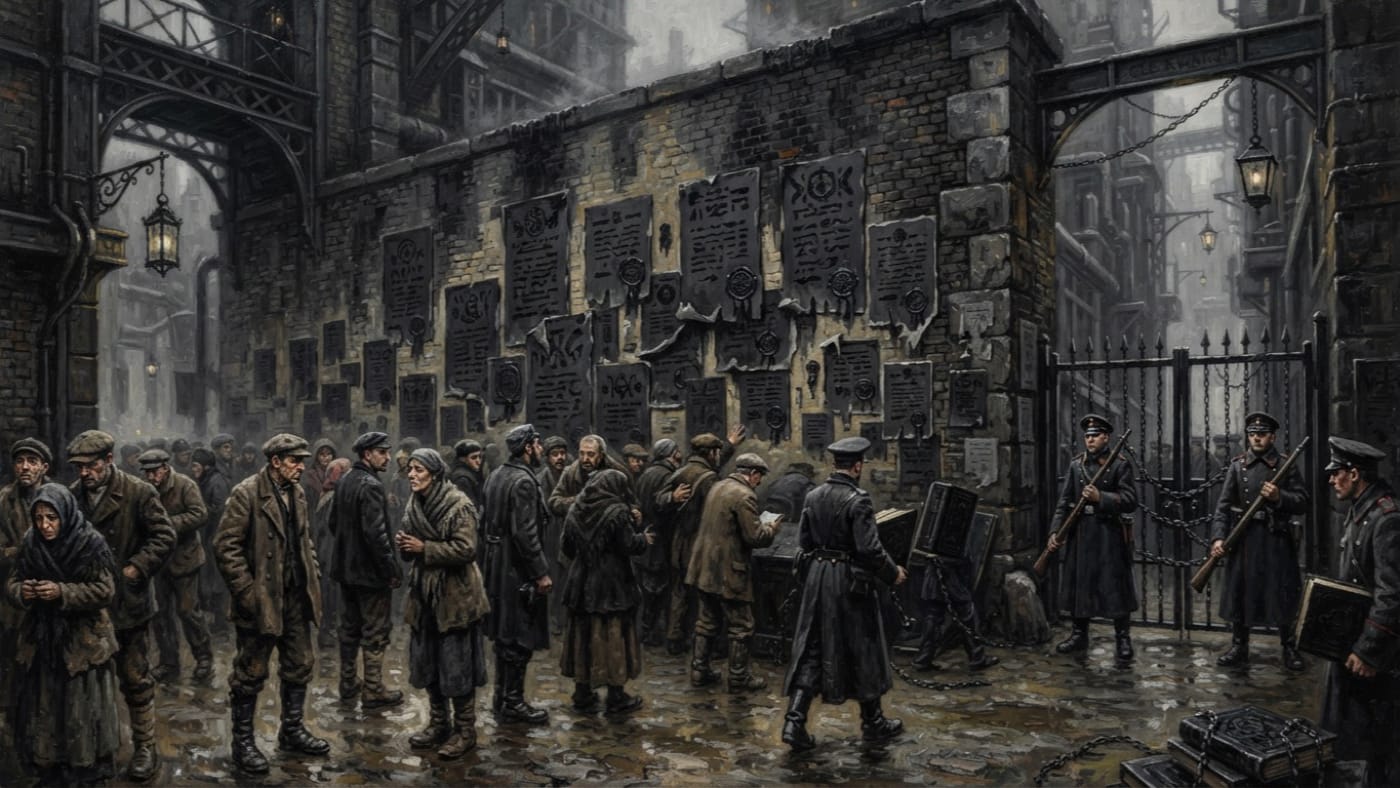
The Posting Wall of the Cloister of Miscounted Beads is where the compound admits, in wax, that it has lost count. On most days it is masonry with notices on it, and nobody reads them except the hopeful and the paid. The Cloister builds in brick, bone-lime mortar and cheap slate. Records has never certified which of these the Wall is made of or where in the compound it stands, and I decline to do Records' surveying for free. All a reader needs to know is that it is a surface at eye height, damp from canal fog, and dark at the edges with soot blown in from Strasbourg.
When an Anomoly Week is declared, the Wall receives its black notice.
Detainees who read it learn three things at once. The gate will not open for them. The clerk will not hear them. The date on their clearance slip is now of historical interest only. Many detainees cannot read, and they learn the same three things from the colour. Black wax needs no grammar. Of all the Cloister's documents it is the only one that every class of inmate understands on sight, and it is the only one that promises nothing.
#On the Authority Behind the Notice
The notice is the last link in a chain, and the first link a detainee is allowed to see. Prior-Scribe Erem Vale signs the declaration. The Chapter countersigns. Records acknowledges. The emergency becomes lawful only when all three marks are on the page, and only a lawful emergency may be posted. After that the Outer Watch chains the gates and holds the cordon. The declaration belongs to the Prior-Scribe and the enforcement to the Watch. The Wall's share is communication, the humblest of the three duties and the one most often cursed.
The published record does not say whose hand presses the notice to the Wall. Two unsealed drafts in Bureau keeping name different hands. I will not settle a quarrel between two papers when neither has earned a seal.
For an officer, a sealed week is three acts of ink in a warm room, each one checked against the last, each one dry before the next is added. For a detainee it is a black square that was not there at Matins, and then a chain heard somewhere behind it before it is seen. Both accounts are accurate. Only the first is filed.
#On Protective Narrowness
Vale named the condition protective narrowness during the A.S. 199 week. The phrase has aged better than the people it describes. In the Chapter's usage it promises orderly reconciliation carried out inside tighter walls, with fewer interruptions and kinder supervision. Detainees take a narrower meaning from it. They hear that they will stay where they are, eat less while they do it, and be told it is for their good.
The consequences spread outward from the notice like damp through paper. Clearance stops at the Clearance Gate, and no prior-day seal will carry anyone through it. Movement inside the compound shrinks to the lanes the Watch is willing to see. In the Counting Hall, open ink goes under lids and cloth. Strings are inspected and sealed in salt-wax. In the Bead Vault, Keth seals the lower cabinets. Files are sealed. Complaints are postponed, which in the Cloister means they are kept somewhere damp until someone has the leisure to read them, and nobody has had that leisure since A.S. 198. More guards walk the rows. In the Dorm Rows the rations are adjusted. In Cloister vocabulary, "adjusted" means made smaller.
In my entry on the Anomoly Weeks I wrote that the condition calls for enough black-wax notices to make the Posting Wall look devout. I stand by it. The Wall wears its wax the way a penitent wears ash. The display is public and thorough and belongs to someone else's sin.
#On Names and Public Order
During a sealed week, the black notice is the one piece of writing in the compound that everyone can trust, because everyone knows who wrote it. That certainty fails elsewhere, and its failure is the reason the notice goes up at all.
A week is declared only when the ordinary Anomoly Protocols can no longer keep drift local. The Chapter recognises six signs. In brief, they are roster seep, recurrent bodies, string hostility, ink overreach, basin rise and external echo. The full catalogue belongs to the parent entry. The first sign matters most to anyone standing in front of a wall full of notices. Names appear on rosters and slates where no clerk wrote them. A gate slate corrects itself faster than the Watch can scrape it clean. Ink thickens and creeps toward names in the Counting Hall. When written records start adding entries nobody made, a written order becomes unreliable, and a spoken name becomes worse.
The restrictions on speech follow from this, and each one belongs to a particular place. At the gates, no name passes through an aperture in the iron. In the Chapel of the Second String, no childhood name may be spoken after third bell. People who mix up the two rules tend to break both.
For the record, the Wall has written nothing. The question is put to me by people who have spent too long in Awaiting. Every letter on the black notice has a known hand behind it. Whatever gets into the rosters gets in somewhere else, by means the Chapter has not explained, and I will not explain them on the Chapter's behalf. The Wall's whole offence is telling the truth on a schedule.
#On the Price of Waiting
The Cloister charges for filings, for accommodation and for clerical time. Detainees who cannot pay work off the debt by cleaning, copying, standing night watch or pulling the corpse-cart. That is the ordinary economy, and it was arranged long before anyone needed black wax. A sealed week adds days to every bill and no service to any of them. The ledger keeps counting while the gate stays shut.
Scarcity takes care of the rest. Salt, wax, candle stubs, dry socks and access to slates turn into currency. Brokers disappear for the first day of a sealed week and come back on the second in better coats. A berth nearer the awning costs double. A clerk who would never sell a release may still be persuaded to rent out a delay. None of this commerce is the Wall's doing, and the Wall charges nothing. It shows the bill. It does not collect it.
Sponsors work in this climate as they work in every other. They buy a drier berth, a shorter line, a witness who keeps quiet. One thing is off the market. No sum in Strasbourg will lift a declared emergency or take a black notice down, and Chapter practice puts the nullification of an active anomaly beyond even ordinary corruption. A sponsor can buy a client comfort inside the sealed week but cannot buy the client out of it. As a result, the rich and the poor read the same notice. The rich read it sitting down.
#On the Present Notices
The survey frame is A.S. 201. Intake has been beyond capacity since A.S. 198. The first recorded sealed-week form appears in the Chapter minutes of A.S. 199. That date belongs to the emergency form. The Wall's own age is not recorded. I have looked for a dedication, a first use and a replacement, found none, and refuse to borrow the Cloister's foundation date to cover the gap.
A.S. 199 Chapter minutes record the first sealed week as "extraordinary pilgrim congestion caused by weather."
Corrected. The weather explanation has been withdrawn from the minutes. The black notice posted that week was issued under declaration, countersign and acknowledgement, and none of those instruments has ever been signed on behalf of rain.
Three Anomoly Weeks were declared in A.S. 200, and five are projected for A.S. 201. Five is a projection and not a count. The Chapter has not declared five weeks. It expects to. Strasbourg's magistrates take some comfort from that distinction, and I would not take the comfort from them.
No record says how long a week runs, and none prescribes what happens to a spent notice: whether it is scraped, burned, or filed somewhere colder. The record covers one point only. An Anomoly Week ends when the Chapter declares it ended, and the Posting Wall hears of it the same way it heard of the beginning.