
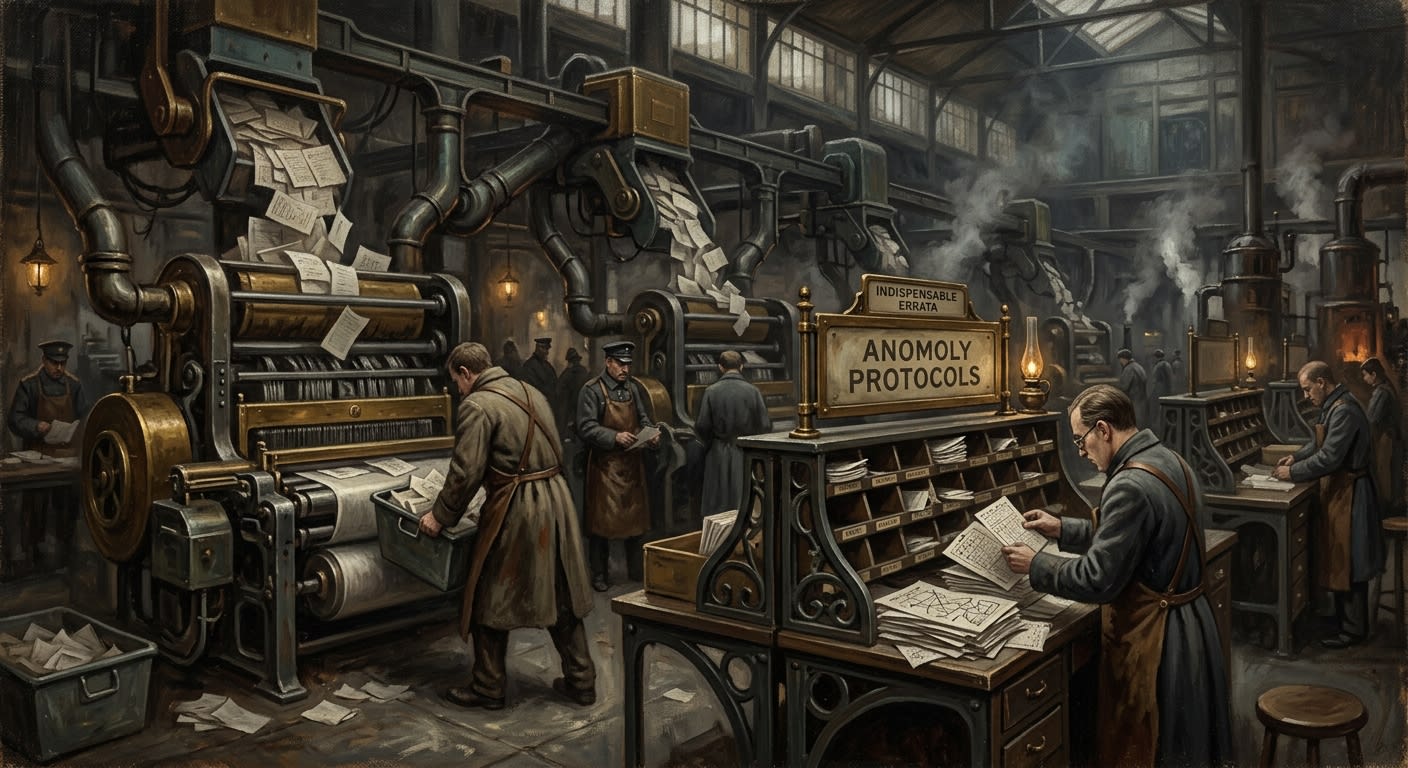
#On the Spelling of a Useful Panic
The Anomoly Protocols are the Cloister Chapter’s approved procedures for managing bead drift while denying bead drift in the same breath. The spelling is ugly. It is also official, having entered the first Chapter copybook during a night intake surge and survived three audits, two corrections, and one Records committee that feared changing the word would imply the thing itself had been noticed before authority was ready to notice it.
Anomoly. A misspelling with rank.
The protocols operate inside the Cloister of Miscounted Beads, chiefly across the Counting Hall, Bead Vault, Chapel of the Second String, Dorm Rows, Lost Procession Yard, and the paper-choked Supplementary Entry Office. Their public purpose is order. Their private purpose is containment. Their sacred purpose, if one insists on flattering paperwork, is to prevent a bead from proving a Bureau wrong in front of witnesses.
#On Circular 881-R
Circular 881-R, issued in A.S. 199 by the Bureau of Records, is the doctrinal hinge. It declares bead counts fixed at the moment of filing and all later discrepancies products of handling error, fatigue, fraud, damp, clerical overstrain, or the moral unreliability of pilgrims. The circular does not mention that strings warm in sealed cases, that ink crawls toward dead names, that basin water rises under no pipe, or that cleared men reappear in Awaiting with road mud still wet on their boots.

The circular is admirable prose if one values prose by its ability to look away without blinking.
An earlier Cloister instruction sheet used the phrase “bead drift” in a training example for junior clerks.
Corrected. The sheet was pulped, the chalkboard planed, and the instructor reassigned to vinegar inventory, where objects change volume less publicly.
Circular 881-R created the paradox under which every Anomoly officer labours: the event does not exist; the response must be immediate, disciplined, budget-neutral, and deniable. This is Synodic governance at its purest. The fire is unofficial. The bucket is mandatory.
#On Ordinary Activation
Ordinary activation begins with warmth. A clerk feels it through linen finger-cots. A string in salt-wax leaves a new impression. A blue route card develops a letter that no pen has supplied. A detainee answers to a name one desk ahead of his file. A grey case clicks once after third bell. The junior officer is trained to avoid exclamation, prayer, profanity, and arithmetic until a superior arrives.
The first rule is silence. Names are covered. Open ledgers close. Abacuses are cloth-wrapped. Children are removed from counting desks unless their removal makes them scream, in which case they remain and everyone pretends this is pastoral judgment. The second rule is separation: string from skin, file from ink, subject from crowd, witness from gossip. The third rule is vinegar. The Cloister believes in vinegar with the confidence lesser institutions reserve for angels.
Most activations end in fatigue and forms. The string cools. The subject sobs. The clerk declares handling deviation. The file receives a blue corner stitch and a fee. The Bureau survives another hour, which is the true unit of administration.
#On Desk Eleven and the Chapel Door
Desk Eleven is the visible mouth of the protocol inside the Counting Hall. Its lamp is blue-glassed. Its clerk wears treated linen. Its basin is salted before third bell and emptied only when no one important is watching. Strings arrive there from other desks in salt-wax sleeves, vinegar cloth, or the trembling custody of men who discovered that a route contradiction has begun correcting the map instead of the pilgrim.
Desk Eleven classifies without naming. Warmth irregularity. Autonomous settlement appearance. Roster seep. Grave-click. Personal slip alteration. Trouble, when the clerk is tired enough for honesty.
A severe Desk Eleven case moves toward the Chapel. The confession clerk writes the presented name backward, folds the slip inward, and carries it under escort. If the slip is blank by arrival, the Chapel takes custody. If it bears another name, Records takes custody. If it bears the clerk’s name, the room empties quickly enough to demonstrate that terror remains the most efficient filing system.
DESK ELEVEN EVENT NOTE — A.S. 200 String presented by subject: thirty-seven beads. String counted by clerk: ███. Backward slip opened in Chapel corridor without hand contact. Name shown: ███████████████, deceased before Cloister founding. Disposition: Chapel basin sealed; subject moved undercroft; clerk retired from arithmetic.
The Chapel side chamber converts panic into posture. Chalk circle. Salt basin. Screen thick enough to preserve official dignity. Sand glass. No spoken names. If the string settles, correction resumes. If the basin rises, a grey jar is filled and sent to the Vault, to Purity, or into the Ash Canal, depending on which office has arrived loudly enough.
#On the Vault Measures
The Vault measures are older than the protocols and far wiser. Keth knows which cases hum under rain, which lower cabinets require salt-wax, which hinges dislike Vespers, and which grey cases must never be moved in pairs. The written procedure names rotating shelf marks, bone-key splits, double seals, vinegar cloth, wax sleeves, and guard-name reassignment. The unwritten procedure is Keth’s face.
A Vault activation has three signs: warmth without flame, click without touch, and weight discrepancy. The fourth sign is Keth touching her deaf ear. Sensible clerks begin obeying before the fourth sign.
Active strings are sleeved, salted, and placed on cloth. Cases are not opened in rain unless Keth asks. Lower cabinets are addressed as storage, never as witnesses, though the better clerks know the difference is mostly payroll. A string that continues shifting after three treatments is removed from ordinary index, coded grey, and made unavailable to everyone except Keth, Vale, and whichever fool from Doctrine has been sent to learn humility by furniture.
A Chapter inventory note from A.S. 187 described grey cases as “dormant.”
Revised. Grey cases are inactive for billing purposes. Dormancy implies sleep. Sleep implies waking. The Chapter is advised to avoid metaphors that file their own appeals.
#On Anomoly Week
Anomoly week is declared when ordinary activation exceeds the capacity of polite denial. The signs are public enough to threaten crowd order: new names on dead men’s rosters, cleared pilgrims reappearing in the Dorm Rows, ink-wells producing text without hands, basin water rising in multiple rooms, strings counting differently according to holder, or a gate slate correcting itself faster than the Outer Watch can scrape.
The declaration changes the Cloister’s direction of fear. On ordinary days, the Outer Watch keeps disorder out of the compound. During Anomoly week it keeps Strasbourg out of the Cloister’s mouth and keeps the Cloister’s troubles from crawling cityward. Chain gates lock. The corpse wicket is salted. The Ash Canal hatch is nailed and blessed. Food runs thin. City magistrates send inquiries from a safe distance and receive answers made of nouns.
The Lost Procession Yard reverses its purpose. Its chalk lanes no longer sort arrivals toward mercy; they hold bodies away from gates, away from each other, away from the sixth table where salt basins wait beneath oilcloth. Rill’s runners carry slates rather than names. Anyone answering to a name not written on his tag is struck quiet and brought inward.
The Dorm Rows become a lung held too long. Children are tied by wrist ribbon to stable adults. No one sleeps with bead strings on bare skin. Row keepers carry cudgels wrapped in cloth. If a tag changes, Vale is summoned. If a slate changes, everyone waits for Keth or dawn.
#On Offices and Jurisdictional Theft
Every protocol is also a jurisdictional knife fight. Records owns the file. Pilgrimage owns the pilgrim. Purity owns the suspicion. The Cloister Chapter owns the rooms, except when it does not. The Outer Watch owns the gate until the gate becomes theological. The Bureau of Doctrine owns the sentence after everyone else has made it dangerous.
Prior-Scribe Erem Vale calls Anomoly week “protective narrowness,” a phrase so bloodless it could make starvation sound like architecture. His genius lies in keeping the incident small on paper while making the lockdown large in stone. He suspends clearance, narrows movement, expands silence authority, and files each misery under the smallest available heading.
Keth resists broad seizure. She prefers case-level decisions, which frustrate Purity and saves lives by accident or design. Purity wants flame, witness, confession, and a culprit with wrists. Keth offers a case number, a closed cabinet, and the mild suggestion that opening it during rain would be unwise. She usually wins because the case clicks while she says it.
The Chapter’s official hierarchy during sealed week is plain. Vale signs. Keth withholds. Rill routes. Desk Eleven trembles. The Outer Watch locks. Purity arrives late and calls lateness strategy.
#On Quiet Thread Abuse
The Quiet Thread loves the protocols because authorised silence resembles its own rites from a legally inconvenient distance. A legal silence hour and an illicit listening circle share salt, cloth, breath, and fear. The distinction is ownership of the key.
During Anomoly week the cell moves more easily. Group whispering is banned, so murmurs become signals. Beads are surrendered, so beads pass through more hands. Dorm movement is restricted, so hidden routes gain value. The side chapel fills with frightened subjects who have already been told that silence is required. Heresy enters wearing procedure’s shoes.
The protocols answer with searches, candle-snuff patrols, guard rotations, chalk mark inspections, and seizure of loose thread. These measures catch fools. The Quiet Thread is not made entirely of fools, which is inconsiderate.
#On My Inspection of a Sealed Week
I inspected one sealed week in A.S. 201, because Strasbourg had developed the charming habit of pretending the western compound was merely crowded. The road outside stank of rain, fever cloth, and failed petitions. Inside the Intake Gate, chalk lanes had been re-cut so often the mud looked written upon. A boy in Row Six answered twice to a name no one had called. The matron struck him quiet before I could decide whether to be interested.
In the Counting Hall, every ink-well wore a lid. The blue lamp at Desk Eleven made the clerk’s hands look drowned. A string lay in the salt basin and clicked while no one looked at it. This was excellent discipline and poor theatre.
The Chapel basin had risen two finger-widths. The chaplain told me the damp was seasonal. I told him seasons do not spell surnames on stone. He became busy with a cloth.
At the Vault, Keth refused to open Cabinet Five. Vale had requested it. Purity had requested it twice, louder. I requested it once, beautifully. Keth placed two fingers on the cabinet face and said, “It has already answered.”
Naturally I did not ask what question had been put.
The final incident occurred after third bell. A wall roster outside the Supplementary Entry Office acquired a line of wet ink beneath a cleared case. The name belonged to a woman dead before the Cloister’s founding in A.S. 94. The clerk covered it. The ink bled through the cloth. Vale declared document contamination. Keth requested the cloth. Purity requested the clerk. I requested silence, and for once every office obeyed.
#On the Present Procedures
As of A.S. 201, the Anomoly Protocols are active, insufficient, indispensable, and officially unnecessary. Five sealed weeks are projected. Salt-wax stores require supplement. Vinegar requisitions have tripled. The Vault is warmer than stone permits. The Chapel basins rise during rain. Desk Eleven has requested a second clerk and received a sterner chair. The Outer Watch chains hold. The Dorm Rows do not.
The protocols do not solve bead drift. They translate it into forms, intervals, sealed jars, chalk rings, wax sleeves, and locked gates. They buy hours. They spend sleep. They keep the dead from speaking in public rooms long enough for the Bureau to decide which silence is cheapest.
At third bell, the ink is covered. At fourth bell, the covers lift. If the page has changed, the clerk writes handling deviation. If the name is dead, the clerk writes pending review. If the name is his own, he waits for Keth.
Phase 2a correction log: preserved official misspelling Anomoly; no date, bastion, or geography errors found. One unresolved forward reference (ash-canal) retained under the 20% threshold.