
#On the Gate That Releases by Refusing
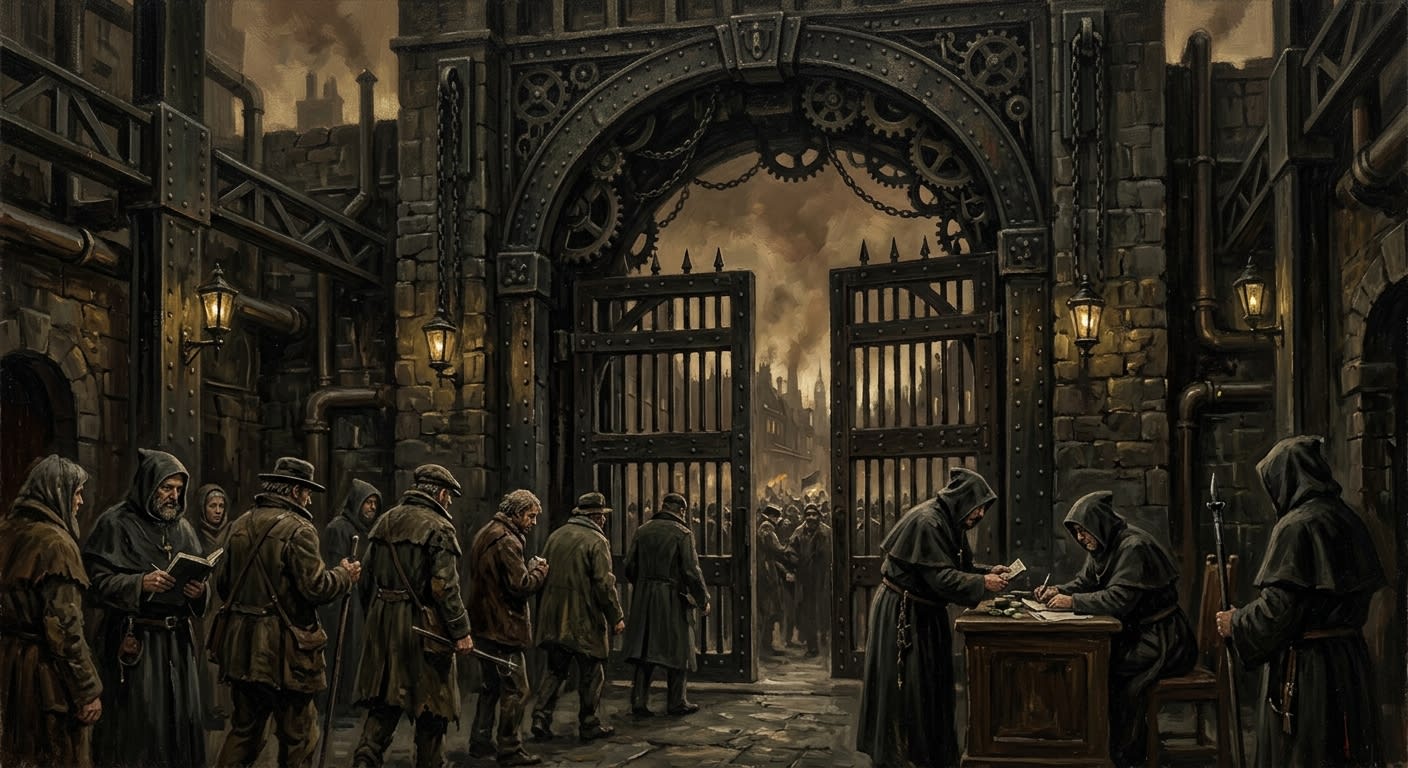
The Clearance Gate of the Cloister of Miscounted Beads faces Strasbourg proper, which is to say it faces the city that invented charity as a queue, salvation as a fee, and release as a stamped inconvenience to be moved off premises before supper. It is the Cloister's eastern mouth, chain-hung, iron-braced, tar-sealed at the lower hinge, and old enough to have learned the difference between opening and absolving.
It opens after correction. It shuts during Anomoly Weeks. It receives spit, kisses, petitions, curses, debt hands, sponsor signals, and the occasional person who has already been cleared once and returned with no memory after the threshold. It is not the Intake Gate's twin. Intake admits the miscounted. Clearance expels the corrected. The difference is clerical. The suffering is practical.
A gate is a theological instrument when properly supervised. It says yes and no with iron. It divides those still under correction from those who have been corrected enough to become another jurisdiction's nuisance. The Outer Watch Post holds the chains, the Counting Hall supplies the arithmetic, the Chapel of the Second String supplies lawful cord, Records supplies the paper, and the city supplies outrage once the released begin sleeping beneath market awnings.
#On Its Iron and Its Temper
The Gate was regularised after the Cloister's A.S. 94 overflow foundation, when the western pilgrim intake required a controlled cityward exit and the first municipal complaints acquired stationery. Its frame is older than its present office. Some say the hinges came from a dismantled toll-yard. Some say from a minor debtor prison. The iron gives no testimony, though it has the air of a thing that remembers both uses and prefers not to choose.
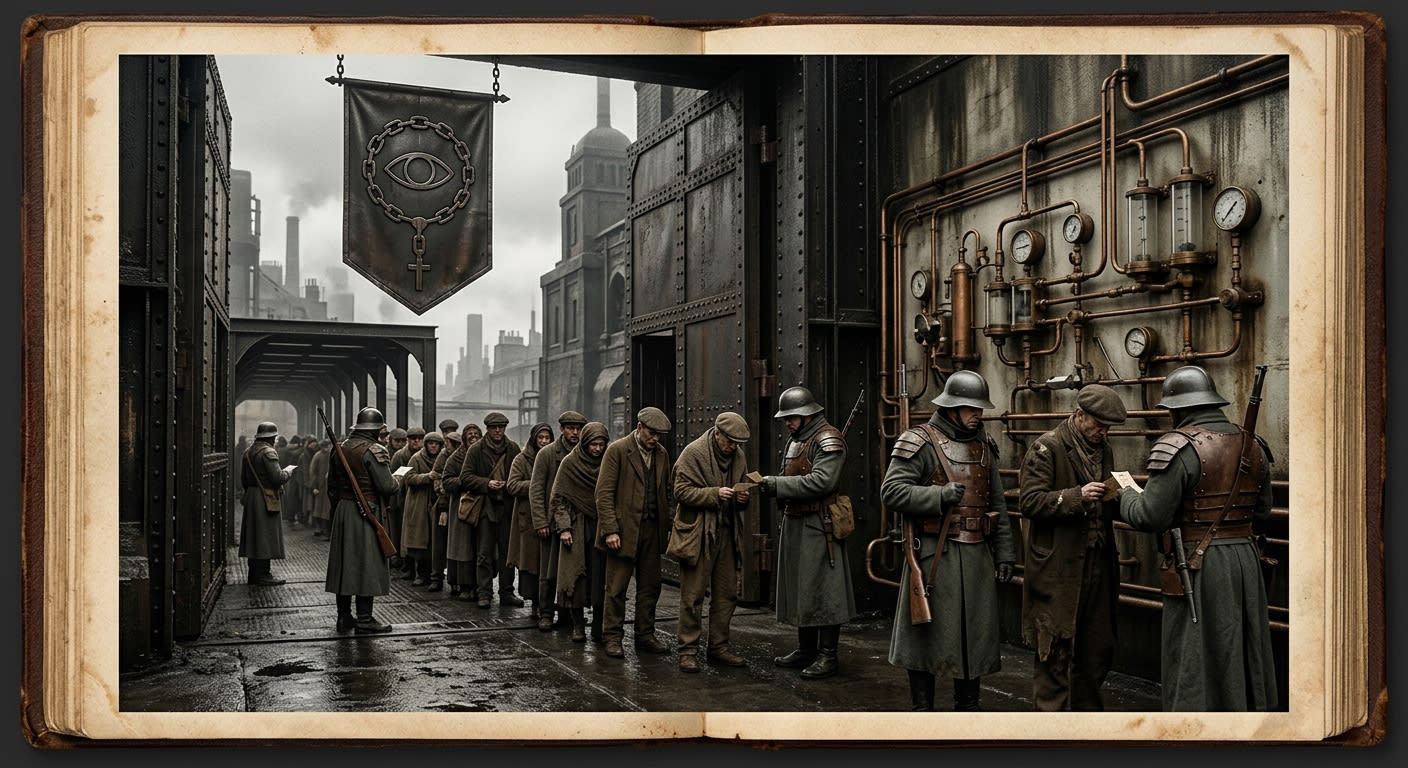
The structure is plain: double leaves of blackened oak under iron straps, outer chain, inner chain, view-slit, seal shelf, sponsor rail, wrist-check hook, return bell, threshold drain, tarred lower seam, and three nail marks where Purity once attached a red notice so violently that the wood bled resin for a month. The threshold stone is worn hollow at the centre by hesitating feet.
A municipal maintenance ledger calls the Clearance Gate “a civic egress convenience.”
Corrected. It is an ecclesiastical sorting aperture with municipal consequences. Convenience enters only when the hinge behaves, the clerk is sober, and the released person has somewhere else to be unwanted.
It has a temper. I do not mean this poetically, and I despise myself for needing to say so. The chain settles differently during rain. The view-slit sticks when dead names appear on the dorm slates. The return bell sounds dull during ordinary crowding and bright during sealed weeks, when no one is meant to touch it. The lower hinge exudes tar in summer heat though the Post insists it has not been re-tarred since the last anomaly cordon. Objects near the miscounted acquire habits. Sensible clerks record them under maintenance.
#On the Rite of Clearance
Clearance begins before the Gate appears. A detainee passes count, penance, record reconciliation, dorm release, sponsor review if any, and second-string inspection. The first string is surrendered, sealed, denied, stored, destroyed, or made interesting. The second string becomes lawful. The name becomes usable. The wrist tag is compared with the gate slate. The face is compared with the name. The body, if inconveniently changed since intake, is compared with the paperwork until one of them yields.
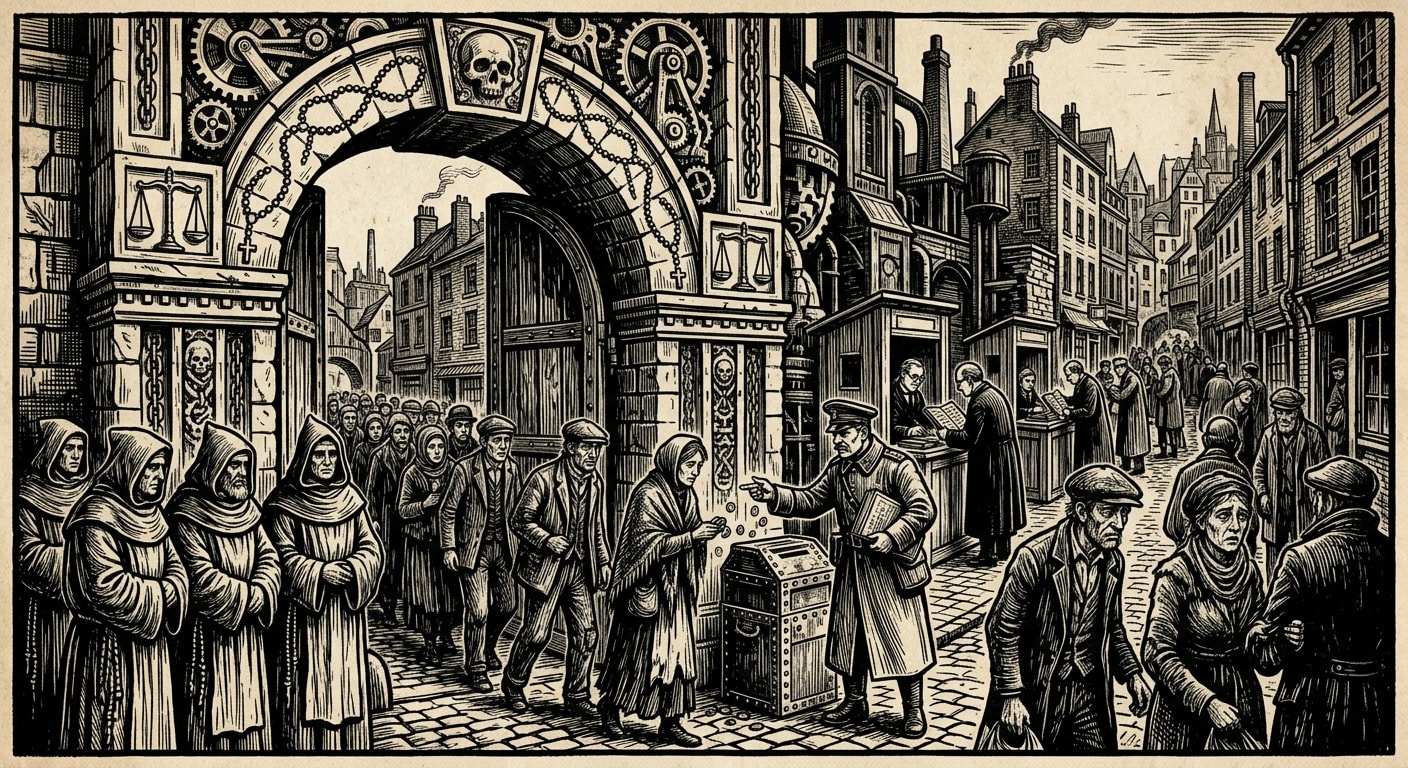
At the Gate, the released stands inside the inner chain. The watchman reads the name once. The clerk reads the clearance slip. The released repeats the corrected count without touching the black witness bead. A sponsor may answer from beyond the rail, provided the sponsor's seal is current and his appetite not too visible. City debt men hover beyond the gutter. Family members cry, bargain, or fail to arrive. The chain-keeper decides whether the moment has become troublesome.
The instruction is optimistic. Many return. Some return within the hour claiming the street miscounted them. Some return after dusk saying the city has no place for their corrected name. Some return because the sponsor sold their berth before they crossed. Some return with mud on their shoes from roads they never walked. The Post divides them into calm, inconvenient, dangerous, and already known. Calm cases go to the Counting Hall. Inconvenient cases go to Dorm Rows. Dangerous cases go to Purity. Already known cases make the gate sergeant pale.
#On Sponsors, Brokers, and the Cityward Gutter
Outside the Clearance Gate lies the sponsor rail, and beyond the sponsor rail lies the cityward gutter, and beyond the gutter lies Strasbourg's immense capacity to look away while charging rent. Sponsors arrive with seals, household writs, guild tokens, parish recognitions, debt orders, marriage claims, orphanary notices, and philanthropic expressions sharpened for later use.
A good sponsor takes the corrected person quickly. A bad sponsor haggles in public. A false sponsor knows too many details. A desperate family shouts the old name and ruins the release. A debt agent says nothing until the outer chain lifts, then places a hand on the shoulder with the gentleness of a receipt. The Gate has seen more reunions broken by valid paperwork than by plague.
The sponsor-brokers conduct business just beyond lawful rebuke. They sell doorways, introductions, witness standing, parish address, guild custody, false cousins, clean blankets, route silence, and the promise that no debt man will be waiting at the third alley. During Anomoly Weeks they vanish for a day and return at triple price, because fear is the only market with perfect memory.
City magistrates call the Gate a spillway for corrected vagrancy. They are correct, which makes their complaints no less contemptible. The Cloister replies that release completes the mandate. Records replies that the name has been reconciled. Pilgrimage replies that spiritual passage has concluded. The city replies with patrols, fines, and benches designed to punish sleep. A civic choir, every throat a complaint.
#On Return, Refusal, and the Prior-Day Seal
The most dangerous releases are yesterday's releases. A prior-day seal (Unregistered) carries authority that has begun to rot. Under ordinary weather, a person presenting with yesterday's clearance may be returned for review, fined for disorder, sent to the Supplementary Entry Office, or shoved into the street if the watchman has reached the end of patience. During sealed week, no release occurs under prior-day seal. The rule is written in black on the gate copy because too many men died before the ink learned emphasis.
A prior-day seal once opened the Gate to a woman who had already been accepted by her sponsor, entered the city, purchased bread, slept under the awning of Saint Merault's (Unregistered) minor shrine, and been seen at Matins by three witnesses. She appeared again at the view-slit with the same slip, dry shoes, and no memory after the chain. Her sponsor, summoned from the city, identified her, fainted, and then identified the woman already in his household as also her.
CLEARANCE DUPLICATION REPORT — A.S. 200 Subject: female pilgrim, second string valid. Instance at Gate: calm, hungry, no post-release memory. Instance in city: sponsored, sleeping, same wrist mark. Test phrase spoken through slit: ███████████ Both instances answered. Disposition: gate sealed; sponsor held; records divided; final count unavailable.
After that, prior-day seals were demoted during anomaly cordon from proof to provocation. The Gate still receives them. Paper does not become humble merely because it has caused deaths.
A post-incident circular blamed duplicate clearance on “sponsor confusion and crowd pressure.”
Withdrawn. Crowd pressure does not produce two bodies with one wrist mark. Sponsor confusion is cheaper than metaphysics, but the Gate has never respected cheap explanations.
#On Sealed Weeks
During an Anomoly Week, the Clearance Gate becomes a locked confession. The chains double. The corpse wicket is salted. The view-slit remains shut after second call. No spoken name passes through iron. No watchman answers if called by childhood name. The city stands outside pretending impatience while thanking every saint not to be admitted.
Inside, detainees hear the road and call it freedom. Outside, families hear the chains and call it cruelty. Both are wrong in useful ways. During a sealed week, the wall protects Strasbourg from whatever the Cloister has collected in bead, basin, slate, and name. Release waits because release is movement, and movement is the first luxury withdrawn when reality begins correcting the forms.
Voices come anyway. They ask for entry, release, mother, old count, dry socks, forgiveness, and once for the gate sergeant's childhood toy by name. The Gate does not answer. The men at it sometimes do. Those men are transferred, buried, or promoted into posts where their mistake can become training.
#On the Gate as Theological Boundary
The Gate teaches the doctrine that correction outranks origin. A first string may have crossed half of Europe, touched shrines, absorbed sweat, rain, ash, grief, and a mother's knot. At Clearance, the lawful second string is what opens the chain. Memory may plead. Procedure has the key.
This makes the Gate hated with a purity rare even in Strasbourg. Detainees curse it while waiting to pass through. Released persons kiss it and then wipe their mouths. Families decorate it with scraps of cloth, petitions, wax saints, chalk marks, and little tied threads that the watchmen cut away at dawn. The city blames it for every corrected person who cannot become useful quickly enough. The Cloister blames it whenever its trouble becomes visible outside.
The Gate accepts all blame with the patience of iron. Iron is superior to most officials in this respect.
At law, the threshold is decisive. Inside: detainee, case, penitent, miscount, subject of correction. Outside: released person, civic poor, sponsored pilgrim, vagrant, debtor, parish burden, citizen if fortunate. The step is less than the length of a boot. The classification changes faster than the soul can catch up.
#On My Inspection at Dusk
I inspected the Clearance Gate at dusk during rain, when the wall looked less built than exhaled. The key rack was wet. The chain-keeper counted by touch. The clerk had ink on three fingers and a bite mark on the fourth, which she attributed to a child and I attributed to a child poorly supervised by theology.
Seventeen persons were cleared. Six went cityward without looking back. Four turned back and were struck away. Three waited for sponsors who did not come. Two were seized by debt men before reaching the gutter. One laughed until the watchman hit him. One woman kissed the chain, then wiped her mouth as if the chain had tasted of her.
The clerk asked whether that counted as contempt. I told her it counted as discernment.
A boy in a too-large coat presented a second string and answered the corrected name in a voice old enough to have paid taxes. His sponsor did not appear. The Post held him until bell-change, then released him to municipal custody, which is a phrase that can mean shelter, prison, labour, or a doorway depending upon weather and witness. His black bead clicked once as the chain lifted. Everyone heard it. No one wrote it down until I looked at them.
#On the Present Gate
As of A.S. 201, the Clearance Gate is overstrained by the post-A.S. 198 intake surge, the rising frequency of Anomoly Weeks, sponsor-broker traffic, municipal complaints, and the simple arithmetic of too many corrected persons with nowhere lawful to stand. Five sealed weeks are projected. Tar stores are low. The outer chain has been replaced twice since last winter. The view-slit has been blessed, cursed, hammered shut, reopened, and blessed again by three offices using incompatible prayers.
Vale wants tighter release authority. The Outer Watch wants boots and a rule that stays true after midnight. Records wants cleaner slips. Pilgrimage wants fewer visible returns. The city wants the Gate moved, closed, widened, narrowed, sanctified, audited, or abolished depending upon which committee is speaking and who was robbed near it that week. The Gate wants nothing. Desire would make it less useful.
At fourth bell the Clearance Gate settles in its bracket. The chain cools. The threshold drain ticks with rainwater, basin water, or some third fluid no one volunteers to sample. Beyond it, Strasbourg waits with lamps and fines. Behind it, the Cloister counts what remains.
The Gate opens when the form permits. The Gate closes when the form requires. The Gate remembers both.