
#On the Vault Where Beads Become Evidence
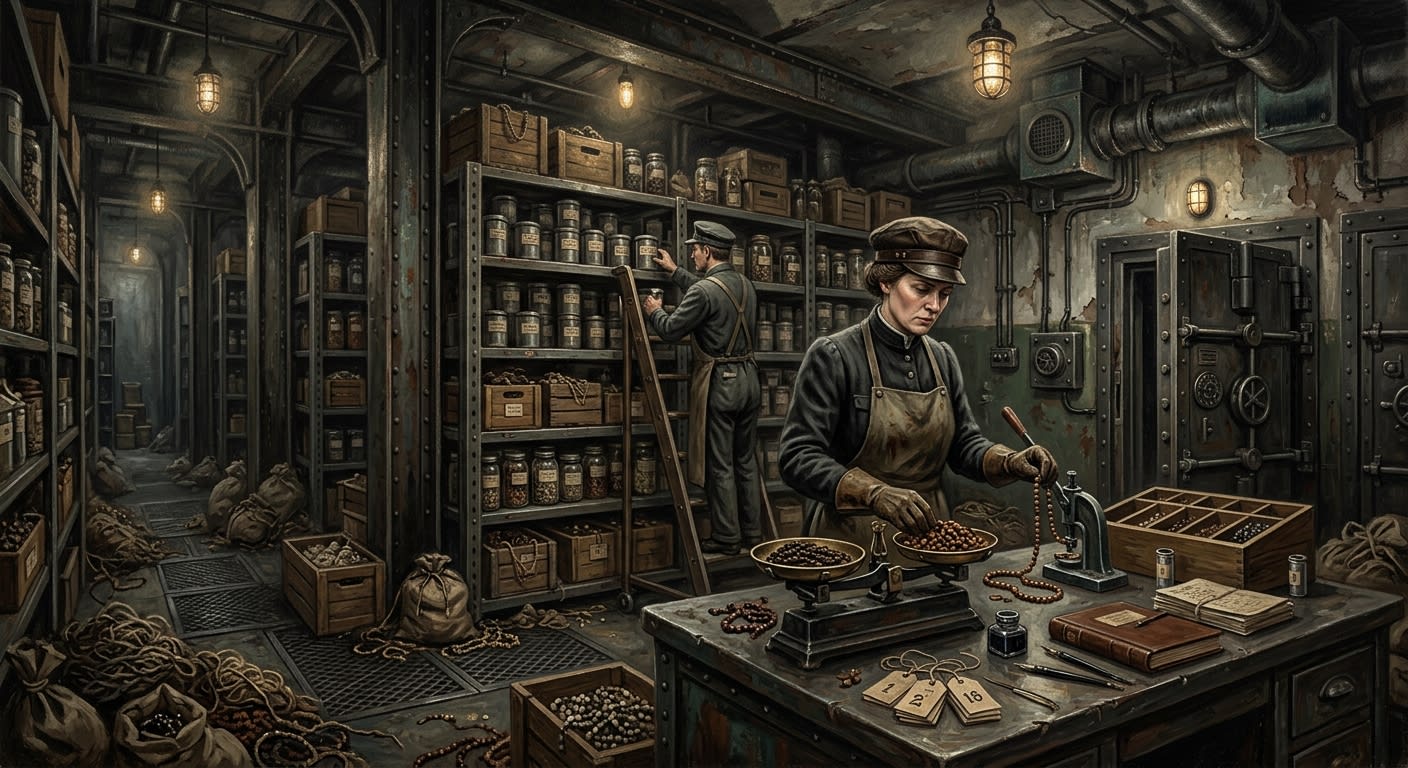
The Bead Vault occupies the coldest quarter of the Cloister of Miscounted Beads, behind the chapel wall and beneath a roof that sweats in winter. It stores confiscated strings. This is the official sentence, and it is almost useful: a bureaucratic nutshell with something wet inside. The Vault stores prayer made physical, route made countable, oath made cord, fraud made exhibit, and, when the hour between third and fourth bell opens its little black mouth, the names of the dead trying to re-enter procedure.
The room smells of dust, sealed wood, old wax, salt, vinegar, and the mineral damp that rises from undercroft stones when the gravefields breathe through them. Cabinets stand in five ranks, each rank locked by two keys and one spoken clearance. Cases bear pilgrim numbers, route marks, anomaly seals, confiscation stamps, and coloured cords showing disposition: white for ordinary evidence, blue for route contradiction, yellow for sponsor challenge, black for suspected counterfeit, red for Purity referral, grey for dead claimant. Uncoloured cases are avoided by junior archivists with the obedience of men who still value sleep.
A bead string enters the Vault when the Counting Hall can no longer pretend that counting it in public serves Doctrine. It may be warm. It may have changed number. It may have acquired a name in ink along its cord. It may belong to a pilgrim whose body sits in the Dorm Rows while the Great Ledger insists he died in A.S. 143. The Vault receives such contradictions with a composure that shames most bishops.
#On the Cases and Their Discipline
The cases are poplar, oak, cypress, and, in the oldest rank, a blackened cedar the Cloister Chapter claims was recovered from a pre-Concordat reliquary storehouse. Each case contains one string, one intake slip, one recount card, one sealed disposition, and a strip of absorbent cloth for moisture, blood, canal water, grave-soil, or whatever else the pilgrim brought to the desk and failed to declare.
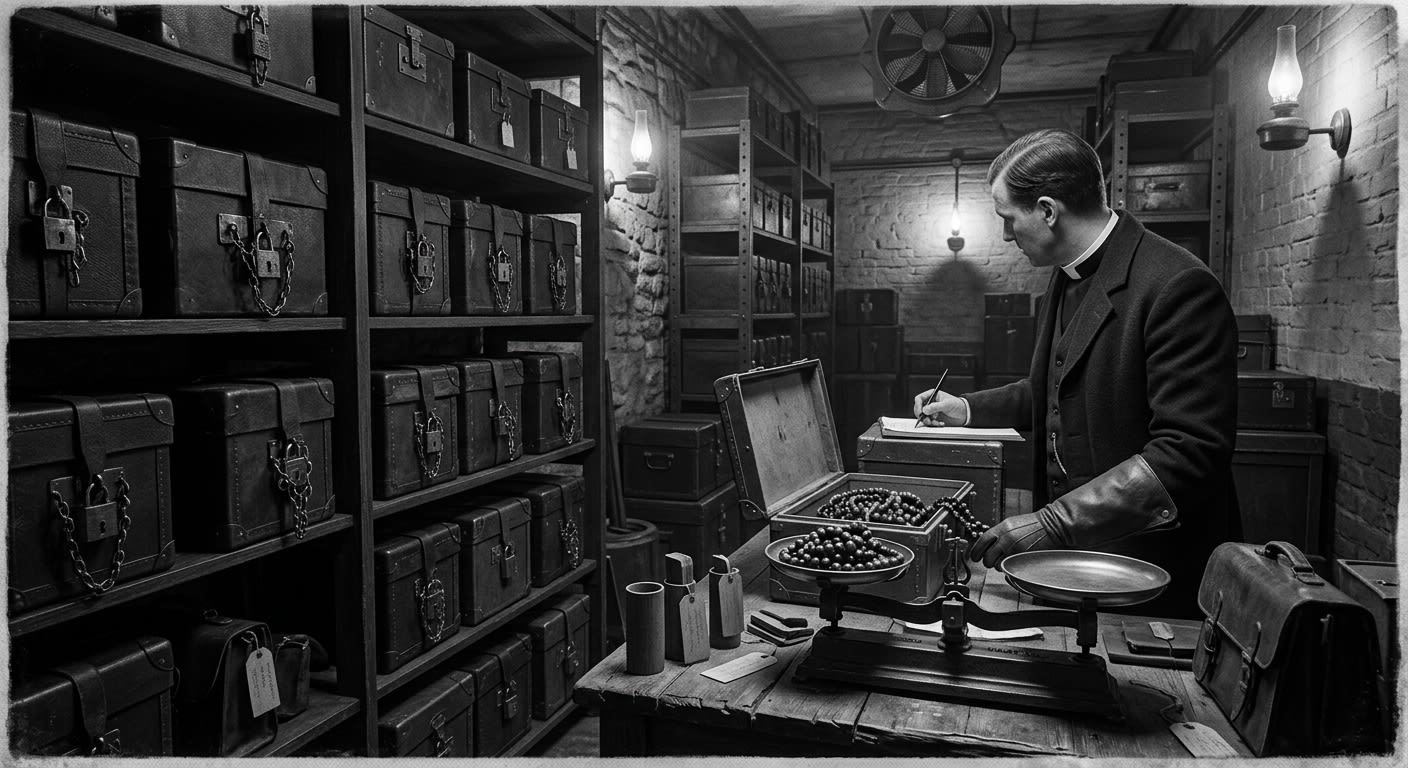
The Bureau of Records loves compartments because compartments flatter the mind into thinking separation has occurred. The Bead Vault is a cathedral of compartments. Shelves divide the cases by year. Years divide into intake quarter. Intake quarters divide into route class. Route classes divide into discrepancy family. Discrepancy families divide into human misery small enough to be tied shut.
No string may be touched bare-handed after entry. Treated linen finger-cots are issued at the threshold and burned after severe handling. Vinegar bowls stand at each rank. Salt-wax sleeves hang from brass hooks. The junior archivist reads the case number aloud, the senior confirms without looking, and the vault guard writes the time in a ledger kept on a slanted stand whose legs have been shortened twice because the floor settled toward the undercroft.
Beads are weighed as well as counted. This practice began after the A.S. 187 revision to the Pilgrim Reconciliation Statutes, when one string gained seven beads overnight but lost no length, no knots, and no dignity. Weight tells what arithmetic conceals. A string that counts thirty-seven and weighs forty-one is trouble. A string that weighs less after being counted by a grieving widow is sent to chapel salt. A string that weighs nothing but remains visible is covered, locked, and mentioned to no one beneath the rank of Prior-Scribe.
#On Archivist Keth
Archivist Keth controls the Bead Vault. The clerks call her Mother Thread when she is out of earshot, which is superstition, since her deaf ear hears more than their whole frightened heads. She has held the post since A.S. 182, longer than any archivist the Cloister can publicly admit. Paper has paled her skin. Ink has entered the cuts around her nails. Her keys hang from bone rings at the hip and click against one another with the irritating confidence of small authorities.
Keth knows every string by weight. She knows the cases that hum under rain. She knows which shelves should never be dusted after Vespers. She knows the junior clerks who steal glances toward the deepest cabinet and the senior clerks who pretend they have never done the same. She sleeps in the undercroft among older records, where the tunnels angle toward the gravefields and the air tastes faintly of wet linen laid over a dead face.
A visitor’s guide of A.S. 166 attributes Vault supervision to “rotating chapel sisters.”
This has been corrected. Rotating sisters kept the outer evidence cupboards before Keth’s tenure. The present Vault is under dedicated archivist authority, and the sisters have been restored to occupations better suited to their gifts: candle trimming, silence enforcement, and frightening children into catechism.
I asked Keth, during my second inspection, whether the oldest case contained the First String. She answered, “There are only corrections.” This is a beautiful answer because it refuses the question without lying in any provable way. It also caused the case behind her to click once. Keth did not turn. The best servants of Records know when not to acknowledge assistance.
#On Entry from the Hall
A severe Desk Eleven case arrives under escort. The string is sleeved in salt-wax. The confession clerk carries the name slip backward-written and folded inward. The escort does not speak in the corridor between the Supplementary Entry Office and the Vault. Speech gives loose things handles.
At the threshold the vault guard asks three questions. Case number. Desk of origin. Whether the pilgrim answered to any name not written on the intake slip. A wrong answer does not halt entry. Nothing useful is halted at the threshold. Wrong answers are marked in red and allowed inside, where they can be studied under lock.
Ordinary strings are silent when placed in their cases. Counterfeit strings creak, being vain little objects and resentful of enclosure. Route contradiction strings tremble along the cord as though the road were still moving beneath them. The anomaly-adjacent strings settle with a small final sound, bead against bead, like teeth closing.
The clerk then waits. If the case remains quiet for eleven breaths, the entry is complete. If the case clicks once, the clerk adds a handling note. If it clicks twice, the guard covers the ledger. If it clicks three times, Keth is summoned from wherever she has been listening.
#On Bead Drift, Which Does Not Exist
The Bureau of Records does not acknowledge bead drift. Circular 881-R, issued in A.S. 199, states with exemplary stiffness that bead counts are fixed at the moment of filing and do not change. This is the approved doctrine. It has the elegance common to statements made by men who do not work after midnight.
The beads change.
Between third and fourth bell, cases warm without flame. Counts filed as thirty-seven read thirty-nine at dawn. Strings move within sealed sleeves, leaving new wax impressions where no bead rested before. Ink on recount cards crawls toward the pilgrim’s name. Cases containing dead claimants sometimes smell of fresh road-mud. Once, in A.S. 200, a blue route-contradiction string entered the Vault with twenty-four beads and emerged from silence protocol with twenty-three beads, one tooth, and a station mark belonging to a shrine demolished before the Concordat.
Countermeasures are simple because panic loves ceremony. Silence hours. Vinegar cleansing. Salt-wax sealing. No open counting in rain. No spoken names after third bell. No junior clerk alone with a grey case. Strings that continue shifting after three treatments are moved to the lower cabinets, where the hinges have been blessed, oiled, and threatened.
VAULT EVENT LOG — A.S. 199, SEALED UNDER NINTH-RATIFICATION Cabinet Five opened without key during anomaly week. Seven cases found reordered by death date rather than intake number. Case ███████ contained no string, only damp cord marks and a child’s voice answering from the wood. Archivist Keth ordered ████████████████████████. The voice used her baptismal name.
#On Theft, Markets, and the Price of a Past
Stealing from the Bead Vault is a red line. Red lines attract ambitious fools, which is why every institution has them. A confiscated string is worth money in the rubble lots. A dead claimant’s string can buy passage for a deserter. A sponsor-challenged string can ruin a family or rescue it. A counterfeit string, once entered into evidence, becomes more valuable because bureaucracy has touched it and bureaucracy, like certain flies, leaves residue.
The Grave-Name Market wants the Vault index more than it wants gold. Gold buys food, knives, beds, silence. The index buys pasts. With the right case number, a broker can find a dead name still warm enough to wear, a cleared identity clean enough to sell, a pilgrim route that can be stitched onto a fugitive like a second skin. The Ninth Count tavern has hosted three knife fights, two poisonings, and one polite bidding war over rumours of copied index leaves. The polite bidding war produced the highest casualty total. Politeness often does.
The Cloister Chapter previously described the theft risk as “minimal.”
Revised following the A.S. 200 index-fragment scandal. Theft risk is now classified as “contained by vigilance.” This phrase means the thieves have not yet embarrassed anyone important enough to force confession.
Keth’s countermeasures are old-fashioned and effective: rotating shelf marks, false case numbers, bone-key splits, quarterly guard-name reassignment, and a ledger written in an abbreviated hand that appears illiterate until one has stolen it. More than one thief has escaped with pages he believed valuable and later discovered he possessed only a list of cleaning rags, vinegar requisitions, and funeral dates for people not yet dead.
#On the First String
Somewhere in the Vault, say the detainees, there is a string never counted, never filed, never reconciled. The First String. The original count. The cord against which every bead, every penance, every route correction, every dead name in the Cloister is secretly measured. The Quiet Thread calls it holy. The Sponsor-Seal Brokers call it an opportunity. The Bureau of Purity calls it unproven and keeps investigators within walking distance. Keth calls it nothing at all.
The rumour worsened after A.S. 198, when intake pressure rose and anomaly weeks multiplied. Broker wars in the rubble lots began over scraps of shelf-map and overheard cabinet numbers. Clerks in the undercroft started finding beads in their shoes. A dorm matron claimed a grey case sang the names of cleared dead into her wash basin. Prior-Scribe Vale sealed the report, which is the Synod’s way of hanging a lantern over a pit and calling the pit confidential.
The theological danger is plain enough even for a layman, though I resent making matters accessible. If a string can rewrite a life by count, the Great Ledger is not a throne but a desk with a faulty drawer. If the dead can reappear because a cord remembers them, erasure is imperfect. If erasure is imperfect, Records has lied. And if Records has lied, we must either punish Records or promote it. The Bureau will choose correctly.
#On the Present Lock
As of A.S. 201, the Bead Vault is operational, crowded, and warmer than stone permits. Five anomaly weeks are projected for the year. Lower cabinets are at capacity. Salt-wax stores require monthly supplement. Keth has requested two additional senior archivists and received one novice, a new vinegar basin, and a memorandum commending efficient evidence retention. The novice lasted eleven days before asking why Cabinet Three clicked in rain. He now files laundry.
The Vault guard’s name changes quarterly. The guard herself may be the same woman. Records insists identity rotation is a security practice, and the Bureau of Doctrine applauds any policy that makes personhood inconvenient. The guard admits no one without counterseal, countersign, and visible nerve. Fear is not disqualifying. Curiosity is.
At night the cases answer one another. Not loudly. Never theatrically. A click from Cabinet Two. A soft settling in the grey rank. A wax sleeve tightening around beads that have decided they are misarranged. Keth hears it through her deaf ear and touches the bone keys at her hip. Somewhere beneath the floor, old records breathe toward the gravefields. Somewhere in the oldest cabinet, or in no cabinet at all, a string counts without hands.
Review docket correction log: restored ratified links for Dorm Rows and Supplementary Entry Office; added provisional docket links for Grave-Name Market and Quiet Thread. No date, bastion, or geography corrections required.