
#On the Column
"Nothing is forgotten." — motto of the Bureau of Records
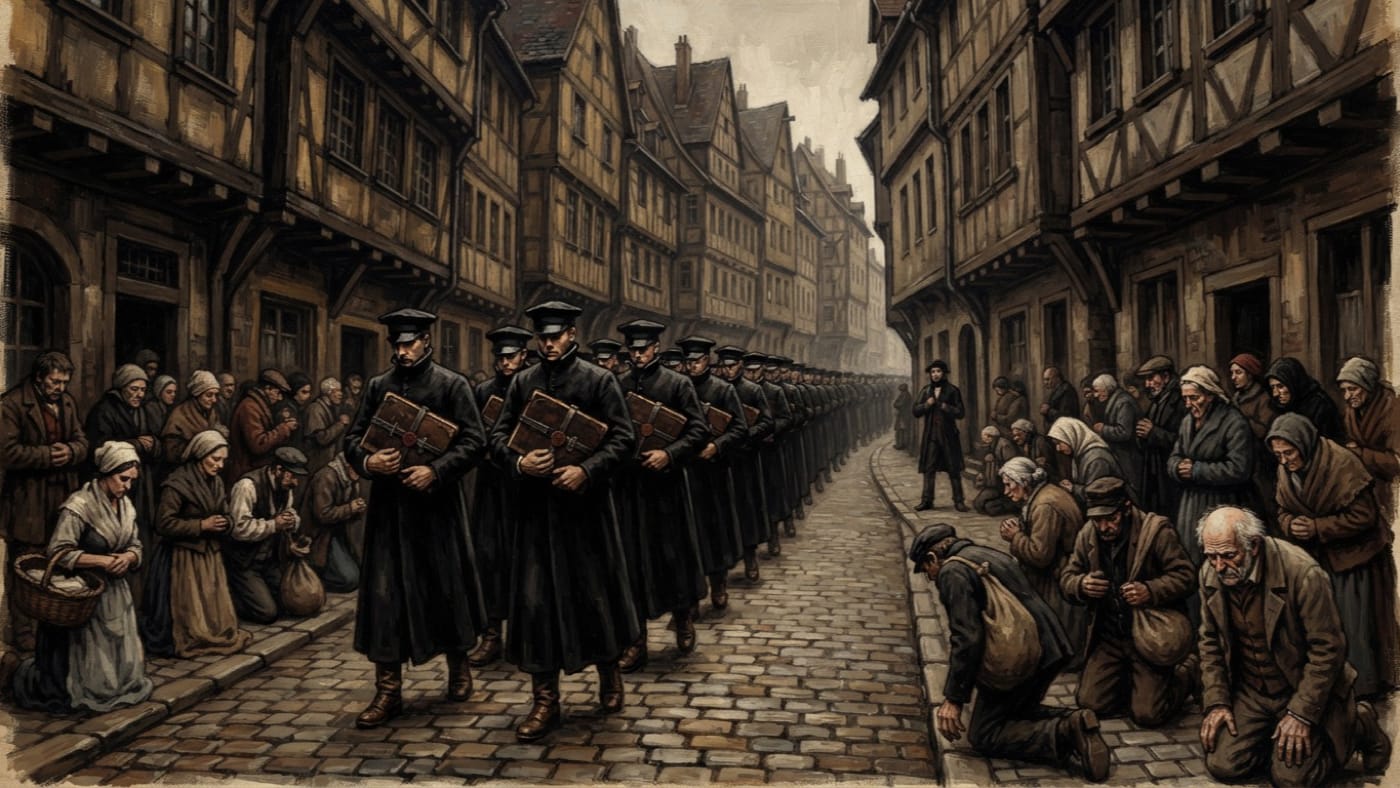
A long file of clerks in black, each carrying a closed ledger, moves down a Strasbourg street so narrow that the chimneys on either side seem to lean in to read. Along both edges of the street the citizens are on their knees. The Codex keeps this scene in charcoal, under the name the Synod gave it: the Procession of the Sealed Ledgers, Strasbourg, A.S. 109. The secular almanacs, in the few places where they survive, would call the year 1819.
I did not see it, because I had not been born. I say so because lesser archivists write about the Synod's early decades as if they had watched from an upper window with a cup of chocolate, and I will not be counted among them. What I have is the record, and the record is more reliable than memory. Memory kneels when it gets tired. The record kneels when it is told to.
Nineteen years separate this procession from the constitutional settlement of A.S. 90. The government was young enough that its offices still argued about which of them was oldest. It was also old enough to have learned that a book carried through a street does more work than a book left on a shelf. In the drawing the column stands upright and the citizens are lowered, and the gap between those two postures holds the whole constitution of Strasbourg. An attentive reader could stop here.
You will not stop here. You never do.
#On What Was Carried
The surviving record does not say what was written in those ledgers. I want to be exact about this, because the temptation to fill the gap is very strong. A lesser writer would tell you they were volumes of the Great Ledger of Souls, or tithe books, or the denied Codices Obscurae carried through the streets in wax like relics on a feast day. Nothing in the record supports any of that. The books were closed, they were sealed, and they were carried. What was inside them belongs to the people who sealed them, and those people have never written to me.
The citizen of A.S. 109 did not need to read a line to know what a ledger in Strasbourg could do. The Bureau of Records keeps births and deaths, baptisms and tithes, confessions and pardons. A name in those books can draw rations, keep a room, pass a checkpoint, and be buried with a priest standing over the grave. A name missing from them belongs to a body without a parish. That body may go on breathing, but it will find breathing remarkably expensive.
When Records classifies a volume, its seal-binders close it with wax, wire, and prayer, and no one below the rank of Archon may undo a seal-binder's knot. I cannot certify that the Procession's books carried that particular knot. The drawing shows covers and sleeves, and clerks holding their volumes flat against the chest the way a deacon carries the lectionary to the ambo. It shows no open page. That is the point. An open book is information. A closed book is jurisdiction.
As Archivist of the Bureau of Doctrine I have handled sealed volumes for most of my working life. I can tell you that the hands carrying them learn a particular stiffness at the wrist, the stiffness of a man who knows that dropping the thing would not be forgiven. In the drawing every wrist has it.
#On the Obligation of the Knee
The rule is short enough to fit in a caption, and a caption is where the Codex has kept it. Citizens are required to kneel. Failure to kneel results in a notation. Three notations result in a Hearing.
The people of Strasbourg knelt of their own accord, moved by love of the record and by nothing else.
The people of Strasbourg knelt of their own accord, moved by love of the record and by nothing else.
Corrected: the kneeling was required. The requirement, the notation for failing it, and the Hearing after three notations are all on file. Love of the record was neither required nor recorded, and the Bureau declines to estimate it.
What makes the knee such an excellent instrument is that anyone can see it. The Creator sees the heart. The Confessor in his booth listens for it, and the Bureau of Purity has its own methods for extracting it. On an open street, at the speed of a walking column, the heart cannot be audited. The knee can. A knee is either on the stone or it is not, and a rule that counts in whole notations has no use for a half-bent leg.
Picture the laundress with a basket on her hip, the coal-porter with a sack across his shoulders, and the old man whose knee has not bent properly in thirty years. The rule treats all three the same. The caption records no exemption for the basket, the sack, or the knee, and I do not invent mercy the Synod never filed.
A notation is a small thing, one line among millions. But it is written in a city where lines decide who eats, and the rule gives it company. Three lines make a Hearing. The caption does not say which office conducted the Hearing. It does not say over how long a period the three notations had to accumulate. It does not say whether a notation could be answered, appealed, or outlived. I have looked. Records answers questions like these the way Records answers everything: it confirms that the question has been received.
#On the Second Ledger
I consider this the most elegant instrument the early Synod produced, and I will explain why without apology.
The clerks walk through the street carrying closed books. Every citizen who kneels as they pass gives public proof of obedience. Every citizen who stays standing supplies the material for a notation. The column comes into the street holding one kind of record and leaves having created another. The first kind is sealed and unread. The second is written on the street itself, in knees and in the standing bodies of those who would not kneel, and it is read by whoever the rule needs to read it.
The record does not name who held the pen that day, and it has no need to. The rule assumes a pen, and in Strasbourg an assumed pen has never failed to appear.
Consider what the instrument costs. A few dozen clerks, an afternoon, and a street that was already there. No pyre, no herald reading a proclamation. The Inquisition has to go looking for people. The Procession simply walks past them and lets each one decide, in the time it takes a column to pass a doorway, which ledger they would rather appear in.
The arrangement also has a reflexive quality that Records must find beautiful. The citizen kneels to the record, and the kneeling becomes part of the record. Refusal is filed as well. Nobody in that street could choose to stay out of the books. The only choice was which entry to receive.
#On What the Procession Is Not
Careless readers mix ledger observances together the way careless clerks mix inks, so I will separate them.
The Feast of the Ledger is the recital of the twelve canonical portfolios of the Holy Bureaus. It is liturgy by enumeration and has its own article and its own customs. The Procession of Receipts is a quarterly Heartland inspection in which households carry their own books and their children sing the family's debts aloud. In the Sealed Ledgers the books belong to the clerks, and the citizens bring nothing but their knees. Nothing in the record makes either observance a predecessor, a component, or another name for this one, and I will not put them into the same binding.
Some readers imagine Procession Marshals in the drawing, cadence-sticks raised and keeping the column in step. They should check the date of the Cadence Corps' formal charter, A.S. 112. That is three years too late for this street.
The caption also does not tell me whether the column walked before A.S. 109, after it, or still walks now. I will not decide that on its behalf. Inventing a tradition is easy, and it is the kind of work done by men who are later reassigned to the paper mines.
#On the Number Withheld
One sentence remains in the caption, and I have left it until last because it was written to come last.
The number of Hearings required to result in disappearance is classified.
Look at how the caption is built. Kneeling is required. Failure produces a notation. Three notations produce a Hearing. Each step is stated plainly, with numbers, and any citizen can count along. Then the counting stops. The steps leading down are all marked except the bottom one. The citizen is told that there is a bottom. The citizen is not told how many steps it takes to reach it.
I hold clearance for a great many things, and this number is not one of them. I asked once, in writing, in the proper form. The request was received.