
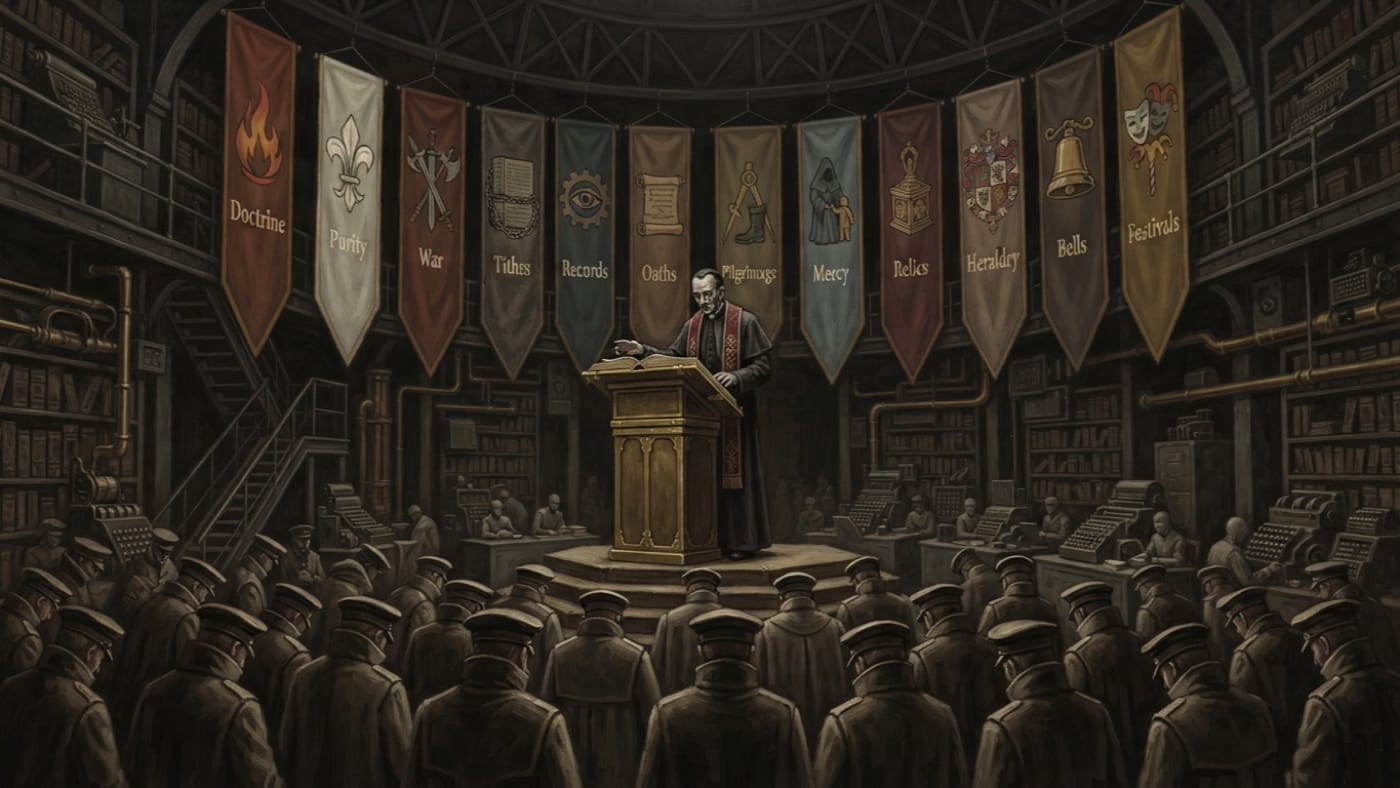
#On the Reading of the Portfolios
"Twelve names, read whole. The Synod counts itself aloud."
At the Feast of the Ledger, the twelve canonical portfolios of the Holy Bureaus are read aloud. That is the rite. Its embellishments differ from one keeper to the next, but the core is always the same: a name is spoken, the faithful hear it, and the reader goes on to the next name. Twelve times the Bureaucratic Synod pronounces its own anatomy, and twelve times the hearer is invited to believe that the body is entire.
I have no quarrel with the arithmetic. Twelve is a respectable number. It has an apostolic savour, and it divides by every sum a clerk is likely to need. My quarrel, if a Warden of the Sacred Ledger may quarrel with a recital he has defended in print, concerns the distance between a name read and an authority exercised. The recital confers recognition, and it confers nothing more. An office may be named at the Feast and do very little between one reading and the next. Another office may go unnamed and decide, before the reader has drawn breath, where a widow in the Rhineland is permitted to sleep.
The Feast honours the first kind. The second kind keeps the Church in bread.
#On the Twelve Offices
"The Creator ordained the hand. The Synod ordained the fingers, and counted them."
I set the twelve down by function. The order in which they are read is a matter for those who keep the reading, and I will not fix it here for some provincial cantor to treat as rubric.
First come the offices of speech and conformity. Doctrine holds the Flame of Interpretation, issues binding definitions and grants its imprimatur to every authorized teaching. Purity sees that those definitions are obeyed, and its white cloaks walk from city to city carrying writs of cleansing. One office writes the sentence and the other enforces it.
The sword and the purse come next. War administers the levies, the campaigns and the crimson sashes. Tithes assesses and collects every coin, harvest and contribution, and gilds the corners of its own ledgers in case anyone forgets they are sacred.
Memory and the sworn word follow. Records keeps the documentary account of every subject and transaction under the motto "Nothing is forgotten." Oaths sanctions every vow from a coronation to a shepherd's marriage, and its Witnessers stand by with lead tablets.
Then there are the offices of the moving and the ailing body. Pilgrimage decides which roads the devout may walk toward which shrines. Mercy runs the orphanages, hospitals and asylums, and some of my colleagues call that mercy without irony.
Last come the offices of sacred matter and public sign. Relics authenticates the holy remains. Heraldry polices every banner and sigil. Bells regulates when and in what tones the Church may ring. Festivals licenses joy itself: the days, the costumes, the plays and the permitted shouting.
The twelve are the Synod. Whatever lies outside them is furniture.
The twelve are the Synod. Whatever lies outside them is furniture.
The twelve are the portfolios the Synod reads aloud. Strasbourg also keeps Settlement, Conscription, Silence and enough lesser offices to fill a register of their own, and the recital names none of them. That furniture, it turns out, assigns three hundred million addresses.
Shadows is absent from the twelve, which needs no erratum. Officially that Bureau does not exist, and Doctrine regards its silence at the Feast as confirmation.
#On the Authority of the Ledger
"What is written exists. What is read aloud is permitted to be believed."
In Strasbourg we are taught that to record is to pray. A name entered in good ink, under a proper seal and in the correct register, has been offered up. A name left out has not, and the Creator is spared the trouble of considering it. I hold this doctrine, and I hold it with a quill in my hand.
The Feast carries that doctrine one step further. A register sits closed on its shelf and speaks to no one. A recital speaks to everyone in hearing, and it speaks with license. Nobody improvises the list of portfolios, and nobody adds a thirteenth because he has a cousin in the Palatine Wing. The words are fixed, and saying them aloud makes them an object of reverence. The faithful learn to bow their heads at a name the way they bow to a relic in its glass. The Bureaus become something to venerate as well as obey. As a piece of administration, it is very elegant.
The Feast's name invites a confusion I must correct before some enthusiast writes it into a sermon. The ledger that the Feast honours is the ledger in general, meaning the habit of entry, the ruled column and the consecrated tally. The Great Ledger of Souls is a particular instrument held in the custody of Records. I have found no rubric that brings it out for the occasion, and I have looked. The Feast takes the Ledger's name and leaves the book where it lies.
The danger to the Church never comes from the list itself. The Great Deceiver has no interest in a correct list, recited faithfully. A list read so often that the hearers forget it is a list is another matter. If enough voices pronounce it complete, the faithful take it for the whole government. After that, every office left off it governs in the dark. The clerks of those offices remain in post. They simply go unseen.
#On the Bureau Omitted
"No hymn, no sash, no seat. Every address on the continent."
I come now to the Bureau of Settlement, because no tract on the Feast is honest without it, and I have promised the Bureau of Doctrine honesty in reasonable quantities.
Settlement is not among the twelve canonical portfolios read at the Feast of the Ledger. It has no seat in the Semicircular Chamber either. That is a separate humiliation, recorded separately, and I do not connect the two by any rule I could cite. Settlement holds no Flame. Its clerks wear no crimson. No cantor gives it a single syllable.
What it does instead is assign zones, issue transit permits and redistrict populations for something like three hundred million registered subjects of the Theocracy. It does this from the third sub-level of the Palatine Administrative Wing, in rooms built for Rhenish white and only partly converted. Its head has carried the word "Provisional" in her title longer than some of my clerks have carried a pen.
Consider what the recital leaves out. A child is baptised, and the certificate carries Settlement's stamp beside the priest's seal. A subject dies, and Settlement cancels the permit and releases the address before the body reaches the ground. Between those two documents lies a whole life of permits, writs, extensions and refusals, and every one of them carries the authority of an office the Feast never names. Records preserves the entry. Settlement decides where the entry is permitted to live.
Silence at the Feast does not reduce that authority by a single folio. A Transit Writ is valid whether or not anyone sang about it. An Assignor's stamp is just as wet. The family moved from one district to another carries its possessions on its back exactly as far as it would have carried them had the recital run to thirteen.
That is why the omission is so useful. The celebrated list stays complete as a ceremony. The labour that keeps the faithful housed, counted and in place stays outside it, where nobody has to bow to it, praise it or confirm its head. Every hearer at the Feast stands at an address that Settlement assigned, and Settlement goes unnamed while they stand there.
Whether Settlement's own clerks stand among the hearers, I cannot certify. I have seen no record of it. Wherever they stand, a Settlement writ put them there.
#On the Present Application
"The recital is correct. The recital is also short."
In this year of survey, A.S. 201, the recital stands at twelve, and I see no reason it should change. The portfolios read aloud are true portfolios. Their mandates are real, their seals are good, and their precedence is a proper matter for reverence. I have defended every one of them in this Codex, and I will defend them again once the Hierarchy tells me which defence is currently required.
Faith and administration have two separate accounts, though, and the faithful have trouble keeping them apart. The Feast teaches the Church which offices to honour. It has never been asked to teach the Church which offices it cannot do without. That second list is longer, less musical and kept in a wine cellar. It still has not been read aloud.
The Feast of the Ledger is sound doctrine. It is an incomplete census. I certify both.